Showing posts with label World War Two. Show all posts

Tuesday, 29 May 2018

Enemy camp by David Hill

Enemy camp by David Hill (Puffin, 2016)

260 pages (in diary format)


Subjects: World War Two, New Zealand, Japan, Prisoners of war, young adult fiction (Year 7-10)

Image result for enemy camp david hill

Synopsis
“When of hundreds of Japanese captives arrive at Featherston POW camp, the tiny town is divided. Tensions run high and then, on 25 February 1943, disaster strikes. Three boys witness it all.” (Publisher’s blurb)

Ewen lives in the small town of Featherson, where his father works as a guard at the POW camp. His diary covers the months between October 1942 and February 1943 and describes everyday life in wartime, school, the summer holidays, the attitudes of local people to the Japanese and the gradually increasing tension between some of the prisoners and guards. Together with his best friend Barry and Barry’s younger (polio-affected) brother Clarry, Ewen starts taking Japanese lessons from one of the officers, and this provides a great way to show a positive side of Japanese life and culture that many of the townsfolk have no idea of.

David Hill skilfully builds in many other aspects of 1940s life: the ever-present fear of polio, food shortages, barbed wire on the beaches, the blackout, the Home Guard, American GIs handing out sticks of gum, practice air raids, school milk, ink wells, picnics, the movies and dances. He has a wonderful way of capturing a 12-year-old boy’s voice, in Ewen’s remarks on the progress of the war (“So yeah, we’re going to win”) as well as the progress of his friendship with “snobby Susan Proctor” (“And – I’m still trying to believe this – I spent most of the time talking to Susan Proctor”). 

It’s also a refreshing change to read about a boy who reads and likes writing, and wants to be an author when he grows up, and about a warm and close, even if undemonstrative, father-son relationship.  

Reviews:
Bobs book blog says: "Superbly written in short diary entries that primary and intermediate students can easily read, coupled with David Hill’s easy style and you have great historical fiction. The account of the event itself with the boys looking on is sensitively done. A very readable novel." 
Another review by Siobhan Harvey calls it "both an enjoyable read and an imperceptible history lesson" and notes that "importantly, Hill personalises the demonised foe, allowing young readers to see Japanese captives as much victims of war as anyone fighting on the Allied side." 

About the author
David Hill is one of NZ’s best loved authors for young people. Here is an article in which he talks about the book: 
"I'm not preaching any themes. I want them to have a story first. I hope they like the people, especially Ewen the young protagonist. If they see attitudes that they agree with and some they disagree with I'll be very happy with that." 
There's another interview here on Radio NZ. I also enjoyed this interview and David Hill's comments about writing about war ("War is wonderful to write about because it involves conflict - physical, mental and internal") and why he likes writing for and about this age group ("because they're coming across ideas and experiences for the first time. They're surprisingly sophisticated, they have a good vocabulary and understand a lot. They're a lovely mixture between naivety and sophistication.")   

Links
You can read more about the “Featherston incident" here. 
And if you are ever driving on SH 2 between Featherston and Greytown, look out for the roadside memorial to the POW site.

Have you read it?
Have you read this book? Let me know what you think!

Monday, 30 October 2017

The war that saved my life by Kimberly Brubaker Bradley

The war that saved my life by Kimberly Brubaker Bradley (Dial Books, 2015)

46 chapters; 316 pages

Subjects: World War Two, London, evacuees, family, junior fiction (Year 5-8)

Image result for The war that saved my life by Kimberly Brubaker Bradley

Synopsis
I’ve always been fascinated by stories about World War Two evacuees, as it’s not part of the New Zealand war story at all. This author takes a different approach. The main character Ada is already damaged by a childhood of emotional and physical abuse by her mother, who seems to hate Ada for her disability (a clubfoot, which could have been easily fixed) and never lets her go outside. (The local children, who only ever see her waving from their window, think she is simple, not disabled.)

Ada is about ten years old, although she doesn’t know for sure. Despite being kept indoors for her whole life, she is smart and determined, and she gets her chance when her little brother Jamie comes home from school and announces that they are being sent to the country because of the war. Ada manages to escape to the train with him and as nobody else wants the two of them, they are reluctantly taken into the home of a childless woman, Susan Smith.

WW2 forms a backdrop to the story, with the neighbouring airfield and the danger of spies, and it provides several important plot points, especially at the end. The book traces the developing relationship between Ada and Susan, but also Ada’s growing sense of her own self-worth, which has been almost destroyed by her mother’s treatment of her.

Because she has lived such a restricted life up until now, Ada has never been to school, and can’t read or write.  The fact that she doesn’t know what everyday things like shops or banks are, or the meaning of many common words, is potentially tricky for a writer but Kimberly Bradley handles the challenge very skilfully.

This is a memorable story and I especially liked Susan as a character. Her life story is only hinted at, never fully described, but enough is hinted at to make it understandable, at least for older readers.      

I didn’t find Ada’s mother quite as convincing. She was so utterly malevolent that she seemed less believable, although the scene when Jamie finally realised the truth about her (which he had always been shielded from before) is very sad.

Reviews:
There are many glowing reviews of this book, such as this one on NZBookgirl. 
Kidsreads calls it “an unforgettable gripping story, one that is not only earmarked to be an award-winning novel, but also has the potential of becoming an all-time classic.”
The School Library Journal describes it as “Anne of Green Gables without quite so much whimsy” in which “hope, in whatever form it ultimately takes, is the name of the game.” “Enormously satisfying and fun to read, Bradley takes a work of historical fiction and gives the whole premise of WWII evacuees a kick in the pants.”
And this from Kirkus Reviews: “Set against a backdrop of war and sacrifice, Ada’s personal fight for freedom and ultimate triumph are cause for celebration.”
You can also find lesson plans here. 

About the author
You can find Kimberly Brubaker Bradley's website here. 
In this review on book reporter, she describes how she was born in Fort Wayne, Indiana, studied chemistry at college and married her high school sweetheart, and now lives on a 52-acre farm, with ponies, dogs, cats, sheep, goats, and lots and lots of trees in the foothills of the Appalachian mountains.

Other books you might like:
Other books about evacuees include: Lord of the nutcracker men by Iain Lawrence, When the siren wailed by Noel Streatfeild, Ronnie’s war by Bernard Ashley, The dolphin crossing by Jill Paton Walsh, Carrie’s war by Nina Bawden and Uprooted: a Canadian war story by Lynne Reid Banks.

Have you read it?
Have you read this book? Let me know what you think!

Thursday, 12 October 2017

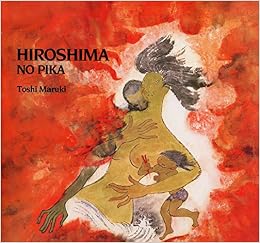
Hiroshima no pika written and illustrated by Toshi Maruki

Hiroshima no pika written and illustrated by Toshi Maruki (translation of the same Japanese title; New York: Lothrop, Lee & Shepard, 1980)

48 pages with colour illustrations, sometimes full page double spreads

Subjects: World War Two, Hiroshima, atomic bomb, anti-war books, Japan, picture books (Year 6-8)

Image result for Hiroshima no pika

Synopsis

This is based on a first-person account that the author heard when he was holding an exhibition of pictures about the atomic bomb in a small town in Hokkaido.

It begins with a cloudless blue morning in Hiroshima, with streetcars picking up people on their way to work and the seven rivers flowing quietly through the city. Seven-year-old Mii and her parents are breakfasting on sweet potatoes “brought in the day before by cousins who lived in the country” when the bomb falls at 8.15am on August 6, 1945. Mii’s mother carries her injured husband on her back across the city, across rivers and all the way to the coast, where they stay for days until he is taken into a makeshift hospital: “no doctors, no medicine, no bandages – only shelter.” 

The illustrations are stylised but portray a powerful sense of the horror of the event, and the consequent suffering, partly through the lurid and unnatural colours of the skies and surroundings.

This is a terrible event, and parts of the text would be upsetting to younger (or even older) children: the mother carrying a dead baby, the floating bodies, the wasteland of the city, Mii’s father’s death, the glass slivers that poke their way out of her scalp in years to come.

Look out for the red chopsticks that Mii clutches for days after the Flash, until her mother manages to prise them from her grip. It’s a clever way to identify her on each page, but also hints at the hidden trauma she has undergone.

The book feeds in some factual details about the atomic bomb and ends with the lantern memorial service held each year on the seven rivers. I couldn’t see a translation of the title anywhere – maybe I missed it – but it means The Flash of Hiroshima.  

Reviews:
An entry in Kirkus reviews is always prestigious. “Japanese artist and antiwar activist Maruki manages to avoid the opposing perils of giving children nightmares and belittling the horror.”

About the author
Toshi Maruki (1912–2000) was born in Hokkaido and studied Western art at the Joshibi Women's School of Art and Design.
“I am now past seventy years old. I have neither children nor grandchildren. But I have written this book for grandchildren everywhere. It took me a very long time to complete it. It is very difficult to tell young people about something bad that happened in the hope that their knowing will help keep it from happening again.”

Maruki Gallery for the Hiroshima Panels, established by husband and wife Iri and Toshi Maruki, "is famous for its message for peace all over the world". The artist couple went into Hiroshima city just three days after the bombing and spent 30 years painting the 15 panels.

Other books you might like:
Sadako by Eleanor Coerr, illustrated by Ed Young, also tells of a young girl in Hiroshima. 

Things I didn’t know
I didn’t know that other Japanese cities like Tokyo, Osaka and Nagoya had already experienced air raids, so the people of Hiroshima were readying for them by storing water and making evacuation plans. There is a sad poignancy in the statement that “Everyone carried small bags of medicine and when they were out of doors, wore air-raid hats or hoods to protect their heads.”

Have you read it?
Have you read this book? Let me know what you think!
Thursday, 24 August 2017

A winter’s day in 1939 by Melinda Szymanik

A winter’s day in 1939 by Melinda Szymanik (Scholastic, 2013)
24 chapters; 285 pages
Subjects: World War Two; Poland; family; evacuees, refugees; junior fiction (Year 7-10)
Image result for A winter’s day in 1939

Synopsis
I should have reviewed this book before, because it is so good and has collected lots of awards and shortlistings: Storylines Notable Book 2014, Finalist 2014 NZ Post Book Awards, Finalist 2014 LIANZA Esther Glen Junior Fiction Award, Winner Librarian's Choice Award 2014 LIANZA Children's Book Awards

Melinda explains in the foreword that A winter’s day in 1939 is based on the story of her father, Leszek Szymanik, who was 12 when the Soviet Red Army invaded his homeland of Poland in 1939. His family was transported from Poland to a Russian labour camp in 1940.

The family in the book are Adam, his parents, older brother Tomasz and younger sisters Zofia and Maria. They live on a small farm, growing crops (tobacco, potatoes) and raising cows, pigs and chickens. Tragedy strikes the family at the very start of the story, followed by uncertainty and worry as Germany invades Poland – and then the Russian tanks arrive. Their farm is requisitioned (taken over by the Russians) and they are given a week to leave and find a new home - one room in a house  in a village 15km away.  

Things get worse, not better, and more long hard journeys, and much sadness, lie ahead of them.

Melinda includes a historical note, a map of the family’s journey, glossary, bibliography and a postscript about what happened next. Her foreword ends: “The past is filled with stories like these, of people who suffered terrible conditions and overwhelming sadness but remained hopeful and survived, despite everything. It is up to us to honour their memories and remember this stories to make the world a better place.”

I’m lucky to have a signed copy, and Melinda has written this in the front of my book: “We have to know the past to make a better future.”

Reviews
Booksellers NZ comments that “Melinda is a very skilled observer of family relationships, and this is what really brings the book to a higher level”.
Hooked on NZ books has links to a whole collection of reviews.
Teacher notes from Scholastic here.
About the author
Melinda has a great blog where she talks about all sort of writing issues and the writing life. In this blog post, she talks about how she came to write the book.
You can read more about Melinda here.   
Other books you might like:
Stefania's dancing slippers by Jennifer Beck tells another story of a Polish refugee family in picture book format. 
New Zealand connection
Of course there is a very real NZ connection in this case, because Melinda’s father ended up here, and so did over 700 Polish children who came out by ship and went to the Polish children’s camp at Pahiatua. It’s hard for us as an island nation to imagine what it must be like to live in a country that is surrounded by other nations and has been the site of conflict for centuries.
Links
In November 2014, there was a series of events to mark the 70th anniversary of the arrival of the Polish children at Pahiatua. You can read more about the "Polish Week" anniversary here.    
Have you read it?

Have you read this book? Let me know what you think.

Sunday, 6 August 2017

Three books by Mark Wilson

Angel of Kokoda (Lothian Children’s Books, 2010)
Vietnam diary (Lothian Children’s Books, 2013)
The Afghanistan pup (Lothian Children’s Books, 2014)

All similar format: hardback, 32 pages with full colour illustrations

Subjects: World War Two, Papua New Guinea, Pacific, Vietnam, brothers, Afghanistan, animals, dogs, mascots, picture books (Year 3-6)


Synopsis
A Papua New Guinea boy helps a wounded Australian soldier along the Kokoda Track. A young man goes off to fight in Vietnam, despite the protests of his brother. A dog is rescued from the ruins of a bombed school and becomes a soldier’s pet. 

These three books are part of the Children in War series which explores children’s experiences of, and reactions to, four different wars involving Australians:  World War One, World War Two, the Vietnam War and the war in Afghanistan. The texts are clear and not too detailed (apart from the Vietnam one, which includes handwritten diary entries).

They are well-produced books that cover lesser known aspects of war, although I would have liked some more context for each story (perhaps because they are very Australian - oriented). 

Reviews
Reading time (from the Children's Book Council of Australia)
reviews The Afghanistan pup here and admires the way that Mark Wilson "skilfully weaves narratives that tell stories of tragedy and hope with his extraordinarily evocative illustrations", while "snippets of newspaper clippings, reports, poems and letters enrich the stories and add layers of meaning."

There are teacher notes and activities - 
for The Afghanistan pup here 
for Angel of Kokoda here
for Vietnam diary here.

About the author: 
Mark Wilson's website shows his prolific and impressive output and also talks about his interesting life and varied career!

Other books you might like: Also by the same author is My mother’s eyes: the story of a boy soldier.  Mark Wilson illustrated A day to remember: the story of Anzac Day by Jackie French.

Have you read it? Have you read these books? Let me know what you think!

Sunday, 2 April 2017

A day to remember: the story of Anzac Day by Jackie French, illustrated by Mark Wilson

A day to remember: the story of Anzac Day by Jackie French, illustrated by Mark Wilson (Angus & Robertson, 2012)

32 pages with Mark Wilson’s colour and black and white illustrations

Subjects: World War One, Gallipoli, World War Two, Korean War, Vietnam War, protest movement, Anzac Day, picture books, non fiction (Year 5-8)


Synopsis
This book tells the story of Anzac Day by tying the date of 25 April to specific events in particular years, starting with the first landings at Gallipoli on 25 April 1915. The first Anzac Day parades and services are held in 1916; in 1918, the war still continues, but it is over by 25 April 1919. In the late 1920s, the tradition of the dawn service begins; in the 1930s, many returned soldiers are suffering through the Depression. Anzac Day continues to be marked through World War Two, the Korean War and the protest years of the Vietnam War.

The book continues up to the present day through Australian involvement (again often controversial) in other wars, such as in Iraq and Afghanistan, and traces the increased interest in visiting Gallipoli for the dawn service at Anzac Cove.

Teacher’s notes include Jackie French talking about her inspiration for the book, and Mark Wilson talking about his technique and how he interpreted his task. The figures on the cover are his son and granddaughter – how lovely is that?

Reviews:
Kids Book Review recommends it highly, saying that "You know a book by Jackie French is going to be researched to the nth degree, and presented with clarity, emotion and fascination - and A Day to Remember is no exception."

The never-ending bookshelf says is it is a picture book that adults would enjoy and learn from as well; "What I found particularly interesting with this book was the way that Jackie French focused on the concept and meaning of Anzac day through various generations and the way that it was developed, shaped and then lessened in meaning before reaching height again today." This reviewer suggests it is not for young children under 8, "as it is very heavy on the history and less narrative based". 


Author’s website
Jackie French is an amazing writer with a brilliant website which features a page on this book. Her other war-related books include The beach they Called Gallipoli, Pennies for Hitler and A rose for the Anzac boys.

Illustrator’s website

NZ connections:
Are we mentioned? Yes, often (thanks, Jackie French!) Sometimes the New Zealanders are left out of (Australian) books on Anzac, so it’s good to see their contribution recognised.

I also appreciated seeing the Aboriginal and Torres Strait Islander soldiers acknowledged, men who “fought long ago in the service of a land where many were not even allowed to vote”.

Have you read it?
Have you read this book? Let me know what you think!

Wednesday, 19 October 2016

The Mozart question by Michael Morpurgo

The Mozart question by Michael Morpurgo, illustrated by Michael Foreman (Walker Books, 2007)

75 pages (but a small size, so quite short); gorgeous watercolour illustrations of Venice and sobering, muted ones of the scenes at the concentration camps

Subjects: World War Two, Jews, concentration camps, music, junior fiction (Year 6-8, but have to be ready to hear about the Holocaust)


Synopsis
I can’t better the synopsis on Michael Morpurgo’s own website:
“When Lesley is sent to Venice to interview world-renowned violinist Paulo Levi on his fiftieth birthday, she cannot believe her luck. She is told that she can ask him anything at all – except the Mozart question. But it is Paulo himself who decides that it is time for the truth to be told. And so follows the story of his parents as Jewish prisoners of war, forced to play Mozart violin concerti for the enemy; how they watched fellow Jews being led off to their deaths and knew that they were playing for their lives.”

In the note at the back, the author talks about how the story grew from “the sight of a small boy in a square… in Venice, sitting one night, in his pyjamas on his tricycle, listening to a busker. He sat totally enthralled by the music that seemed to him, and to me, to be heavenly.”

Reviews:
  • Kids reads says “Morpurgo's tale is straightforwardly told, almost fable-like in its simplicity and emotional impact. Its simple language and elegant structure would make The Mozart question an excellent book for parents and teachers to read with children, opening the door to more questions about family history, historic atrocities, and the miraculous powers of music to resist and overcome even the most shocking evils.”

About the author

What more can you say about Michael Morpurgo – he’s just amazing.
This page on his website talks about themes of war in his books. 

About the illustrator
And similarly for Michael Foreman – equally amazing!
This article in the Guardian profiles his 50-year career. 

Other books you might like:
War horse and Private Peaceful, both by Michael Morpurgo,  War game, The general and The amazing tale of Ali Pasha by Michael Foreman

Have you read it?
Have you read this book? Let me know what you think!

Friday, 2 September 2016

True Brit: Beatrice - 1940 by Rosemary Zibart, illustrated by George Lawrence

True Brit: Beatrice - 1940 by Rosemary Zibart, illustrated by George Lawrence  (Kinkajou Press, c2011 - thanks to the publishers for sending me this book to review)

20 chapters; 205 pages with black and white illustrations

Subjects: World War Two, England, United States, evacuees, junior fiction (Year 5-8)
Synopsis
12-year-old Beatrice lives in London with her upper-class family: mother, father and older brother. When the bombs start falling on London in September 1940, her parents decide to send her as far away as possible to be safe. The Children’s Overseas Reception Board says there are no more places available in Canada, but a public nurse in New Mexico has offered to take a child - and that is where Beatrice is sent, all by herself, by boat (first class) and then train.

Her father, whom she adores, gives her a red leather notebook so she can record her observations as if she is a lady explorer, like Mary Kingsley, and these notebook entries are a clever way of showing Beatrice’s impressions of her new surroundings.

Santa Fe in New Mexico couldn’t be more different from London, and Miss Clementine Pope is hard working, practical and down to earth, the complete opposite of Beatrice’s mother. Beatrice has led a sheltered life; she is used to being waited on by servants and having fine clothes and everything she wants, and to her new friends Arabella, Esteban and Ana, she comes across as faceta (spoiled, stuck up and a “little princess”). She is determined to prove them wrong, and after several months, and one big adventure in particular, Clem says “you showed us that you’ve got quite a bit of starch for a gal your age.”

This book is the first in a series (Far and Away) about children in WW2, with its own facebook page. You can read the first chapter here, and also see a book trailer – filmed on location at the Lamy train station where Beatrice first arrives in New Mexico! 

(I especially like the opening line: “Only Great-Aunt Augusta spoke up against the plan”. And I was tickled by the reference to the four children – 2 boys and 2 girls, one named Lucy, waiting on a railway platform to be sent to their great-uncle’s house in the country. Many readers don't realise that the Pevensie children in The lion the witch and the wardrobe were also WW2 evacuees.)

Reviews:
Chapter 16 review website is impressed by “the attention to detail, from descriptions of mud homes and pinon trees to ‘A-okay’ American slang”.

Questions:
Can you imagine being sent away from your family for such a long time – without any of today’s ways of communicating, like texts or emails or even phone calls – just letters to keep in touch! What would you miss the most about where you live?  

About the author
Rosemary Zibart lives in Santa Fe. She describes herself on her website as a storyteller and writer who has written “film scripts, magazine and newspaper articles, picturebooks, middle-grade and young adult novels, essays, plays, screenplays and most recently websites”.

About the illustrator
You can read about George Lawrence here. 

Other books you might like:
Carrie’s war, Archie’s war, Lord of the nutcracker men, When the siren wailed and Ronnie’s war all cover different aspects of the evacuee experience. Uprooted: a Canadian war story by Lynne Reid Banks gives a Canadian perspective.
Also mentioned here (but not fully reviewed) is Evacuee by Gabriel Alington (Walker Books, 1988) which tells the story of a timid English girl, Frances (or Fanny) sent away to the USA to live with “Aunt” Bird and her adopted daughter, Pepper. It also treats the subject of the debate within the United States as to whether or not they should join WW2.

Things I didn’t know
I didn’t know anything about Santa Fe or New Mexico so I really enjoyed the description of the landscape and town. A historical note at end says that children did come to Santa Fe in WW2, some of the thousands who were sent to Canada, the US and Australia to escape the war.

Links
There is an excellent article on Operation Pied Piper and the evacuee children here, with some great photos.

Have you read it?
Have you read this book? Let me know what you think!

Monday, 22 August 2016

Toitoi: Anzac special issue

Toitoi: Anzac special issue (February 2016)

92 pages with full page colour illustrations

Subjects: World War One, World War Two, Gallipoli, France, trenches, junior fiction, children’s writing (Year 5-8)

toitoi_anzac


Synopsis
Toitoi is a quarterly journal for young New Zealand writers and artists, aged 5-13, which publishes “material with an original and authentic voice that other young people can connect to and be inspired by and that reflects the cultures and experiences of life in New Zealand.” It encourages creativity and can also be used in the classroom with teaching notes for each issue.
You can read more about it here. 
And they also have a Facebook page.

This Anzac special issue is filled with highly imaginative work that tells the story of war in many different forms: stories, poems, letters, diary entries and even a song, with accompanying full page illustrations. One piece in French (Poilu by Tristan Hosking, aged 9) manages to be an acrostic poem as well.  

They cover topics such as leaving NZ by ship (from the point of view both of those leaving and those left behind), posting a tin of Anzac biscuits, Gallipoli, France, the trenches, seeing friends die in battle, losing a loved one and remembering the war years later in Anzac Day ceremonies and small family interactions. Many of the writers show great sensitivity and they also use some powerful sensory descriptions.

I liked so many of these pieces that it’s hard to single any out, but here are a few lines that particularly moved or impressed me with their thoughtfulness, empathy and imagination:

“Imagine having great valour then slowly having a disheartened mind.”
(from Imagine by Kareena Dunlop, aged 11)

“It looks like we are winning which is quite good so I might be home in time for Christmas”
(from April 1915, a letter, by Alice Kelsall, aged 7)

“In Flanders Fields I see death / In every second and every breath.”
(from In Flanders Fields, a poem by Kyuss Williamson, aged 12)

“How still you die / When you are dead / How still you lie…
I know both sides / Both stories / Both losses / I know both sides.”
(from My people, a poem by Ilana Kizildere, aged 10)

“I am ashamed that I killed people. But then again, I’m proud that I ought for my country. That’s why I just sit here. The Second World War haunts me every day.”
(from Grandpa’s story by Megan Foster and Madison Blackwood, aged 11)

Similarly with the many wonderful illustrations, it’s hard to select just a few, but I was especially impressed by Alisha Sangster’s illustration for Grandpa’s story, showing the old man leaning on a stick with a soldier’s shadow looming behind him. I also liked Aisha Tanaka-Avers’ departing  ship, Apple Minoza’s white cross on a swirly coloured background, Pieta Bayley’s woman packing up the tin of Anzac biscuits, Anna de Boyett’s dramatic portrait of a horse, Stella Hinton’s soldier silhouette (reproduced on the front cover above) and Shahni Tagatoa’s muted graveside scene.

Have you read it?
Have you read this issue of Toitoi? Let me know what you think!
Have you submitted anything to Toitoi? Check out the dates that the next submissions close and have a go. It's such a great magazine and a wonderful opportunity to see your work in print.  

Friday, 29 July 2016

Soldier in the yellow socks by Janice Marriott

Soldier in the yellow socks: Charles Upham, our finest fighting soldier by Janice Marriott, illustrated by Bruce Potter (HarperCollins, 2006)

8 chapters; 48 pages with black and white illustrations

Subjects: World War Two, Greece, Crete, North Africa, prisoners of war, non fiction (Year 5-8)


Synopsis
I didn’t know anything about Charles Upham before reading Janice Marriott’s book. In 1939 when war broke out, Upham was a Canterbury high country farmer. By the end of the war he had fought in Greece, Crete and North Africa, been awarded the Victoria Cross (VC) twice - a very rare achievement, been taken prisoner, escaped (sometimes from moving trains) and taken prisoner again several times, and finally ended up imprisoned in the top-security Colditz Castle.

Charles Upham’s reaction to winning the VC was similar to that of Cyril Bassett in World War One. Both insisted that the award was as much for the men as for themselves and were almost embarrassed to be singled out. (I don’t know if that is a peculiarly New Zealand reaction.)  Cyril Bassett famously said, “All my mates ever got were wooden crosses”.

I thought the yellow socks in the title might have more importance, but they were only mentioned once; however, they did seem to symbolise his non-soldierly qualities (we are told several times how bad he was at marching) as opposed to his amazing bravery, courage and calmness under fire.

The book was shortlisted for the NZ Post Children's Book Awards in 2007.

Questions:
Was Charles Upham our "finest fighting soldier"? What makes a fine soldier? What do you think?

About the author
On Janice Marriott's website, she has this lovely description of herself and her current work: 
"After years spent writing fiction, plays, memoir, gardening books and newspaper columns, I became a grandmother, a very involved grandmother. Now life is a discontinuous narrative. Time for writing is unpredictable and starts with clearing clutter off the dining room table. Increasingly I spend my non-family time teaching others what I have learnt about writing and the publishing industry. And in my own writing life I have turned to poetry to express my new self. I think of the poems as small wild animals I have captured for a few moments in my hands and then released."

About the illustrator
You can read more about Bruce Potter and his impressive output of work here on his website. 

Things I didn’t know
After the war, Charles Upham bought a farm in North Canterbury, married and had three children. He lived on the farm until the year he died, in 1994. Crowds of more than 50,000 people lined the streets of Christchurch for his funeral.

His obituary in the Telegraph has a comprehensive overview of his life and the actions which won him his VCs, and includes his statement that "the military honours bestowed on me are the property of the men of my unit". 

There is more info about him on the nzhistory and te ara sites. 

Links
Here is a list of the 22 New Zealand VC winners (Willie Apiata is the only post-WW2 VC winner. I didn't know that Charles Heaphy won one in the New Zealand Wars!)