Showing posts with label Australia. Show all posts

Saturday, 10 June 2017

Dreaming the enemy by David Metzenthen

Dreaming the enemy by David Metzenthen (Allen & Unwin, 2016)
47 chapters; 292 pages
Subjects: Vietnam, Australia, conscription, veterans, PTSD (post-traumatic stress disorder), young adult fiction (Year 11-13)

Synopsis
Johnny Shoebridge has come home from fighting in the jungles of Vietnam. It’s hard to readjust to ordinary life with his parents and the girl he used to know. He is haunted by memories of all the things he has seen; literally haunted, by a Viet-Cong ghost fighter called Khan who won’t leave him alone.

He is still young and can't understand how he has ended up in this position: “How had he gone from a kid swinging a stick as a Samurai sword, the star of a flickering home movie, to a nineteen-year-old digger on ambush, prepared to shoot someone in the side of the head?” He has lost good mates in battle and is trying to summon up the courage to go and visit their families. (These eventual encounters make for heart-wrenching scenes.) Even though he was a conscript with no choice about going, he’s assailed by anti-Vietnam war protesters, with people coming up to say “I just hope you’re happy… with what you did.”

“There was an awful lot of stuff that he wished he didn’t know.”

The story jumps back and forth in time and place. In the present, Johnny is back home again, heading off on a road trip. In the past, he is getting to know his new mates Baz and Lex; they start training together, go out on patrol, and fight side by side in battle. Another parallel story is that of Khan, Trung and Thang as they hide in the jungle, crawl through tunnels and fight on the other side.

I found the parts where Johnny somehow knows or imagines what Khan is doing a bit confusing, perhaps because of the distance imposed by having Johnny comment on what he sees. What worked best for me were the scenes between Johnny and his mates, and their convincing teenage-boy speech as they get to know and rely on each other. Johnny “knew himself to be one corner of a triangle, the strongest shape of all. He knew Lex and he knew Barry like he knew no one else on the planet.”

Of course you know that’s not going to end well. They’re going to get caught up in some terrible fighting and you suspect that at least one of them won’t make it home again.  

Reviews:
Booksellers NZ calls it “a poignant novel, posing meaningful questions about the effects of war”. It acknowledges “some might suggest the book is difficult to keep up with as it flicks from past to present to imagination “, but suggests that “this is in keeping with Johnny’s head and the confusion that follows him”.
A very good review in The Australian too: this final paragraph is worth quoting in full:
"Senior secondary students, especially boys, (and their teachers) might be grateful if Dreaming the Enemy were set for study. It is a sophisticated work — substantial, powerful, highly readable and with key characters close to their age. It touches on many issues: the aftermath of war, including how returned fighters were and are treated; the effects on mental and physical health and on families and relationships. It looks at conscription, the politics of wars, the destruction caused by the bombing and napalm, the attitudes of Americans, the contribution of Australians, and much else. The story is infused with humanity and embellished by Metzenthen’s flair for language and flashes of dry Aussie humour."
And on Reading time, David Metzenthen has some very wise words about the book:
"I wanted strongly to present something of what young Australians went through in this war, at the orders of their Government, and the great toll it took on them, their families, friends, and futures. In Dreaming The Enemy, I hope to have shown what happens to people, that what we do or is done to us, stays with us for a long time and must be met with compassion and understanding."
About the author
David Metzenthen lives in Melbourne. He is a keen environmentalist and was an advertising copywriter and a builder’s labourer before turning to fiction. He has written another war-related YA novel, Boys of blood and bone, as well as the thought-provoking picture book One minute’s silence.
Other books you might like:
There aren't nearly as many books about Vietnam as about World Wars One and Two. One book that I have reviewed is The battle of Messines Road.
Have you read it?
Have you read this book? Let me know what you think!

Friday, 2 June 2017

From Billabong to London by Mary Grant Bruce

From Billabong to London by Mary Grant Bruce (London: Ward Lock, 1915)

About 320 pages with a few full page illustrations

Subjects: World War One, Australia, England, London, ships, family, junior fiction (Year 8-10)


Synopsis
I had to borrow this book from the Dorothy Neal White collection at the National Library, and it’s the earliest book that I’ve yet reviewed. It’s number 4 of the 15 books that make up the Billabong series; others include Jim and Wally and Captain Jim (1916 & 1919).

Billabong is the house and the station, 2 miles from the nearest road and 17 miles from the nearest town. No other home is visible, “only peaceful paddocks”. The main characters are gradually introduced, but readers of the series would already know them: David Linton, the widowed station owner, and his children Jim (19) and Norah (nearly 15); their friend Wally (17); Mrs Brown, the housekeeper; the station hands, and Black Billy, the “native boy”.

The first quarter of the book is taken up with station life: a tame wallaby, snakes, a bullock stuck in a swamp, breaking in a new colt, as shown on the cover. But two topics overshadow everyone’s thoughts: the drought, and the war in Europe. Many of the local young men have already signed up. Wally (who is still underage) and Jim are desperate to go as well. A fortuitous inheritance calls Mr Linton “Home” to deal with the paperwork in England, and the decision is made that they will all go – Jim and Wally, so they can sign up there, and Norah so she’s not left on her own.

By pg. 91, they are on board the Perseus in some degree of comfort, about to leave from Port Melbourne. Their 6-week journey takes them via Adelaide and across the Indian Ocean to Durban, Cape Town, then Las Palmas to arrive in Falmouth, Cornwall, from where they take a train to London. Ordinary shipboard pursuits such as deck quoits, boat drill, whale and porpoise spotting and listening to the Captain’s gramophone life are enlivened by the capture of a German spy (not really a spoiler as it’s so heavily foreshadowed), an alarming passage through the fog and their own capture by a German warship. Not surprisingly, they are rescued in time and make it to England safely.

This is a well-written story with lively dialogue and warm family relationships, but reading it 100 years after publication, it’s hard to overlook the book’s treatment of Aboriginal and black South African characters. The Zulus are viewed either as picturesque rickshaw-pullers, or as dangerous robbers. The Aboriginal people are dismissed as “useless, shifty, lazy” and “thieving”. Black Billy is ridiculed for his use of English, rather than admired for having learnt another language, and there is no acknowledgment of the original inhabitants of the land. The writing is of course a product of its time, but the attitudes jar today.

Reviews:
Here you can read a contemporary review from the Port Fairy Gazette of 15 October 1915, which compares Norah’s stories to that of Little Women in their widespread appeal.

About the author
Mary Grant Bruce (1878-1958) worked as a journalist after leaving school and started the Billabong stories as a newspaper serial; she became a best-selling and much loved Australian children’s author. In WW2 she wrote patriotic talks and sold her autographs at charity auctions for the war effort.

Here's my favourite part of her bio from the official website: “Mary began writing when she was six and, from age 16, she entered and won the annual examinations of the Melbourne Shakespeare Society three times in a row whilst still a schoolgirl.”

You can read more about her here in the Australian Dictionary of Biography, which says that she was known as Minnie but "Mary" was thought to be a "more marketable" name. It also points out that "Australians, and not only children, looking at Billabong, could see themselves as they wanted to be - mates in fortune and adversity, sturdy, decent and fearless inheritors of a tough, but rewarding land."

About the illustrator
The Port Fairy Gazette review above credits them to Fred Leist, “an Australian artist now in London”.

Other books you might like:
The Belgian twins by Lucy Fitch Perkins (1917) and Rilla of Ingleside by L.M. Montgomery (1921) are two other books written during or just after WW1.

New Zealand connections:
Does NZ get a mention? Possibly not - anyway, I didn't spot any!

Have you read it?
Have you read this book? Let me know what you think!

Monday, 3 October 2016

Anzac biscuits by Phil Cummings

Anzac biscuits by Phil Cummings, illustrated by Owen Swan (Scholastic, 2013)

32 pages with full page illustrations

Subjects: World War One, Australia, family, food, picture books (Year 1-3)

Synopsis
This book seems to be set during World War One but that is never actually stated, although there are clues (barbed wire, choking smells, snow, trenches suggest Europe; the “smell of burning red gum” suggests Australia).

The story, told in very few words, alternates between Rachel and her mother baking biscuits in their cosy farmhouse, and Rachel’s father alone on the battlefield, tramping through the mud and sheltering from the weather and the gunfire. The colours alternate between warm colours and colder hues, but the two worlds are linked by mirrored words, images and actions and by a framed photograph of her father on the farmhouse wall.  

I’ve said “alone” because the soldier is completely alone in almost every scene (in one spread, he is trudging behind two other men, but we can’t see their faces.) It feels odd and unusual to have a battlefield shown as being so empty, but it does underline his loneliness and separation from his family. 

On the final page, the biscuits have found their way to Rachel’s father on the other side of the world. The back page blurb says: “This is a touching story of a family torn apart by war but brought together through the powerful simplicity of ANZAC biscuits.”

At first reading, I found it a bit disconcerting that Rachel and her mother could be singing, dancing and laughing. But actually I think that is a good message: that you can miss someone, but you don’t have to be miserable all the time, or feel guilty about having happy moments. (I think that’s why the empty battlefield bothered me, because many soldiers did find companionship with their mates).

Reviews:                                                         
My little bookcase calls it “a tender story of war” that “shows the private moments of families who are left behind to worry about their fathers, brothers, uncles and sons.”

Kids’ book review says it offers a gentle narrative that isn’t too scary or confronting.

Aussie reviews calls it "a lovely tale, and a beautiful way of introducing both the subject of war and the history of Anzac biscuits".

Questions:                                               
“The soldier bravely lifted his head to peer across the fields.” I’m still wondering about this line - is he brave or not? Shouldn’t he be keeping his head down?

About the author
You can see Phil Cummings' website here. You can also watch him talk about Anzac biscuits and his inspiration or the book. 

About the illustrator
You can read about Owen Swan and some of the other books he has illustrated here. 

Other books you might like
The Anzac puppy by Peter Millett is another non-confrontational book about war for this age group.

Have you read it?                          
Have you read this book? Let me know what you think!

Saturday, 21 May 2016

The year it all ended by Kirsty Murray

The year it all ended by Kirsty Murray (Allen & Unwin, 2014)

30 chapters; 243 pages

Subjects: World War One, Australia, France, Belgium, Germany, enemy aliens, white feathers, family, influenza, armistice, peace, Peace Day, war graves, Cheer Up Society, young adult fiction (Year 9-12)


Synopsis
This book starts with a poignant vignette of a pre-war scene, when 11-year-old Tiney – short for Martina - is allowed to join her big brother Louis and older cousin Will on their early morning expedition to Glenelg Beach. Six years later, everything has changed. Louis has gone to war and now the bells are ringing on Tiney’s 17th birthday to signal the armistice on 11 November 1918. 

As well as Louis, the family includes Tiney’s three older sisters: Dorothea (or Thea) the artist, Minna and Nette. Their family ancestry is German and Will (or Wilhelm) went to Heidelberg to study and was caught in Germany when the war started. As a result he was conscripted to fight on the German side. Will’s brother Paul, their other cousin, was interned as an enemy alien on Torrens Island.

As the cover suggests, “the year it all ended” was the year that things started to change, and the sub title (“War ends, the Jazz Age dawns. What will destiny bring Tiney Flynn?”) underlines this theme. Although the war is over, its effects continue and there will be many changes in Tiney’s life, both good and bad. Tiney is obsessed with what seems like an impossible dream, to go to Europe, but she manages to achieve it and sails across the world with her friend Ida and Ida’s mother, to visit the battlefields of France and Belgium.

I found this a very interesting viewpoint – not just Tiney’s, but that of a German-Australian family and the attitudes they faced in the war. 

Reviews:
I’ve tried to look for reviews that don’t give away too much of the plot, which is tricky as this reviewer acknowledges (but succeeds in doing - or not doing!) The reviewer loved "the vivid way in which Kirsty Murray has bought a period of history to life."

This review does contain more plot descriptions but I’ve included it as it has an author interview, I liked the answers to questions 4 and 6 in particular.

Here is a review from the Kids’ Bookshop (having given up by now on trying to avoid spoilers).

And there are more excerpts from reviews on Kirsty Murray's website here. 

About the author:
Kirsty Murray grew up in a family of seven children, in Melbourne and then Canada, has travelled widely, loves reading and says her most important job “and the one that took up most of my time was being a mother”, but has still produced a string of prize winning books. Lots of other info about her on her bio and FAQ pages.

I like her answers to What were your favourite books when you were a kid? and What’s the hardest part of writing for you?

Teachers’ notes are also available on her website here.

Other books you might like:
Remembrance by Theresa Breslin and Flora’s war by Pamela Rushby both tell the story of WW1 from the viewpoint of girls about Tiney's age. 

Things I didn’t know
The Cheer Up Society really did exist. “Its object was to support the soldiers in the First and Second World Wars as well as to bring them into contact with the 'highest type of womanhood'. “

You can see some wonderful photos here and here. 


Monday, 9 May 2016

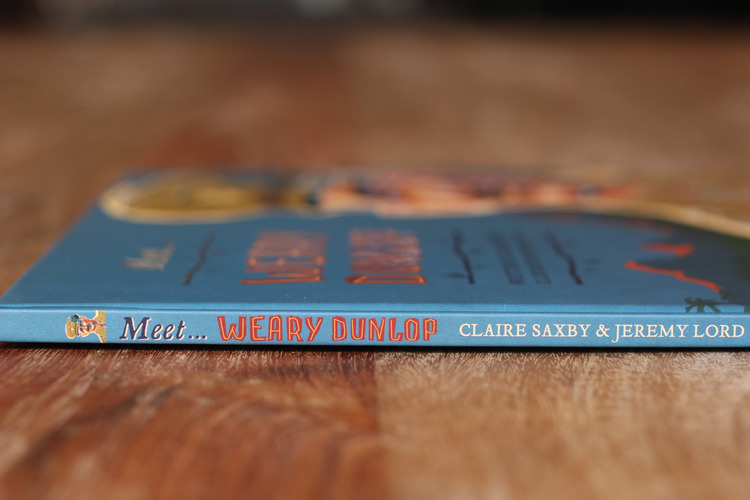
Meet Weary Dunlop by Claire Saxby, illustrated by Jeremy Lord

Meet Weary Dunlop by Claire Saxby, illustrated by Jeremy Lord (Random House Australia, 2015)

32 pages with colour illustrations, map and timeline

Subjects: World War Two, Australia, Singapore, Thailand, Burma, Ernest Dunlop, prisoners of war, junior fiction (Year 5-8)

Synopsis
Thanks to Claire Saxby for kindly sending me a copy of her new book. This is one of a series about “the extraordinary men and women who have shaped Australia’s history”. Others in the Meet… series are Ned Kelly, Mary Mackillop, Captain Cook, Douglas Mawson, Nancy Bird Walton and Banjo Patterson (with more titles promised soon).

“Weary” Dunlop (his nickname is explained inside) was an Australian army surgeon in WW2. His bravery, compassion, knowledge and skill helped to save the lives and bolster the spirits of fellow POWs on the Thai-Burma railway.

About the author
Claire Saxby's website is here. 
I love her description of her early reading habits: “I have always loved reading. I used to go home from boarding school and read for days on end, only emerging to swim and eat. I love words. I love how they sound, the work they do, the images they create.”

About the illustrator
This is Jeremy Lord’s website, with a page about this book (and some illustrations) here. 
He also has an online store (for his prints, often Aussie-themed) where he describes himself as “a French/Aussie, Sydney based illustrator.”

jlcom_illo_weary_pic004.jpg
From Jeremy Lord's website
Other books you might like
Meet the Anzacs, also by Claire Saxby, is another book in the same series.

NZ connections
Each year on 25 April, Anzac Day in Thailand is commemorated with a Dawn Service and Gunfire Breakfast at Hellfire Pass and a Memorial Service and Wreath Laying Ceremony at Kanchanaburi Allied War Cemetery.

People gather for Anzac Day in Hellfire Pass,  Kanchanaburi province, west of Bangkok, Thailand, on the route of the Thai-Burma railway.
People gather for Anzac Day in Hellfire Pass, Kanchanaburi province, Thailand,
on the route of the Thai-Burma railway. Photograph: Sakchai Lalit/AP
Things I didn’t know
What did I know about Sir (Ernest) Edward “Weary” Dunlop before reading this? Nothing! (So this book was a good place to start.) 

The Australian War Memorial bio says that "On 20 January 1943 he left Singapore for Thailand in charge of "Dunlop Force" to work on the Burma-Thailand railway. He remained there until the war ended, labouring tirelessly to save wounded, sick and malnourished men. Many times he put his own life at risk as he stood up to the brutality of his Japanese captors. Though not the only medical officer to act in this selfless way, his name was to become a legend among Australian prisoners of war and an inspiration for their own survival. Throughout his captivity and at great personal risk Dunlop recorded his experiences in his diaries."

After the war, he got married and continued both working as a surgeon and supporting former POWs of the Japanese. Over 10,000 people came to his state funeral in Melbourne in 1993 and portions of his ashes were later interred at Hellfire Pass and floated down the nearby river.

There is lots of info about him online – more here, including a video clip of the floating of his ashes which is a very moving scene.


Saturday, 2 April 2016

My Gallipoli by Ruth Starke, illustrated by Robert Hannaford

Anzac Day is only a few weeks away and so this book on people who were at at Gallipoli seems like a good one to review at this time. It also marks my 70th book review for this blog. 

My Gallipoli by Ruth Starke, illustrated by Robert Hannaford (Working Title Press, 2015)

32 pages with full page illustrations

Subjects: World War One, France, Australia, Turkey, nurses, chaplains, war correspondents, Charles Bean, war artists, George Lambert, snipers, Billy Sing, Ataturk, Mule Corps, war graves, Cyril Hughes, sophisticated picture books (Year 6-12)

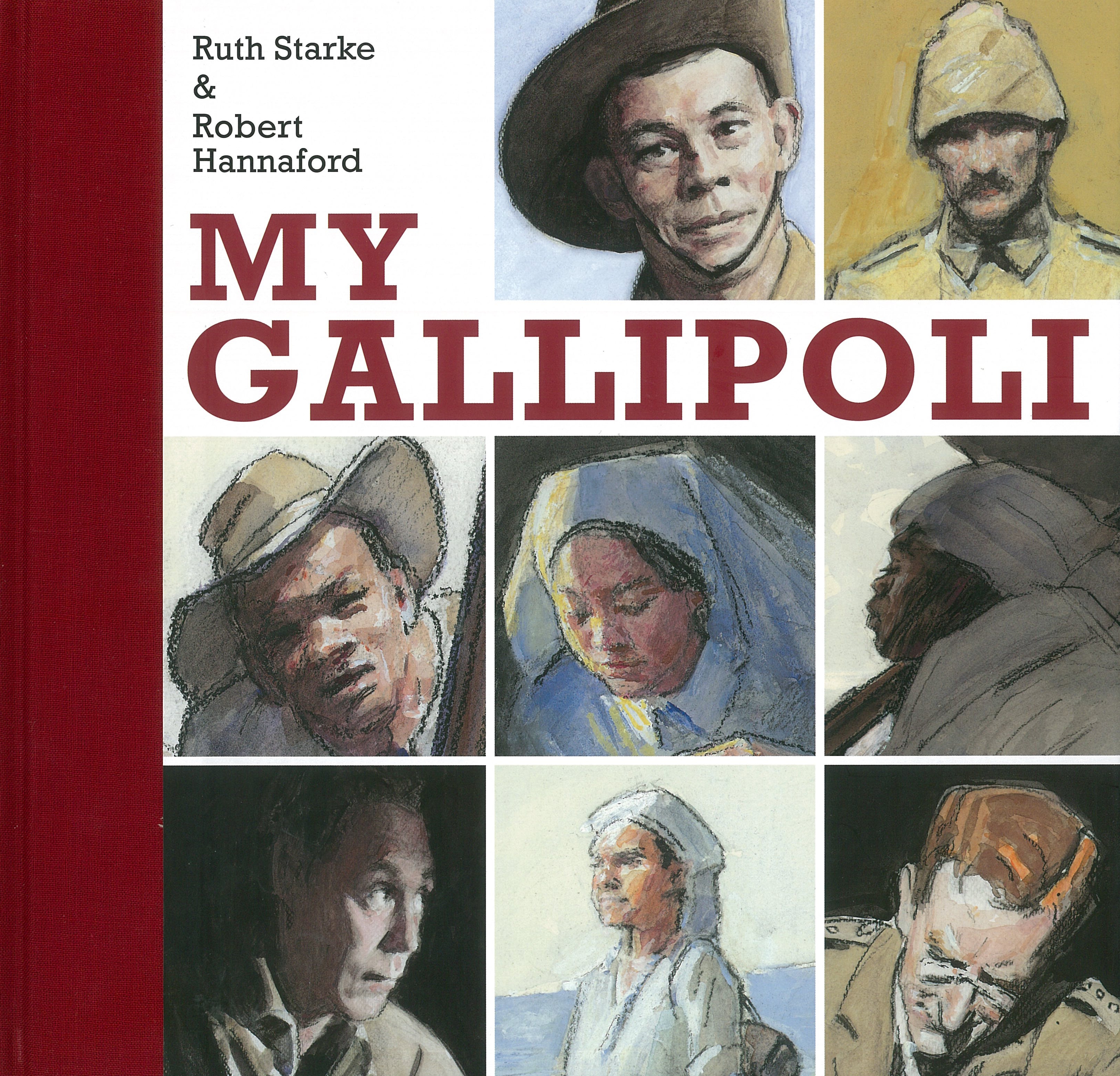
Book Cover:  My Gallipoli

Synopsis
“From the shores of Anzac Cove to the heights of Chunuk Bair, from Cape Helles to Gurkha Bluff, the Gallipoli Peninsula was the place where thousands of men from sixteen nations fought, suffered, endured or died during the eight months of occupation in 1915. For each of them, their families and their nurses, Gallipoli meant something different. Their voices emerge from the landscape and across the decades with stories of courage, valour, despair and loss.” (Penguin Books website)

The title suggests that Gallipoli has some personal resonance for all of us, while the cover, with its portraits in individual squares, gives a clue to the way the story will be told inside. I like the way that it focuses on real historical characters, as well as nameless Anzac soldiers and Turkish people, and also includes women, stretcher bearers, the chaplain and indigenous soldiers.

I also like the fact that it doesn’t finish in December 1915, but shows the ongoing effects of the campaign, and what it might be like to revisit Gallipoli today. There are useful extra facts at the back and a map at the front. Each spread could be used as a springboard to find out lots more information.

Teachers’ notes are available here and include comments from both author and illustrator about the thinking, ideas and inspiration behind the book.

Reviews:
There are plenty of good reviews that will give you a idea of the book’s themes and potential readership. The Readings website says that "the rich panoply of voices in Ruth Starke’s text offers upper primary and lower secondary students a broad understanding of the Anzac Campaign and the current views of those engaged in the war as well as those at home." Other reviews appear in The Book Chook and Kids Book Review.

Questions:
Which page was the most surprising for you? Which one presented a viewpoint that you hadn’t thought of before?

Author’s website
Ruth Starke lives in Adelaide, South Australia, and has published more than 20 novels for young people. Before becoming an author, Ruth worked in public relations and travel marketing, and at a great variety of other jobs - of which the most interesting, she says, were selling French perfume in Harrods, cooking on the radio, taking tourists to Kashmir, and interviewing Grand Prix drivers. Ruth has also written “An Anzac tale,” a graphic novel about Gallipoli.

This is my favourite of “20 questions with Ruth” on her website:
What is the naughtiest thing you did?
Accidentally swallowed my best friend's brother's prize goldfish during a “dare”.

Info about the illustrator
This is Robert Hannaford’s gallery. 

In an interview in The Advertiser, he explains “How to paint a portrait” and says, “This is why I paint. I never get sick of it. Painting for me is a learning experience.”

NZ connections:
I’m pleased to see that  Ruth Starke, included a story told by a New Zealand soldier, “Private Andrew McBain” of the Auckland Mounted Rifles, and his mate Frankie, in the pages on Chunuk Bair.

Sunday, 5 April 2015

The last Anzac: questions and answers

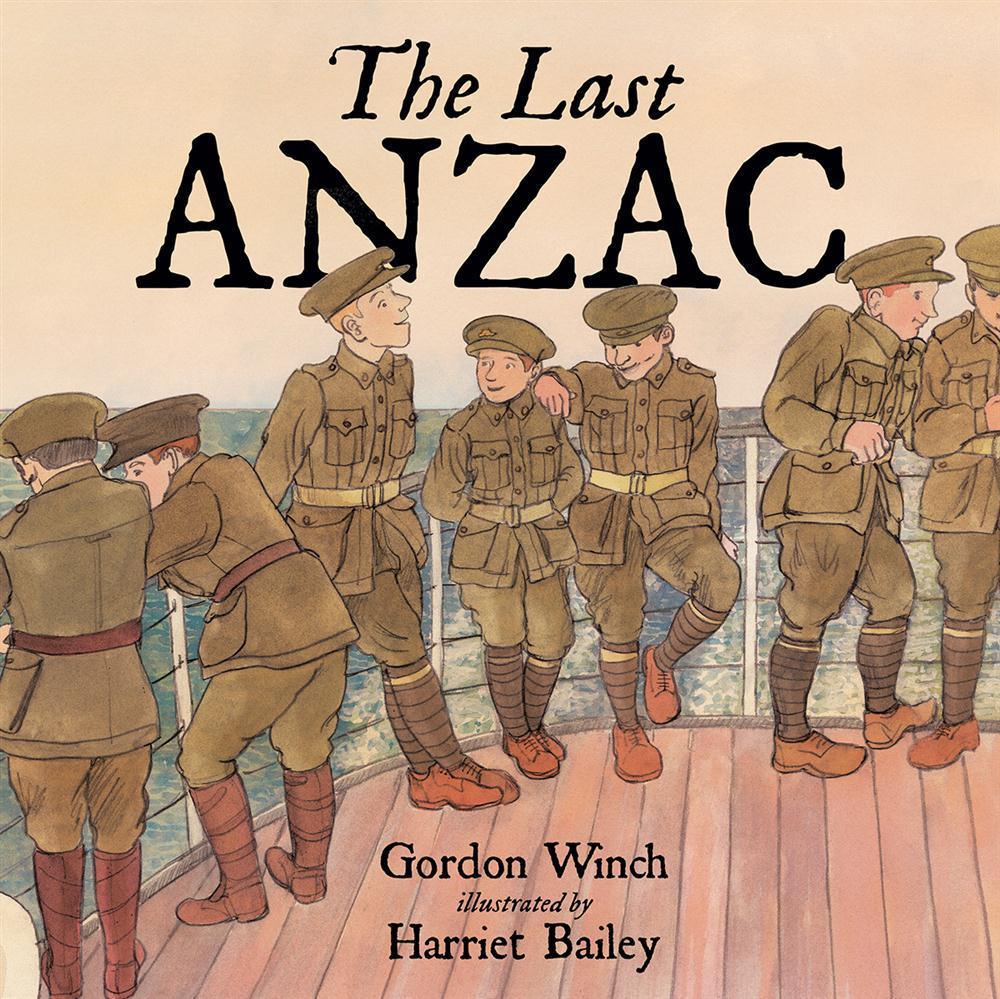
The last Anzac by Gordon Winch, illustrated by Harriet Bailey

I was lucky enough to attend the launch of this lovely book at The Children's Bookshop, Kilbirnie, in March. You can read my review of the book here, and Harriet has very kindly agreed to answer some questions about the book, how she worked on it and her illustrating style.

The book is a lovely production and it' s interesting to see the Anzac connection (Australian author and publisher / NZ illustrator). How were you approached by New Frontier to take the job on?
Thank you! An editor from New Frontier Publishing sent an email asking if I would be interested in illustrating a picture book for them, and that it would be a ANZAC WW1 Centenary title for 2015. I jumped at the chance to illustrate a heavily referenced story and one based on a soldier who served at Gallipoli.

How would you describe your own illustrating style, and why do you think it lent itself to this project in particular?
I have a range of illustration styles and felt the light and descriptive drawing line was needed to depict the various scenes and peoples expressions. When it got to the colouring stage, the publisher originally wanted all the 1915 scenes to be produced in sepia (brown and white or black and white, as was the photography at the time) in order to have a clear contrast between past and present. I wished to retain full colour to make it visually appealing and descriptive. I wanted the oranges to be a lovely juicy orange! We compromised by having the 1915 scenes set on a darker cream background.

At the launch of "The last Anzac", Ruth Paul made some fascinating comments about how well your illustrations worked to balance, and in some cases extend, the text. She used as examples the sequence showing Alec carrying the water and then spilling it when he jumps into the trench, and also the feet in the hospital beds. How do those ideas develop, and how do you decide what aspects of the story you want to illustrate?
This particular story was light on descriptive detail so I filled it in by reading as many accounts of the war at Gallipoli as I could. Books with collections of photographs of WW1 and men’s stories gave me ideas for the other soldiers that are shown. Soldiers injuries were horrific and of those that survived to be treated in the field hospitals, then the hospital ships and after that make shift hospitals in Greece and Egypt. I wanted to show men recuperating and with their wounds being looked after by ANZAC nurses. The missing limbs are sure to be noticed by children looking at the pictures.

Alec Campbell suffered many illness that kept him from sailing off to France to join the frontline but compared to his fellow patients he didn't have war wounds that were apparent until Bells Palsy appeared and 1/2 of his face became immobile.

As far as telling the story in pictures, “what happen’s next” is the major vehicle for turning pages of a picture book. I really wanted to have a sequence of illustrations to show what Alec Campbell did for the majority of the time: carrying water from the beach to inland for the soldiers who were in fighting in the trenches. Illustrating the effort and the danger of such an essential and appreciated task is the most interesting part of the story for children, I think!

I guess you haven't met the author, Gordon Winch, but do you know much about him?
I read about Gordon Winch online and discovered he has had a long career as a teacher of children and training teachers and has written many engaging and humorous books for children of Australia. 

How did you go about doing the research you needed for the illustrations? (at the launch, you told a lovely story about how you pinpointed the cottage that Alec Campbell lived in.)
It pays to use as many contacts that you have available when it comes to research and it was fortunate that I have a retired Australian uncle who is a whizz at tracing things using historical records. Part of the problem of weighing heavily on the internet for information is being certain that it is accurate. I had thought Alec Campbell was in a rest home at the time of James’ visit, but the publishers assured me he was still living with his wife in her mothers cottage, address unknown.

My Uncle was able to consult Electoral Rolls to hone down on a street number using the information I provided, sourced from historian Jonathan King’s book, Gallipoli: Our Last Man Standing. I used Google Street View to take a reference image of the cottage for the illustration. I like to think I have the correct little humble home where Alec lived!

As I have mentioned there was a lot of research needed to for a historical picture book. To avoid confusion due to the backwards and forwards of time and change in narration, I learnt it was important to keep visual elements limited to that which related to Alec and the story. I made a point of contrasting Alec's two ages: his visibly apparent youth when he went to war and his advanced age that he reached after a life where he achieved so much in Australia.

After Harriet had sent me these answers, I showed the book to my sister who came up with another question - which Harriet kindly answered as well!

Did you know any more about the boy's visit to Alec, and how that came about?
This story is based on a true event with one of the publishers' sons visiting Alec Campbell. New Frontier sent me two photos of father and son sitting with Alec and his wife Kate in their living room. I don’t know how the visit came about. I imagine the boy wrote Alec a letter requesting to visit him in Tasmania. I expect that Alec wished to met this young boy who was so keen to met him and learn about his experience at Gallipoli. 


The last Anzac by Gordon Winch; illustrated by Harriet Bailey

The last Anzac by Gordon Winch; illustrated by Harriet Bailey (New Frontier Publishing, 2015, “with historical advice from the Australian War Memorial”)

ISBN 9781925059298

32 pages, hard cover with beautiful colour illustrations

Subjects: World War One, Gallipoli, Australia, boy soldiers, Alec Campbell, veterans, picture books (Year 2-6)

Synopsis
Alec Campbell enlisted in 1915 when he was only sixteen. He served in Gallipoli but got sick and returned home, a veteran, at the age of seventeen. He died in 2002, aged 103. This is his story, told through the eyes of a young boy called James who went to visit him in the year before Alec died. That’s why this Anzac story starts, unusually, on a plane and then at an airport in Tasmania in 2001.

The endpapers contain facsimiles of wartime letters, postcards and envelopes, including a letter written by Alec (at Gallipoli) to his mother on 5 November 1915.

Reviews:
In Aussie reviews, writer Claire Saxby (Meet the Anzacs) points out that “it’s not easy to share the enormity of a war with young readers” and describes this as “an introduction to WW1 for early primary readers, showing them Gallipoli through the eyes of someone who was there”.

Teachers’ notes include the set of questions drawn up by James and his classmates which he took to ask Alec on Sunday 5 August 2001. Question 16 is What was your greatest moment? and the answer (Eating oranges when we got off Gallipoli) appears in one of my favourite illustrations. Also look out for the beautiful illustration of moonlight over the Aegean – and observant children will pick up on some unspoken details in the spread of the hospital scene.

Questions:
I had a number of questions that I wanted to ask the illustrator, Harriet Bailey and she kindly agreed to answer them. You can read her replies here.

About the author:
Gordon Winch was a teacher for over fifty years and has written a number of books for children. 

About the illustrator:
Harriet Bailey is a designer and illustrator based in Wellington, New Zealand. She began her career as a graphic designer. In 2010, she was the inaugural recipient of The Storylines Gavin Bishop Award and since then has illustrated Hester & Lester (Random House, 2011) and Out of Bed, Fred! (Scholastic, 2011). Both books were named in the Storylines Notable Books List 2012 in the picture book category.

You can see other examples of Harriet's art and design work on her website. 

Other books you might like:
There are several fictional treatments of boy soldiers, such as My mother's eyes: the story of a boy soldier by Mark Wilson, One boy’s war by Lynn Huggins-Cooper; illustrated by Ian Benfold Haywood and The horses didn’t come home by Pamela Rushby. Charlie and Tommo in Private Peaceful sign up at nearly 16, and the boys in War game are very young as well.

Links
You can find out more about Alec Campbell (nicknamed The Kid by his fellow soldiers, because he was so young and small) here, and here on the Australian War Memorial site, which also has an article about the last veterans from a number of different countries.

Have you read it?
Have you read this book? Let me know what you think!