Showing posts with label Ypres. Show all posts

Wednesday, 29 July 2015

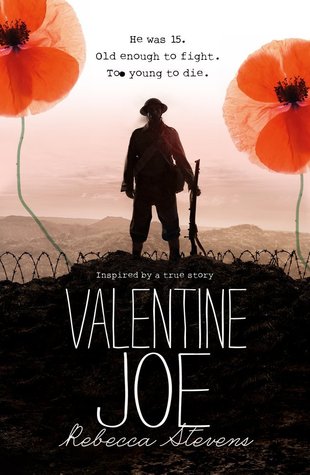
Valentine Joe by Rebecca Stevens

Valentine Joe by Rebecca Stevens (The Chicken House, 2014)

15 chapters; 154 pages

Subjects: World War One, France, Ypres, Belgium, Menin Gate, grandparents, boy soldiers, time travel, junior fiction (Year 5-8)
18663734

Synopsis
Rose’s father died a year ago and she still misses him so much that she secretly sends him texts on her phone. Her grandad takes her along on a trip to visit his uncle’s grave in Ypres, and in the cemetery she comes across the grave of a young soldier who died just before his sixteenth birthday. A stray dog leads her into a time slip adventure where she goes back in time to World War One and meets the soldier, 15-year-old Valentine Joe. As well as being an adventure, this also turns into a way of Rose coming to terms with her father’s death.

The best part of this book for me was the relationship between Rose and her grandad, which is teasing, funny and affectionate, as shown by their nicknames for each other. I found parts of the story slightly disjointed, which reflects the fact that Rose keeps getting thrown back into different times. She is often unsure where or when she is, or what is happening, which made it a bit confusing for the reader too.

Rose is 14 (and not a very sophisticated 14), and for the sake of the plot, she has to go off on her own at night, but I wasn’t sure if her grandad would really have let her wander round the streets of a strange town in the dark, no matter how safe the hotel keeper assured them it was.

This would appeal to readers who like time travel and a touch of romance as well as a war story. I wonder if it would also appeal more to British children who are more likely to go on school trips to visit the graves. 

Reviews:
The first chapter is online on the Guardian children’s books site, which also has a review (“It’s only a slim volume, but in its 150 pages Rebecca Stevens manages to weave a perfect war story: gripping, heartbreaking, realistic, witty and full of hope.”)

The Bookbag also refers to its length and calls it “small in terms of number of pages”, but “decidedly big in terms of themes and emotional weight” with "one of my favourite endings of the year".  

Author’s website
Rebecca Stevens has been an actor, a standup comedian and a script writer for children’s television, writing for shows like Mr Bean and Postman Pat. This is described as “her first solo book project.”
You can see Rebecca Stevens here reading from Valentine Joe.

And here on the BookTrust website ("telling the story of the short life of a real person"), she writes an interesting piece on using someone else’s story, or someone else’s life as the basis for your book:

Did I have the right to use Joe and the events of his tragically short life for the purposes of my book? I don't know... Although I managed to contact one of his relatives who gave me her blessing (and I've subsequently met another), it still felt wrong, disrespectful somehow, to put myself in his shoes, imagine his experiences from his point of view. So I decided to tell his story through the eyes of a character who was entirely invented, someone I felt closer to. Rose is a 14 year old girl from the present day, who goes to Ypres with her granddad.”

She also talks about her own grandfather who signed up when he was 16, but was sent home when a doctor suspected his real age. (He signed up again at 18 but survived the war.)

Other books you might like:
The topic of boy soldiers is a popular one. Charlie and Tommo in Private Peaceful sign up at nearly 16, so does William in My mother’s eyes: the story of a boy soldier, Sydney in One boy’s war and Harry and Jack in The horses didn’t come home. The boys in War game are very young as well.

“Boy soldiers” by Norman Bilbrough in School Journal, Part 4, No 3, 2008 tells the story of two young soldiers, Stan Stanfield and Len Coley, who fought in World War One. 

The red suitcase by Jill Harris and Charlotte sometimes by Penelope Farmer are war-related time travel stories. When the guns fall silent by James Riordan also uses the device of a child visiting the war graves with a grandfather.

Links
Private Valentine Joe Strudwick was a real soldier. He was born in Dorking, Surrey, and you can read more about him here on the website of the Dorking Museum.
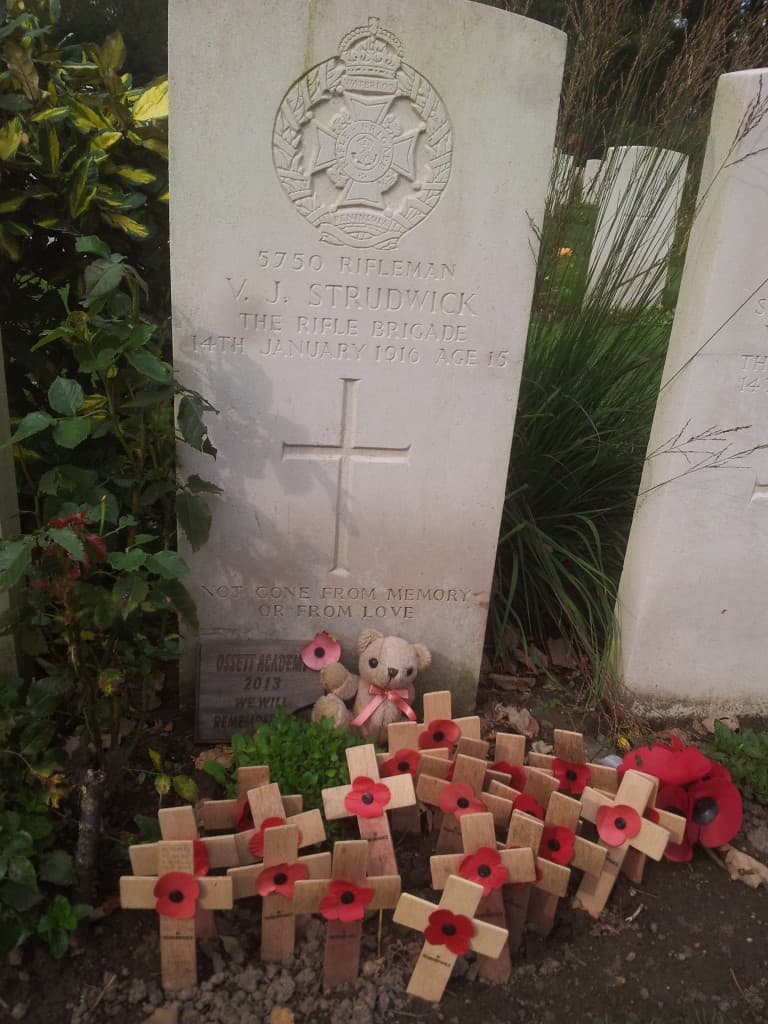
Valentine Joe Strudwick
"Not gone from memory or from love"
Have you read it?
Have you read this book? Let me know what you think!


Saturday, 2 August 2014

When our Jack went to war by Sandy McKay

When our Jack went to war by Sandy McKay (Longacre, 2013)

ISBN 978 1 77553 309 2

192 pages

Subjects: World War One, France, Belgium, England, letters, Messines, Ypres, junior fiction (Year 5-8)


Synopsis
When our Jack went to war is described on the title page as “a fictional story based on a real-life event”. It is dedicated to “Private John McIntosh, 27553, 2nd Battalion Otago Regiment, NZEF” who was the author’s great uncle, killed in action in 1917.

In Sandy McKay’s story, her great uncle John becomes the “Jack” of the title, and the narrator is his younger brother Tom, who is twelve when Jack leaves his carpenter’s apprenticeship and signs up in 1916. Many of Jack’s friends sign up at the same time: Ted, Cyril, Stuart, Billy. The rest of the family consists of their mother and Tom’s younger sister Amy; their father had died a year or two earlier, soon after the war began. 

The story is told in Tom’s voice, interspersed with Jack’s letters and (real) newspaper clippings and other notices. Jack’s first letters are from Trentham Training Camp; then from the troop ship on the way to England, Sling Camp on Salisbury Plain, a trip on leave to London and Scotland and finally the trenches of the Western Front. He is wounded and sent to recover at a hospital in England, but then goes back to the front line again. Meanwhile Tom’s letters tell about his own school and home life.

The newspaper clippings include descriptions of the battles (not always the same as Jack’s descriptions), casualty lists and articles about conscientious objectors. Headlines give glimpses into little known aspects of the war at home; stories like “Disloyal utterance – indiscretion in railway carriage” (a man who made use of “language calculated to interfere with recruiting” by claiming “a man is a *** fool for going to the front”), “Drawing of first ballot” (for conscription)  or “Refusing to parade” (a man who was a Quaker, and “objected to service” as a conscientious objector.)

The dialogue, slang and domestic details of the time ring true (Jack’s letters are kept “in a biscuit tin on the shelf in the kitchen, right next to the hook for his nail bag”.) At the end is a factual section titled What do you know about the First World War?

Reviews:
You can read a review of the book on Bobs books blog. Bob says: "The last 15 pages will wrench your heart out."

Teaching notes are also available here and include a great set of suggestions for creative or research responses.  

Author’s website
Sandy McKay's website is here. 

You can also read about her on the NZ Book Council site and the Christchurch City Libraries Interviews with NZ children's authors. 

New Zealand connections:

In the acknowledgements, Sandy McKay makes special mention of the Papers Past website of the National Library. This really is an amazing resource. At present it covers from 1839 to 1945, and includes 90 publications from all over the country, but more newspapers - and newspaper issues - are being added all the time. 

Wednesday, 11 June 2014

Memorial by Gary Crew, illustrated by Shaun Tan

Memorial by Gary Crew, illustrated by Shaun Tan (Thomas C Lothian Pty Ltd., 1999)

ISBN 0 85091 983 5

32 pages with colour illustrations and collage

Subjects: World War One, Ypres, Vietnam, war memorials, unknown soldier, trees, picture books (Year 5-8)


Synopsis
This is a surprising book. Things are hinted at or left unsaid in the text, and the illustrations often seem to go off at a tangent. I don’t think I appreciated it properly until I read Shaun Tan’s comments about how he chose to illustrate it. When you think about it, the title gives it away: Memorial, but not War memorial, even though the tree is a war memorial – but the book is also about the wider subject of memories, how and why and what we remember.

War memorials are a fascinating topic and they make you ponder all sorts of things – how and when they were built, who has gathered there over the years – as well as the stories behind the names of the men and women who went off to war. “Lest we forget” is  a common engraving – “But generations later, what do those who pause in the shadows of the tree’s immense branches remember?”  

Something I discovered when researching for Anzac Day: the New Zealand story was the fact that whereas in New Zealand, World War One war memorials usually list the names of those who died, in Australia they often list the names of all from that community who went to serve. Some people think that the difference is due to the fact that there was no conscription in Australia at that time, so the communities wanted to recognise each person who voluntarily went to serve.

Reviews:
There is a review on the Gathering books blog (if you scroll down), with lovely reproductions of some of the pictures. 

You can also find Teachers notes here. 

Questions:
What do we know about the people in the family? How many generations are there? Who is telling the story?
Which wars did they fight in?
Where do you think the book is set?
Why does the Council want to cut the tree down? Does the tree get cut down? If so when does that happen?
What do people in the book say about memories?
What do you understand or get from the pages that have no words, only pictures?
What does the last page mean?

Author’s website
Gary Crew has a page on the Literature Centre website. 

Info about the illustrator
Shaun Tan has a website that is as amazing as you would expect. (Click on Picture books to get to Memorial.) 

On his website, Shaun Tan says that "Memorial is a story about a tree planted beside a war memorial monument, in a small country town by returned servicemen. Years on, the tree has grown to be huge and unruly, dislodging the statue next to it and creating a traffic hazard in what is now a much larger, busier town. A decision is made by a local council to cut the tree down."

‘Midsummer’ acrylic, gouache and pencil, paper collage.
Further down this page, Shaun Tan has written some thoughtful comments on illustrating the book. Too long to summarise, but I especially liked these remarks: 

"What made the subject of the book engaging for both of us was that it ended up being not about war, memorials or remembrance as ‘grand’ subjects, but about the small, quiet memories that make up ordinary day-to-day lives - really about the nature of memory itself."

"Perhaps the point of this picture book is to open a passage for its readers to think about the way symbols really work in relation to collective memory, as a container that needs to be continually topped up to have any currency."

"I was particularly interested in the idea of silence to add further depth to the book, that there are great reserves of feeling which cannot be expressed in words, and that the stories only ‘skim’ over the top of these lakes." 

Things I didn’t know
The tree that was planted was “a piddly Moreton Bay fig tree.” 

I found out from Gardening Australia  that the Moreton Bay fig (Ficus macrophylla) is native to parts of Australia and Lord Howe Island. According to this article, they also grow in New Zealand. In fact the New Zealand Tree Register has a description of the tree that has been historically considered the largest Moreton Bay fig growing in New Zealand, at Monte Cecilia Park in Hillsborough, Auckland. (Must be worth a look, next time you go to see the Pah Homestead.) 


New Zealand Geographic also has a short article talking about how the Moreton Bay fig ("these banyan-like botanical goliaths" - wonderful description!) arrived in this country. 


Saturday, 22 February 2014

Tank commander by Ronald Welch

Tank commander by Ronald Welch, illustrated by Victor G. Ambrus (OUP, 1972)

14 chapters; 182 pages with occasional pen and ink sketches

Subjects: World War One, France, Ypres, Mons, deserters, tanks, junior fiction (Year 8-10)


Synopsis
At the start of the book, John Carey is a Second Lieutenant with the West Glamorgans, who are comfortably ensconced in the regimental barracks at Tidworth. It is August 1914 and war is imminent. There is one last ceremonial regimental dinner, complete with Georgian silver service, toasts and cigars, before the dress clothes are packed away and everyone sets off for war.

Ronald Welch is very good on battle strategy, he understands how and where battles are fought, and he shows how the First World War marked the end of traditional cavalry regiments. You couldn’t use cavalry in trench warfare, because they simply got mown down. He also explains how and why tanks were first used, what they were good for and what they could and couldn’t do.

However, despite the comments quoted later, this book would be unlikely to be read in the same way today as it was when first published.

For a start, there are NO WOMEN in the whole book. Even the medical staff are men. No - actually - there are two women in London who give John a white feather because he is in mufti, but by then he has already been in the trenches and wounded and decorated and it is the tradition for his Battalion to wear mufti on leave, so you get the impression those women are a bit dim because they don't understand anything.

There is little reflection on the awful toll of war, although it’s hard to know if this book was written in 1972 to reflect attitudes prevalent in WW1, or if those attitudes were still prevalent in 1972. (In the Historical note at the back, the author notes that in 1972, the year it was published, “there were still 78,000 men in Britain drawing disability allowances from wounds received in the 1914-18 War.”) 

For example, the chapter on Desertion, where Private Tyler is courtmartialled and sentenced to death, shows no sensitivity to his plight (at one stage, John and his senior officer are discussing Gilbert and Sullivan operas); the man is simply treated as a despicable coward. “John stepped back, trying to free himself from the grip of those desperate fingers. He stared with revulsion and horror at that moaning, scrabbling figure on the floor at his feet.” (Compare that with Private Peaceful or David Hill's My brother’s war.)

Some of the comments below compare Ronald Welch to Rosemary Sutcliffe, and I did enjoy her books as a child. It will be interesting to see how they fare on re-reading, and if her books are equally weighted in favour of male characters. 

Author’s website
Ronald Welch (1909-1982) was writing well before the days of authors’ websites, and it wasn’t even his real name. He was born Ronald Oliver Fenton, in Wales, to English parents. He was a well-known author of children’s historical fiction, as well as being a history teacher and later headmaster. During World War Two, he fought in the Welch Regiment, and that was what he took his pen name from.

In 1955, he won the Carnegie Medal for the most outstanding children’s book of 1954 with Knight Crusader, which was the first in the Carey Family series. There are 12 books altogether, covering wars from the 12th to the 20th century, although they weren’t written in chronological order. Tank commander is the final title in the series (it has a Family Tree at the beginning), but not the last one to be published.

This website contains an interesting account of what he was like as a headmaster.

Bear Alley is a blog run by a freelance author and editor with a special interest in old British comics, books and magazines. Here he talks about Ronald Welch and his books,and his piece is followed by a string of enthusiastic comments from readers:
  •  I remember reading as many of Ronald Welch’s historical novels as I could manage, when I was a boy growing up in the 1960s.
  •  I devoured all his books as a child, through to my late teens. I read and re-read them all. From these books and those of C.S. Forester I gained a huge interest in History and Military History in particular.
  • Ronald Welch’s and Rosemary Sutcliffe’s historical novels kindled my love of reading and history which has lasted all my life.
  • Why isn’t somebody reprinting him?
  • As a school librarian, I do not think that the calibre of these authors can be matched today, fantasy and chick lit are the popular genres.
With only a few dissenters:
  • I think they’re too unreflective on Empire, Class and War for modern tastes, and not lyrical enough.
And according to a note on the end of this post on the Historical Writers' Association, Slightly Foxed is republishing all 12 of Ronald Welch’s Carey Novels, starting with Knight Crusader, The Galleon and For The King in September 2013, with subsequent titles to follow throughout 2014-2016.

Info about the illustrator
Victor G. Ambrus (1935- ) was born in Budapest and is still alive – with a website! I’m not sure why I was so surprised, except that this book does have such an old-fashioned feel.

Here is an example of his illustrating style (from his website):

The battle of Stamford Bridge

Things I didn’t know:
  • Tanks in WW1:
I didn't know anything about how tanks were developed or when they were first used.

A WW1 tank
Here's another article about them with some more fascinating pictures. 

British "Whippets", 3rd Battalion, Tank Corps, Mar 1918


  • New words in the war:
“Anzac” was of course a new word that emerged in World War One, but Ronald Welch notes others, such as “camouflage”, which comes from the French word camoufler, to disguise, and is recorded as having its first known use in 1917.
I went looking for other examples and found a post on language of the First World War. There was “camouflage” again:
“Many words which emerged at the time have clear associations with the conflict, such as camouflage, blimp, aerobatics, demob and shell shock.”
If you’re interested, you could also follow up the derivation of other war words such as Blighty, cushy or strafe.

  • Officers in the British Army
I knew that officers in the British Army traditionally came from the upper classes. It was a well-recognised career path for a younger son.
However I didn’t realise that this was made inevitable by low rates of pay. According to Ronald Welch, “the pay of a Second Lieutenant was 5/3 per day and his Mess Bill 7/6 without any drinks at all. Not even Senior Officers could live on their pay and a private income was essential. A thousand a year in some regiments, six hundred at least in many more, and not far short of four hundred the absolute minimum. John knew of several officers in the room who were heavily in debt, and to them the coming war, if they survived it, would be an enormous relief.”

  • The Battle of Waterloo:
I didn't know that the Battle of Waterloo, fought in 1814 between the English and the French (think Vanity Fair), took place close by some of the battles fought in World War One. 
John Carey’s first experience of war is at Mons, in Belgium. “For the first time in ninety-nine years the British army was fighting again in western Europe…  It was quite possible, John thought, remembering his Military History, that some of those men falling as British bullets hit them were grandsons of the Prussian soldiers who had made a forced march ninety-nine years ago on another Sunday, not so very far to the north of Mons, so that they could fight with their British allies, already fiercely engaged in battle at a place called Waterloo.”
That means that 2015 is also the bicentenary of that battle - which is a complete diversion, but still interesting.