Showing posts with label Michael Morpurgo. Show all posts

Wednesday, 19 October 2016

The Mozart question by Michael Morpurgo

The Mozart question by Michael Morpurgo, illustrated by Michael Foreman (Walker Books, 2007)

75 pages (but a small size, so quite short); gorgeous watercolour illustrations of Venice and sobering, muted ones of the scenes at the concentration camps

Subjects: World War Two, Jews, concentration camps, music, junior fiction (Year 6-8, but have to be ready to hear about the Holocaust)


Synopsis
I can’t better the synopsis on Michael Morpurgo’s own website:
“When Lesley is sent to Venice to interview world-renowned violinist Paulo Levi on his fiftieth birthday, she cannot believe her luck. She is told that she can ask him anything at all – except the Mozart question. But it is Paulo himself who decides that it is time for the truth to be told. And so follows the story of his parents as Jewish prisoners of war, forced to play Mozart violin concerti for the enemy; how they watched fellow Jews being led off to their deaths and knew that they were playing for their lives.”

In the note at the back, the author talks about how the story grew from “the sight of a small boy in a square… in Venice, sitting one night, in his pyjamas on his tricycle, listening to a busker. He sat totally enthralled by the music that seemed to him, and to me, to be heavenly.”

Reviews:
  • Kids reads says “Morpurgo's tale is straightforwardly told, almost fable-like in its simplicity and emotional impact. Its simple language and elegant structure would make The Mozart question an excellent book for parents and teachers to read with children, opening the door to more questions about family history, historic atrocities, and the miraculous powers of music to resist and overcome even the most shocking evils.”

About the author

What more can you say about Michael Morpurgo – he’s just amazing.
This page on his website talks about themes of war in his books. 

About the illustrator
And similarly for Michael Foreman – equally amazing!
This article in the Guardian profiles his 50-year career. 

Other books you might like:
War horse and Private Peaceful, both by Michael Morpurgo,  War gameThe general and The amazing tale of Ali Pasha by Michael Foreman

Have you read it?
Have you read this book? Let me know what you think!

Saturday, 16 January 2016

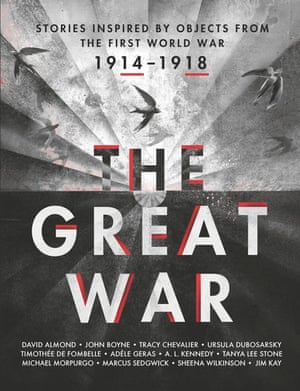
The Great War: stories inspired by objects from the First World War

The Great War: stories inspired by objects from the First World War (Walker Books, 2014)

304 pages, with full page black and white illustrations by Jim Kay; 11 stories by David Almond, John Boyne, Tracy Chevalier, Ursula Dubosarsky, Timothée de Fombelle, Adèle Geras, A.L. Kennedy, Tanya Lee Stone, Michael Morpurgo, Marcus Sedgwick and Sheena Wilkinson.

Subjects: World War One, England, France, short stories (Year 5-8)

Great War: Great War cover

Synopsis
This anthology contains stories by English, American, French, Irish and Australian authors. Each author uses a particular object as the inspiration for a story about the First World War. The objects include items belonging to individual soldiers – a helmet, a writing case, a compass. Some are printed material: sheet music, school magazines, a recruitment poster.  There is a French toy soldier, the nose from a Zeppelin bomb and a Victoria Cross and a Princess Mary gift box. One of my favourite items was a hand-painted war time butter dish.

Some stories are set in the present day (a school history trip to the battlefields), others in the past. A number of them have girls as the main characters. One is a sort of ghost story. One is written as a poem. Many are firmly based in family life. As in all anthologies, some stories work better than others, but all are of a very high standard.

The pages at the end of the book contain biographical information about the contributors and pictures of their chosen objects. From the picture credits, you can work out where most of the objects come from (many are held in the Imperial War Museum), but I would have liked some more information about how the authors chose the object they wrote about. (This article in the Guardian shows some of the objects.)

About the illustrator
Interesting random facts: Jim Kay won the Kate Greenaway Medal in 2012 for his illustrations for A monster calls by Patrick Ness and was chosen by J.K. Rowling to illustrate the full-colour editions of the Harry Potter series. Here they are!

And here he talks about his illustrations for The Great War.

Other books you might like:
War girls is another recent collection of war-related short stories. The curioseum, although not war- related, is another example of using museum objects to spark a story. 

Things I didn’t know
The country you call home by John Boyne describes the fierce debate amongst the Irish about whether they should support England in the First World War, when for years they had been fighting to get England out of Ireland.

The words that struck me most were from A world that has no war in it by David Almond, a story about a long-running neighbourhood feud.  Near the end, the narrator is talking about all the wars that feature on the news every day. “Are we daft?” he asks. “Are we evil? Is it just the way we are? Are we acting out something that started with our ancestors? Is it in our bones and blood? Do we go to war because we’re in love with war? Will we be asking those damn questions till the very end of time?”

The words stayed in my mind because I think a lot about writing books about war for children, and why we do it and what we are trying to say. Surely we want our readers to reflect on the futility of war, but as David Almond says, the wars just keep happening.

Tuesday, 9 July 2013

Private Peaceful by Michael Morpurgo

Private Peaceful by Michael Morpurgo (Harper Collins, 2003)

187 pgs; told in 13 sections over the course of one night.

Subjects: World War One, England, Belgium, Flanders, Ypres, deserters, junior fiction/junior YA (Year 7-10)

Also made into a film (2012) and a one-man stage show (although from what I've read, this has a different ending).  The film has a study resource which includes interviews with Michael Morpurgo and screen writer Simon Reade, as well as a trailer.


Synopsis
The story is told in a series of flashbacks by Private Tommo Peaceful, aged nearly 18, who spends one long night waiting for the dawn and remembering back over his life so far. The reason for his night-long vigil is hinted at but contains an unexpected twist at the end.   

Tommo grew up in a small village in Devon with his two older brothers, Charlie (whom he idolises) and Big Joe, who is mentally handicapped. The first half of the book deals with his childhood: schooling, his father’s death, his mother’s desperate efforts to keep the family together and the girl – Molly – whom both he and Charlie fall in love with, although it’s Charlie who wins and marries her. The pressure put on young men and boys to sign up for war is clearly shown when the sergeant major comes to town with his band of soldiers, “splendid in their scarlet uniforms.”

Both Charlie and Tommo (aged nearly 16) sign up and are sent to the trenches near Ypres, where they soon realise there is nothing splendid about war at all. The bullying behaviour of one of the army sergeants, and Charlie’s refusal to kowtow to him, is a constant theme, as is the fierce loyalty between the two brothers. At the end these two themes coincide, with fateful results.   

Questions:
Do you think Charlie did the right thing when he refused to leave Tommo? What would have happened to him if he had left Tommo? What would have happened to Tommo?
The motto on the cover says “Innocence and love, courage and cowardice.” How are each of these qualities dealt with in the book?

Reviews:

Here is a review of the book from the Booksellers New Zealand blog. This review on the Independent website talks about "Why children should see Michael Morpurgo’s ‘Private Peaceful" (the movie). 

Author’s website:
Michael Morpurgo's website includes worksheets, posters and book covers to download.
He has written a number of other war-related books, notably The war horse (also made into a film.)
Here he is talking about writing on BBC Authors Live.


Other books you might like:
The silver donkey by Sonya Hartnett also deals with the topic of army deserters and how they were treated.  
So does My brother's war by David Hill (NZ author). 
My review of The silver donkey includes some information on  the Shot at Dawn Memorial in Britain which is a memorial to some of these young men from Britain and the Commonwealth. 

New Zealand connections:
Desertion was treated as a crime by the army and could be punished by  court-martial and execution.  On pg 47 of Anzac Day: the New Zealand story is a section called “Pardoned at last”. This tells the story of the men who were court-martialled for mutiny or desertion, often because they were suffering from undiagnosed shell shock. Many of these men had fought bravely in other parts of the war but had just reached the limit of what they could endure. Their deaths were seen as terribly shameful for their families and often they were not talked about for years.
In 2000, the Pardon for Soldiers of the Great War Act was passed to pardon the five NZ soldiers who were subsequently shot. You can read more about the Act here.
The medals and certificate of pardon for one of the soldiers, Victor Spencer, were later gifted to the Bluff Maritime Museum

The story of two of the five soldiers, both born in Australia, is told further in this transcript: "ANZAC tragedies revealed after 80 years: the stories of Private John Sweeney and Frank Needs / John King , both Australians who signed up in NZ, and served bravely in Gallipoli but were charged with desertion in France and shot."

(It’s interesting to note that Australian never allowed its own soldiers to be shot, perhaps because the AIF was only ever made up of volunteers  - conscription was voted against twice by the Australian public during WW1 – and the public outcry would have been huge. But these two men had signed up for the NZ army.)