Showing posts with label girls. Show all posts

Saturday, 18 July 2015

The little ships by Louise Borden

The little ships by Louise Borden, illustrated by Michael Foreman (Pavilion, 1997)

32 pages

Subjects: World War Two, England, France, Dunkirk, boats, girls, picture books (Year 3-6)

Some covers have the subtitle: The heroic rescue at Dunkirk in World War II
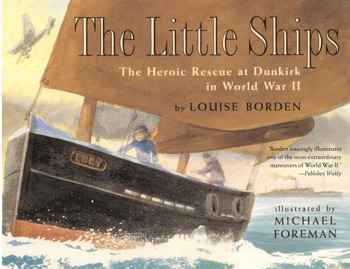
The Little Ships
Synopsis
In May 1940, the unnamed narrator lives with her father, a fisherman, in the town of Deal on the Kent Coast.  She is a girl, but “fisherman on the beach said I was my father’s daughter.” Her brother John is away fighting in France.  When word comes that half a million British and French soldiers are trapped on the beaches of Dunkirk, she disguises herself as a boy in some of her brother’s old clothes and joins her father (in his fishing boat the Lucy) and an armada of "little ships" that sets sail across the English Channel to rescue them.
I didn’t know that people from English villages and towns actually signed up to go and help, as shown in one of the illustrations. And I didn’t know that soldiers brought back their pet dogs (and some strays) with them – over 200 dogs were aboard ships landing in Dover!
There is a map in the front, and a historical note and excerpt from Winston Churchill’s famous speech (“we shall fight on the beaches…”) at the end. Some of the pages have a lot of writing on them, and I would think that the text is longer than that of an average picture book. There are a lot of illustrations of boats and ships, which I guess is understandable!
Reviews:
Kirkus reviews (always a prestigious place to get a review) calls this "A moving, fictionalized account of the ``miracle of Dunkirk,'' in which an armada of 861 ships ferried to safety across the English Channel over 300,000 Allied soldiers who had been trapped in northern France by the Germans."

The Children's War blog says it is "an excellent book for introducing the topic of Dunkirk to younger kids but is also a good teaching tool for older kids who may already know something about World War II."

Author’s website
Louise Borden is an American writer from Cincinnati.  I’d never heard of her before reading this book, but now I’m hoping to read more of her work. Her website has a very readable section about Becoming a writer (under the About button). I like how she talks about riding home on her bicycle as a child: “Pedaling slowly up my street may be where I learned perseverance, something all writers need when they are working alone at their desks.”

And I love what she says about writers needing to have thinking time. It’s a long quotation but it makes so much sense to me: 
“Often I am in my car, driving to new places to meet new people, and to talk about writing. I have a lot of thinking time on those miles. And I have a lot of thinking time when I am working in my garden at home. Thinking time: It's so very essential for a writer. I think about new ideas for books, and new ways to write them. I think about what is important to me, and the new things that I want to learn. I think about the books I read as a child—and the books I am reading today. 
I think about my family who are my great encouragers. And my wonderful editors who understand, in just the right way, my creative vision for a picture book. These thoughts always inspire me to return to my desk and begin working on a rough draft for a new manuscript.”

Info about the illustrator
You can read more about Michael Foreman on my review of his book War game.

Other books you might like:
The snow goose and The dolphin crossing, both already reviewed on this blog, are other books about Dunkirk. The evacuation of Dunkirk has a resonance for England that is perhaps a bit like Gallipoli for us in New Zealand: a defeat, but a heroic failure.

Things I didn’t know
Louise Borden’s website has pictures of her research trip for writing this book. She took part in one of the Crossings of the Association of Dunkirk’s Little Ships (as referred to in the Foreword), which is “the surviving remnants of the intrepid band of assorted boats and yachts that contributed so much to the miracle of Dunkirk.” 
I didn't know there was an Association of Dunkirk's Little Ships! There  is some fascinating info about it on their website, including an answer to the question “how do I identify if my boat took part in the Dunkirk evacuations?” 

The Association returned to Dunkirk in May 2015 to commemorate the 75th anniversary of Operation Dynamo, with 50 Little Ships escorted by the RNLI and the Royal Navy. There are some great photos and descriptions in this newspaper report from the Telegraph.  

Links
There's a You tube clip here, which describes itself as WW II : RARE COLOR FILM : DUNKIRK : PART 3 OF 3 1939 1940.

Have you read it?
Have you read this book? Let me know what you think!

Friday, 7 November 2014

Lighthouse girl by Dianne Wolfer


Lighthouse girl by Dianne Wolfer, illustrated by Brian Simmonds (Fremantle Press, 2009)

ISBN 978 1921 696 57 2

120 pages with sepia and black and white illustrations, as well as photos, charts, newspaper clippings and postcards.

Subjects: World War One, girls, lighthouses, Australia, Albany, junior fiction (Year 5-8)


Synopsis
Lighthouse girl is based on the true story of Fay Catherine Howe, daughter of the Breaksea Island lighthouse keeper. Fay lived at the lighthouse, near Albany in King George Sound, where the first Australian and NZ troopships departed from on their way to WW1 in 1914. She was proficient at semaphore and used to take down messages for the troops and send them to their families, as their last farewell before they left Australia. There is a brief biography of her in a historical note at the back, including a description of the newspaper article that first sparked Dianne Wolfer’s interest in the subject.

In the story, Fay keeps writing to some of the soldiers, in particular one called Charlie, whom she has never met, apart from through her original semaphore messages.  From them, she finds out about the war happening a long way away on the other side of the world, until finally it impacts on her personally. 

Lighthouse girl was shortlisted for the 2009 NSW Premier’s History Awards and the WA Premier’s Awards. It won the children’s choice 2010 WA Young Readers Book Awards and is an ASLA recommended reading text for the National History Curriculum.

You can see see a trailer for the book here on Youtube. 

A photograph of the real Fay Catherine Howe, courtesy of Fay’s son, Don Watson
Reviews:
Aussie reviews calls this book "an amazing blend of diary, narrative, picture book and scrapbook, based on a true story" and says it provides "a gentle presentation of the coming of age of a girl during the hardships of war."

Reading for Australia has a piece by the author in which she talks about Small moments in big pictures ("I love stories about small moments that are also part of bigger historical pictures") and includes a list of Books I loved when I was young: Anne of Green Gables, Bottersnikes and Gumbles, the Little Women books (especially Jo’s Boys) and anything by Ivan Southall. His books made a huge impact on me, particularly a lesser known one called Finns Folly. It was so raw and powerful. (I remember reading Ivan Southall's books too, especially one called Ash Road about bush fires; they had a strong Australian flavour at a time when there were very few Australian or NZ children's books being published, but today you hardly ever hear him mentioned.) 

Author’s website
Dianne Wolfer lives on the south coast of Western Australia, and she sounds like such a nice person! Here is her website, which includes a book trailer and teaching notes. 

There is also a short bio of her on the Fremantle Press website. 


Info about the illustrator
The Fremantle Press website also includes a bio of Brian Simmonds, 

The May/June issue of Artist's chronicle contains a feature article in which Brian talks about Being a book illustrator. The article also discusses how Brian and other artists have come to be invited to illustrate books for Fremantle Press:

"Fremantle Press publisher Cate Sutherland said illustrations can change the way a children's book is interpreted, and is very much an integral part of the story. "It's a team effort between author and illustrator," a fact Brian Simmonds soon discovered. "There were many meetings with the author and publisher to establish the right tone of the book," he said."

Charcoal drawing by Brian Simmonds from the book 'Lighthouse Girl' 
written by Dianne Wolfer.
Other books you might like:
Light Horse Boy, by the same author, is a companion novel to Lighthouse girl.

My book Lighthouse family is also set on a lighthouse in war time, but this is New Zealand in WW2.

You can find out more online about Albany, including centenary events held in November 1914, and about Albany and the Anzacs. 

The Albany Convoy Commemorative Event took place in Albany from 31 October - 2 November 2014 to mark the 100th anniversary of the departure of the first convoy and the significant role Albany has played in Australia’s history. The schedule of activities included a RAN Ceremonial Sunset, Troop March, Commemorative Service, the opening of the National Anzac Centre and a Ship Open Day. A New Zealand Defence Force contingent also took part in the commemorative events.


Sailors from HMNZS TE KAHA take part in the Troop March and Commemorative Service at Albany
Sailors from HMNZS TE KAHA take part 
in the Troop March and Commemorative Service at Albany