Showing posts with label mascots. Show all posts

Sunday, 6 August 2017

Three books by Mark Wilson

Angel of Kokoda (Lothian Children’s Books, 2010)
Vietnam diary (Lothian Children’s Books, 2013)
The Afghanistan pup (Lothian Children’s Books, 2014)

All similar format: hardback, 32 pages with full colour illustrations

Subjects: World War Two, Papua New Guinea, Pacific, Vietnam, brothers, Afghanistan, animals, dogs, mascots, picture books (Year 3-6)


Synopsis
A Papua New Guinea boy helps a wounded Australian soldier along the Kokoda Track. A young man goes off to fight in Vietnam, despite the protests of his brother. A dog is rescued from the ruins of a bombed school and becomes a soldier’s pet. 

These three books are part of the Children in War series which explores children’s experiences of, and reactions to, four different wars involving Australians:  World War One, World War Two, the Vietnam War and the war in Afghanistan. The texts are clear and not too detailed (apart from the Vietnam one, which includes handwritten diary entries).

They are well-produced books that cover lesser known aspects of war, although I would have liked some more context for each story (perhaps because they are very Australian - oriented). 

Reviews
Reading time (from the Children's Book Council of Australia)
reviews The Afghanistan pup here and admires the way that Mark Wilson "skilfully weaves narratives that tell stories of tragedy and hope with his extraordinarily evocative illustrations", while "snippets of newspaper clippings, reports, poems and letters enrich the stories and add layers of meaning."

There are teacher notes and activities - 
for The Afghanistan pup here 
for Angel of Kokoda here
for Vietnam diary here.

About the author: 
Mark Wilson's website shows his prolific and impressive output and also talks about his interesting life and varied career!

Other books you might like: Also by the same author is My mother’s eyes: the story of a boy soldier.  Mark Wilson illustrated A day to remember: the story of Anzac Day by Jackie French.

Have you read it? Have you read these books? Let me know what you think!

Thursday, 11 February 2016

Where poppies grow by Linda Granfield

Where poppies grow: a World War I companion by Linda Granfield (Stoddart, 2001)

48 pages with numerous illustrations

Subjects: World War One, Canada, Flanders, animals, non fiction (Years 5-8)


Synopsis
This is a non-fiction book giving an overview of World War One. There are other similar books, but this one tells the story from a Canadian perspective. Many of the images, letters and photos were new to me because they are sourced from Canadian records and archives. Some of them, such as the postcards, seem to come from the author’s own collection (according to the picture credits).

In many ways, the Canadian experience was similar (with the exception of the Gallipoli campaign) to that of the Anzacs:  training camps at home, sailing across to Europe, more training in England, then across the Channel to Flanders and the trenches.

Some of the images that particularly caught my attention show “Canadian recruits undergoing training at Salisbury” (stabbing with bayonets at hanging bales of straw; hardly the same as the real thing), fresh bread being baked at the field bakery, cinema tickets for a West End Cinema Theatre offering free entry to wounded soldiers and sailors, ships being painted in “dazzle” camouflage and the Poppies poem “In Flanders fields”, written by Canadian medical officer John McCrae.   

Other topics include nurses, propaganda, a child’s war and letters and postcards. The section on animals features the black bear cub Winnie, a mascot later donated to the London Zoo where a young Christopher Milne saw him, went home and christened his own teddy bear “Winnie the Pooh”.
You can read more about Winnie here and here.

Author’s website
Linda Granfield’s website includes a section on books on war and remembrance. She has written about John McCrae whose poem “In Flanders fields” is 100 years old in May 2015, and about The unknown soldier all around the  world. 

"When I write non-fiction books, and you read them, we become time-travellers," she says.  
"History is all around us, inviting us to share our own family and community stories."

Find out more about her here.

Other books you might like:
Archie’s war by Marcia Williams is fiction, but told in a similar scrapbook style.

Things I didn’t know
I didn't know about the church of Notre Dame de Brebières (Our Lady of the Ewes) in the town of Albert, France, although I came across another reference to it just after reading this book. The statue of Mary and Jesus on top of the church was knocked sideways in 1915 by a shell bombardment. A legend developed that when it fell completely, the war would be over. 
In spring 1918, the Germans captured the town and the statue fell (but has since been restored); later that year, the war ended.
The other reference I came across mentioned that passing Australian soldiers would joke that it reminded them of the famous Australian swimmer, Fanny Durack.

Tuesday, 27 October 2015

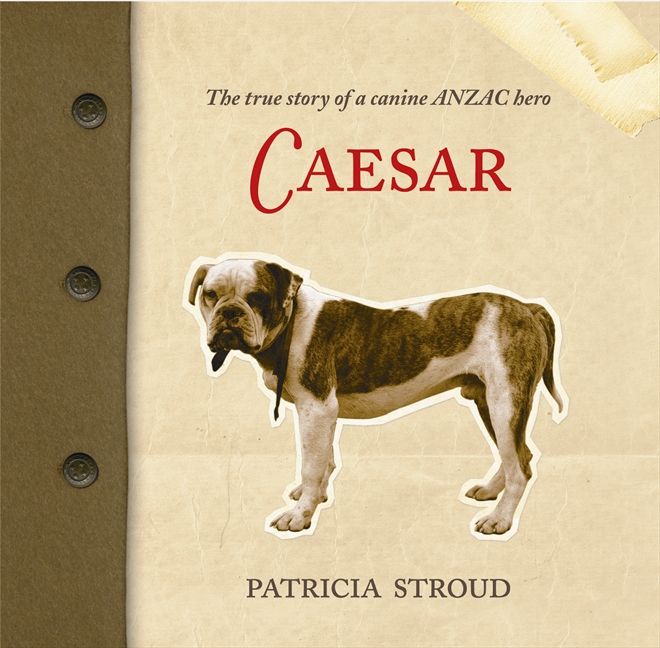
Caesar the Anzac dog by Patricia Stroud, illustrated by Bruce Potter

Caesar the Anzac dog by Patricia Stroud, illustrated by Bruce Potter (Harper Collins, 2003)

40 pages with sepia illustrations

Subjects: World War One, France, dogs, animals, mascots, junior fiction (Year 2-6)


Synopsis:
This book is based on the true story of Caesar, which was told to the author, Patricia Stroud, by her mother, Ida. 

Ida (aged four) was in the crowd when Caesar the bulldog, as official mascot, led the Rifle Brigade down Queen St in Auckland to board the ships that would take them to Egypt and the Western Front. As described in the book, Ida donated her blue ribbon for Caesar to wear. She gave it to her uncle Tom who was Caesar’s handler and he tied it onto Caesar’s collar.

Caesar worked during the Battle of the Somme in 1916 as a Red Cross dog. These dogs helped the stretcher-bearers to rescue wounded soldiers at night from No man’s land, the area in-between the trenches of the two opposing sides. They were trained to look for something that belonged to the man, such as a coat or cap, bring that item back to the stretcher bearers and then lead them to the wounded soldier.

Caesar was shot and killed in action. His handler, Tom, was temporarily blinded by mustard gas and sent to hospital in England. He married one of the nurses and they returned home on a hospital ship.

The family history aspect of the story is underlined by the way it is told to three boys, James, Brendon and Michael, who are visiting their great-grandmother (Ida) in the summer holidays. She tells them about the parade, and how her other uncles also went off to war.

The book was reprinted in 2009, with extra content, as Caesar: The True Story of a Canine ANZAC Hero ("A recount of the life of the bulldog that became the official mascot of the 4th Battalion of the NZ Rifle Brigade").


About the author
According to the Harper Collins website: “Patricia Stroud is a mother and grandmother, who has researched the facts behind a much loved family story to record a little-known aspect of New Zealand’s military history. As a volunteer, she spends many hours interviewing war veterans and recording their stories for the oral history archives of her local museum. Patricia and her mother Ida both live in Auckland.”

There is an interview with Patricia in the New Zealand herald, and here she is visiting the children of Botany Downs school

About the illustrator
Bruce Potter (here is his Storylines profile) has illustrated many other books, including The Donkey Man by Glyn Harper, Grandad's Medals by Tracy Duncan, Soldier in the Yellow socks by Janice Marriott and My Grandfather's War by Glyn Harper. (And who knew he is also "an internationally ranked powerlifter"??)

Other books you might like 
The Anzac puppy by Peter Millett and Trish Bowles is an appealing picture book based on the true story of a World War One mascot. The red poppy by David Hill, illustrated by Fifi Colston, tells the story of Nipper the messenger dog. 

Links
This unusual vintage clip shows a French Bulldog working on the Western Front in France in 1917.

The article about Caesar on the NZ History website includes this photograph of his collar (with an incorrect spelling of his name), now held at the Auckland War Memorial Museum (where you can also buy a soft toy Caesar!).


Jack, the New Zealand Engineers' canine mascot in France, World War I
Jack, the New Zealand Engineers' canine mascot in France, World War I. Ref: 1/2-013104-G. Alexander Turnbull Library. http://natlib.govt.nz/records/23171041

Bull, George Robert, 1910-1966 (Photographer) : Maori Battalion soldier and dog Paddy the mascot, Christmas Day, Maadi camp, Egypt
WW2 Maori Battalion soldier and dog Paddy, the mascot, share some pork from the hangi on Christmas Day at Maadi Camp, Egypt; Ref: DA-04880-F. Alexander Turnbull Library, http://natlib.govt.nz/records/22812710

Have you read it?
Have you read this book? Let me know what you think!

Monday, 24 March 2014

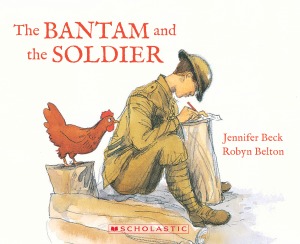
The bantam and the soldier by Jennifer Beck and Robyn Belton

The bantam and the soldier by Jennifer Beck and Robyn Belton  (Scholastic, 2014; first published 1996)

ISBN 978 1 77543 207 4

32 pages with extra illustrations at front and back

Subjects: World War One, France, animals, hens, mascots, picture books (Year 3-8)

9781775432074

Synopsis
This is a redesigned and rejacketed edition of a book which many people will already know and love, and which won New Zealand Children’s Book of the Year in 1997. 

It tells the story of “the smallest bantam” on a French farm, abandoned as the war gets closer, and a shy, homesick farmer’s son called Arthur “from a country on the other side of the world”. Arthur saves the starving bantam, feeds it and looks after it and names it Bertha after his niece back home. At first the other soldiers make fun of him, but then they adopt Bertha as a mascot too and start to hunt out grubs and worms for her. Bertha rewards them each day with “a warm, brown egg” and her resilience gives them courage and hope.

Look out for the names “In memory of” on the front flap (Jennifer Beck’s great uncle, killed in action in WW1; Robyn Belton’s grandfathers who served in WW1 and her uncles who died in active service in WW2.) The additional illustrations at front and back include soldiers’ photographs, sketches and war posters and postcards.

The Acknowledgements show the research that went into this book, and the Author’s note reveals some of the true history behind it. 

This was the original cover:


Reviews:
"Among a number of fine New Zealand stories about the First World War, The Bantam and the Soldier stands out because of its superb illustrations. The picture book for older readers is a growing genre in children’s literature, and is an excellent development. Pictures, especially about an historical setting, often convey so much more than words. Belton’s sensitive drawings show something of what it was like to be in the front line in 1917. In the trenches Arthur managed to keep his sanity by caring for a bantam hen he found trapped in a hedge after an explosion. When Arthur returned to New Zealand he (like so many soldiers) did not want to talk about his war experiences, but he found he could tell the story of Bertha the bantam…and that, too, was therapeutic."
(Susan Price)

Author’s website
You can read about Jennifer Beck on the NZ Book Council website and on Christchurch City Libraries Interviews with NZ children's authors

Info about the illustrator
You can read about Robyn Belton on the NZ Book Council website and on her Storylines profile. Interestingly, her first storybook was The Duck in the Gun, written by Joy Cowley, which won the Russell Clark Award in 1985. This book, with its powerful anti-war message, soon established an international following and was one of ten children’s books selected for the Hiroshima Peace Museum. 

Other books you might like
The Anzac puppy by Peter Millett and Trish Bowles also tells the story of a soldier who is helped to survive the war by a pet that he has saved. 


Tuesday, 11 March 2014

The Anzac puppy by Peter Millett and Trish Bowles


The Anzac puppy by Peter Millett and Trish Bowles (Scholastic, March 2014)

32 pages

Subjects: World War One, France, trenches, animals, dogs, mascots, picture books (Year 3-6)

cv_the_anzac_puppy

Synopsis
I really like the opening lines:
"In the middle of the night, in the middle of winter,
In the middle of a war, a puppy was born."

Freda is a Dalmatian puppy owned by Lucy’s family. They can’t afford to keep her and she is adopted by a young soldier called Sam who promises to bring her back to Lucy “safe and sound” after the war. Freda becomes his good luck mascot, and the memory of the promise he made keeps him brave amidst the terror of the trenches. There are many recorded examples of dogs and other animals whom the troops adopted as their mascots, and they really did play an important role in helping to keep the soldiers' morale up.

Freda gets bigger, Sam gets older, the war goes on until one day at last “the roaring guns fell silent.” Sam goes back with Freda to fulfil his promise to Lucy, and…(here's a clue: it's a happy ending.) 

Author’s website
Peter Millett lives on the North Shore and is a part-time writer and a full-time house dad. He started writing for children in 1998. His books published since then include The Anzac Biscuit Man and Other Classic Kiwi Tales (Reed 2007) and Boy Zero Wannabe Hero (shortlisted for the LIANZA book awards 2011) 

In his website, he explains that “the fictional story 'The Anzac Puppy' was inspired a by a series of true events that took place during the Great War of 1914-18.” These true events are described in a two-page spread of historical notes at the back. 

You can read an interview with Peter here


Peter Millett and illustrator Trish Bowles


Info about the illustrator
Trish Bowles is a self-taught artist who lives in Christchurch and has illustrated more than 20 children's books.

I'm sure children will find her style of illustration very appealing, especially the picture of Freda sitting in her box on the pavement under the sign "Puppy free to a good home". The cover also shows a nice juxtaposition of war-related images (uniforms, airplanes, soldiers with guns, handwritten letters home) with the puppy peeping out of Sam's knapsack in the foreground. 

Other books you might like:
Caesar the Anzac dog by Patricia Stroud, illustrated by Bruce Potter (Harper Collins, 2003; reprinted in 2009, with extra content, as Caesar: The True Story of a Canine ANZAC Hero)

NZ connections:
I knew about Freda, the Great Dane (or possibly Dalmatian) mascot of the New Zealand Rifle Brigade at their training camp at Cannock Chase in England. You can read about her here

Image copyright Auckland War Memorial Museum.

I did some research on Freda and found someone in England who kindly went out on Cannock Chase to get me a photo of her grave for my Anzac Day book. However I didn’t know the story about Sergeant Ashby and the real life Freda which Peter tells at the back of the book.


Cannock Chase
Cannock Chase is an area of pine forests, woodland and open heath in the county of Staffordshire. In England, a “chase” is an area of unenclosed land formerly reserved for hunting, so in medieval times it was a royal hunting forest. Today it has lots of walking and biking trails and also contains several war cemeteries and memorials.

During WW1, the Chase was the site of a large military camp (used by the NZ Rifle Brigade) and also a prisoner of war hospital. Men who died at the camp (many of them from the influenza pandemic) and in the hospital are buried in the Cannock Chase War Cemetery which contains the graves of 73 New Zealanders and 286 German POWs.  You can find it on the map hereThe Anzac Day Commemoration Service which takes place at there is one of the largest outside Australia and NZ.

After Freda died in 1918, she was buried at Cannock Chase and members of the Rifle Brigade put up a headstone (since replaced by a newer one)  in her memory. On Armistice Day 2010, a special ceremony for working dogs took place at her grave, to remember and celebrate their “loyalty and service.”

Model WW1 battlefield at Cannock Chase
I’d never heard about this before. Completely off the topic of the Anzac puppy, but fascinating!

“In June 1917, soldiers from the New Zealand Rifle Brigade held off stiff resistance from German forces in the Belgian town [of Messines], near the French border, to take control of a ridge regarded as strategically important in setting up the later assault on Passchendaele.
On their return to the UK from the Western Front, troops sketched out in minute detail replica trenches, terrain, contours, and obstacles before it was rendered in concrete. They used German POWs to do the hard labour and make small-scale reconstructions of Messines' buildings, including its church, railway lines, and roads. The mock-up was then used as a training aid for soldiers coming through Brocton Camp in Staffordshire.”
The practice battlefield was uncovered by archaeologists in 2013. You can read more about what they discovered here and here
The Dolores Cross Project
It’s very nice to see the publisher’s acknowledgements to historians Marion Kettle and Dolores Ho “for the extensive research they undertook to preserve Freda’s memory”. I haven’t worked with Marion, but I’ve had contact several times with Dolores and she's always been unfailingly helpful. 

I’ve been interested to learn about her own war-related project, the Dolores Cross Project, which aims “to personally pay tribute to approximately 30,000 New Zealand military personnel buried on foreign soil with a hand-made tribute.”

Dolores Cross Military Gravestone
A military gravestone bearing the Dolores Cross.
In fact Dolores began her Cross project at Cannock Chase. She was there for Anzac Day 2008 (see the History section of this page of her blog) and wanted to place RSA poppies on the graves, but didn’t have enough so made some flax crosses to make up the shortfall.

Meeting the Prime Minister
Dolores meeting the PM at Westminster Abbey, Anzac Day 2011