Showing posts with label Dunkirk. Show all posts

Saturday, 18 July 2015

The little ships by Louise Borden

The little ships by Louise Borden, illustrated by Michael Foreman (Pavilion, 1997)

32 pages

Subjects: World War Two, England, France, Dunkirk, boats, girls, picture books (Year 3-6)

Some covers have the subtitle: The heroic rescue at Dunkirk in World War II
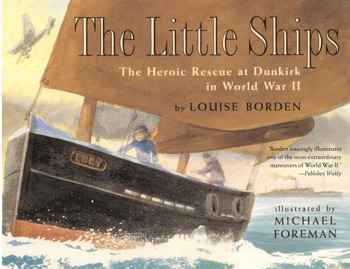
The Little Ships
Synopsis
In May 1940, the unnamed narrator lives with her father, a fisherman, in the town of Deal on the Kent Coast.  She is a girl, but “fisherman on the beach said I was my father’s daughter.” Her brother John is away fighting in France.  When word comes that half a million British and French soldiers are trapped on the beaches of Dunkirk, she disguises herself as a boy in some of her brother’s old clothes and joins her father (in his fishing boat the Lucy) and an armada of "little ships" that sets sail across the English Channel to rescue them.
I didn’t know that people from English villages and towns actually signed up to go and help, as shown in one of the illustrations. And I didn’t know that soldiers brought back their pet dogs (and some strays) with them – over 200 dogs were aboard ships landing in Dover!
There is a map in the front, and a historical note and excerpt from Winston Churchill’s famous speech (“we shall fight on the beaches…”) at the end. Some of the pages have a lot of writing on them, and I would think that the text is longer than that of an average picture book. There are a lot of illustrations of boats and ships, which I guess is understandable!
Reviews:
Kirkus reviews (always a prestigious place to get a review) calls this "A moving, fictionalized account of the ``miracle of Dunkirk,'' in which an armada of 861 ships ferried to safety across the English Channel over 300,000 Allied soldiers who had been trapped in northern France by the Germans."

The Children's War blog says it is "an excellent book for introducing the topic of Dunkirk to younger kids but is also a good teaching tool for older kids who may already know something about World War II."

Author’s website
Louise Borden is an American writer from Cincinnati.  I’d never heard of her before reading this book, but now I’m hoping to read more of her work. Her website has a very readable section about Becoming a writer (under the About button). I like how she talks about riding home on her bicycle as a child:Pedaling slowly up my street may be where I learned perseverance, something all writers need when they are working alone at their desks.”

And I love what she says about writers needing to have thinking time. It’s a long quotation but it makes so much sense to me: 
“Often I am in my car, driving to new places to meet new people, and to talk about writing. I have a lot of thinking time on those miles. And I have a lot of thinking time when I am working in my garden at home. Thinking time: It's so very essential for a writer. I think about new ideas for books, and new ways to write them. I think about what is important to me, and the new things that I want to learn. I think about the books I read as a child—and the books I am reading today. 
I think about my family who are my great encouragers. And my wonderful editors who understand, in just the right way, my creative vision for a picture book. These thoughts always inspire me to return to my desk and begin working on a rough draft for a new manuscript.”

Info about the illustrator
You can read more about Michael Foreman on my review of his book War game.

Other books you might like:
The snow goose and The dolphin crossing, both already reviewed on this blog, are other books about Dunkirk. The evacuation of Dunkirk has a resonance for England that is perhaps a bit like Gallipoli for us in New Zealand: a defeat, but a heroic failure.

Things I didn’t know
Louise Borden’s website has pictures of her research trip for writing this book. She took part in one of the Crossings of the Association of Dunkirk’s Little Ships (as referred to in the Foreword), which is “the surviving remnants of the intrepid band of assorted boats and yachts that contributed so much to the miracle of Dunkirk.” 
I didn't know there was an Association of Dunkirk's Little Ships! There  is some fascinating info about it on their website, including an answer to the question “how do I identify if my boat took part in the Dunkirk evacuations?” 

The Association returned to Dunkirk in May 2015 to commemorate the 75th anniversary of Operation Dynamo, with 50 Little Ships escorted by the RNLI and the Royal Navy. There are some great photos and descriptions in this newspaper report from the Telegraph.  

Links
There's a You tube clip here, which describes itself as WW II : RARE COLOR FILM : DUNKIRK : PART 3 OF 3 1939 1940.

Have you read it?
Have you read this book? Let me know what you think!

Tuesday, 5 May 2015

The dolphin crossing by Jill Paton Walsh

The dolphin crossing by Jill Paton Walsh (Macmillan, 1967)

16 chapters; 134 pages

Subjects: World War Two, England, France, Dunkirk, boats, evacuees, junior fiction (Year 5-8)

There are several different covers and this one (Puffin modern classics) is better than some of the others! 


Synopsis
This book was a surprise as I had certainly heard of it and was sure that I had read it as a child, but actually I don’t think I ever did, as it seemed quite new to me.

The story is set in 1940 on England’s South Coast. John, aged 17, has come home from boarding school to keep his mother company as his father is away in the Merchant Navy. His older brother, whom we never meet, is a conscientious objector and has volunteered as a medical orderly in a hospital in Birmingham. The other main character, Pat, is a few years younger, and an evacuee from London; his father is fighting in France, and he and his mother, who is heavily pregnant, have been put up in a ramshackle disused old railway carriage sitting in a farmer’s field.

John has a tutor who is teaching him Latin and Greek in preparation for his exams for Oxford, and his family is obviously well-to-do, although their house has been taken over for use as a hospital and they are living in a smaller cottage in the grounds. Pat comes from a much less privileged background. The differences show in their speech and in the things they each take for granted.  John comes across as quite a “prim” character for a 17 year old; for example, he is shocked that Pat expects him to eat chips out of a newspaper parcel, in public. He is also conflicted over his brother’s decision and finds it hard to defend his choice.

The boys become friends over a project to turn an old stable into more suitable accommodation for Pat’s mother and the baby. When they start to realise what is happening in France – the thousands of Allied soldiers trapped on the beaches of Dunkirk – they hatch a plan to take John’s father’s boat, the Dolphin, across the Channel to help rescue them. Gradually they come to appreciate each other’s strengths - Pat is better at building and practical work, John is better at handling the boat - and in the end they work together as a team.

This isn't a long book; there are very few characters, and some (like Pat’s mother or John’s tutor) are lightly sketched.  After an initial scene of the local school bullies taunting Pat, we hardly ever see any more children or young people.  

The scenes of sailing the boat and the action at Dunkirk are well done and full of tension. The main sticking points for today’s readers are likely to be the vocabulary (words like “Gracious!” and “beastly”) and the dialogue which sometimes feels old fashioned, formal and wooden (for example, John’s father greets him with, “Where the hell do you think you’ve been, sir?”) 

Reviews
goodtoread.org (a parent's guide to children's books) calls it "A short but thoughtful story, focusing on the effect war has on different characters and what courage is about". 

This reviewer also comments on the uninspiring cover design and describes it as "a short book that covers a lot of ground", with a particular focus on class differences. 


One more review here from someone else who (like those mentioned in Questions below) has an issue with the ending. 

Questions
The review on goodtoread.org ends with the line: “The question of whether Pat's final action is bravery or stupidity is left open”. Another reviewer quoted above says the reader has to "decide for themselves whether Pat’s disappearance was an act of heroism or simply schoolboy foolishness."

Bravery or stupidity; heroism or foolishness - what do you think?

Author’s website
Jill Paton Walsh was born Gillian Bliss in London in 1937. She is married to John Rowe Townsend (another author). Her website includes an author interview for young readers, for example, "when did you start to write?" 
  • I'm a late developer. I started only when I was 26. All the other writers I know started sensibly, when they were children. If you are thinking of being a writer, however old or young you are, start now!
There is a very funny article in the Guardian about how her self-published book Knowledge of angels made the Booker shortlist in 1994.

On the back flap is a quotation from Jill Paton Walsh
“This book is an attempt to make a serious picture for young readers of the great experience of their parents’ lives – the last war. That war raised difficult moral questions; disrupted the lives of almost everyone then living; permanently upset the social order of England, and brought out in ordinary people astonishing manifestations of courage and unselfishness. it was not a matter of cheap heroics.
For real heroics are painful and costly. I have tried to show this. The actions of my characters fall far short of the heroism of real life; they are, however, “truthful” in the sense that there really were school-boys who joined the many civilians in ferrying the British army across the Channel. I hope this is also a truthful book in another sense; when real people take real risks, they really get killed.”

Other books you might like
Jill Paton Walsh wrote other books about war, including Fireweed.

The snow goose by Paul Gallico is a haunting tale about the evacuation of Dunkirk.

Things I didn't know
How to make the most of your butter ration! Food rationing was in force and the lack of butter (and inadequacy of margarine) is often mentioned. John dreams of “great slabs of butter, too thick to spread, piled on sticky buns” and prefers to eat his ration all at once: “that way at least I can have enough to taste properly one day a week.” John’s mother spreads a thin scraping of butter on her scone and says, “The Ministry of Food adviser wrote to the paper today saying if you put it in your mouth upside down you can taste it better. Butter side against the tongue.”

Have you read it?
Have you read this book? Let me know what you think!

Thursday, 3 July 2014

The snow goose by Paul Gallico, illustrated by Peter Scott

The snow goose by Paul Gallico, illustrated by Peter Scott (Michael Joseph, 1946)

10 chapters; 55 pages with colour and black and white illustrations

Subjects: World War Two, France, Dunkirk, birds, fable, boats, young adult fiction (Year 9-13)


Synopsis
I’m not sure if this counts as a children’s book, but it doesn’t really fall into any other category that I can think of, and some older children would definitely enjoy it. Apparently (according to Wikipedia), it was “first published in 1940 as a short story in The Saturday Evening Post, then … expanded … to create a short novella which was first published on April 7, 1941.”

The book covers the decade from 1930 to 1940. It is set on an abandoned lighthouse on the remote Essex marches and tells the story of Philip Rhayader, a hunchbacked reclusive painter and Fritha, a young girl from the nearby fishing village. The two of them are linked in friendship and, later, unspoken love by the snow goose of the title, until Philip sails away to help in the evacuation of British troops from the beaches of Dunkirk in late May 1940. What happens to him can only be guessed by Fritha, but is told in snatches of overheard dialogue by by soldiers and naval officers.

When I went to borrow a copy from the library, I had to ask a librarian to retrieve it from the YA Fiction Nostalgia section out the back. (I didn’t even know there was such a section.) And the loveliest thing happened, which was when I gave her the title, she said. “I’m named after that book.” Her name was Fritha.

Fritha (in the library) told me about a 1970s BBC film of The snow goose, starring Richard Harris (aka Dumbledore in Harry Potter) and Jenny Agutter (from The railway children.) She said it’s hard to track down, but can be viewed on Youtube, and here it is (I'm going to watch it, and it looks wonderful.) 

The original 1940 copy of The Snow Goose, as it appeared in The Saturday Evening Post is now available online.


Reviews:
If you’ve read this book, you will know it is a sad, melancholic, haunting tale. Some contemporary reviewers called the book sentimental, but it achieved near classic status almost at once and Michael Morpurgo cites it as an influence on his book War Horse.

Winter reads in The Guardian calls it a wartime classic, “a novella no thicker than a love letter, in which every sentence seems to shiver with the salt-laden chill of the desolate landscape in which it is set.” The reviewer made me think of my Fritha-in-the-library. She says, “My mother loved the story so much she wanted to call me Fritha, after the untamed Anglo-Saxon heroine. And growing up I would think of that other girl I might have been if only my resolutely unsentimental father had not intervened.”

The Guardian also put it on its list of 1000 Novels You Must Read


(1000 novels is a lot of reading! If you are feeling brave, here is a link to the compete list.)

Another review says it is "a moving story about love and courage, with an ending that is unforgettable."

About the author
Paul Gallico (1897 – 1976) was an American writer whose name is not often heard these days, but he used to be popular. His other well-known stories include The small miracle, about a little boy and his beloved donkey,  Thomasina (filmed by Walt Disney) and The Poseidon adventure, about a cruise ship sinking, which was also made into a movie.

About the illustrator
The Nostalgic library copy was the 1946 edition with illustrations by Peter Scott, which we had at home when I was growing up. Peter Scott (1909-1989) was the son of Antarctic explorer Sir Robert Falcon Scott, who died when he was only two years old. Famously, Scott left instructions for his wife that she should "Make the boy interested in natural history; it is better than games. Make him a strenuous man". 

Peter Scott became a naval officer in WW2, and was also a famous painter, ornithologist and conservationist, who founded the Wildlife and Wetlands Trust at Slimbridge on the Severn River estuary in Gloucester. 

According to Wikipedia (again) he used his first wife Elizabeth Jane Howard as the model for Fritha – another fascinating sidebar, as I’m currently reading her wartime chronicles of the Cazalet family.  EJH was about 15 years younger than him, and had striking good looks; their marriage ended in divorce, and she later married Kingsley Amis; she died in January 2014, aged 90.

You can read more about Peter Scott's life here and here.  

I never knew this and it's fascinating:
According to a story in the Telegraph in 2010, a disused lighthouse at Sutton Bridge on the Norfolk Wash provided the inspiration for the setting of this book. Peter Scott rented it for £5 a year in the 1930s, and was visited every year by a pink-footed goose that he called Annabel. Gallico, who was a friend of his, transformed the timing (to wartime), the setting (to Essex) and the bird (to a snow goose.) The story is told in more detail on the website of Sutton Bridge village.   

Peter Scott in front of the East Lighthouse
Peter Scott in front of the East Bank Lighthouse 
If you visit the area, you can go on the Peter Scott walk, which follows the old sea bank along the Wash from King's Lynn, to the Peter Scott lighthouse at Sutton Bridge. 

Other books you might like
The dolphin crossing by Jill Paton Walsh tells the story of two school boys who take a small boat across the Channel to help in the evacuation of Dunkirk. 

The story of Dunkirk
The evacuation from Dunkirk took place over ten days from late May to early June 1940, and ten days later, German troops entered Paris. It's true that hundreds of small boats sailed across the Channel to help take men off the beaches. You can read more about Dunkirk here and listen to Voices from Dunkirk in the words of eight survivors here

You can also see some images of the evacuation on the Imperial War Museum site.