Showing posts with label Japan. Show all posts

Tuesday, 29 May 2018

Enemy camp by David Hill

Enemy camp by David Hill (Puffin, 2016)

260 pages (in diary format)


Subjects: World War Two, New Zealand, Japan, Prisoners of war, young adult fiction (Year 7-10)

Image result for enemy camp david hill

Synopsis
“When of hundreds of Japanese captives arrive at Featherston POW camp, the tiny town is divided. Tensions run high and then, on 25 February 1943, disaster strikes. Three boys witness it all.” (Publisher’s blurb)

Ewen lives in the small town of Featherson, where his father works as a guard at the POW camp. His diary covers the months between October 1942 and February 1943 and describes everyday life in wartime, school, the summer holidays, the attitudes of local people to the Japanese and the gradually increasing tension between some of the prisoners and guards. Together with his best friend Barry and Barry’s younger (polio-affected) brother Clarry, Ewen starts taking Japanese lessons from one of the officers, and this provides a great way to show a positive side of Japanese life and culture that many of the townsfolk have no idea of.

David Hill skilfully builds in many other aspects of 1940s life: the ever-present fear of polio, food shortages, barbed wire on the beaches, the blackout, the Home Guard, American GIs handing out sticks of gum, practice air raids, school milk, ink wells, picnics, the movies and dances. He has a wonderful way of capturing a 12-year-old boy’s voice, in Ewen’s remarks on the progress of the war (“So yeah, we’re going to win”) as well as the progress of his friendship with “snobby Susan Proctor” (“And – I’m still trying to believe this – I spent most of the time talking to Susan Proctor”). 

It’s also a refreshing change to read about a boy who reads and likes writing, and wants to be an author when he grows up, and about a warm and close, even if undemonstrative, father-son relationship.  

Reviews:
Bobs book blog says: "Superbly written in short diary entries that primary and intermediate students can easily read, coupled with David Hill’s easy style and you have great historical fiction. The account of the event itself with the boys looking on is sensitively done. A very readable novel." 
Another review by Siobhan Harvey calls it "both an enjoyable read and an imperceptible history lesson" and notes that "importantly, Hill personalises the demonised foe, allowing young readers to see Japanese captives as much victims of war as anyone fighting on the Allied side." 

About the author
David Hill is one of NZ’s best loved authors for young people. Here is an article in which he talks about the book: 
"I'm not preaching any themes. I want them to have a story first. I hope they like the people, especially Ewen the young protagonist. If they see attitudes that they agree with and some they disagree with I'll be very happy with that." 
There's another interview here on Radio NZ. I also enjoyed this interview and David Hill's comments about writing about war ("War is wonderful to write about because it involves conflict - physical, mental and internal") and why he likes writing for and about this age group ("because they're coming across ideas and experiences for the first time. They're surprisingly sophisticated, they have a good vocabulary and understand a lot. They're a lovely mixture between naivety and sophistication.")   

Links
You can read more about the “Featherston incident" here
And if you are ever driving on SH 2 between Featherston and Greytown, look out for the roadside memorial to the POW site.

Have you read it?
Have you read this book? Let me know what you think!

Thursday, 12 October 2017

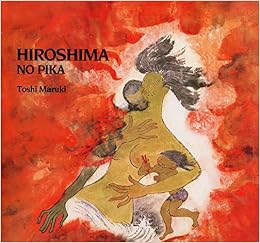
Hiroshima no pika written and illustrated by Toshi Maruki

Hiroshima no pika written and illustrated by Toshi Maruki (translation of the same Japanese title; New York: Lothrop, Lee & Shepard, 1980)

48 pages with colour illustrations, sometimes full page double spreads

Subjects: World War Two, Hiroshima, atomic bomb, anti-war books, Japan, picture books (Year 6-8)

Image result for Hiroshima no pika

Synopsis

This is based on a first-person account that the author heard when he was holding an exhibition of pictures about the atomic bomb in a small town in Hokkaido.

It begins with a cloudless blue morning in Hiroshima, with streetcars picking up people on their way to work and the seven rivers flowing quietly through the city. Seven-year-old Mii and her parents are breakfasting on sweet potatoes “brought in the day before by cousins who lived in the country” when the bomb falls at 8.15am on August 6, 1945. Mii’s mother carries her injured husband on her back across the city, across rivers and all the way to the coast, where they stay for days until he is taken into a makeshift hospital: “no doctors, no medicine, no bandages – only shelter.” 

The illustrations are stylised but portray a powerful sense of the horror of the event, and the consequent suffering, partly through the lurid and unnatural colours of the skies and surroundings.

This is a terrible event, and parts of the text would be upsetting to younger (or even older) children: the mother carrying a dead baby, the floating bodies, the wasteland of the city, Mii’s father’s death, the glass slivers that poke their way out of her scalp in years to come.

Look out for the red chopsticks that Mii clutches for days after the Flash, until her mother manages to prise them from her grip. It’s a clever way to identify her on each page, but also hints at the hidden trauma she has undergone.

The book feeds in some factual details about the atomic bomb and ends with the lantern memorial service held each year on the seven rivers. I couldn’t see a translation of the title anywhere – maybe I missed it – but it means The Flash of Hiroshima.  

Reviews:
An entry in Kirkus reviews is always prestigious. “Japanese artist and antiwar activist Maruki manages to avoid the opposing perils of giving children nightmares and belittling the horror.”

About the author
Toshi Maruki (1912–2000) was born in Hokkaido and studied Western art at the Joshibi Women's School of Art and Design.
“I am now past seventy years old. I have neither children nor grandchildren. But I have written this book for grandchildren everywhere. It took me a very long time to complete it. It is very difficult to tell young people about something bad that happened in the hope that their knowing will help keep it from happening again.”

Maruki Gallery for the Hiroshima Panels, established by husband and wife Iri and Toshi Maruki, "is famous for its message for peace all over the world". The artist couple went into Hiroshima city just three days after the bombing and spent 30 years painting the 15 panels.

Other books you might like:
Sadako by Eleanor Coerr, illustrated by Ed Young, also tells of a young girl in Hiroshima. 

Things I didn’t know
I didn’t know that other Japanese cities like Tokyo, Osaka and Nagoya had already experienced air raids, so the people of Hiroshima were readying for them by storing water and making evacuation plans. There is a sad poignancy in the statement that “Everyone carried small bags of medicine and when they were out of doors, wore air-raid hats or hoods to protect their heads.”

Have you read it?
Have you read this book? Let me know what you think!
Friday, 18 March 2016

Sadako by Eleanor Coerr

This week my new book on Armistice Day is being launched, and it seemed a good time to review this book on Sadako and her work for peace. 

Sadako by Eleanor Coerr, illustrated by Ed Young (Margaret Hamilton Books, 1995)

45 pages with full-page colour illustrations

Subjects: World War Two, Japan, Hiroshima, nuclear war, bombs, family, picture books

A longer version for older children is called Sadako and the thousand paper cranes


Synopsis
Sadako Sasaki was just two years old when the atomic bomb was dropped over her home town, Hiroshima, in 1945. She was an ordinary little girl, surrounded by a loving family, and a keen runner. The story starts with her waking up in August 1954, excited about the Peace Day events at the Peace Park. In the evening, she writes the name of her grandmother who died in the bomb blast and launches it on the river where it floats along amidst rice-paper lanterns lit up by candles.

But when she was 11, Sadako started experiencing dizzy spells and was diagnosed with leukaemia, “the atom bomb disease”. By February 1955, she was in hospital.

One day, Sadako’s best friend Chizuko came to visit her in hospital. Chizuko brought paper and scissors and cut a piece of gold paper into a square. She folded it into a paper crane and told Sadako the old Japanese story about how anyone who folded 1000 cranes would be granted a wish. Sadako knew what her wish would be to get better, so she started folding paper cranes.

Sadako didn’t get her wish and she died a few months later, on 25 October 1955, ten years after the atomic bomb was dropped.  But her name lives on, thanks to her determination, her hope for peace and her wish for a better future, and her paper cranes have now become a symbol of peace. After she died, Japanese children helped to raise money for the Children’s Peace Memorial which now stands in the Hiroshima Peace Memorial Park, with a statue of Sadako on the top, often surrounded and decorated by thousands of paper cranes from all around the world. At the base is written: “This is our cry, this is our prayer. Peace in the world”.

There is a lovely photo of Sadako and one of her paper cranes here

You can read more here about some of the original paper cranes, kept by her brother. 

Reviews:
This review on  The children's war has a picture of Sadako with her relay team and calls it an “a perfect book for introducing this difficult topic to young readers. There are no detailed graphic images described about the war, the bomb or even to after effects, only an acknowledgement of these things. There is some controversy over whether or not Sadako actually did finish folding 1,000 cranes. Regardless of whether she did or didn't, there is much to be learned from Sadako's story.

Sadako, in the middle of the front row, with her relay team

About the author
This is a nice start to Eleanor Cooer's bio on the Penguin website: “Eleanor Coerr was born in Kamsack, Saskatchewan, Canada, and grew up in Saskatoon. Two of her favorite childhood hobbies were reading and making up stories.” It also describes how her fascination with Japan began as a child, her first visit to Japan – and to Hiroshima - as a young reporter, and how she finally managed to get hold of a copy of Sadako’s autobiography, Kokeshi. so she could start writing her own book.

She died in  2010 and you can read her obituary here

About the illustrator
Ed Young was born in China and later moved to Hong Kong, then went to the United States on a student visa to study architecture, but became an artist instead.  He says he draws inspiration from the philosophy of Chinese painting: “There are things that words do that pictures never can, and likewise, there are images that words can never describe.”

Other books you might like:
Hiroshima no pika, written and illustrated by Toshi Maruki, also tells the story of the day the bomb fell. 

How to make paper cranes
You can learn how to make your own paper cranes here
Or here (with an address for where to send them). 
Or here (also with an address). 

Links
You can learn more about Sadako at the Kids Peace Station, Hiroshima.

Sunday, 10 August 2014

So far from the sea by Eve Bunting

So far from the sea by Eve Bunting, illustrated by Chris K. Soentpiet (Sandpiper, 1998)

ISBN 978-0-395-72095-0

32 pages with black and white and colour illustrations

Subjects: World War Two, Japan, USA, family, internees, junior fiction (Year 5-8)

Synopsis
Laura Iwasaki and her little brother Thomas are in the car, driving to visit her grandfather’s grave. Their family is moving from California to Boston, so this may be their last visit for some time. They are all huddled up in warm clothes, it is February, and bitterly cold. From their sad and solemn faces, we realise this is a difficult trip for them to make.

The cemetery is in the middle of a deserted, sandy site that was once bustling with people. Gradually we find out that Laura’s grandparents and her father, as a small boy, were among the thousands of Americans with a Japanese background who were taken to internment camps in World War Two. Her grandfather, a tuna fisherman, hated being so far from the sea and in the end he died in the camp, at Manzanar.

The writing is simple but evocative and some of the descriptions are very effective: “The road is straight and endless. Crows strut in the stubbly fields.”

The illustrations vary page by page, from black and white –for the scenes in the camp during the 1940s – to colour, for the family’s farewell visit more than thirty years later, in the 1970s. The picture of the offerings left at the monument – “origami birds, their wings trapped under little rocks” and “crumbs of a rice cake” – is especially moving. So too is the picture of Laura’s father as a boy, dressed in his American Cub Scout uniform, saluting the soldiers who have come to take him and his parents away.

Reviews:
This review in Publishers weekly describes how "the artist's watercolors recreate two vastly different settings, evoking the tense 1940s scenarios in black and white and the serene yet wistful 1970s setting in bright color" and calls it "an exceptionally effective collaboration. 

Author’s website
Eve Bunting was born in Ireland but emigrated to the USA with her husband and three small children and has since written more than 200 books for children. Her first book, written after she took a creative writing course, was a retelling of an Irish folk tale. Her books often deal with the experiences of immigrants or with difficult issues such as race riots or homelessness.

In this biography of Eve Bunting, she says “One of my greatest joys is writing picture books. I have discovered the pleasures of telling a story of happiness or sorrow in a few simple words. I like to write picture books that make young people ponder, that encourage them to ask questions. 'Why did that happen, Mom? Could it happen again? Can't we help? What can we do?' One child wrote to tell me that one of my books had won the Heal the World award at her school. It is among the most cherished honors I have ever received and the plaque hangs proudly above my desk."


There is a video interview with her here.

And this is her talking about how her father used to read to her as a child:
"You know, it rains a lot in Ireland, and lots of times we'd sit in the house by the big turf fire. And he would take me on his lap and read to me. He would stop now and then when it would maybe be a little difficult. And he would say, "Now, my darlin', do ya understand that? What's the poet trying to say?" And we would talk about it."

About the illustrator
Chris K.Soentpiet was born in south Korea. When he was eight, he and his sister were adopted by the Soentpiet family and they moved to Hawaii. His website includes teacher’s lesson plans for this book. 

Other books you might like:
I only just realised from reading this interview that Eve Bunting wrote another book that my children enjoyed: Spying on Miss Müller. “The main character, Jessie, is a thinly disguised Eve attending boarding school in Ireland during World War II.”

Summer of my German soldier by Bette Greene is a book for older readers about the German Prisoner of War camps set up in America in World War Two. 

Things I didn’t know
I had never heard of Manzanar (Spanish for “apple orchard”) which is now a national historic site in California. It was one of ten war relocation centres, built to house 120,000 men, women and children of Japanese ancestry who were living in the USA when Japan bombed Pearl Harbor on 7 December 1941, thus bringing the USA into World War Two.  

These Japanese Americans were given only days to sort out their houses, farms, businesses and possessions before they were moved to the camps. Two thirds of the internees at Manzanar were under 18 years of age and 541 babies were born there. Manzanar was in the desert so it was very hot in summer, freezing cold in winter, with fierce winds that blew dust everywhere.

New Zealand links
Parallels in this country (where internees were held in the war) would be Matiu/Somes Island in Wellington harbour and Motuihe island in the Hauraki Gulf.

Camp on Somes Island [ca 1910s]. Reference number: 1/2-038622-F. Permission of the Alexander Turnbull Library, Wellington, New Zealand, must be obtained before any re-use of this image.
Camp on Matiu/Somes Island 
during WWI