Showing posts with label England. Show all posts

Friday, 2 June 2017

From Billabong to London by Mary Grant Bruce

From Billabong to London by Mary Grant Bruce (London: Ward Lock, 1915)

About 320 pages with a few full page illustrations

Subjects: World War One, Australia, England, London, ships, family, junior fiction (Year 8-10)


Synopsis
I had to borrow this book from the Dorothy Neal White collection at the National Library, and it’s the earliest book that I’ve yet reviewed. It’s number 4 of the 15 books that make up the Billabong series; others include Jim and Wally and Captain Jim (1916 & 1919).

Billabong is the house and the station, 2 miles from the nearest road and 17 miles from the nearest town. No other home is visible, “only peaceful paddocks”. The main characters are gradually introduced, but readers of the series would already know them: David Linton, the widowed station owner, and his children Jim (19) and Norah (nearly 15); their friend Wally (17); Mrs Brown, the housekeeper; the station hands, and Black Billy, the “native boy”.

The first quarter of the book is taken up with station life: a tame wallaby, snakes, a bullock stuck in a swamp, breaking in a new colt, as shown on the cover. But two topics overshadow everyone’s thoughts: the drought, and the war in Europe. Many of the local young men have already signed up. Wally (who is still underage) and Jim are desperate to go as well. A fortuitous inheritance calls Mr Linton “Home” to deal with the paperwork in England, and the decision is made that they will all go – Jim and Wally, so they can sign up there, and Norah so she’s not left on her own.

By pg. 91, they are on board the Perseus in some degree of comfort, about to leave from Port Melbourne. Their 6-week journey takes them via Adelaide and across the Indian Ocean to Durban, Cape Town, then Las Palmas to arrive in Falmouth, Cornwall, from where they take a train to London. Ordinary shipboard pursuits such as deck quoits, boat drill, whale and porpoise spotting and listening to the Captain’s gramophone life are enlivened by the capture of a German spy (not really a spoiler as it’s so heavily foreshadowed), an alarming passage through the fog and their own capture by a German warship. Not surprisingly, they are rescued in time and make it to England safely.

This is a well-written story with lively dialogue and warm family relationships, but reading it 100 years after publication, it’s hard to overlook the book’s treatment of Aboriginal and black South African characters. The Zulus are viewed either as picturesque rickshaw-pullers, or as dangerous robbers. The Aboriginal people are dismissed as “useless, shifty, lazy” and “thieving”. Black Billy is ridiculed for his use of English, rather than admired for having learnt another language, and there is no acknowledgment of the original inhabitants of the land. The writing is of course a product of its time, but the attitudes jar today.

Reviews:
Here you can read a contemporary review from the Port Fairy Gazette of 15 October 1915, which compares Norah’s stories to that of Little Women in their widespread appeal.

About the author
Mary Grant Bruce (1878-1958) worked as a journalist after leaving school and started the Billabong stories as a newspaper serial; she became a best-selling and much loved Australian children’s author. In WW2 she wrote patriotic talks and sold her autographs at charity auctions for the war effort.

Here's my favourite part of her bio from the official website: “Mary began writing when she was six and, from age 16, she entered and won the annual examinations of the Melbourne Shakespeare Society three times in a row whilst still a schoolgirl.”

You can read more about her here in the Australian Dictionary of Biography, which says that she was known as Minnie but "Mary" was thought to be a "more marketable" name. It also points out that "Australians, and not only children, looking at Billabong, could see themselves as they wanted to be - mates in fortune and adversity, sturdy, decent and fearless inheritors of a tough, but rewarding land."

About the illustrator
The Port Fairy Gazette review above credits them to Fred Leist, “an Australian artist now in London”.

Other books you might like:
The Belgian twins by Lucy Fitch Perkins (1917) and Rilla of Ingleside by L.M. Montgomery (1921) are two other books written during or just after WW1.

New Zealand connections:
Does NZ get a mention? Possibly not - anyway, I didn't spot any!

Have you read it?
Have you read this book? Let me know what you think!

Friday, 2 September 2016

True Brit: Beatrice - 1940 by Rosemary Zibart, illustrated by George Lawrence

True Brit: Beatrice - 1940 by Rosemary Zibart, illustrated by George Lawrence  (Kinkajou Press, c2011 - thanks to the publishers for sending me this book to review)

20 chapters; 205 pages with black and white illustrations

Subjects: World War Two, England, United States, evacuees, junior fiction (Year 5-8)
Synopsis
12-year-old Beatrice lives in London with her upper-class family: mother, father and older brother. When the bombs start falling on London in September 1940, her parents decide to send her as far away as possible to be safe. The Children’s Overseas Reception Board says there are no more places available in Canada, but a public nurse in New Mexico has offered to take a child - and that is where Beatrice is sent, all by herself, by boat (first class) and then train.

Her father, whom she adores, gives her a red leather notebook so she can record her observations as if she is a lady explorer, like Mary Kingsley, and these notebook entries are a clever way of showing Beatrice’s impressions of her new surroundings.

Santa Fe in New Mexico couldn’t be more different from London, and Miss Clementine Pope is hard working, practical and down to earth, the complete opposite of Beatrice’s mother. Beatrice has led a sheltered life; she is used to being waited on by servants and having fine clothes and everything she wants, and to her new friends Arabella, Esteban and Ana, she comes across as faceta (spoiled, stuck up and a “little princess”). She is determined to prove them wrong, and after several months, and one big adventure in particular, Clem says “you showed us that you’ve got quite a bit of starch for a gal your age.”

This book is the first in a series (Far and Away) about children in WW2, with its own facebook page. You can read the first chapter here, and also see a book trailer – filmed on location at the Lamy train station where Beatrice first arrives in New Mexico! 

(I especially like the opening line: “Only Great-Aunt Augusta spoke up against the plan”. And I was tickled by the reference to the four children – 2 boys and 2 girls, one named Lucy, waiting on a railway platform to be sent to their great-uncle’s house in the country. Many readers don't realise that the Pevensie children in The lion the witch and the wardrobe were also WW2 evacuees.)

Reviews:
Chapter 16 review website is impressed by “the attention to detail, from descriptions of mud homes and pinon trees to ‘A-okay’ American slang”.

Questions:
Can you imagine being sent away from your family for such a long time – without any of today’s ways of communicating, like texts or emails or even phone calls – just letters to keep in touch! What would you miss the most about where you live?  

About the author
Rosemary Zibart lives in Santa Fe. She describes herself on her website as a storyteller and writer who has written “film scripts, magazine and newspaper articles, picturebooks, middle-grade and young adult novels, essays, plays, screenplays and most recently websites”.

About the illustrator
You can read about George Lawrence here. 

Other books you might like:
Carrie’s war, Archie’s war, Lord of the nutcracker men, When the siren wailed and Ronnie’s war all cover different aspects of the evacuee experience. Uprooted: a Canadian war story by Lynne Reid Banks gives a Canadian perspective.
Also mentioned here (but not fully reviewed) is Evacuee by Gabriel Alington (Walker Books, 1988) which tells the story of a timid English girl, Frances (or Fanny) sent away to the USA to live with “Aunt” Bird and her adopted daughter, Pepper. It also treats the subject of the debate within the United States as to whether or not they should join WW2.

Things I didn’t know
I didn’t know anything about Santa Fe or New Mexico so I really enjoyed the description of the landscape and town. A historical note at end says that children did come to Santa Fe in WW2, some of the thousands who were sent to Canada, the US and Australia to escape the war.

Links
There is an excellent article on Operation Pied Piper and the evacuee children here, with some great photos.

Have you read it?
Have you read this book? Let me know what you think!

Friday, 3 June 2016

Stay where you are and then leave by John Boyne

Stay where you are and then leave by John Boyne (Doubleday, 2013)

14 chapters; 247 pages

Subjects: World War One, England, London, hospitals, shell shock, conscientious objectors, junior fiction (Year 5-8)


Synopsis
Alfie Summerfield is five years old, living on an ordinary London street called Damley Road, when the war starts. His father, Georgie, signs up almost straightaway. Four years later, Alfie is nine, the war is still going on and there is no word from his father. His letters have stopped arriving and all Alfie knows is what his mother Margie tells him: that his father is on a secret mission for the Government, and that’s why he can’t write any more.

The community of Damley Road is a close-knit one, and we find out what happens to a number of its other occupants during these four years. One of the most powerful moments is when two men in military uniform knock at the door to (slight spoiler alert here) deliver the news of a soldier’s death. Margie’s emotions skip from shock to horror to outrage as she realises they have the wrong house, and every other woman along the street stands in fear on her doorstep, waiting to see where they go next.  

Money is tight and Alfie decides to help out by skipping school (except on the days when they have history or reading) and working as a shoeshine boy at King’s Cross Station. This is where he finds out where his father actually is, and where he starts to dream up a plan to get him home again.

The Guardian review points out some of the coincidence in the plot, and there are some events that stretch credulity. I found it hard to believe that Alfie could get around the hospital without being detected, or that he could escape so easily when finally spotted. But it is still a story that pulls you along, and John Boyne does an amazing job of telling it from the point of view of a young child – for example, the way that Alfie views anyone aged 21 or over to be unimaginably old. There are some lovely insights into the nature of loyalty and friendship, especially that shown by Georgie’s oldest friend, Joe Patience, who is ostracised by everyone else in the street for being a conscientious objector. And I loved any scene with Mr Asquith in it!

Reviews
The Guardian book review (mentioned above) says "There may be a fairytale feel to this wartime tale of a boy's quest to find his father, yet it's a solid, engaging read." 
The Pretty Books blog also comments on the fact that "it is fascinating to see the world through the eyes of a child." 
Finally, the reviewer in The Book zone for Boys loved the book and says it is "much more than just a story about a victim of shell shock" and which "really brought alive the everyday travails of the people left at home".

About the author
You can read about John Boyne on his website, which has a special page for this book (although this older link is also quite amusing). 

About the illustrator
The chapter titles were hand lettered by Oliver Jeffers! 

Other books you might like
I can’t think of many similar books to this one. The way John Boyne gets into the head of a five-year-old, then a nine-year-old is hard to replicate. If you haven’t read The boy in the striped pyjamas, you should definitely read that.

NZ connections
Only to say that I heard John Boyne speak a year or so ago and was fascinated by his account of how he wrote The boy in the striped pyjamas in about three days, virtually non-stop. You can read about it here in this transcript of a talk with Dublin Public Libraries

Things I didn’t know
I didn’t know much about shoe shine boys, but now I've found out that the Shoeblack Brigade set boys up as shoeblacks in London in 1850. More than a dozen brigades were formed, each with their own uniform, and the boys often lived in hostels. The Shoeblack Brigades had mostly disappeared by the start of World War One. “Shoe shining continued as a London street trade for many years” but had virtually vanished by the 1960s.
You can see more of Frederick Wilfred's evocative photos of London here. 

Have you read it?
Have you read this book? Let me know what you think!

Tuesday, 1 March 2016

Five children on the Western Front by Kate Saunders

Five children on the Western Front by Kate Saunders (Faber & Faber, 2014)

24 chapters; 318 pages

Subjects: World War One, France, England, children, fantasy, Edith Nesbit, Five children and it, Psammead, junior fiction (Year 5-8)


Synopsis
This book came out to much acclaim as “an epic, heart-wrenching follow-on from E. Nesbit’s Five children and It stories” (from the back cover) and won the Costa Children’s Book of the Year award.

Five Children and It was published in 1902, with two sequels: The phoenix and the carpet (1904) and The story of the amulet (1906). I read them all as a child and loved them, although I haven’t looked at them again for a long time and I’m not sure if they are as widely read today.

In the Prologue (set in 1905, and adapted from a chapter of The story of the amulet), Cyril is 12, Anthea 11, Robert 9, Jane 7 and the (youngest child) Lamb – actually Hilary – is still a baby. By the start of WW1 in 1914, they are old enough, in some cases, to go off and fight, or volunteer as a VAD (Voluntary Aid Detachment) .

Because Cyril and Anthea are almost grown up and often away, Kate Saunders adds another child (Edie, aged 9) and she and the Lamb/Hilary, now 11, become the main characters. The two of them rediscover the Psammead (a grumpy, wish-granting sand fairy - “you pronounce it Sammy-ad”) and he stays with them for almost the duration of the war. The story gets sadder and the mood more sombre as it gets closer to the end.

The idea behind the book – bringing these children from their Edwardian childhood into the horrors of WW1 – is very clever. I did wonder if the theme of the  Psammead’s “repentance” could be confusing for children.

Reviews:
The Guardian calls it a “respectful homage” and says that “transplanting E Nesbit’s much-loved characters into the trenches tugs at the heartstrings in a way statistics can’t”.

“For all Saunders's delight in channelling Nesbit's Edwardian sensibilities, this is not a nostalgic book. It asks questions about lost innocence and the kind of stories we used to tell ourselves. Saunders dedicates her book "To all the boys and girls, 1914-18". Nesbit described her characters as "not bad sorts on the whole; in fact, they were rather like you". The same can be said, Saunders implies, about the doomed generation that met its fate in Flanders fields.”

About the author
In this interview in the Telegraph, Kate Saunders talks about events in her own life that background the story; some of it is very moving, and it made me think about the book in a different way.

There’s another interview with her here on BBC news.

About E Nesbit
The Edith Nesbit Society has its own website where you can read a sedate biography of Edith Nesbit (1858-1924). 

But this article in the Guardian paints a rather racier (and sadder) picture of her life.

Other books you might like:
Edith Nesbit also wrote the much-loved classic The railway children, published in 1906 and never out of print since.  

Sunday, 31 January 2016

Ghost soldier by Theresa Breslin

Ghost soldier by Theresa Breslin (Doubleday, 2014)

33 chapters; 291 pages (but fairly large print)

Subjects: World War One, England, Borders, Scotland, trains, animals, dogs, hospitals, junior fiction (Year 5-8)


Synopsis
The author’s website calls this “a mystery plus detective story with poignant scenes as two children, in a desperate search for their ‘missing-in-action’ father, meet the staff and wounded men on the hospital trains that stop near their farm”. The mystery/detective element is related to strange goings-on in an old house in the woods, a suspected German spy and a shadowy ghost figure in an upstairs window.

I liked the relationship between brother and sister Rob and Millie; the focus on how those at home coped – or didn’t cope - while the husbands and fathers were away at war, and the details about how dogs could be taken away by the army (which is why they try to save their puppy, and how they end up hiding it at the old house in the woods). Thousands of dogs were needed in the war so many families must have had to give theirs up, willingly or not. The story of the ambulance trains was interesting, too, although I was never clear about whether they did or didn’t try to take injured soldiers to a hospital near their home.

I found some of the action a bit hard to believe; either too many coincidences, or too unlikely (would they really have let the children on board the train? would they have let the wounded soldier wander round the grounds so freely at night?) but this post by the author about her research suggests that the ambulance trains did stop in the countryside like this.

Reviews:
In this review, Theresa Breslin said she started writing the book because she “was asked to provide a story for a film company and this was a story I felt needed to be told”. So I wonder if that means there is a film underway?

Author’s website
I didn’t know anything about Theresa Breslin before I read her book Remembrance, but according to her website, she was born and brought up in a small town in Scotland, worked as a mobile librarian, has written over 30 books for children and young adults and won the Carnegie Medal for Whispers in the graveyard (1994) about a dyslexic boy. Her website also provides teaching notes for the book. 

Other books you might like:
Remembrance is another book about World War One by Theresa Breslin, but for older readers.
The Anzac puppy by Peter Millett and Trish Bowles is written for younger readers about a dog in war time.

Things I didn’t know
The details about blood transfusion are intriguing. Today we take blood banks for granted but back in WW1 they were still figuring out the science of blood groups and anticoagulants. 
You can read about "A brief history of blood transfusion" at the Institute of Biomedical Science, or find out more at the Science Museum. 


Saturday, 16 January 2016

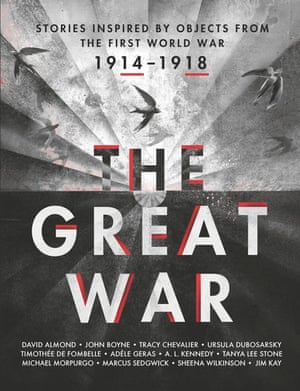
The Great War: stories inspired by objects from the First World War

The Great War: stories inspired by objects from the First World War (Walker Books, 2014)

304 pages, with full page black and white illustrations by Jim Kay; 11 stories by David Almond, John Boyne, Tracy Chevalier, Ursula Dubosarsky, Timothée de Fombelle, Adèle Geras, A.L. Kennedy, Tanya Lee Stone, Michael Morpurgo, Marcus Sedgwick and Sheena Wilkinson.

Subjects: World War One, England, France, short stories (Year 5-8)

Great War: Great War cover

Synopsis
This anthology contains stories by English, American, French, Irish and Australian authors. Each author uses a particular object as the inspiration for a story about the First World War. The objects include items belonging to individual soldiers – a helmet, a writing case, a compass. Some are printed material: sheet music, school magazines, a recruitment poster.  There is a French toy soldier, the nose from a Zeppelin bomb and a Victoria Cross and a Princess Mary gift box. One of my favourite items was a hand-painted war time butter dish.

Some stories are set in the present day (a school history trip to the battlefields), others in the past. A number of them have girls as the main characters. One is a sort of ghost story. One is written as a poem. Many are firmly based in family life. As in all anthologies, some stories work better than others, but all are of a very high standard.

The pages at the end of the book contain biographical information about the contributors and pictures of their chosen objects. From the picture credits, you can work out where most of the objects come from (many are held in the Imperial War Museum), but I would have liked some more information about how the authors chose the object they wrote about. (This article in the Guardian shows some of the objects.)

About the illustrator
Interesting random facts: Jim Kay won the Kate Greenaway Medal in 2012 for his illustrations for A monster calls by Patrick Ness and was chosen by J.K. Rowling to illustrate the full-colour editions of the Harry Potter series. Here they are!

And here he talks about his illustrations for The Great War.

Other books you might like:
War girls is another recent collection of war-related short stories. The curioseum, although not war- related, is another example of using museum objects to spark a story. 

Things I didn’t know
The country you call home by John Boyne describes the fierce debate amongst the Irish about whether they should support England in the First World War, when for years they had been fighting to get England out of Ireland.

The words that struck me most were from A world that has no war in it by David Almond, a story about a long-running neighbourhood feud.  Near the end, the narrator is talking about all the wars that feature on the news every day. “Are we daft?” he asks. “Are we evil? Is it just the way we are? Are we acting out something that started with our ancestors? Is it in our bones and blood? Do we go to war because we’re in love with war? Will we be asking those damn questions till the very end of time?”

The words stayed in my mind because I think a lot about writing books about war for children, and why we do it and what we are trying to say. Surely we want our readers to reflect on the futility of war, but as David Almond says, the wars just keep happening.

Wednesday, 25 November 2015

The machine gunners by Robert Westall

The machine gunners by Robert Westall (Macmillan, 1975)

18 chapters; 189 pages

Subjects: World War Two, England, bombing raids, junior fiction (Year 5-8)


Synopsis
The machine gunners is set in north-eastern England in 1940-41. We often read about the bombing on London - the Blitz and the deadly V2s later in the war – but forget how other parts of England were affected. Tyneside (around Newcastle, or the fictional Garmouth in this story) is surprisingly close to Germany on the map, and it was the focus of many bombing raids at this time, often as devastating as the ones that were targeting London.

Chas is one of the local kids who hang around bomb sites, foraging for items (machine gun bullets, pieces of shrapnel, tail fins, nose cones) to add to their collections of war souvenirs. Their parents, worn out by sleepless nights, food shortages and warden duties, don’t care too much what they are up to, as long as they are safe in the Anderson shelters when the alarm goes.

Then Chas finds a crashed German plane in the woods, with a dead German gunner slumped inside, and the machinegun turret still attached. He calls in a gang of others to help – Cem (short for Cemetery Jones), Clogger, Audrey and Nicky - and they end up with not only the machine gun, but also an elaborate underground bomb shelter in the grounds of a ruined house and Rudi, a captured German airman. Meanwhile, the local Home Guard officer is aware that the machine gun is missing, suspects that local kids are involved and is desperately trying to retrieve it before disaster strikes.

The author comments that the plot was inspired by a newspaper article about a gang of Dutch children who found a wrecked Allied bomber long after the war, in 1969. They managed to “remove its rear gun turret, transport it several miles to their den, clean and repair it and were about to fire it when the Dutch police finally caught up with them”.  He adds that one night in 1941, some people on Tyneside really believed the German invasion had begun.

Some of the dialogue is written in dialect, especially Clogger’s (from Glasgow), which isn’t always easy to follow. But it is could work well as a book for a teacher to read out to a class. The idea of children working together, with little parental supervision, and finding warmth and acceptance in their gang, provides a very different slant on war. 

It has been a popular book over the years, especially in English schools, and there are lots of different covers. 


Reviews
A musical adaptation was first staged in 1998, and later appeared at the Edinburgh Fringe Festival. 

FreelanceProduction: The Machine Gunners
About the author
Robert Westall, according to the blurb on the back flap, “was a schoolboy in Tyneside during the war years” (later he went into the army and then became a teacher) which must be why the passages about the bombing raids and their aftermath – like when Chas and his dad make their way across town to try and find out if his grandparents are still alive - seem so authentic.

Other books you might like
Ronnie’s war by Bernard Ashley (the scene where Ronnie goes to look for his mother is another dramatic description of the aftermath of an air raid).

Things I didn’t know
I didn’t know that school started late if the raids had gone on late the previous night (in the opening chapter, Chas wakes in the air raid shelter after a raid that went on past midnight, so school doesn’t start until 10.30am). I didn’t know how important it was to have your insurance policies with you when you ran for the shelter in your back year, in case your house was destroyed. And I didn’t realise that wardens were unpaid and had to do their warden duties at night on top of a job during the day.

NZ connections
The final chapters – with the arrival of the Polish Free Army 
and non-arrival of the Germans – have semi-comic moments but pose a real question about what you would do and how your family might react to a possible invasion. In WW2, many people in Australia and New Zealand feared that a Japanese invasion was imminent, and I’ve heard stories from people about how their families had planned to retreat to farms in the countryside if that happened. 


Have you read it?
Have you read this book? Let me know what you think!

Saturday, 26 September 2015

The Flambards trilogy by K.M. Peyton

The Flambards trilogy by K.M. Peyton (Flambards, The edge of the cloud, Flambards in summer) (Penguin, 1980)

Flambards was first published in 1967 and the sequels in 1969; the trilogy runs to just over 500 pages

Subjects: World War One, England, flying, pilots, class system, hunting, horses, women in war, young adult fiction (Year 9-12)


Synopsis
Winner of the 1970 Guardian award, and later made into a film, the Flambards trilogy captures a fascinating slice of history, not just the history of WW1 which is largely peripheral to the main action – mostly shown by men signing up and leaving, returning or failing to return from the front - but also the history of social attitudes, especially concerning women and the class system. Reading it makes you realise how often books about WW1 start in the middle of the war, or at the very beginning, but seldom before it. 

The three parts of the first book, Flambards, are set in 1908, 1910 and 1912. With the benefit of hindsight we know that war is looming, and some of the characters suspect that something bad is coming, but the story stays focused on Christina Parsons, 12 years old when the book opens, an orphan but an heiress, due to come into a fortune at 21. 

Having spent her childhood moving from household to household, Christina is summoned by her Uncle Russell to join him and his two sons, Mark and William, at Flambards, a crumbling estate famous for having the best stables in the county, where the year revolves around the hunting season (the opening sentence is: “The fox was running easily”) and far more care and attention is lavished on the horses than on the house. Uncle Russell, crippled after a hunting accident, angry, frustrated and bullying, rules the house from the study and despises his younger son, Will, who hates hunting so much that he goes to terrible lengths to ensure he will never have to hunt again.

Christina, self-possessed and used to looking after herself from an early age, copes with her new strange surroundings but she is convinced that “they’re all mad”. Everything changes for her when her uncle insists she learns to ride (under the careful tutelage of Dick, the stable boy) and she discovers how much she loves it; like her mother before her, she is “a hunting Russell”. With Mark, she goes out riding and hunting all through the hunting season and returns to talk over each day’s events with Russell over dinner, while Will sits by, mute.

In the two-year jumps between each part of this book, Christina, Mark, Will and Dick all get older and there are more changes. Will, a gifted mathematician, is besotted with the new flying machines. Dick is given his notice, a dreadful thing to happen in the days before social security when poverty and the workhouse posed real threats and families could easily fall through the cracks and disappear. Christina, growing up in a house without women apart from the cook and maid, and ignorant of matters that today’s children would understand at a much younger age, is often at a loss in situations where nobody will explain the truth or meaning to her. She doesn’t understand Will’s views on the inequality between their lives and those of the servants, and thinks it impossible for a servant girl to become pregnant before marriage, but she is brave and resilient, determined, sensible and loyal, with a warm and loving heart.  

The second book, The edge of the cloud, leaves Flambards behind and explores the world of the young flying enthusiasts. Flambards in summer takes us back again, with a grown-up (21-year-old) Christina, to a world that has changed in so many ways because of the war.

I enjoyed the first two books more than the third, because – without revealing too much of later plot (or romantic) developments – the third one has more of an elegiac and introspective tone, overshadowed by death, loss and grief, without any of the excitement of flying, and also the character of the child Tizzy didn’t really work for me. But the three together give a powerful impression of how people’s lives changed so utterly in that decade from 1908 to 1918.

Here is Christina, watching a sunset in the peace of the countryside: 
“It made her more bitter, this peace, that while she was standing looking at everything that was the essence of the sentimental picture of home, which all the newspapers made out that the  ‘boys over there’ were fighting for, the fact that the boys over there were now dead and would never come home again made completely negative the sweetness of every flower and the balm of every sunset.”

Reviews
These books with their long descriptive passages show the differences in writing for young people that have evolved over the last 40 years. On the other hand, I can remember skipping those long passages as a child reader. Did every child do that?
  
About the author
The bio at the front of the book says that K.M. Peyton was born in 1929, studied painting at Manchester Art School, lives in a village in Essex and enjoys sailing, riding and long distance walks.

Other books you might like
There are a number of book about horses in war, especially the Australian and NZ horses that travelled to Egypt, as well as Michael Morpurgo’s famous War horse. Elizabeth Wein's Rose under fire tells the story of a WW2 female pilot, but I haven't found many books that tell the stories of the early pilots (Biggles learns to fly is one.) The Flambards trilogy captures these heady days when flying was still new and largely untested, when aircraft were fragile and their design still a matter of experimentation, as were techniques like looping the loop, but accidents were common and often fatal. Some adventurous people paid to go up for a ride, others turned up in droves to watch competitions, but many ridiculed the new machines and doubted that they would ever replaces the horse and carriage.


Have you read it?
Have you read these books? Let me know what you think!

Friday, 4 September 2015

Charlotte sometimes by Penelope Farmer

Charlotte sometimes by Penelope Farmer (Red Fox, 1999; first published Chatto and Windus, 1969)

3 parts; 198 pages with a few full-page black and white illustrations

Subjects: World War One, England, Armistice, VE Day, school, sisters, friends, time travel, junior fiction (Year 5-8)


Synopsis
This was one of my favourite books as a child, although I realise now that I read it as a time travel fantasy, with very little understanding of the historical background.

The New York Review has a succinct summary of the plot:
It’s natural to feel a little out of place when you’re the new girl, but when Charlotte Makepeace wakes up after her first night at boarding school, she’s baffled: everyone thinks she’s a girl called Clare Mobley, and even more shockingly, it seems she has traveled forty years back in time to 1918. In the months to follow, Charlotte wakes alternately in her own time and in Clare’s. And instead of having only one new set of rules to learn, she also has to contend with the unprecedented strangeness of being an entirely new person in an era she knows nothing about. Her teachers think she’s slow, the other girls find her odd, and, as she spends more and more time in 1918, Charlotte starts to wonder if she remembers how to be Charlotte at all. If she doesn’t figure out some way to get back to the world she knows before the end of the term, she might never have another chance.

On her blog, Penelope Farmer writes an interesting summary herself, describing the book as being “set in the kind of English boarding school my twin sister and I attended/were incarcerated in – take your pick – for part of the fifties.” No wonder the school scenes ring so true. The girls have very English names: Susannah, Vanessa, Janet, Elizabeth, Sarah, and there is a mystery about Sarah’s unexpected kindness to Charlotte, explained at the end.

(This is the school which Penelope and her sister went to, and which she used as the setting for the book, including the cedar tree and the glassed-over verandah that Charlotte climbs out onto.)

She adds that “the whole book turned – though I didn’t see that when I wrote it – on identity; how do people identify you as you?” and says this is “a particularly relevant question for twins in general, and still more so for two not identical but similar looking twins like my sister and me, quite different in character and ability – even opposites in many respects, she right-handed, me left - but always taken together not singly. This was another connection I did not make at the time I was writing.” (More on her twin sister below.)

The first clues about the war setting come with breakfast (“porridge… as solid as bread, much solider in lumps, and slippery too”) when Bunty tells Charlotte-as-Clare, “Miss Bite says it’s doing your bit, to eat things you don’t like… I don’t see how it hurts Germans myself, eating nasty porridge.” 

In September 1918, the war is drawing to a close. We as readers know it is nearly over, but the girls at school don’t, and it still affects their everyday lives. There are air raid alarms in the middle of the night, and an army training camp nearby with soldiers dressed in khaki, who “strolled casually about or marched stiffly up and down.”  Injured soldiers arrive home on the hospital trains. A girl with a German surname is ostracised by the others, and the teachers, girls and nearby villagers have fiancés, fathers or sons away fighting in France; some of them won’t ever come back.  

Part Three only takes up about 25 pages but it brings the story to a perfect, poignant ending. 

You can find lots of lots of different covers, some of which are better than others.  

About the author
A number of excellent fiction writers are called Penelope. This writer is not Penelope Mortimer or Penelope Fitzgerald or (another of my favourites) Penelope Lively.

Penelope Farmer was born in 1939. At first glance, there isn’t a lot of information about her online, but the New York Review says that she published her first book of short stories for children, The China People, in 1960 and writes novels for adults and children, including several books about Charlotte and her sister Emma.  (We also had Emma in winter when I was a child, which I enjoyed - but not as much as Charlotte sometimes.)

There is some biographical material about her here (including more fascinating twin info about the circumstances of her birth).

However, an absorbing article in the Guardian reveals a lot about her family life. Written in 2007, it describes the events of 16 years before when her twin sister lay dying in hospital in Oxford, and the connection that developed between her and the daughters of the woman who was dying in the next bed. It is a sad, moving and yet lovely story, all hinging on a chance meeting in the street.

Later, living in Lanzarote in the Canary Islands, she wrote about starting a blog called grannyp (“Old writers may not die, but they do have to move on. Thank God for the internet”) but it doesn’t seem to go beyond 2010.

Info about the illustrator
The cover illustration on my copy is by Emma Chichester-Clark who is best known for her Blue kangaroo books (and incidentally she also went to boarding school)

Other books you might like
Valentine Joe is a time travel book about World War One.
The red suitcase by Jill Harris is another, but about World War Two.

Things I didn’t know
I didn’t know anything at all about Penelope Farmer. It has been a delight to find out all this info about her, and this remains one of my favourite books.

And how many children’s books have inspired songs? This one inspired a song by The Cure, called Charlotte Sometimes and full of quotations.  This Smashwords blog article points to two other blog postings that talk about the copyright implications, the impact it had on her sales, how Penelope Farmer actually got to meet the Cure at one of their concerts, how she signed a copy of the Puffin edition for Robert Smith (who told her that his older brother read him the story at bedtime when he was about 12, and “it never got out of my head”) and how she enjoyed her own “brief moment of pop glory” when they played the song as an encore at the end of the concert.
You can read them here and here (scroll down to the entry for June 12).


Have you read it?
Have you read this book? If so, I hope you loved it as much as I do. Let me know what you think!