Showing posts with label Michael Foreman. Show all posts

Wednesday, 19 October 2016

The Mozart question by Michael Morpurgo

The Mozart question by Michael Morpurgo, illustrated by Michael Foreman (Walker Books, 2007)

75 pages (but a small size, so quite short); gorgeous watercolour illustrations of Venice and sobering, muted ones of the scenes at the concentration camps

Subjects: World War Two, Jews, concentration camps, music, junior fiction (Year 6-8, but have to be ready to hear about the Holocaust)


Synopsis
I can’t better the synopsis on Michael Morpurgo’s own website:
“When Lesley is sent to Venice to interview world-renowned violinist Paulo Levi on his fiftieth birthday, she cannot believe her luck. She is told that she can ask him anything at all – except the Mozart question. But it is Paulo himself who decides that it is time for the truth to be told. And so follows the story of his parents as Jewish prisoners of war, forced to play Mozart violin concerti for the enemy; how they watched fellow Jews being led off to their deaths and knew that they were playing for their lives.”

In the note at the back, the author talks about how the story grew from “the sight of a small boy in a square… in Venice, sitting one night, in his pyjamas on his tricycle, listening to a busker. He sat totally enthralled by the music that seemed to him, and to me, to be heavenly.”

Reviews:
  • Kids reads says “Morpurgo's tale is straightforwardly told, almost fable-like in its simplicity and emotional impact. Its simple language and elegant structure would make The Mozart question an excellent book for parents and teachers to read with children, opening the door to more questions about family history, historic atrocities, and the miraculous powers of music to resist and overcome even the most shocking evils.”

About the author

What more can you say about Michael Morpurgo – he’s just amazing.
This page on his website talks about themes of war in his books. 

About the illustrator
And similarly for Michael Foreman – equally amazing!
This article in the Guardian profiles his 50-year career. 

Other books you might like:
War horse and Private Peaceful, both by Michael Morpurgo,  War gameThe general and The amazing tale of Ali Pasha by Michael Foreman

Have you read it?
Have you read this book? Let me know what you think!

Monday, 17 August 2015

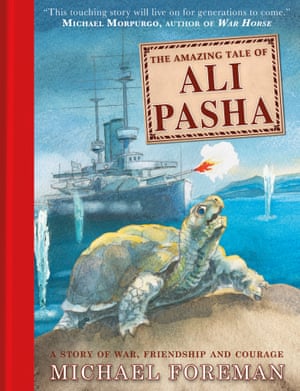
The amazing tale of Ali Pasha by Michael Foreman

The amazing tale of Ali Pasha by Michael Foreman (Templar, 2013)

9 chapters; 128 pages with numerous beautiful colour illustrations

Subjects: World War One, Gallipoli, Egypt, Navy, animals, tortoises, junior fiction (Year 5-8)

Ali Pasha 1

Synopsis
I tracked down this title after reading an article in the Guardian that asked well-known authors, “What are the best first world war books for children?” This book was Michael Morpurgo’s pick.  

On the cover, it is subtitled “a story of fear, friendship and courage”. The story, based on fact, is that of Henry Friston, a 21-year-old seaman on the HMS Implacable. In April 1915, the Implacable sails to Gallipoli and Henry and his gunner mates are sent on shore at X Beach (one of the five landing beaches at Cape Helles) to act as stretcher bearers. Sheltering after a shell blast, he finds a tortoise and determines to take it - against orders - back onto the ship with him. Soon afterwards the Implacable leaves for Egypt and Ali Pasha becomes a companion and good luck totem for the four friends who keep his existence on board a secret.

The author describes these events through the eyes of a young reporter, Trevor Roberts, who in turn hears them from Henry himself as an “old man” (actually not that old – only 59! – but presumably seemed so to the reporter!)

The endpapers contain family photographs of Henry as a young boy at school, a 13-year-old in his first job at the “Big House”, a sailor in his Navy uniform, and after the war as a bus driver, tram conductor, father and (really) old man. There is an afterword by the author explaining how and when he met Henry, his son Don and Ali Pasha himself.  

The final pages show some media coverage of Ali Pasha (who made The Times and even got to appear on the BBC’s Blue Peter show) and tell of how he outlived Henry by  ten years and died, aged at least 90 but quite possibly over 100, in 1987. By then, he had lived with the Friston family for 72 years.

You can see some of the beautiful illustrations from the book in Ali Pasha in pictures.  

Reviews:
Books for Keeps says that “most stories for this age group about the Great War concentrate on the trenches and the Army fighting in France, and it is refreshing to hear of the Navy’s part in the campaigns and especially of the part it played at Gallipoli.

Info on the author: 
Michael Foreman is primarily an illustrator, but his book War boy : a wartime childhood tells of growing up (he was born in 1938) in an English fishing village during World War Two. It is followed by After the war was over.

There is a lovely article about him here in the Guardiancelebrating the 50th anniversary of his first book.

Other books you might like:
Anything else written or illustrated by Michael Foreman about war (or peace), including War game, War boy : a wartime childhood and The General and also The little ships by Louise Borden. 

NZ connections:
A number of tortoises made it back to New Zealand after World War One - not all of them alive. One of the exhibits at the National Army Museum in Waiouru is a tortoise shell from Gallipoli

This tortoise didn’t enjoy the same long life as Ali Pasha, but there was another Gallipoli tortoise that did – in fact, Torty is still alive and living in Hawkes Bay. (Tortoises have been known to live to over 200 years old.) 

PRONE TO WATER: Ninety-one years after coming to New Zealand in a Gallipoli veteran's backpack, Torty is as limber as ever.
KATHY WEBB/ The Dominion Post

The tale of the Anzac tortoise by Shona Riddell, illustrated by official Defence Force artist Matt Gauldie, was partly inspired by the story of another tortoise which was given to a nurse by a wounded soldier and lived out its life on the Kapti Coast.
Official NZ Defence Force artist Matt Gauldie and Shona Riddell have created a children's book about a time-travelling war tortoise.
Matt Gauldie
Have you read it?
Have you read this book? Let me know what you think!

Saturday, 18 July 2015

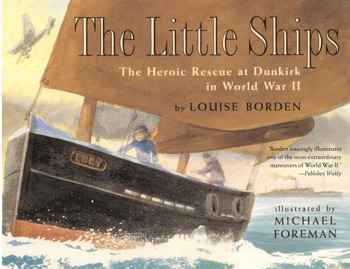
The little ships by Louise Borden

The little ships by Louise Borden, illustrated by Michael Foreman (Pavilion, 1997)

32 pages

Subjects: World War Two, England, France, Dunkirk, boats, girls, picture books (Year 3-6)

Some covers have the subtitle: The heroic rescue at Dunkirk in World War II

The Little Ships
Synopsis
In May 1940, the unnamed narrator lives with her father, a fisherman, in the town of Deal on the Kent Coast.  She is a girl, but “fisherman on the beach said I was my father’s daughter.” Her brother John is away fighting in France.  When word comes that half a million British and French soldiers are trapped on the beaches of Dunkirk, she disguises herself as a boy in some of her brother’s old clothes and joins her father (in his fishing boat the Lucy) and an armada of "little ships" that sets sail across the English Channel to rescue them.
I didn’t know that people from English villages and towns actually signed up to go and help, as shown in one of the illustrations. And I didn’t know that soldiers brought back their pet dogs (and some strays) with them – over 200 dogs were aboard ships landing in Dover!
There is a map in the front, and a historical note and excerpt from Winston Churchill’s famous speech (“we shall fight on the beaches…”) at the end. Some of the pages have a lot of writing on them, and I would think that the text is longer than that of an average picture book. There are a lot of illustrations of boats and ships, which I guess is understandable!
Reviews:
Kirkus reviews (always a prestigious place to get a review) calls this "A moving, fictionalized account of the ``miracle of Dunkirk,'' in which an armada of 861 ships ferried to safety across the English Channel over 300,000 Allied soldiers who had been trapped in northern France by the Germans."

The Children's War blog says it is "an excellent book for introducing the topic of Dunkirk to younger kids but is also a good teaching tool for older kids who may already know something about World War II."

Author’s website
Louise Borden is an American writer from Cincinnati.  I’d never heard of her before reading this book, but now I’m hoping to read more of her work. Her website has a very readable section about Becoming a writer (under the About button). I like how she talks about riding home on her bicycle as a child:Pedaling slowly up my street may be where I learned perseverance, something all writers need when they are working alone at their desks.”

And I love what she says about writers needing to have thinking time. It’s a long quotation but it makes so much sense to me: 
“Often I am in my car, driving to new places to meet new people, and to talk about writing. I have a lot of thinking time on those miles. And I have a lot of thinking time when I am working in my garden at home. Thinking time: It's so very essential for a writer. I think about new ideas for books, and new ways to write them. I think about what is important to me, and the new things that I want to learn. I think about the books I read as a child—and the books I am reading today. 
I think about my family who are my great encouragers. And my wonderful editors who understand, in just the right way, my creative vision for a picture book. These thoughts always inspire me to return to my desk and begin working on a rough draft for a new manuscript.”

Info about the illustrator
You can read more about Michael Foreman on my review of his book War game.

Other books you might like:
The snow goose and The dolphin crossing, both already reviewed on this blog, are other books about Dunkirk. The evacuation of Dunkirk has a resonance for England that is perhaps a bit like Gallipoli for us in New Zealand: a defeat, but a heroic failure.

Things I didn’t know
Louise Borden’s website has pictures of her research trip for writing this book. She took part in one of the Crossings of the Association of Dunkirk’s Little Ships (as referred to in the Foreword), which is “the surviving remnants of the intrepid band of assorted boats and yachts that contributed so much to the miracle of Dunkirk.” 
I didn't know there was an Association of Dunkirk's Little Ships! There  is some fascinating info about it on their website, including an answer to the question “how do I identify if my boat took part in the Dunkirk evacuations?” 

The Association returned to Dunkirk in May 2015 to commemorate the 75th anniversary of Operation Dynamo, with 50 Little Ships escorted by the RNLI and the Royal Navy. There are some great photos and descriptions in this newspaper report from the Telegraph.  

Links
There's a You tube clip here, which describes itself as WW II : RARE COLOR FILM : DUNKIRK : PART 3 OF 3 1939 1940.

Have you read it?
Have you read this book? Let me know what you think!

Wednesday, 21 January 2015

The general by Janet Charters, illustrated by Michael Foreman

The general  by Janet Charters, illustrated by Michael Foreman (first pub 1961; Templar Pub., 2010)

ISBN 978-1-84877-153-6

38 pages

Subjects: war, peace, flowers, animals, picture books (Year 1-8)


Synopsis
Having finished 2014 with a book about peace, it seems like a good - and hopeful - idea to include another one on the same theme at the start of 2015. 

On the cover is a badge marking this as the 50th anniversary edition, with the words “A celebration of peace and beauty”.

This is Michael Foreman’s first book:  an anti-war story (written in 1961 during the Cold War) about General Jodhpur who wants to be the most famous general in the world.  One day he falls off his horse and, lying in the grass, suddenly notices the beauty of flowers and nature. He decides to concentrate on peace, not war, from then on.

Reviews:
This insightful review on The bookbag makes so many good points (about both text and illustration)  that it’s hard not to quote it in full. The reviewer points out that the book “was written in 1961 and it shows. It has a naivety (even for a picture book) that screams of the early 60s - all soldiers need is a flower and they'll toss aside their guns. I wish dearly it were true, but fifty years on, it seems almost too simple. The book isn't dated, but it is very much of its time. ..but the quality of the writing is great. The vocabulary is clear and direct, making it suitable for the youngest readers.

This was one of the books that began Michael Foreman's illustrious career, and you can see exactly why he's become one of the best-loved illustrators. His pen and ink drawings look stunning, perfectly capturing the rigidity of military life, then blossoming into the bright and varied colours of nature. His mosaic-like overhead view of a city is such a unique approach that you'll love seeing the moment of realisation on a child's face. Every page is a joy to pore over.

There's another review here on the blog Seven impossible things before breakfast

About the illustrator
Michael Foreman was born in 1938, so he was only 22 or 23 when this book was first published. The Guardian published a lovely article in 2011 to mark his 50 years in print; it describes his childhood, how he became an artist, why he believes that that “each day is precious” and  why “so many of his books focus on matters of conflict and injustice “ – fascinating stuff.  

Michael Foreman - The General
 Trooping the colours ... from The General by Michael Foreman Templar
You can see more lovely images online from his 50 years of picture books.

About the author
Janet Charters (now Abis) was also born in 1938 but I can’t find out much information either about her, or about any other books she has written.  

Other books you might like:
War game by Michael Foreman also conveys a message of peace. The story of Ferdinand by Munro Leaf and The duck in the gun by Joy Cowley have a similar anti-war message to The General.


Wednesday, 26 June 2013

War game by Michael Foreman

War game by Michael Foreman (Arcade Publishing, c1993)

ISBN -1-55970-242-7

68 pgs (unnumbered); no contents page, but 3 short chapters (The kickoff, The adventure, To the front) and one long chapter (No-man’s-land.)

Subjects: World War One, football, Christmas, armistice, truce, junior fiction (Year 5-8)


Four boys from the same village in Suffolk - Will, Lacey, Billy and Freddie – dream of playing soccer for England, but instead they sign up in August 1914 to go to war. Life in the trenches is miserable and the war shows no sign of ending. Then on Christmas Day, a miracle happens. British and German soldiers start to sing carols, the Germans put up lighted Christmas trees and both sides meet in the middle to exchange Christmas wishes. A game of football starts and for a while, the young men make up two opposing sports teams, not two sides at war.

The book contains lots of full page illustrations, with some small fact boxes and a few reproductions of newspaper articles and advertisements. The endpapers contain examples of recruiting posters.

Make sure you look at the dedication to the author’s four uncles who died in the Great War.

There is a fascinating website about the Christmas truce hereIt has been put together by two English journalists who are encouraging volunteers to search through old newspapers and local archives for details of the 1914 Christmas truce (which took place all along the lines, and was larger than just this one football match.)

Reviews:
There is a short review of the book on the Booktrust website. 

Questions:
What made boys like Will, Lacey, Billy and Freddie decide to join up?
What did they expect the war to be like? When did they realise they might be wrong? What was it like?
The last four pages contain only pictures, no words. What do you think happens at the end? Why did Michael Foreman choose to finish the book like this? If you wanted to write some final words to go with the pictures, what would they be?

Information about the author:
Michael Foreman is primarily an illustrator, but his book War boy : a wartime childhood tells of growing up (he was born in 1938) in an English fishing village during World War Two. It is followed by After the war was over. He has also illustrated two other war stories, Billy the kid and Farm boy (both by Michael Morpurgo.) His very first book, The General, is an anti-war story (written in 1961 during the Cold War) about General Jodhpur who suddenly notices the beauty of grass, flowers and nature when he falls off his horse, and decides to concentrate on peace, not war, from then on. 


Michael Foreman: Michael Foreman
Illustration from The General (1961) 

Other books you might like:
The duck in the gun by Joy Cowley has a similar anti-war message to The General.
Private Peaceful by Michael Morpurgo also shows the pressure put on young men to join up.
One of the letters in Harry and the Anzac poppy by John Lockyer describes the misery of being in the trenches on Christmas Day, longing for home, with nothing for dinner except bully beef stew.
Near the end of War game, Will finds himself in a shell hole with a German soldier. Read The red poppy by David Hill for another similar encounter.

Football in war:
"Football has a long history, and some of it is tied up with war. In 1914, when the First World War broke out, football was the most popular national sport, especially with young men just the right age to fight for their country. Entire football teams joined up to fight together, and some died together too.
Many footballers joined up in the Second World War too, and many lost their lives.
This site tells some of their stories and looks at how the Commonwealth War Graves Commission remembers them by recording their details and looking after their graves and memorials."

  • There are plans to re-create the Christmas truce football game on Boxing Day 2014 at Messines. It has recently been announced that David Beckham may be called out of retirement to lead the English side against a German team. 
New Zealand connections:
When war was declared in August 1914, many people thought it would be over by Christmas. Men from New Zealand and Australia hurried to enlist so they didn’t miss out. They knew it would take weeks to get there by ship and worried that the fighting would be finished by the time they arrived, but in fact it dragged on for four more years.

Postcard. Christmas greetings from New Zealand. Ake ake. In my loneliness I ponder, Think of you by night and day, Of you bravely fighting yonder; May God keep you safe I pray / Roslyn. Published by Frank Duncan & Co., High St., Auckland [1914-1918]
Frank Duncan and Company. Postcard. Christmas greetings from New Zealand. [Album of postcards donated by the Hurley family. 1905-1920].. Ref: Eph-B-POSTCARD-Vol-17-010-1. Alexander Turnbull Library, Wellington, New Zealand.http://natlib.govt.nz/records/22506829

For the first Christmas of the war, 17-year-old Princess Mary (daughter of King George V) sent all the troops a Christmas gift: a brass tin containing tobacco, sweets, pencils, a card and a picture of her. You can read more about the Christmas tins on the Museum Victoria site. 

This one belonged to Hami Grace, whose story is told on pg 22 of Anzac Day: the New Zealand story in the section called “Maori in the Great War”.


If you go to the National Library website and search on ”Christmas” and “war”, then filter the results by type (Images) and date (1910s), you will find some photographs of wartime Christmas celebrations.

New Zealand Commander curves the turkey on Christmas Day, Chateau Segard, 1917
New Zealand Commander curves the turkey on Christmas Day, Chateau Segard, 1917. RNZRSA :New Zealand official negatives, World War 1914-1918. Ref: 1/2-013034-G. Alexander Turnbull Library, Wellington, New Zealand. http://natlib.govt.nz/records/22904056

The Christmas football game is not the only occasion when soldiers from opposing sides met in a temporary truce. In May 1915, a ceasefire was arranged at Gallipoli so both sides could bury their dead (see pg 15 of Anzac Day: the New Zealand story in the section called “A long, tough campaign”.) One story goes that only Australian soldiers who were over six foot (1.8m) tall were chosen for this job, so the Turks would think that all the Australians were that big.

The bodies were lying out in the open on no-man’s-land and it was hard to dig graves in the rocky ground, but the work was lightened by the fact that the men could walk around freely in the open for once without having to worry about being hit by snipers or shells. Soldiers from each side talked together (in sign language if they didn’t have a common language) and swapped cigarettes and food. At the end of the day, they went back to their own trenches and the war started up again.

Armistice day, Gallipoli, Turkey
Armistice day, Gallipoli, Turkey. Powles family :Photographs. Ref: PA1-o-811-23-3. Alexander Turnbull Library, Wellington, New Zealand. http://natlib.govt.nz/records/22861242

  • Michael Foreman tells an intriguing story about why British soldiers are known as “Tommies” – after a soldier named Thomas Atkins - although a bit of Internet research reveals that there are conflicting theories as to where the name originated. The soldiers’ nicknames for each other are also shown in Ataturk’s famous speech on the Johnnies and the Mehmets (see pg 35 of Anzac Day: the New Zealand story in the section with that title.)