Showing posts with label anti war books. Show all posts

Thursday, 12 October 2017

Hiroshima no pika written and illustrated by Toshi Maruki

Hiroshima no pika written and illustrated by Toshi Maruki (translation of the same Japanese title; New York: Lothrop, Lee & Shepard, 1980)

48 pages with colour illustrations, sometimes full page double spreads

Subjects: World War Two, Hiroshima, atomic bomb, anti-war books, Japan, picture books (Year 6-8)
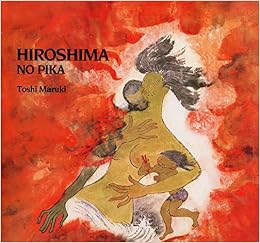
Image result for Hiroshima no pika

Synopsis

This is based on a first-person account that the author heard when he was holding an exhibition of pictures about the atomic bomb in a small town in Hokkaido.

It begins with a cloudless blue morning in Hiroshima, with streetcars picking up people on their way to work and the seven rivers flowing quietly through the city. Seven-year-old Mii and her parents are breakfasting on sweet potatoes “brought in the day before by cousins who lived in the country” when the bomb falls at 8.15am on August 6, 1945. Mii’s mother carries her injured husband on her back across the city, across rivers and all the way to the coast, where they stay for days until he is taken into a makeshift hospital: “no doctors, no medicine, no bandages – only shelter.” 

The illustrations are stylised but portray a powerful sense of the horror of the event, and the consequent suffering, partly through the lurid and unnatural colours of the skies and surroundings.

This is a terrible event, and parts of the text would be upsetting to younger (or even older) children: the mother carrying a dead baby, the floating bodies, the wasteland of the city, Mii’s father’s death, the glass slivers that poke their way out of her scalp in years to come.

Look out for the red chopsticks that Mii clutches for days after the Flash, until her mother manages to prise them from her grip. It’s a clever way to identify her on each page, but also hints at the hidden trauma she has undergone.

The book feeds in some factual details about the atomic bomb and ends with the lantern memorial service held each year on the seven rivers. I couldn’t see a translation of the title anywhere – maybe I missed it – but it means The Flash of Hiroshima.  

Reviews:
An entry in Kirkus reviews is always prestigious. “Japanese artist and antiwar activist Maruki manages to avoid the opposing perils of giving children nightmares and belittling the horror.”

About the author
Toshi Maruki (1912–2000) was born in Hokkaido and studied Western art at the Joshibi Women's School of Art and Design.
“I am now past seventy years old. I have neither children nor grandchildren. But I have written this book for grandchildren everywhere. It took me a very long time to complete it. It is very difficult to tell young people about something bad that happened in the hope that their knowing will help keep it from happening again.”

Maruki Gallery for the Hiroshima Panels, established by husband and wife Iri and Toshi Maruki, "is famous for its message for peace all over the world". The artist couple went into Hiroshima city just three days after the bombing and spent 30 years painting the 15 panels.

Other books you might like:
Sadako by Eleanor Coerr, illustrated by Ed Young, also tells of a young girl in Hiroshima. 

Things I didn’t know
I didn’t know that other Japanese cities like Tokyo, Osaka and Nagoya had already experienced air raids, so the people of Hiroshima were readying for them by storing water and making evacuation plans. There is a sad poignancy in the statement that “Everyone carried small bags of medicine and when they were out of doors, wore air-raid hats or hoods to protect their heads.”

Have you read it?
Have you read this book? Let me know what you think!

Tuesday, 25 April 2017

The butter battle book by Dr Seuss

The butter battle book by Dr Seuss (Random House, 1984)

48 pages with typical Dr Seuss style illustrations!

Subjects: anti-war books, fable, picture books (Year 3-8)


Synopsis
Written in Dr Seuss’ usual zany rhyming style, this book tells the story of two neighbouring communities – Yooks and Zooks – who are divided by their differing opinions on the best way to butter their bread. Things get more heated, and following an initial exchange with a slingshot, the Boys in the Back Room dream up bigger, crazily-named and ever more powerful weapons.

But it’s also a metaphorical look at The Cold War (after all, it’s surely no coincidence that “Yooks” and “Zooks” sound like “Nukes”, and that they are divided by a Wall.) As I got closer to the end, I wondered how it was going to finish and whether the escalating situation could be resolved – but it ends on top of the wall in a situation of total uncertainty.

You can read the whole text online here. 
Or you can watch it on YouTube. 

Reviews:
The Teach Peace Foundation calls it an “anti-war…children’s rhyming story addressing fears from the cold war era during which it was written. Specifically it deals with the nuclear war and the possibility of mutually assured destruction”. The website has some suggested teaching notes. 

Questions:
Does it matter which way up your butter your bread?
What are some equivalent differences between people in today’s world? (Which way do you...?) 
The Teaching Children Philosophy site also poses lots of good questions arising from this story.

About the author
Everyone knows Theodor Seuss Geisel (1904-1991) in other words, Dr Seuss! 
Some things I didn’t know about him –
  • His first book, And to think that I saw it on Mulberry Street, was rejected 27 times before being published by Vanguard Press
  • Seuss was his middle name and his mother’s maiden name
  • And my favourite fact: his mother used to soothe her children to sleep by chanting rhymes, which is where Dr Seuss thought he got his ability to rhyme from.


Find out more about him here. 
And see more of his art here. 

Other things I didn’t know
According to the Teach Peace Foundation, this book “was censored and taken out of public libraries for its obvious statements against the arms race between the United States and the Soviet Union.”

Other books you might like:
Other anti-war picture books include The story of Ferdinand by Munro Leaf, The general by Janet Charters, illustrated by Michael Foreman, and Bravo! by Philip Waechter and Moni Port.

Have you read it?
Have you read this book? Let me know what you think! 

Friday, 5 August 2016

Bravo! by Philip Waechter and Moni Port

Bravo! by Philip Waechter and Moni Port, translated by Sally-Ann Spencer (Gecko Press, 2011; original title Der Krakeeler)

32 pages with colour illustrations

Subjects:  anger management, anti-war books, peace, animals, fable, picture books (Year 3-6)


Synopsis
I wouldn’t have thought to review this book, if not for finding it on Raymond Huber’s excellent list of Anti-war books for children.

It tells the story of Helena, “a little girl” who “lived in a crooked house, deep in a valley, beside a turquoise stream”. (I love the hint of fairytale in the word “crooked”, and the exactness of “turquoise”.)

Helena’s life is almost perfect, apart from her loud shouting father, and the book follows the decisions she makes, and the outcome of those decisions.  (As Raymond says, “Children have to find peace within themselves before they can change the world".)

Raymond also provides teaching notes – on words, characters, story structure and illustrations - here.


Reviews:
Publishers Weekly calls it a “spare, delicately drawn offering” in which “Helena’s decisive act allows her to find her own voice and to mend her relationship with her father, too.” 

Curled up with a good kid's book says it "delivers a thought provoking message about positive behaviour and making socially acceptable and positive choices". 

Questions:
Raymond Huber poses some excellent questions in his teaching notes:
  • What does Helena think of her father? 
  • Is she scared of him? 
  • Is it his loudness she hates or something else? (Remember she plays the trumpet).

About the author and illustrator
This book was originally published as Der Krakeeler, which means “rowdy type”, “brawler” or “roisterer”. It’s interesting that the translator and publishers (the wonderful Gecko Press) have chosen a different sort of title for the English version, focusing more on Helena and her actions than on her father.
It’s also interesting that the cover gives both names equal weight, with no clues as to which is the author and which the illustrator. A bit of sleuthing reveals that it is written by Moni Port and illustrated by Philip Waechter (so the names on the cover are in the opposite order to how you would usually find them displayed on a NZ picture book). 
According to Gecko Press, Moni Port was born in 1968 in Germany. She has worked as a bookseller, then studied communication design, focussing on illustration and book design. 
Philip Waechter was born in 1968 in Germany. He now lives as a freelance graphic designer and illustrator in Frankfurt am Main. In 1999, Philip and Moni co-founded the community studio LABOR. You can read more about Philip here.

Other books you might like:
Other anti-war books for children include The story of Ferdinand by Munro Leaf and The general by Janet Charters, illustrated by Michael Foreman.