Showing posts with label picture books. Show all posts

Sunday, 24 June 2018

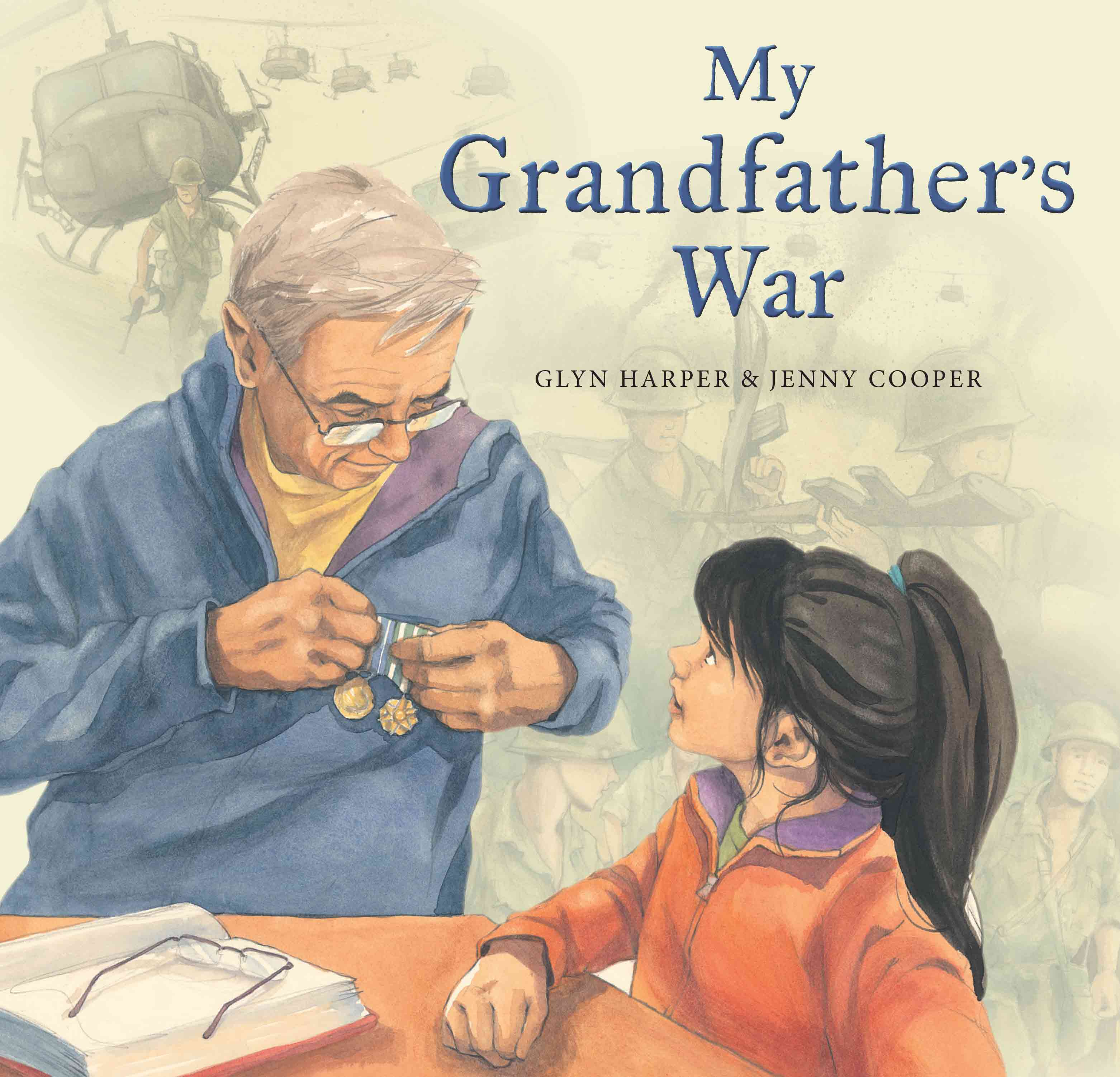
My grandfather’s war by Glyn Harper, illustrated by Jenny Cooper


My grandfather’s war by Glyn Harper, illustrated by Jenny Cooper (EK Books, 2018)

32 pages with full page colour illustrations (hardback edition)

Subjects: Vietnam, grandparents, veterans, picture books (Year 3-4)


Synopsis
My Grandfather’s War tells the story of 8-year-old Sarah and her grandfather Robert, who lives with her family and looks after her before and after school. The pair have a close relationship and Sarah is sensitive to her grandfather’s occasional spells of sadness. The family doesn’t talk about these, except to tell Sarah that he is thinking about a war in a place called Vietnam.

When Sarah summons up her courage to ask her grandfather why he feels sad, he tells her about his time in Vietnam. The flashbacks of his memory present images of a war which was “not like other wars” and he also tells Sarah about the difficulties the troops faced when they returned home, from anti-war protesters and the after-effects of chemicals.

This is a reworked version of an earlier book, now with the added magic of Glyn Harper’s collaboration with Jenny Cooper, whose illustrations show the warm bond between grandfather and grandchild. 

Another thing I really liked about this book is how it models (to both children and adults) how to handle difficult conversations. Sarah is nervous about asking her question but summons up the courage to do so because she loves her grandfather. She tells him that she’s scared and he acknowledges that with a serious, concerned expression (that picture is one of my favourites). Her grandfather doesn’t fob her off and answers carefully but truthfully. The conversation doesn’t make his sadness go away but now Sarah understands it better.

Reviews
Kids book reviews calls it "the perfect mix of narrative and history" and "a gentle educational tool, highly recommended" for classrooms. 
Teacher notes are available here and include some thoughtful comments from Jenny about how she approaches the subject of war as an illustrator.

Author’s website
Glyn Harper is Professor of War Studies at Massey University in Palmerston North, New Zealand. He is Massey's Project Manager of the Centenary History of New Zealand and the First World War. A former teacher, he joined the Australian Army in 1988 and after eight years transferred to the New Zealand Army, where he rose to the rank of lieutenant colonel. Glyn was the army's official historian for the deployment to East Timor and is the author of numerous history books. (From the Penguin website)

Info about the illustrator
Jenny Cooper is a wonderful artist who has illustrated more than 70 children’s books. Read more about her on the Book Council site or Christchurch City libraries or Storylines.

Other books you might like
This is the sixth book that Glyn Harper and Jenny Cooper have worked on together. Their previous titles are Roly the Anzac donkey, Jim’s letters, Le Quesnoy: the story of the town New Zealand saved, Gladys goes to war and Bobby the littlest war hero.
There aren’t many books for young readers about Vietnam. Memorial by Gary Crew and Lest we forget by Feana Tu’akoi both touch on it. Other books are Vietnam diary by Mark Wilson and I was only nineteen by John Schumann.
Books about the grandfather-grandchild relationship include Grandad’s medals by Tracy Duncan.

Have you read it?
Have you read this book? Let me know what you think!

Monday, 23 April 2018

The red poppy by David Hill, illustrated by Fifi Colston

The red poppy by David Hill, illustrated by Fifi Colston (Scholastic, 2012)

Also published in te reo as Te Popi Whero. 

Subjects: World War One, France, poppy, dogs, animals, picture books (Year 3-6)


The Red Poppy (Book and CD)

Synopsis

Jim McLeod is a young soldier like any other, waiting in the trenches as the time of attack draws nearer. Nipper is a stray dog, found in an abandoned French  village, whom the soldiers have trained to act as a messenger dog, carrying messages in a leather bag around his neck (and he was a good rat-killer as well).

The only patch of colour is a cluster of poppies amidst the grey mud. Jim, an "enemy" German soldier and Nipper are about to see their paths meet - and the poppies have a role to play as well.

There's a CD at the back of the book  (and lyrics on the back page) featuring an original song (Little red poppy) written by Canadian musician Rob Kennedy and performed by Giselle Sanderson. (David Hill says in the acknowledgements that the song "started everything off".) Little red poppy has now been sung at commemoration services around the world and you can listen to it here on You tube.

You can also listen to The red poppy on Radio NZ's Treasure chest.

Reviews:
My bestfriends are books interviews David and Fifi about family history, writing this book and what it meant to them. 
Kids' book review calls it "a breathtaking and deeply moving book. It’s about a man, a war, and the basic concepts of humankind. It’s about a dog, an unlikely friendship and the iconic red poppy used to commemorate our fallen". 
You can find teacher notes from Scholastic here. 

About the author:
David Hill is one of New Zealand's best (and best loved) writers for children and young adults. You can read more about him on the NZ Book Council site or the Christchurch City libraries site. 
His other books with a war theme include Enemy camp and Flight path.  (Interestingly, he says in this newspaper interview that he started writing war stories because "it became embarrassing for an "old guy" to try and write contemporary teenage slang ".)

About the illustrator:
Fifi Colston has a great website with this page about her children's book illustration (including The red poppy).  

Other books you might like:
Caesar the Anzac dog and The Anzac puppy are both stories about dogs in World War One.

Links
Dogs were used for many different purposes in World War One (there was even a War Dog School Of Instruction). This article has some interesting facts about "four-legged fighters". 
This one has a picture of a dog wearing a gas mask. 
More pictures and info here and here. 

Have you read it?
Have you read this book? Let me know what you think!

Wednesday, 13 December 2017

The duck in the gun by Joy Cowley, illustrated by Robyn Belton

The duck in the gun by Joy Cowley, illustrated by Robyn Belton (Walker Books, 2009; first published 1969)

32 pages with delightful colour illustrations

Subjects: peace, ducks, animals, picture books (Year 2-6)

Image result for The duck in the gun by Joy Cowley

Synopsis
For the last post of the year, it seems appropriate to feature a book about peace -
“The General and his men are about to fire on a town they are at war with. But the Gunner has bad news for the General – they can’t load the gun as there is a duck nesting inside it! Determined to not let a single duck stop an army, the General visits the Prime Minister of the town he is preparing to fight to resolve the situation. Can one duck put an end to the war?” (Outline from Walker Books)

This book won the NZLA Russell Clark Award and was also one of ten children’s books selected for the Hiroshima Peace Memorial Museum. You can see the 1984 Shortland Educational Publications edition online at the International Children’s Digital Library.

Activities
Lots of good classroom ideas here.

Questions
There are some very good questions in Walker Books’ list of classroom ideas (shown above), including these ones:
“What does ‘peace’ mean to you? 
Do you have a favourite place that makes you feel at peace, or a person that makes you feel peaceful? 
Draw a place, person (this can be imaginary or real) that makes you feel this way.”

About the author
One of New Zealand's best-loved writers, Joy Cowley needs little introduction. 

About the illustrator
RobynBelton is also well known for her many prize-winning children’s books. 

I love the illustrations in this book. One of my favourites is the picture of the General  relaxing over his newspaper while his men are painting houses in the town (that's the town they are supposed to be at war with!)

Other books you might like:
Other anti-war books for children include The story of Ferdinand by Munro Leaf, The general by Janet Charters, illustrated by Michael Foreman, Bravo! by Philip Waechter and Moni Port and Thebutter battle book by Dr Seuss.

Things I didn’t know
In the brief bios at the back, Robyn Belton says she added a dog that wasn’t in Joy’s text, to act as a “mirror” - “amplifying the gestures and expressions of the girl”. 
Joy says that the book grew out of her “feelings of distress” about the Vietnam War in the late 1960s, combined with a heart-warming news story about a duck that made its nest on a building site in Chicago and halted construction for three weeks.   

Have you read it?
Have you read this book? Let me know what you think!

Thursday, 12 October 2017

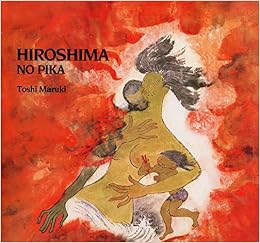
Hiroshima no pika written and illustrated by Toshi Maruki

Hiroshima no pika written and illustrated by Toshi Maruki (translation of the same Japanese title; New York: Lothrop, Lee & Shepard, 1980)

48 pages with colour illustrations, sometimes full page double spreads

Subjects: World War Two, Hiroshima, atomic bomb, anti-war books, Japan, picture books (Year 6-8)

Image result for Hiroshima no pika

Synopsis

This is based on a first-person account that the author heard when he was holding an exhibition of pictures about the atomic bomb in a small town in Hokkaido.

It begins with a cloudless blue morning in Hiroshima, with streetcars picking up people on their way to work and the seven rivers flowing quietly through the city. Seven-year-old Mii and her parents are breakfasting on sweet potatoes “brought in the day before by cousins who lived in the country” when the bomb falls at 8.15am on August 6, 1945. Mii’s mother carries her injured husband on her back across the city, across rivers and all the way to the coast, where they stay for days until he is taken into a makeshift hospital: “no doctors, no medicine, no bandages – only shelter.” 

The illustrations are stylised but portray a powerful sense of the horror of the event, and the consequent suffering, partly through the lurid and unnatural colours of the skies and surroundings.

This is a terrible event, and parts of the text would be upsetting to younger (or even older) children: the mother carrying a dead baby, the floating bodies, the wasteland of the city, Mii’s father’s death, the glass slivers that poke their way out of her scalp in years to come.

Look out for the red chopsticks that Mii clutches for days after the Flash, until her mother manages to prise them from her grip. It’s a clever way to identify her on each page, but also hints at the hidden trauma she has undergone.

The book feeds in some factual details about the atomic bomb and ends with the lantern memorial service held each year on the seven rivers. I couldn’t see a translation of the title anywhere – maybe I missed it – but it means The Flash of Hiroshima.  

Reviews:
An entry in Kirkus reviews is always prestigious. “Japanese artist and antiwar activist Maruki manages to avoid the opposing perils of giving children nightmares and belittling the horror.”

About the author
Toshi Maruki (1912–2000) was born in Hokkaido and studied Western art at the Joshibi Women's School of Art and Design.
“I am now past seventy years old. I have neither children nor grandchildren. But I have written this book for grandchildren everywhere. It took me a very long time to complete it. It is very difficult to tell young people about something bad that happened in the hope that their knowing will help keep it from happening again.”

Maruki Gallery for the Hiroshima Panels, established by husband and wife Iri and Toshi Maruki, "is famous for its message for peace all over the world". The artist couple went into Hiroshima city just three days after the bombing and spent 30 years painting the 15 panels.

Other books you might like:
Sadako by Eleanor Coerr, illustrated by Ed Young, also tells of a young girl in Hiroshima. 

Things I didn’t know
I didn’t know that other Japanese cities like Tokyo, Osaka and Nagoya had already experienced air raids, so the people of Hiroshima were readying for them by storing water and making evacuation plans. There is a sad poignancy in the statement that “Everyone carried small bags of medicine and when they were out of doors, wore air-raid hats or hoods to protect their heads.”

Have you read it?
Have you read this book? Let me know what you think!
Sunday, 6 August 2017

Three books by Mark Wilson

Angel of Kokoda (Lothian Children’s Books, 2010)
Vietnam diary (Lothian Children’s Books, 2013)
The Afghanistan pup (Lothian Children’s Books, 2014)

All similar format: hardback, 32 pages with full colour illustrations

Subjects: World War Two, Papua New Guinea, Pacific, Vietnam, brothers, Afghanistan, animals, dogs, mascots, picture books (Year 3-6)


Synopsis
A Papua New Guinea boy helps a wounded Australian soldier along the Kokoda Track. A young man goes off to fight in Vietnam, despite the protests of his brother. A dog is rescued from the ruins of a bombed school and becomes a soldier’s pet. 

These three books are part of the Children in War series which explores children’s experiences of, and reactions to, four different wars involving Australians:  World War One, World War Two, the Vietnam War and the war in Afghanistan. The texts are clear and not too detailed (apart from the Vietnam one, which includes handwritten diary entries).

They are well-produced books that cover lesser known aspects of war, although I would have liked some more context for each story (perhaps because they are very Australian - oriented). 

Reviews
Reading time (from the Children's Book Council of Australia)
reviews The Afghanistan pup here and admires the way that Mark Wilson "skilfully weaves narratives that tell stories of tragedy and hope with his extraordinarily evocative illustrations", while "snippets of newspaper clippings, reports, poems and letters enrich the stories and add layers of meaning."

There are teacher notes and activities - 
for The Afghanistan pup here 
for Angel of Kokoda here
for Vietnam diary here.

About the author: 
Mark Wilson's website shows his prolific and impressive output and also talks about his interesting life and varied career!

Other books you might like: Also by the same author is My mother’s eyes: the story of a boy soldier.  Mark Wilson illustrated A day to remember: the story of Anzac Day by Jackie French.

Have you read it? Have you read these books? Let me know what you think!

Friday, 14 July 2017

A present from the past by Jennifer Beck; illustrated by Lindy Fisher

A present from the past by Jennifer Beck; illustrated by Lindy Fisher (Scholastic, 2006)

32 pages with colour illustrations

Subjects: World War One, France, Christmas, nurses, women in war, grandparents, family, picture books (Year 1-4)


Synopsis

It’s nearly Christmas time. Emily is waiting with her parents at the airport for her Aunt Mary whom she’s never met before. Aunt Mary has come all the way from England, bringing a special gift: a small oblong parcel, with a note saying “Best wishes from Princess Mary”. Inside, to Emily’s disappointment, is nothing but a small brass box with a damaged lid. But as Aunt Mary tells the story behind the box, Emily comes to realise that it is indeed a precious family heirloom.

These boxes, containing items such as sweets and tobacco, were the idea of Princess Mary, the 17-year-old daughter of King George V and Queen Mary, who wanted to give every serving soldier, sailor and nurse a Christmas present in December 1914 as a personal thank you for their sacrifices and hard work. You can read more about them here and here.

These Christmas boxes make a lovely story on their own, but the box in this book played an even more important role.

Don’t miss the dedication: “In memory of women in wartime”. There is also a fact sheet at the end.

Reviews:
A review on Perfect Picture Book Friday says the book "would be a great resource in History classes enticing conversations about war, troops overseas, and families dealing with loved ones during war time in the past."

There's another review on Momo celebrating time to read (great title for a blog!) 

About the author
You can read an interview with Jennifer Beck on the Christchurch City Libraries website, or learn more about her on the Book Council Writers files. 

About the illustrator
Lindy Fisher is profiled on the Book Council and Storylines sites. She has also had over 75 stamps published by New Zealand Post! You can see some of her artwork on her website.

Other books you might like:
Jennifer Beck is the author of the much-loved picture book The bantam and the soldier. She and Lindy Fisher have worked together on other books, including Stefania’s dancing slippers and Remember that November (about Parihaka).

NZ connections:
When I was researching for my Anzac Day book, I got to see one of these tins. It belonged to Hami Grace, an old boy of Wellington College, and is now held in the College Archives.


Things I didn’t know
I didn’t know that Princess Mary was born on 25 April (1897) – the day that later became Anzac Day! What a lovely connection!

Have you read it?
Have you read this book? Let me know what you think!

Tuesday, 25 April 2017

The butter battle book by Dr Seuss

The butter battle book by Dr Seuss (Random House, 1984)

48 pages with typical Dr Seuss style illustrations!

Subjects: anti-war books, fable, picture books (Year 3-8)


Synopsis
Written in Dr Seuss’ usual zany rhyming style, this book tells the story of two neighbouring communities – Yooks and Zooks – who are divided by their differing opinions on the best way to butter their bread. Things get more heated, and following an initial exchange with a slingshot, the Boys in the Back Room dream up bigger, crazily-named and ever more powerful weapons.

But it’s also a metaphorical look at The Cold War (after all, it’s surely no coincidence that “Yooks” and “Zooks” sound like “Nukes”, and that they are divided by a Wall.) As I got closer to the end, I wondered how it was going to finish and whether the escalating situation could be resolved – but it ends on top of the wall in a situation of total uncertainty.

You can read the whole text online here. 
Or you can watch it on YouTube. 

Reviews:
The Teach Peace Foundation calls it an “anti-war…children’s rhyming story addressing fears from the cold war era during which it was written. Specifically it deals with the nuclear war and the possibility of mutually assured destruction”. The website has some suggested teaching notes. 

Questions:
Does it matter which way up your butter your bread?
What are some equivalent differences between people in today’s world? (Which way do you...?) 
The Teaching Children Philosophy site also poses lots of good questions arising from this story.

About the author
Everyone knows Theodor Seuss Geisel (1904-1991) in other words, Dr Seuss! 
Some things I didn’t know about him –
  • His first book, And to think that I saw it on Mulberry Street, was rejected 27 times before being published by Vanguard Press
  • Seuss was his middle name and his mother’s maiden name
  • And my favourite fact: his mother used to soothe her children to sleep by chanting rhymes, which is where Dr Seuss thought he got his ability to rhyme from.


Find out more about him here. 
And see more of his art here. 

Other things I didn’t know
According to the Teach Peace Foundation, this book “was censored and taken out of public libraries for its obvious statements against the arms race between the United States and the Soviet Union.”

Other books you might like:
Other anti-war picture books include The story of Ferdinand by Munro Leaf, The general by Janet Charters, illustrated by Michael Foreman, and Bravo! by Philip Waechter and Moni Port.

Have you read it?
Have you read this book? Let me know what you think! 

Sunday, 2 April 2017

A day to remember: the story of Anzac Day by Jackie French, illustrated by Mark Wilson

A day to remember: the story of Anzac Day by Jackie French, illustrated by Mark Wilson (Angus & Robertson, 2012)

32 pages with Mark Wilson’s colour and black and white illustrations

Subjects: World War One, Gallipoli, World War Two, Korean War, Vietnam War, protest movement, Anzac Day, picture books, non fiction (Year 5-8)


Synopsis
This book tells the story of Anzac Day by tying the date of 25 April to specific events in particular years, starting with the first landings at Gallipoli on 25 April 1915. The first Anzac Day parades and services are held in 1916; in 1918, the war still continues, but it is over by 25 April 1919. In the late 1920s, the tradition of the dawn service begins; in the 1930s, many returned soldiers are suffering through the Depression. Anzac Day continues to be marked through World War Two, the Korean War and the protest years of the Vietnam War.

The book continues up to the present day through Australian involvement (again often controversial) in other wars, such as in Iraq and Afghanistan, and traces the increased interest in visiting Gallipoli for the dawn service at Anzac Cove.

Teacher’s notes include Jackie French talking about her inspiration for the book, and Mark Wilson talking about his technique and how he interpreted his task. The figures on the cover are his son and granddaughter – how lovely is that?

Reviews:
Kids Book Review recommends it highly, saying that "You know a book by Jackie French is going to be researched to the nth degree, and presented with clarity, emotion and fascination - and A Day to Remember is no exception."

The never-ending bookshelf says is it is a picture book that adults would enjoy and learn from as well; "What I found particularly interesting with this book was the way that Jackie French focused on the concept and meaning of Anzac day through various generations and the way that it was developed, shaped and then lessened in meaning before reaching height again today." This reviewer suggests it is not for young children under 8, "as it is very heavy on the history and less narrative based". 


Author’s website
Jackie French is an amazing writer with a brilliant website which features a page on this book. Her other war-related books include The beach they Called Gallipoli, Pennies for Hitler and A rose for the Anzac boys.

Illustrator’s website

NZ connections:
Are we mentioned? Yes, often (thanks, Jackie French!) Sometimes the New Zealanders are left out of (Australian) books on Anzac, so it’s good to see their contribution recognised.

I also appreciated seeing the Aboriginal and Torres Strait Islander soldiers acknowledged, men who “fought long ago in the service of a land where many were not even allowed to vote”.

Have you read it?
Have you read this book? Let me know what you think!

Monday, 3 October 2016

Anzac biscuits by Phil Cummings

Anzac biscuits by Phil Cummings, illustrated by Owen Swan (Scholastic, 2013)

32 pages with full page illustrations

Subjects: World War One, Australia, family, food, picture books (Year 1-3)

Synopsis
This book seems to be set during World War One but that is never actually stated, although there are clues (barbed wire, choking smells, snow, trenches suggest Europe; the “smell of burning red gum” suggests Australia).

The story, told in very few words, alternates between Rachel and her mother baking biscuits in their cosy farmhouse, and Rachel’s father alone on the battlefield, tramping through the mud and sheltering from the weather and the gunfire. The colours alternate between warm colours and colder hues, but the two worlds are linked by mirrored words, images and actions and by a framed photograph of her father on the farmhouse wall.  

I’ve said “alone” because the soldier is completely alone in almost every scene (in one spread, he is trudging behind two other men, but we can’t see their faces.) It feels odd and unusual to have a battlefield shown as being so empty, but it does underline his loneliness and separation from his family. 

On the final page, the biscuits have found their way to Rachel’s father on the other side of the world. The back page blurb says: “This is a touching story of a family torn apart by war but brought together through the powerful simplicity of ANZAC biscuits.”

At first reading, I found it a bit disconcerting that Rachel and her mother could be singing, dancing and laughing. But actually I think that is a good message: that you can miss someone, but you don’t have to be miserable all the time, or feel guilty about having happy moments. (I think that’s why the empty battlefield bothered me, because many soldiers did find companionship with their mates).

Reviews:                                                         
My little bookcase calls it “a tender story of war” that “shows the private moments of families who are left behind to worry about their fathers, brothers, uncles and sons.”

Kids’ book review says it offers a gentle narrative that isn’t too scary or confronting.

Aussie reviews calls it "a lovely tale, and a beautiful way of introducing both the subject of war and the history of Anzac biscuits".

Questions:                                               
“The soldier bravely lifted his head to peer across the fields.” I’m still wondering about this line - is he brave or not? Shouldn’t he be keeping his head down?

About the author
You can see Phil Cummings' website here. You can also watch him talk about Anzac biscuits and his inspiration or the book. 

About the illustrator
You can read about Owen Swan and some of the other books he has illustrated here. 

Other books you might like
The Anzac puppy by Peter Millett is another non-confrontational book about war for this age group.

Have you read it?                          
Have you read this book? Let me know what you think!