Showing posts with label Hiroshima no pika. Show all posts

Thursday, 12 October 2017

Hiroshima no pika written and illustrated by Toshi Maruki

Hiroshima no pika written and illustrated by Toshi Maruki (translation of the same Japanese title; New York: Lothrop, Lee & Shepard, 1980)

48 pages with colour illustrations, sometimes full page double spreads

Subjects: World War Two, Hiroshima, atomic bomb, anti-war books, Japan, picture books (Year 6-8)
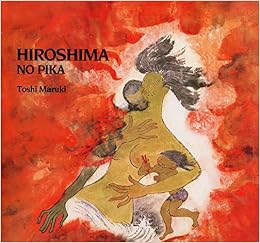
Image result for Hiroshima no pika

Synopsis

This is based on a first-person account that the author heard when he was holding an exhibition of pictures about the atomic bomb in a small town in Hokkaido.

It begins with a cloudless blue morning in Hiroshima, with streetcars picking up people on their way to work and the seven rivers flowing quietly through the city. Seven-year-old Mii and her parents are breakfasting on sweet potatoes “brought in the day before by cousins who lived in the country” when the bomb falls at 8.15am on August 6, 1945. Mii’s mother carries her injured husband on her back across the city, across rivers and all the way to the coast, where they stay for days until he is taken into a makeshift hospital: “no doctors, no medicine, no bandages – only shelter.” 

The illustrations are stylised but portray a powerful sense of the horror of the event, and the consequent suffering, partly through the lurid and unnatural colours of the skies and surroundings.

This is a terrible event, and parts of the text would be upsetting to younger (or even older) children: the mother carrying a dead baby, the floating bodies, the wasteland of the city, Mii’s father’s death, the glass slivers that poke their way out of her scalp in years to come.

Look out for the red chopsticks that Mii clutches for days after the Flash, until her mother manages to prise them from her grip. It’s a clever way to identify her on each page, but also hints at the hidden trauma she has undergone.

The book feeds in some factual details about the atomic bomb and ends with the lantern memorial service held each year on the seven rivers. I couldn’t see a translation of the title anywhere – maybe I missed it – but it means The Flash of Hiroshima.  

Reviews:
An entry in Kirkus reviews is always prestigious. “Japanese artist and antiwar activist Maruki manages to avoid the opposing perils of giving children nightmares and belittling the horror.”

About the author
Toshi Maruki (1912–2000) was born in Hokkaido and studied Western art at the Joshibi Women's School of Art and Design.
“I am now past seventy years old. I have neither children nor grandchildren. But I have written this book for grandchildren everywhere. It took me a very long time to complete it. It is very difficult to tell young people about something bad that happened in the hope that their knowing will help keep it from happening again.”

Maruki Gallery for the Hiroshima Panels, established by husband and wife Iri and Toshi Maruki, "is famous for its message for peace all over the world". The artist couple went into Hiroshima city just three days after the bombing and spent 30 years painting the 15 panels.

Other books you might like:
Sadako by Eleanor Coerr, illustrated by Ed Young, also tells of a young girl in Hiroshima. 

Things I didn’t know
I didn’t know that other Japanese cities like Tokyo, Osaka and Nagoya had already experienced air raids, so the people of Hiroshima were readying for them by storing water and making evacuation plans. There is a sad poignancy in the statement that “Everyone carried small bags of medicine and when they were out of doors, wore air-raid hats or hoods to protect their heads.”

Have you read it?
Have you read this book? Let me know what you think!

Sunday, 8 February 2015

A child's war: questions and answers

Mary Skarott is Research Librarian, Children’s Literature at the National Library. Recently she has curated an exhibition called "A child's war", which explores how children in New Zealand were affected by the Great War (or World War One.) 

The exhibition runs until 27 February, so if you are in Wellington, do try and see it. You can read more about it here, and Mary has also written a fascinating blog post about the effect of WW1 on school prizes. 

I asked Mary if she would answer some questions for me about her experience of putting the exhibition together, and I'm so glad she agreed because what she has to say is so interesting, especially her ideas about how writing about war for children has changed over the years. I'm looking forward to tracking down some of the books she mentions. 

Covers of three books from the children's collections: A child's history of ANZAC; Munition Mary; and the Boy Allies on the North Sea Patrol.
L-R: A child's history of ANZACMunition MaryThe boy allies on the North Sea patrol
                
  • A child's war contains a wide variety of material (and even an opportunity for people to sit and do a spot of knitting!) How did you decide what to put in the exhibition?
There are two main components to the exhibition: the books that children read during wartime (focusing on those that are actually about WWI), and an examination of how children in New Zealand were affected by and involved in the war, both at school and at home. It is very interesting to see how these two aspects intertwine: the content of the books is very much a reflection of the patriotic fervour of the time.

Part of my job is to look after the Dorothy Neal White Collection of pre-1940 children’s books, so I knew that there was a wealth of material there to choose from, although narrowing it down to 16 books in display cases and 9 cover images on the wall was certainly a difficult task. It was a matter of balancing interesting written content with visual appeal. Some really interesting books had to be discounted purely for aesthetic reasons. I particularly wanted visitors to be able to see inside the books, so many of them are displayed open. I also wanted to include material that was marketed for both boys and girls. The book cover images include some striking examples of the use of persuasive imagery.

It was the other component of the exhibition that I found the more challenging in terms of selecting material. After a lot of searching to identify potential items in the collections and a lot of background reading some clear topics began to stand out for me. I decided to select case items and images to go with four subjects that I felt would effectively illustrate what children experienced during the war: military cadets, patriotism in schools, fundraising and warwork, and the impact on family life. Again, it was a matter of balancing text and images.  

Large format photographs are a key part of this section, and visitors have said how much they enjoy seeing the detail in them such as the old buildings and people’s clothing and facial expressions. Other items that begged to be included are the School Journals, Her Excellency’s knitting book, and letters and drawings from two of Lieutenant-Colonel William Malone’s sons sent to their father after his departure to the war.
  
  • I really enjoyed looking at the selection of children’s books from the Dorothy Neal White Collection that were published during World War I. What were some of these that stood out for you?
First pick would have to be Elphinstone Thorpe’s Nursery rhymes for fighting times, with illustrations by G.A. Stevens (London: Everett, 1915). Visitor’s jaws invariably drop when they see this one, open at her rewrite of Mary, Mary, quite contrary:

                Belgian Mary, quite contrary,
                                How does your garden grow?
                With German shells and poisoned wells,
                                And ruined folk all in a row.

I was also particularly taken with Munition Mary, by Brenda Girvin (London: Humphrey Milford, Oxford University Press, 1918) because it is one of the few stories written about a girl taking an active part in the war effort, beyond knitting socks for the soldiers. Mary, who comes from a well-to-do London family decides to seek work in a munitions factory.
Notable for its speed of production is Mrs Belloc Lowndes’ Told in gallant deeds: a child’s history of the war (London: James Nisbet & Co., 1914), which gives accounts (very much from a British perspective) of battles fought during the first months of the war. I wonder whether, when she started to write it, she thought like many others that the war would be over by Christmas.

  • You mentioned that the National Children’s Collection holds a number of contemporary children's books about WWI. What are some of the differences that you see in how children's writers today approach the subject of WWI, compared to how they wrote about it 100 years ago?
Many of the children’s writers producing books during WWI were motivated by the desire to promote the cause of the Empire, and consequently imperial attitudes feature strongly in their writing. The adventure stories aimed at boys tended to paint a sanitised picture of conditions at the Front, focusing on heroism and derring-do rather than pain or death. There was unrelenting patriotism, and national stereotypes abounded.

In contrast, contemporary writers have very different motives, and the approach looking back generally produces works that are much less black and white and which recognise the complexities of war.
Some of the key differences are:
-Inclusion of the conscientious objector’s viewpoint
-Acknowledging the devastating impact of battle on soldiers at the front line (both physical and psychological)
-Acknowledging the enemy as human, not as a national stereotype
-Taking a critical view of the justification for the war, and poor leadership decisions
-The use of primary source material such as diaries and letters
  
  • In your job, you must get to see lots of children's books about war that many of us have forgotten about, or don't even know about. What do you think are some of the little known treasures in the Library's collection?
Two more WWI books that nearly made it into the exhibition:
Mary Grant Bruce, From Billabong to London (London: Ward Lock, 1915)
Mary Grant Bruce, Captain Jim (London: Ward Lock, 1919)

Mary Treadgold, We couldn’t leave Dinah (London: Cape, 1941)
Winner of the 1941 Carnegie Medal. Set on the Channel Islands during Nazi occupation.

Two of my favourite sophisticated picture books. These are still on some public library shelves, but are old enough that they may not be familiar to all:
Raymond Briggs, The tin-pot foreign general and the old iron woman (London: Hamish Hamilton, 1984) An allegorical treatment of the Falkland Islands War.

Toshi Maruki, Hiroshima no pika (New York: Lothrop, Lee & Shepard, 1980)
A retelling of a mother’s account of what happened to her family in the destruction of Hiroshima by atomic bomb in 1945.