Showing posts with label grandparents. Show all posts

Sunday, 24 June 2018

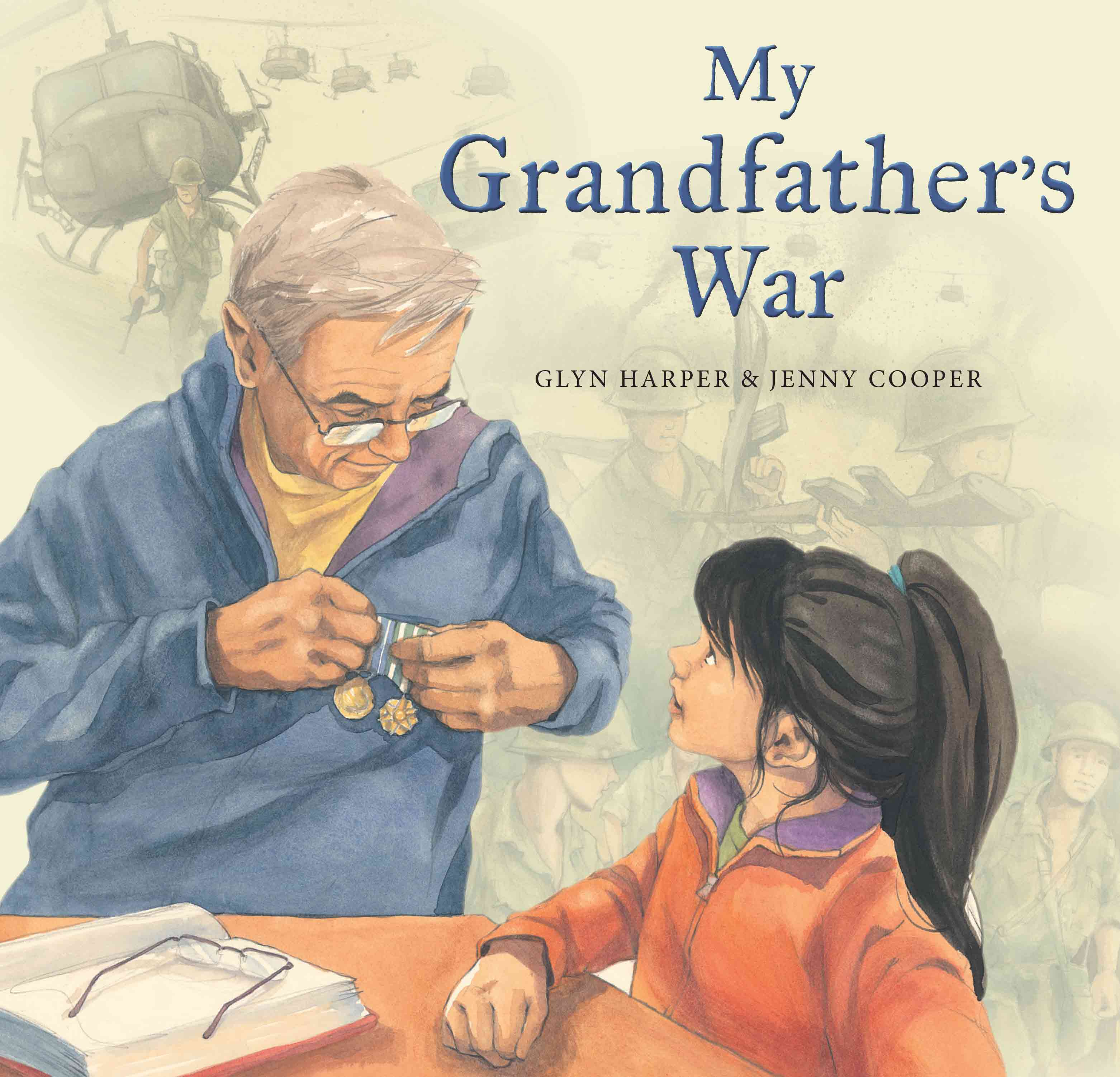
My grandfather’s war by Glyn Harper, illustrated by Jenny Cooper


My grandfather’s war by Glyn Harper, illustrated by Jenny Cooper (EK Books, 2018)

32 pages with full page colour illustrations (hardback edition)

Subjects: Vietnam, grandparents, veterans, picture books (Year 3-4)


Synopsis
My Grandfather’s War tells the story of 8-year-old Sarah and her grandfather Robert, who lives with her family and looks after her before and after school. The pair have a close relationship and Sarah is sensitive to her grandfather’s occasional spells of sadness. The family doesn’t talk about these, except to tell Sarah that he is thinking about a war in a place called Vietnam.

When Sarah summons up her courage to ask her grandfather why he feels sad, he tells her about his time in Vietnam. The flashbacks of his memory present images of a war which was “not like other wars” and he also tells Sarah about the difficulties the troops faced when they returned home, from anti-war protesters and the after-effects of chemicals.

This is a reworked version of an earlier book, now with the added magic of Glyn Harper’s collaboration with Jenny Cooper, whose illustrations show the warm bond between grandfather and grandchild. 

Another thing I really liked about this book is how it models (to both children and adults) how to handle difficult conversations. Sarah is nervous about asking her question but summons up the courage to do so because she loves her grandfather. She tells him that she’s scared and he acknowledges that with a serious, concerned expression (that picture is one of my favourites). Her grandfather doesn’t fob her off and answers carefully but truthfully. The conversation doesn’t make his sadness go away but now Sarah understands it better.

Reviews
Kids book reviews calls it "the perfect mix of narrative and history" and "a gentle educational tool, highly recommended" for classrooms. 
Teacher notes are available here and include some thoughtful comments from Jenny about how she approaches the subject of war as an illustrator.

Author’s website
Glyn Harper is Professor of War Studies at Massey University in Palmerston North, New Zealand. He is Massey's Project Manager of the Centenary History of New Zealand and the First World War. A former teacher, he joined the Australian Army in 1988 and after eight years transferred to the New Zealand Army, where he rose to the rank of lieutenant colonel. Glyn was the army's official historian for the deployment to East Timor and is the author of numerous history books. (From the Penguin website)

Info about the illustrator
Jenny Cooper is a wonderful artist who has illustrated more than 70 children’s books. Read more about her on the Book Council site or Christchurch City libraries or Storylines.

Other books you might like
This is the sixth book that Glyn Harper and Jenny Cooper have worked on together. Their previous titles are Roly the Anzac donkey, Jim’s letters, Le Quesnoy: the story of the town New Zealand saved, Gladys goes to war and Bobby the littlest war hero.
There aren’t many books for young readers about Vietnam. Memorial by Gary Crew and Lest we forget by Feana Tu’akoi both touch on it. Other books are Vietnam diary by Mark Wilson and I was only nineteen by John Schumann.
Books about the grandfather-grandchild relationship include Grandad’s medals by Tracy Duncan.

Have you read it?
Have you read this book? Let me know what you think!

Friday, 14 July 2017

A present from the past by Jennifer Beck; illustrated by Lindy Fisher

A present from the past by Jennifer Beck; illustrated by Lindy Fisher (Scholastic, 2006)

32 pages with colour illustrations

Subjects: World War One, France, Christmas, nurses, women in war, grandparents, family, picture books (Year 1-4)


Synopsis

It’s nearly Christmas time. Emily is waiting with her parents at the airport for her Aunt Mary whom she’s never met before. Aunt Mary has come all the way from England, bringing a special gift: a small oblong parcel, with a note saying “Best wishes from Princess Mary”. Inside, to Emily’s disappointment, is nothing but a small brass box with a damaged lid. But as Aunt Mary tells the story behind the box, Emily comes to realise that it is indeed a precious family heirloom.

These boxes, containing items such as sweets and tobacco, were the idea of Princess Mary, the 17-year-old daughter of King George V and Queen Mary, who wanted to give every serving soldier, sailor and nurse a Christmas present in December 1914 as a personal thank you for their sacrifices and hard work. You can read more about them here and here.

These Christmas boxes make a lovely story on their own, but the box in this book played an even more important role.

Don’t miss the dedication: “In memory of women in wartime”. There is also a fact sheet at the end.

Reviews:
A review on Perfect Picture Book Friday says the book "would be a great resource in History classes enticing conversations about war, troops overseas, and families dealing with loved ones during war time in the past."

There's another review on Momo celebrating time to read (great title for a blog!) 

About the author
You can read an interview with Jennifer Beck on the Christchurch City Libraries website, or learn more about her on the Book Council Writers files

About the illustrator
Lindy Fisher is profiled on the Book Council and Storylines sites. She has also had over 75 stamps published by New Zealand Post! You can see some of her artwork on her website.

Other books you might like:
Jennifer Beck is the author of the much-loved picture book The bantam and the soldier. She and Lindy Fisher have worked together on other books, including Stefania’s dancing slippers and Remember that November (about Parihaka).

NZ connections:
When I was researching for my Anzac Day book, I got to see one of these tins. It belonged to Hami Grace, an old boy of Wellington College, and is now held in the College Archives.


Things I didn’t know
I didn’t know that Princess Mary was born on 25 April (1897) – the day that later became Anzac Day! What a lovely connection!

Have you read it?
Have you read this book? Let me know what you think!

Saturday, 24 September 2016

Grandad’s medals by Tracy Duncan, illustrated by Bruce Potter

Grandad’s medals by Tracy Duncan, illustrated by Bruce Potter (Reed, 2005)

32 pages with colour illustrations

Subjects: grandparents, Anzac Day, picture books (Year 1-4)


Synopsis
The first half of this picture book shows a young boy’s relationship with his grandfather. They go fishing together, fly kites and gather pinecones (accompanied by the dog). They stack wood for fires on winter nights when Grandad tells stories “about the old days”, and sometimes the boy plays with the medals he got when he was a soldier in an (unnamed) war, “a long time ago”.

All this leads up to Anzac Day, when the boy and his mother (and the dog!) get up early and go down to the RSA hall to watch his Grandad – wearing his medals - march in the dawn parade. There is a simple description of the service, seen from the boy’s point of view: songs, speeches, the Last Post, the silence, the national anthem, laying of wreaths and a cup of tea and a biscuit afterwards. The boy notices that some familiar faces are missing this year, including Grandad’s best friend, and how all the soldiers are getting older.

At the end, the boy and his grandfather sit and look at the medals for a while, until Grandad puts them away, and then they go fishing again - which is a nice ending. 

As a writer, I was intrigued by the way in which the medals of the title act as a focus or a symbol through which to tell the story, even though they are only mentioned on three pages in the text (but appear more often in the illustrations). You can tell by the cover illustration that the young boy is fascinated by their “shiny silver faces”.

Questions:
Have you ever been to an Anzac Day dawn service? Was it like this one?

About the author
Tracy Duncan is an artist and writer who lives near Nelson. She has written and illustrated many books in both te reo Māori and in English.

About the illustrator
Bruce Potter has also illustrated The Donkey Man by Glyn Harper, Grandad's Medals text by Tracy Duncan, Soldier in the Yellow socks: Charles Upham: Our Finest Fighting Soldier text by Janice Marriott and My Grandfather's War text by Glyn Harper

Have you read it?
Have you read this book? Let me know what you think!

Wednesday, 29 July 2015

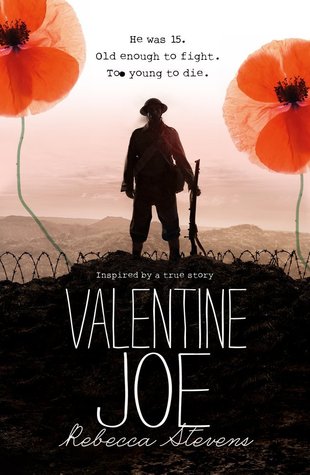
Valentine Joe by Rebecca Stevens

Valentine Joe by Rebecca Stevens (The Chicken House, 2014)

15 chapters; 154 pages

Subjects: World War One, France, Ypres, Belgium, Menin Gate, grandparents, boy soldiers, time travel, junior fiction (Year 5-8)

18663734

Synopsis
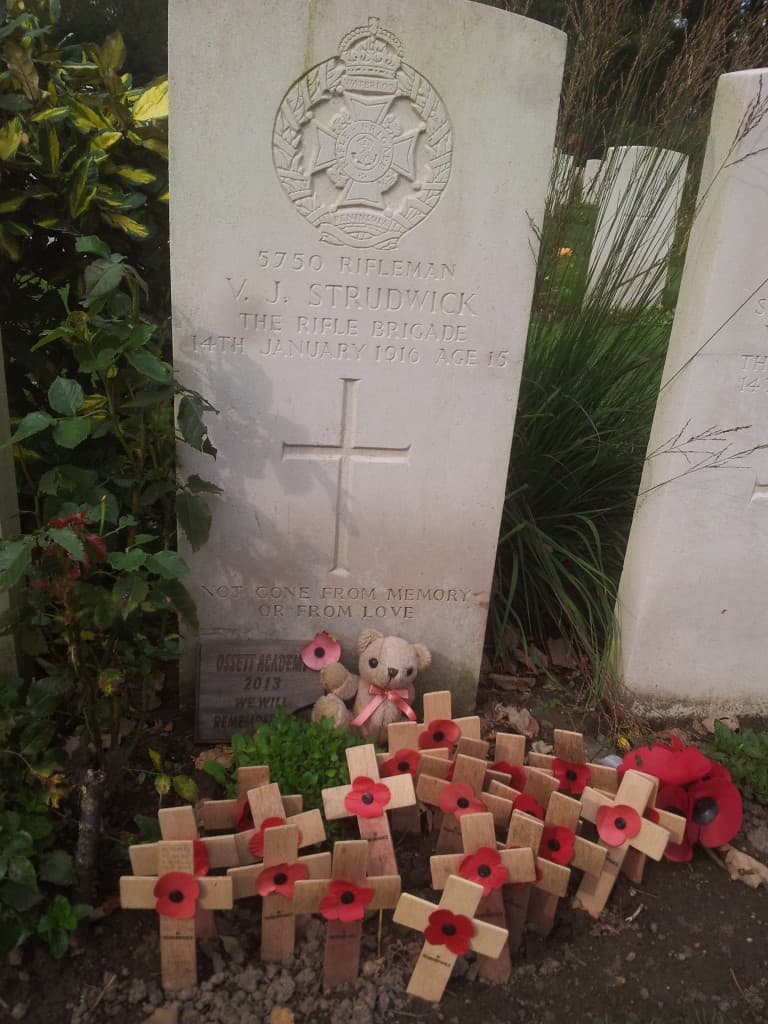
Rose’s father died a year ago and she still misses him so much that she secretly sends him texts on her phone. Her grandad takes her along on a trip to visit his uncle’s grave in Ypres, and in the cemetery she comes across the grave of a young soldier who died just before his sixteenth birthday. A stray dog leads her into a time slip adventure where she goes back in time to World War One and meets the soldier, 15-year-old Valentine Joe. As well as being an adventure, this also turns into a way of Rose coming to terms with her father’s death.

The best part of this book for me was the relationship between Rose and her grandad, which is teasing, funny and affectionate, as shown by their nicknames for each other. I found parts of the story slightly disjointed, which reflects the fact that Rose keeps getting thrown back into different times. She is often unsure where or when she is, or what is happening, which made it a bit confusing for the reader too.

Rose is 14 (and not a very sophisticated 14), and for the sake of the plot, she has to go off on her own at night, but I wasn’t sure if her grandad would really have let her wander round the streets of a strange town in the dark, no matter how safe the hotel keeper assured them it was.

This would appeal to readers who like time travel and a touch of romance as well as a war story. I wonder if it would also appeal more to British children who are more likely to go on school trips to visit the graves. 

Reviews:
The first chapter is online on the Guardian children’s books site, which also has a review (“It’s only a slim volume, but in its 150 pages Rebecca Stevens manages to weave a perfect war story: gripping, heartbreaking, realistic, witty and full of hope.”)

The Bookbag also refers to its length and calls it “small in terms of number of pages”, but “decidedly big in terms of themes and emotional weight” with "one of my favourite endings of the year".  

Author’s website
Rebecca Stevens has been an actor, a standup comedian and a script writer for children’s television, writing for shows like Mr Bean and Postman Pat. This is described as “her first solo book project.”
You can see Rebecca Stevens here reading from Valentine Joe.

And here on the BookTrust website ("telling the story of the short life of a real person"), she writes an interesting piece on using someone else’s story, or someone else’s life as the basis for your book:

Did I have the right to use Joe and the events of his tragically short life for the purposes of my book? I don't know... Although I managed to contact one of his relatives who gave me her blessing (and I've subsequently met another), it still felt wrong, disrespectful somehow, to put myself in his shoes, imagine his experiences from his point of view. So I decided to tell his story through the eyes of a character who was entirely invented, someone I felt closer to. Rose is a 14 year old girl from the present day, who goes to Ypres with her granddad.”

She also talks about her own grandfather who signed up when he was 16, but was sent home when a doctor suspected his real age. (He signed up again at 18 but survived the war.)

Other books you might like:
The topic of boy soldiers is a popular one. Charlie and Tommo in Private Peaceful sign up at nearly 16, so does William in My mother’s eyes: the story of a boy soldier, Sydney in One boy’s war and Harry and Jack in The horses didn’t come home. The boys in War game are very young as well.

“Boy soldiers” by Norman Bilbrough in School Journal, Part 4, No 3, 2008 tells the story of two young soldiers, Stan Stanfield and Len Coley, who fought in World War One. 

The red suitcase by Jill Harris and Charlotte sometimes by Penelope Farmer are war-related time travel stories. When the guns fall silent by James Riordan also uses the device of a child visiting the war graves with a grandfather.

Links
Private Valentine Joe Strudwick was a real soldier. He was born in Dorking, Surrey, and you can read more about him here on the website of the Dorking Museum.

Valentine Joe Strudwick
"Not gone from memory or from love"
Have you read it?
Have you read this book? Let me know what you think!


Thursday, 4 July 2013

Harry and the Anzac poppy by John Lockyer

Harry and the Anzac poppy by John Lockyer, illustrated by Raewyn Whaley (Reed, 1997)

New Zealand author and illustrator. 

Picturebook; 24 pgs, with text facing full page illustrations

Subjects: World War One, France, Anzac Day, poppy, letters, New Zealand, grandparents, junior fiction (Year 3-6)

9781869489595.jpg

Synopsis:
Harry and his Great-Grandma Kate go through her special box of letters, sent to her as a child by her father (Harry’s great-great-grandad) when he was away at World War One in 1917 and 1918.

Reviews:
TKI notes are available here

Questions:
How many generations away is a great-great-grandfather? How many great-great-grandfathers are on your family tree? Do you know any of their names?

Harry is named after his great-great-grandfather. Are you or anyone else in your family named after another family member? Do you know why?

In his letters, Harry’s great-great-grandfather compares himself to different animals: a pack horse, a rat, a rabbit in a hole, a crayfish. What does he mean in each case?

What do the letters tell you about conditions at the Front: the weather, the food, the sleeping arrangements and other living conditions?

What was happening in World War One in 1917 and 1918?

Where does the poppy first appear in the story? What significance does it have for us now?

Info on the author:
New Zealand Book Council biography
Christchurch City Libraries interview

John Lockyer’s other titles include Lottie Gallipoli Nurse (1998) and The Anzacs at Gallipoli (1999). Willie Apiata VC (2009, Puffin), written with Paul Little, was a finalist in the Non-Fiction category of the 2010 NZ Post Children’s Book Awards.

Info on the illustrator:
You can read a short bio of Raewyn Whaley here
  
Other books you might like:
War game by Michael Foreman also talks about Christmas in the trenches.

New Zealand connection:
Letters were very important to the soldiers at the front, and to their families back home.  On pg 14 of Anzac Day: the New Zealand story is a section called “How do we know about the war?” This explains how the soldiers’ diaries and letters home tell us a lot of what we know about  the war. “Word from the front” on pg 15 explains how the Turkish soldiers, many of whom could not read or write, got their news from home. 

Delivery of mail to New Zealand soldiers, Etaples
Delivery of mail to New Zealand soldiers, Etaples. World War 1914-1918 albums. Ref: PA1-f-102-0416. Alexander Turnbull Library, Wellington, New Zealand. http://natlib.govt.nz/records/23164376


Sorting letters for troops at the NZ Army Post Office in Cairo, Egypt
Sorting letters for troops at the NZ Army Post Office in Cairo, Egypt, about 1941. NZ Dpt of Internal Affairs. War History Branch : Ref: DA-01414-F. Alexander Turnbull Library, Wellington, New Zealand.http://natlib.govt.nz/records/22903066


Sometimes the mail arrived back home with black marks where the censors (usually officers)  had crossed out anything that they thought might be secret information. The soldiers would often censor what they wrote themselves, not wanting their families to know the worst of what they were going through. 

Lieutenant A R Martin censoring mail outside his bivy near Sora, Italy, World War II - Photograph taken by George Kaye

Lieutenant A R Martin censoring mail outside his bivy near Sora, Italy, World War II , June 1944- Photograph taken by George Kaye. NZ Dpt of Internal Affairs. War History Branch : Ref: DA-06115-F. Alexander Turnbull Library, Wellington, New Zealand. http://natlib.govt.nz/records/22770800

You can read an interesting account here about New Zealand prisoner of war mail in World War Two.