Showing posts with label veterans. Show all posts

Sunday, 24 June 2018

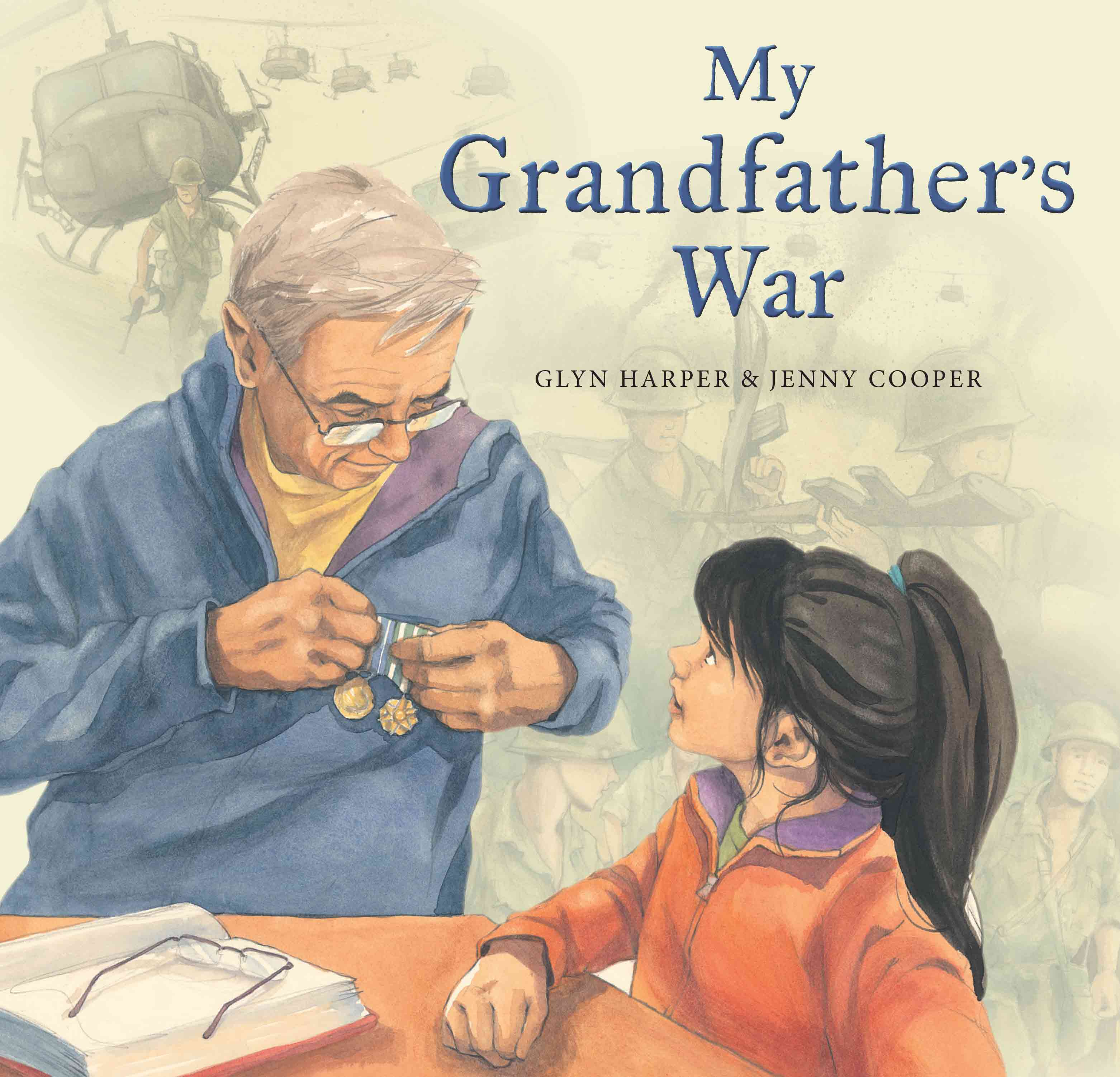
My grandfather’s war by Glyn Harper, illustrated by Jenny Cooper


My grandfather’s war by Glyn Harper, illustrated by Jenny Cooper (EK Books, 2018)

32 pages with full page colour illustrations (hardback edition)

Subjects: Vietnam, grandparents, veterans, picture books (Year 3-4)


Synopsis
My Grandfather’s War tells the story of 8-year-old Sarah and her grandfather Robert, who lives with her family and looks after her before and after school. The pair have a close relationship and Sarah is sensitive to her grandfather’s occasional spells of sadness. The family doesn’t talk about these, except to tell Sarah that he is thinking about a war in a place called Vietnam.

When Sarah summons up her courage to ask her grandfather why he feels sad, he tells her about his time in Vietnam. The flashbacks of his memory present images of a war which was “not like other wars” and he also tells Sarah about the difficulties the troops faced when they returned home, from anti-war protesters and the after-effects of chemicals.

This is a reworked version of an earlier book, now with the added magic of Glyn Harper’s collaboration with Jenny Cooper, whose illustrations show the warm bond between grandfather and grandchild. 

Another thing I really liked about this book is how it models (to both children and adults) how to handle difficult conversations. Sarah is nervous about asking her question but summons up the courage to do so because she loves her grandfather. She tells him that she’s scared and he acknowledges that with a serious, concerned expression (that picture is one of my favourites). Her grandfather doesn’t fob her off and answers carefully but truthfully. The conversation doesn’t make his sadness go away but now Sarah understands it better.

Reviews
Kids book reviews calls it "the perfect mix of narrative and history" and "a gentle educational tool, highly recommended" for classrooms. 
Teacher notes are available here and include some thoughtful comments from Jenny about how she approaches the subject of war as an illustrator.

Author’s website
Glyn Harper is Professor of War Studies at Massey University in Palmerston North, New Zealand. He is Massey's Project Manager of the Centenary History of New Zealand and the First World War. A former teacher, he joined the Australian Army in 1988 and after eight years transferred to the New Zealand Army, where he rose to the rank of lieutenant colonel. Glyn was the army's official historian for the deployment to East Timor and is the author of numerous history books. (From the Penguin website)

Info about the illustrator
Jenny Cooper is a wonderful artist who has illustrated more than 70 children’s books. Read more about her on the Book Council site or Christchurch City libraries or Storylines.

Other books you might like
This is the sixth book that Glyn Harper and Jenny Cooper have worked on together. Their previous titles are Roly the Anzac donkey, Jim’s letters, Le Quesnoy: the story of the town New Zealand saved, Gladys goes to war and Bobby the littlest war hero.
There aren’t many books for young readers about Vietnam. Memorial by Gary Crew and Lest we forget by Feana Tu’akoi both touch on it. Other books are Vietnam diary by Mark Wilson and I was only nineteen by John Schumann.
Books about the grandfather-grandchild relationship include Grandad’s medals by Tracy Duncan.

Have you read it?
Have you read this book? Let me know what you think!

Saturday, 10 June 2017

Dreaming the enemy by David Metzenthen

Dreaming the enemy by David Metzenthen (Allen & Unwin, 2016)
47 chapters; 292 pages
Subjects: Vietnam, Australia, conscription, veterans, PTSD (post-traumatic stress disorder), young adult fiction (Year 11-13)

Synopsis
Johnny Shoebridge has come home from fighting in the jungles of Vietnam. It’s hard to readjust to ordinary life with his parents and the girl he used to know. He is haunted by memories of all the things he has seen; literally haunted, by a Viet-Cong ghost fighter called Khan who won’t leave him alone.

He is still young and can't understand how he has ended up in this position: “How had he gone from a kid swinging a stick as a Samurai sword, the star of a flickering home movie, to a nineteen-year-old digger on ambush, prepared to shoot someone in the side of the head?” He has lost good mates in battle and is trying to summon up the courage to go and visit their families. (These eventual encounters make for heart-wrenching scenes.) Even though he was a conscript with no choice about going, he’s assailed by anti-Vietnam war protesters, with people coming up to say “I just hope you’re happy… with what you did.”

“There was an awful lot of stuff that he wished he didn’t know.”

The story jumps back and forth in time and place. In the present, Johnny is back home again, heading off on a road trip. In the past, he is getting to know his new mates Baz and Lex; they start training together, go out on patrol, and fight side by side in battle. Another parallel story is that of Khan, Trung and Thang as they hide in the jungle, crawl through tunnels and fight on the other side.

I found the parts where Johnny somehow knows or imagines what Khan is doing a bit confusing, perhaps because of the distance imposed by having Johnny comment on what he sees. What worked best for me were the scenes between Johnny and his mates, and their convincing teenage-boy speech as they get to know and rely on each other. Johnny “knew himself to be one corner of a triangle, the strongest shape of all. He knew Lex and he knew Barry like he knew no one else on the planet.”

Of course you know that’s not going to end well. They’re going to get caught up in some terrible fighting and you suspect that at least one of them won’t make it home again.  

Reviews:
Booksellers NZ calls it “a poignant novel, posing meaningful questions about the effects of war”. It acknowledges “some might suggest the book is difficult to keep up with as it flicks from past to present to imagination “, but suggests that “this is in keeping with Johnny’s head and the confusion that follows him”.
A very good review in The Australian too: this final paragraph is worth quoting in full:
"Senior secondary students, especially boys, (and their teachers) might be grateful if Dreaming the Enemy were set for study. It is a sophisticated work — substantial, powerful, highly readable and with key characters close to their age. It touches on many issues: the aftermath of war, including how returned fighters were and are treated; the effects on mental and physical health and on families and relationships. It looks at conscription, the politics of wars, the destruction caused by the bombing and napalm, the attitudes of Americans, the contribution of Australians, and much else. The story is infused with humanity and embellished by Metzenthen’s flair for language and flashes of dry Aussie humour."
And on Reading time, David Metzenthen has some very wise words about the book:
"I wanted strongly to present something of what young Australians went through in this war, at the orders of their Government, and the great toll it took on them, their families, friends, and futures. In Dreaming The Enemy, I hope to have shown what happens to people, that what we do or is done to us, stays with us for a long time and must be met with compassion and understanding."
About the author
David Metzenthen lives in Melbourne. He is a keen environmentalist and was an advertising copywriter and a builder’s labourer before turning to fiction. He has written another war-related YA novel, Boys of blood and bone, as well as the thought-provoking picture book One minute’s silence.
Other books you might like:
There aren't nearly as many books about Vietnam as about World Wars One and Two. One book that I have reviewed is The battle of Messines Road.
Have you read it?
Have you read this book? Let me know what you think!

Sunday, 5 April 2015

The last Anzac: questions and answers

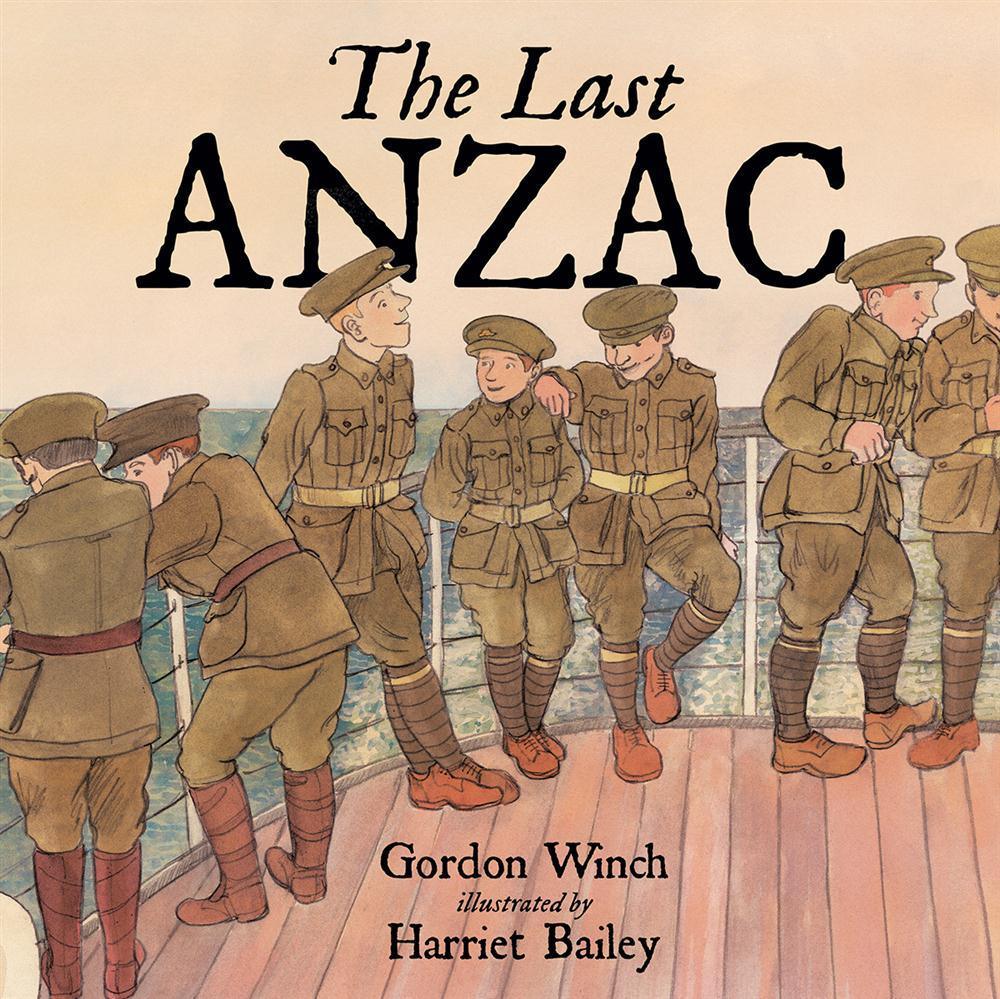
The last Anzac by Gordon Winch, illustrated by Harriet Bailey

I was lucky enough to attend the launch of this lovely book at The Children's Bookshop, Kilbirnie, in March. You can read my review of the book here, and Harriet has very kindly agreed to answer some questions about the book, how she worked on it and her illustrating style.

The book is a lovely production and it' s interesting to see the Anzac connection (Australian author and publisher / NZ illustrator). How were you approached by New Frontier to take the job on?
Thank you! An editor from New Frontier Publishing sent an email asking if I would be interested in illustrating a picture book for them, and that it would be a ANZAC WW1 Centenary title for 2015. I jumped at the chance to illustrate a heavily referenced story and one based on a soldier who served at Gallipoli.

How would you describe your own illustrating style, and why do you think it lent itself to this project in particular?
I have a range of illustration styles and felt the light and descriptive drawing line was needed to depict the various scenes and peoples expressions. When it got to the colouring stage, the publisher originally wanted all the 1915 scenes to be produced in sepia (brown and white or black and white, as was the photography at the time) in order to have a clear contrast between past and present. I wished to retain full colour to make it visually appealing and descriptive. I wanted the oranges to be a lovely juicy orange! We compromised by having the 1915 scenes set on a darker cream background.

At the launch of "The last Anzac", Ruth Paul made some fascinating comments about how well your illustrations worked to balance, and in some cases extend, the text. She used as examples the sequence showing Alec carrying the water and then spilling it when he jumps into the trench, and also the feet in the hospital beds. How do those ideas develop, and how do you decide what aspects of the story you want to illustrate?
This particular story was light on descriptive detail so I filled it in by reading as many accounts of the war at Gallipoli as I could. Books with collections of photographs of WW1 and men’s stories gave me ideas for the other soldiers that are shown. Soldiers injuries were horrific and of those that survived to be treated in the field hospitals, then the hospital ships and after that make shift hospitals in Greece and Egypt. I wanted to show men recuperating and with their wounds being looked after by ANZAC nurses. The missing limbs are sure to be noticed by children looking at the pictures.

Alec Campbell suffered many illness that kept him from sailing off to France to join the frontline but compared to his fellow patients he didn't have war wounds that were apparent until Bells Palsy appeared and 1/2 of his face became immobile.

As far as telling the story in pictures, “what happen’s next” is the major vehicle for turning pages of a picture book. I really wanted to have a sequence of illustrations to show what Alec Campbell did for the majority of the time: carrying water from the beach to inland for the soldiers who were in fighting in the trenches. Illustrating the effort and the danger of such an essential and appreciated task is the most interesting part of the story for children, I think!

I guess you haven't met the author, Gordon Winch, but do you know much about him?
I read about Gordon Winch online and discovered he has had a long career as a teacher of children and training teachers and has written many engaging and humorous books for children of Australia. 

How did you go about doing the research you needed for the illustrations? (at the launch, you told a lovely story about how you pinpointed the cottage that Alec Campbell lived in.)
It pays to use as many contacts that you have available when it comes to research and it was fortunate that I have a retired Australian uncle who is a whizz at tracing things using historical records. Part of the problem of weighing heavily on the internet for information is being certain that it is accurate. I had thought Alec Campbell was in a rest home at the time of James’ visit, but the publishers assured me he was still living with his wife in her mothers cottage, address unknown.

My Uncle was able to consult Electoral Rolls to hone down on a street number using the information I provided, sourced from historian Jonathan King’s book, Gallipoli: Our Last Man Standing. I used Google Street View to take a reference image of the cottage for the illustration. I like to think I have the correct little humble home where Alec lived!

As I have mentioned there was a lot of research needed to for a historical picture book. To avoid confusion due to the backwards and forwards of time and change in narration, I learnt it was important to keep visual elements limited to that which related to Alec and the story. I made a point of contrasting Alec's two ages: his visibly apparent youth when he went to war and his advanced age that he reached after a life where he achieved so much in Australia.

After Harriet had sent me these answers, I showed the book to my sister who came up with another question - which Harriet kindly answered as well!

Did you know any more about the boy's visit to Alec, and how that came about?
This story is based on a true event with one of the publishers' sons visiting Alec Campbell. New Frontier sent me two photos of father and son sitting with Alec and his wife Kate in their living room. I don’t know how the visit came about. I imagine the boy wrote Alec a letter requesting to visit him in Tasmania. I expect that Alec wished to met this young boy who was so keen to met him and learn about his experience at Gallipoli. 


The last Anzac by Gordon Winch; illustrated by Harriet Bailey

The last Anzac by Gordon Winch; illustrated by Harriet Bailey (New Frontier Publishing, 2015, “with historical advice from the Australian War Memorial”)

ISBN 9781925059298

32 pages, hard cover with beautiful colour illustrations

Subjects: World War One, Gallipoli, Australia, boy soldiers, Alec Campbell, veterans, picture books (Year 2-6)

Synopsis
Alec Campbell enlisted in 1915 when he was only sixteen. He served in Gallipoli but got sick and returned home, a veteran, at the age of seventeen. He died in 2002, aged 103. This is his story, told through the eyes of a young boy called James who went to visit him in the year before Alec died. That’s why this Anzac story starts, unusually, on a plane and then at an airport in Tasmania in 2001.

The endpapers contain facsimiles of wartime letters, postcards and envelopes, including a letter written by Alec (at Gallipoli) to his mother on 5 November 1915.

Reviews:
In Aussie reviews, writer Claire Saxby (Meet the Anzacs) points out that “it’s not easy to share the enormity of a war with young readers” and describes this as “an introduction to WW1 for early primary readers, showing them Gallipoli through the eyes of someone who was there”.

Teachers’ notes include the set of questions drawn up by James and his classmates which he took to ask Alec on Sunday 5 August 2001. Question 16 is What was your greatest moment? and the answer (Eating oranges when we got off Gallipoli) appears in one of my favourite illustrations. Also look out for the beautiful illustration of moonlight over the Aegean – and observant children will pick up on some unspoken details in the spread of the hospital scene.

Questions:
I had a number of questions that I wanted to ask the illustrator, Harriet Bailey and she kindly agreed to answer them. You can read her replies here.

About the author:
Gordon Winch was a teacher for over fifty years and has written a number of books for children. 

About the illustrator:
Harriet Bailey is a designer and illustrator based in Wellington, New Zealand. She began her career as a graphic designer. In 2010, she was the inaugural recipient of The Storylines Gavin Bishop Award and since then has illustrated Hester & Lester (Random House, 2011) and Out of Bed, Fred! (Scholastic, 2011). Both books were named in the Storylines Notable Books List 2012 in the picture book category.

You can see other examples of Harriet's art and design work on her website

Other books you might like:
There are several fictional treatments of boy soldiers, such as My mother's eyes: the story of a boy soldier by Mark Wilson, One boy’s war by Lynn Huggins-Cooper; illustrated by Ian Benfold Haywood and The horses didn’t come home by Pamela Rushby. Charlie and Tommo in Private Peaceful sign up at nearly 16, and the boys in War game are very young as well.

Links
You can find out more about Alec Campbell (nicknamed The Kid by his fellow soldiers, because he was so young and small) here, and here on the Australian War Memorial site, which also has an article about the last veterans from a number of different countries.

Have you read it?
Have you read this book? Let me know what you think!