Showing posts with label Egypt. Show all posts

Sunday, 17 July 2016

Brave Bess and the Anzac horses by Susan Brocker

Brave Bess and the Anzac horses: a true story of courage and loyalty by Susan Brocker (HarperCollins, 2010)

12 chapters; 160 pages with black and white photographs

Subjects: World War One, Middle East, Egypt, Palestine, Mounted Rifles, horses, animals, junior fiction (Year 5-8)


Synopsis
Bess was a real horse, one of the thousands sent overseas in World War One, of which only four (including Bess) returned to New Zealand. Susan has told the story of the horses and the men who rode them and cared for them, using the facts of the campaigns backed up by descriptions of the land and scenery, seen through the eyes of both Bess and her master.  

As well as Bess, we meet two other horses – Jack and Flame, the mascot, a dog called Hawker, and a lot of smelly camels.

Susan’s research is impeccable and she includes a map, timeline, historical notes, bibliography and glossary, as well as short summary notes at the start of each chapter.

Reviews:
Bobs books blog calls it “A well written, well researched novel about a little known battle field of World War One in which NZ soldiers and their horses took a vital part.” 

About the author
Susan is a wonderful writer with a real love for horses, as shown in her other books such as 1914: riding into war, The drover’s quest and Dreams of warriors. You can read more about her and her work on her website.   

Other books you might like:
Other books I have reviewed about horses in WW1 include The horses didn't come home by Pamela Rushby and Light Horse boy by Dianne Wolfer.

Links 
Find out more about:

Monday, 17 August 2015

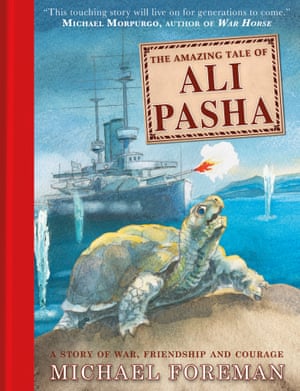
The amazing tale of Ali Pasha by Michael Foreman

The amazing tale of Ali Pasha by Michael Foreman (Templar, 2013)

9 chapters; 128 pages with numerous beautiful colour illustrations

Subjects: World War One, Gallipoli, Egypt, Navy, animals, tortoises, junior fiction (Year 5-8)

Ali Pasha 1

Synopsis
I tracked down this title after reading an article in the Guardian that asked well-known authors, “What are the best first world war books for children?” This book was Michael Morpurgo’s pick.  

On the cover, it is subtitled “a story of fear, friendship and courage”. The story, based on fact, is that of Henry Friston, a 21-year-old seaman on the HMS Implacable. In April 1915, the Implacable sails to Gallipoli and Henry and his gunner mates are sent on shore at X Beach (one of the five landing beaches at Cape Helles) to act as stretcher bearers. Sheltering after a shell blast, he finds a tortoise and determines to take it - against orders - back onto the ship with him. Soon afterwards the Implacable leaves for Egypt and Ali Pasha becomes a companion and good luck totem for the four friends who keep his existence on board a secret.

The author describes these events through the eyes of a young reporter, Trevor Roberts, who in turn hears them from Henry himself as an “old man” (actually not that old – only 59! – but presumably seemed so to the reporter!)

The endpapers contain family photographs of Henry as a young boy at school, a 13-year-old in his first job at the “Big House”, a sailor in his Navy uniform, and after the war as a bus driver, tram conductor, father and (really) old man. There is an afterword by the author explaining how and when he met Henry, his son Don and Ali Pasha himself.  

The final pages show some media coverage of Ali Pasha (who made The Times and even got to appear on the BBC’s Blue Peter show) and tell of how he outlived Henry by  ten years and died, aged at least 90 but quite possibly over 100, in 1987. By then, he had lived with the Friston family for 72 years.

You can see some of the beautiful illustrations from the book in Ali Pasha in pictures.  

Reviews:
Books for Keeps says that “most stories for this age group about the Great War concentrate on the trenches and the Army fighting in France, and it is refreshing to hear of the Navy’s part in the campaigns and especially of the part it played at Gallipoli.

Info on the author: 
Michael Foreman is primarily an illustrator, but his book War boy : a wartime childhood tells of growing up (he was born in 1938) in an English fishing village during World War Two. It is followed by After the war was over.

There is a lovely article about him here in the Guardiancelebrating the 50th anniversary of his first book.

Other books you might like:
Anything else written or illustrated by Michael Foreman about war (or peace), including War game, War boy : a wartime childhood and The General and also The little ships by Louise Borden. 

NZ connections:
A number of tortoises made it back to New Zealand after World War One - not all of them alive. One of the exhibits at the National Army Museum in Waiouru is a tortoise shell from Gallipoli

This tortoise didn’t enjoy the same long life as Ali Pasha, but there was another Gallipoli tortoise that did – in fact, Torty is still alive and living in Hawkes Bay. (Tortoises have been known to live to over 200 years old.) 

PRONE TO WATER: Ninety-one years after coming to New Zealand in a Gallipoli veteran's backpack, Torty is as limber as ever.
KATHY WEBB/ The Dominion Post

The tale of the Anzac tortoise by Shona Riddell, illustrated by official Defence Force artist Matt Gauldie, was partly inspired by the story of another tortoise which was given to a nurse by a wounded soldier and lived out its life on the Kapti Coast.
Official NZ Defence Force artist Matt Gauldie and Shona Riddell have created a children's book about a time-travelling war tortoise.
Matt Gauldie
Have you read it?
Have you read this book? Let me know what you think!

Tuesday, 24 March 2015

Meet the Anzacs by Claire Saxby

Meet the Anzacs by Claire Saxby, illustrated by Max Berry (Random House, 2014)

ISBN 978 0 85798 192 9

32 pages with full page colour illustrations

Subjects: World War One, Australia, Egypt, Cairo, Turkey, Gallipoli, Anzac Cove, picture books (Year 5-8)


Synopsis
This is one of a series of books about “the extraordinary men and women who have shaped Australia’s history”; others to be met in the same series are Ned Kelly, Mary MacKillop and Captain Cook, with more titles coming soon.

The foreword says this is the story of how the Anzac legend began. Unlike many other books, this one finishes on 25 April 1915. It starts with the men going to sign up as war is declared, and I’m pleased that it includes a mention of the “NZ” part of ANZAC: “In New Zealand, men were doing the same.” The story doesn't focus on any particular soldiers; instead, much of it is told through snatches of talk and conversation as the men sail across the world to Egypt, visit the pyramids, play cricket in the sand, pack up and travel across the Mediterranean, finally landing at Gallipoli.

I like the cover, which is similar in some respects to the cover of Best mates (three young men with their arms around each other’s shoulders!) The books were both published at about the same time, so this is sheer serendipity or else a reflection of something important about the theme of both books. There is also a timeline at the end.

You can see some of the pictures if you click on the Free sample on this Random House page, or on the excellent YouTube clip about the book, which cleverly intersperses the artwork with original photographs taken during the war.  "A picture book is a bit like an ice berg", Claire says, "in that you have to have an understanding of all this material to then be able to write lightly across the top of it in the few words that you have available there."

Reviews:
This review on Aussie reviews calls it "a wonderful introduction to the soldiers who forged the ANZAC legend." 

The Teachers' resources include author and illustrator interviews, classroom activities and discussion questions.  

About the author
You can read about Claire Saxby on her website and her blog, Let's have words (great title) which has a blog post about the launch of Meet the Anzacs.

I like the bit in the About me section where she says: "Words have fascinated me as long as I can remember. I have always loved reading. I used to go home from boarding school and read for days on end, only emerging to swim and eat."

Another book in the same series, also by Claire Saxby, is Meet Weary Dunlop

About the illustrator
Max Berry’s website says he was born in 1987 in Katherine, NT, Australia; he did a Bachelor of Design in 2005-2009, and lives and works in Sydney. He’s won a string of prizes, including being a finalist in 2012 and 2014 in the Gallipoli Art Prize. I’d never heard of this before but it began in 2006, runs annually until 2015 and is administered by the Gallipoli Memorial Club (whom I’d never heard of before, either.)


Have you read it?
Have you read this book? Let me know what you think!


Monday, 6 October 2014

Flora's war by Pamela Rushby

Flora’s war by Pamela Rushby (Ford Street Publishing, 2013)

ISBN 978 1 921665 98 1

18 chapters; 243 pages

Subjects: World War One, Egypt, archaeology, nurses, young adult fiction (Year 8-11)


Synopsis
(From the back cover): "It’s 1915 and sixteen year old Australian, Flora Wentworth, is visiting Cairo with her archaeologist father. She watches with growing alarm as first a trickle and then a flood of wounded soldiers are shipped into the city from Gallipoli….As Flora battles to save lives and find her own, a tragic misunderstanding changes everything…"

Reviews:
There are two good reviews here and here. Both mention the way in which the author contrasts the hectic social life of Cairo in 1914 and even early 1915 with the changes that war brings.  

Author’s website
Pamela Rushby was born in Toowoomba, Queensland and now lives in Brisbane.

Other books you might like:
The horses didn’t come home, also by Pamela Rushby (January 2014) describes a visit to an archaeological dig. My review of that book on my blog includes info on the finding in 1922 of Tutankhamen.

Evan's Gallipoli by Kerry Greenwood (October 2013) is a book by another Australian author which has some parallels in the relationship between (vague) father and (confident) child.

Things I didn’t know
Pamela Rushby says in the Author’s note that she was carrying out some early research on WW1 nurses, but what really “grabbed her imagination” was “an entirely different story. Cairo’s story.” The city was “overwhelmed” with wounded soldiers  were sent back from Gallipoli and many hotels and public buildings were turned into hospitals or convalescent homes, with medical staff worked off their feet in trying conditions and volunteers helping as much as possible. 

She paints a convincing picture of the city and its streets and buildings, never letting us forget the history on its outskirts or the ever present heat and dust. I would love to visit the real-life inspiration for the House of the Butcher and Blacksmith (Flora’s home): the Gayer-Anderson Museum. (According to Lonely Planet, this was used as a location for the James Bond movie The spy who loved me!)

Links
Flora and her friend Gwen help out as volunteers at Lady Bellamy’s (very proper) rest and recreation centre, and also on the hospital wards. They make friends with the Australian nurses in Cairo (the first NZ nurses arrived after the 25 April landing at Gallipoli; they were at least in their mid-20s, so would have been quite a bit older than Flora and Gwen.) 

Some of Flora and Gwen's friends depart to work in hospitals on Lemnos or on the hospital ships, so we hear about their nursing work through letters or conversation.  Other actual events such as the riots in the Wozzer are also covered.

There are some amazing photos and stories in this AWM exhibition on the Great War nurses.


A page from the photograph album of my great-great-aunt, Louisa Bird, 
who was one of the first NZ nurses in Egypt.
On the photo in the middle, she has written "15th General Hospital". 


Tuesday, 8 July 2014

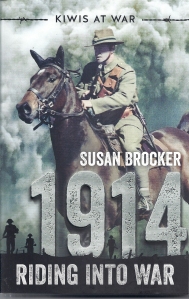
1914: Riding into war by Susan Brocker

1914: Riding into war by Susan Brocker (Scholastic, 2014)

ISBN 978-1-77543-206-7

216 pages with some notes and photos at the end

Subjects: World War One, Egypt, Gallipoli, Mounted Rifles, horses, young adult fiction (Year 8-11)

riding into war

Synopsis
The first thing you notice about this book is the striking cover, with the large embossed “1914”, the barbed wire pattern and the dramatic picture, which immediately tells you that horses are going to play a big part in this story. 

Seventeen-year-old Billy Bowman is old enough to be working on a farm, but young enough to be nicknamed “Billy the Kid” by the older farmworkers, who scoff at the idea of him signing up with the rest of them when war is declared in August 1914. But Billy’s mate Jack reckons “the enlistment age is just for city slickers who can’t ride or shoot”, and they are country boys who can do both. Sure enough, Billy is accepted by the recruitment officer – as long as his parents agree – and soon he and Jack are off with their horses to join the Mounted Rifles at the Awapuni Training Camp near Palmerston North.

The story of how the New Zealand troops got to war is sometimes overshadowed by the events that followed, but is fascinating in itself: the farewell dances, the weeks of training and drills, more farewells at the wharves, the long sea voyages (with the added difficultly here of keeping the horses in good shape), the exotic stopovers, the passage through the Suez Canal and the final arrival in Egypt. This section takes up about a third of the book and the details about caring for the horses on board are especially convincing.

Once in Egypt, there are more weeks of training in the desert before they are sent to Gallipoli - without their horses - after the first landings in April, but in time for the battle of Chunuk Bair in August 1915. The author manages to fit a lot of details about the Gallipoli campaign: the May armistice to bury the bodies, the torpedoing of the British battleship Triumph, the jam pot grenades, the periscope rifles, the awful food. These books are aimed at readers from 12+ but the language is mild with no expletives worse than “Jeez”. 

The focus is kept tightly on Billy, his mate Jack and their nemesis Chopper (“a tall, heavy-set man in his late twenties”, who calls him “Billy Boy” and “a little squirt”.) Other soldiers are there in the background but are seldom named. Billy exchanges letters with Alice, the daughter of the farm owner, although as the months go by, he finds there is more and more that he can’t tell her.

There is a map at the front – very important for tracing the troops' journey to Egypt and beyond (school visits have showed me that children might know about the Anzac landings at Gallipoli, but often don’t know where Gallipoli is – their guesses range from Germany to Russia.) The book also includes a timeline, glossary and bibliography at the back. (I looked for, but couldn’t find any details of the cover art on the front and back covers.)

Kiwis at War
This is the first title in Scholastic’s new Kiwis at War series, which will eventually consist of five books based on events for each year of World War One. (The events in this book carry over into 1915, which is understandable, given that the troops didn’t leave New Zealand until October 1914.) The other books in the series – each to be released in their centenary year - will be written by Diana Menefy (1915), David Hair (1916), Brian Falkner (1917) and Des Hunt (1918).

One of the interesting features about this series is that, while individually written (and perfectly readable as standalone texts), the five titles will be linked by characters who appear in more than one book. I love the idea of this collaboration amongst the authors, each working on their own story but also finding ways to create connections between them.

Susan’s book is to be launched on August 4th (exactly 100 years after the declaration of war), and the launch for each of the other books will also be tied in to a significant date. I’m looking forward to reading them, and to seeing if my guess about the “link” character in this book is correct.


Author’s website
On Susan Brocker's website, she says: “My favourite books are stories I’ve written about my favourite things, such as horses, dogs and animals of all sorts. I also love bringing history alive and making it exciting – and sometimes the two come together in novels like The Drover’s Quest and Brave Bess.”

This book is another example of the two things coming together. I can’t think of a better person to have chosen to write this story. Susan’s knowledge of history, her love of horses and her understanding of their needs and and personalities all come through clearly on every page.

Susan also has a Facebook author page, and you can read more about her on the Bookrapt site and the Storylines site. There is also an interview with her on the wonderful Christchurch City Libraries section on Interviews with NZ authors


Other books you might like:
If you like this book, you are sure to enjoy reading others that Susan has written. Brave Bess and the ANZAC horses (Harper Collins, 2010) is subtitled “a true story of courage and loyalty” – the qualities shown by the thousands of horses that were sent overseas with the New Zealand troops to face heat, stress, thirst, hunger, exhaustion, disease and injury in the deserts of the Middle East. Dreams of Warriors (Harper Collins, 2010), set in Featherston in World War Two, features fourteen-year-old Bella, who is trying to help save their family farm while her father is away at war, and also coping with a crazy bad-tempered horse called Gipsy. 

The horses didn’t come home by Pamela Rushby tells the story of Harry and his friend Jack, both aged 16, who set off for war with the Australian Light Horse and end up taking part in the last great cavalry charge in history, at Beersheba in the Sinai Desert in 1917.

Light Horse Boy by Dianne Wolfer follows Jim, a young Australian who works as a farrier (someone who trims and shoes horses’ hooves) and his best mate Charlie, who also sail for Egypt, camp in the desert and visit the pyramids; they are sent to Gallipoli (without their horses) and later, back in Egypt, Jim takes part in the battles of the Desert Campaign.

James Bayne's World War One diary
While looking for photos of the Mounted Rifles, I came across this diary which is held by the Alexander Turnbull Library and part of the WW1 digitisation project. 

Bayne, James, d 1915 : World War One diary
Bayne, James, d 1915 : World War One diary. Ref: MS-Papers-1418. Alexander Turnbull Library, Wellington, New Zealand. http://natlib.govt.nz/records/23160459
Like many other WW1 soldiers, James Bayne kept a diary; his runs from 10 Aug 1914 to 8 May 1915, and describes many of the same events that Billy and Jack experience, although he served with the Wellington Infantry Battalion, not the Mounted Rifles. James enlisted at Dannevirke, was sent to Awapuni Camp for military training and embarked for Egypt in October 1914. He describes life on board ship and the stopover at Colombo (in modern day Sri Lanka), the arrival in Alexandria, more training at Zeitoun Camp and the "Battle of the Wozzer" in April 1915. After taking part in the first landings at Anzac Cove, he was sent to fight at Cape Helles in the south of the peninsula in May 1915, and that is where he died.

If you scroll down to and click on "See original record", then scroll down to and click on "View archived copy online", you can read every page of his diary, which is a strange and sombre experience - a bit like being in Gallipoli itself, where you often feel like you are trying to match up the past with the present


Saturday, 28 December 2013

Light Horse Boy by Dianne Wolfer


Light Horse Boy by Dianne Wolfer, illustrated by Brian Simmonds (Fremantle Press, 2013)

120 pages with charcoal sketches and facsimile letters

Subjects: World War One, Australia, Palestine, Egypt, horses, animals, junior fiction (Year 6-10)


Synopsis:
Jim is a young Australian boy, not yet 18, who works as a farrier (someone who trims and shoes horses’ hooves.) His best mate Charlie reckons that when the army recruiting officers see how well they can ride, they won’t ask for a birth certificate, and so it turns out. Jim and Charlie sail with the fleet from Albany in 1914, and wave goodbye to the lighthouse keeper’s daughter, Fay, who features in Lighthouse girl

The story is told in a mixture of narrative, illustrations, photographs, and Jim’s letters and postcards back to his younger sister Alice, who is working as a governess. On the way over, Jim is chosen to work as a farrier on the flagship Orvieto. That means he has to leave his mates and his own horse, Breaker, but on the Orvieto, he looks after Major General Bridge’s horse Sandy, and gets to know the Major himself.  He meets up with Charlie again in Egypt, where they camp in the desert, walk alongside the River Nile, visit the pyramids, race camels and leave their kangaroo mascot Rufus at the Cairo Zoo. They are sent to Gallipoli (without their horses) where they see the first of their good mates die in the landings on April 25th 1915. Later Charlie dies in the battle of Lone Pine.

Back in Egypt, Jim takes part in the battles of the Desert Campaign. After being wounded in an explosion, he ends up on a hospital ship on his way to England, and is transferred to a hospital for the blind. Eventually, on his way back to Australia, he finds a surprise below decks that helps him start the process of inward healing. There are a couple more surprises in the final pages.

The book is full of good Aussie slang (Charlie says they will make ”crackerjack soldiers”, and Jim says it’s “bonza” being back with  his mates) and the story of the Light Horse soldiers is a fascinating one, that is less familiar than the stories of Gallipoli and the Western Front. Children who like horses will find it especially interesting as there are lots of descriptions of how the horses are cared for.

Reviews:
There are reviews of this book on the Aussie Reviews site and on Buzz Words books. (This latter reviewer points out that the black charcoal sketches suit the story because they capture "the seriousness and sadness of war".)

This interview and review describes some of the research behind the writing of the book. 

Questions:
At the end of the war, “many soldiers chose to shoot their beloved Walers [horses] rather than leave them behind to an unknown fate.” Why did they do that? What would have happened to the horses otherwise?

Author’s website:
Dianne Wolfer sounds like such a nice person!

Dianne with Han the Possum

Her website includes teaching notes about the book.

There is a bio of her on the Fremantle Press site.

The illustrator is Brian Simmonds and you can read about his work here

Other books you might like:
Light Horse Boy is a companion novel to Dianne Wolfer’s earlier book, Lighthouse girl, which is based on the true story of Fay Howe. Fay lived on the Breaksea Island lighthouse, near Albany where the troopships departed from. She was proficient at semaphore and used to take down messages for the troops and send them to their families, as their last farewell before they left Australia.

Evan’s Gallipoli tells a very different story, but one that overlaps in time and sometimes in location.

New Zealand connections:
The New Zealand Mounted Rifles fought with the Australian Light Horse in the deserts of the Middle East during World War One. You can read about the different units here.

The New Zealand Mounted Rifles Brigade left New Zealand with the Main Body of the NZEF in October 1914. The mounted riflemen fought in Gallipoli, Egypt and Palestine. They sometimes fought from horseback, and sometimes (as when they went to Gallipoli) they left their horses behind. But usually they would ride to the scene of action and then dismount before going into battle. One man in each group of four would then look after those four horses, as happens in Light Horse Boy.

They were fine horses, and not many of them ever came back to Australia or New Zealand. Dianne Wolfer says in her introduction that of the 136,000 horses that left Australia, only one returned. That was Sandy, the horse belonging to Major General Sir William Bridges. The Major General was killed at Gallipoli and was the only Australian to be returned to his homeland for burial. 

Four of the 10,000 New Zealand horses returned home, and the most famous of them is Bess. You can read about her on pg 32 of Anzac Day:the New Zealand story. There is a memorial to her near Bulls. Bess was also the model for the horse on top of the Cenotaph in Wellington.

 'Memorial to Bess the horse', URL: http://www.nzhistory.net.nz/media/photo/memorial-bess-horse, (Ministry for Culture and Heritage), updated 19-Sep-2013

Other links:

A mounted rifleman in uniform sits among a group of farriers, photographed by Laurie Mackie in the World War I military camp at Zeitoun in Egypt, 1914. The farriers are holding equipment for horse shoeing, including hammers and bars.

The farriers, Zeitoun camp, Egypt
The farriers, Zeitoun camp, Egypt. Ref: PA1-o-308-10-3. Alexander Turnbull Library, Wellington, New Zealand. http://natlib.govt.nz/records/22534019

Members of the Mounted Rifles Regiment in Nelson during World War One
Members of the Mounted Rifles Regiment in Nelson during World War One. Ref: 1/2-026531-G. Alexander Turnbull Library, Wellington, New Zealand.http://natlib.govt.nz/records/23081874