Showing posts with label boy soldiers. Show all posts

Wednesday, 7 October 2015

My brother’s keeper by Tom and Tony Bradman

My brother’s keeper by Tom and Tony Bradman (A & C Black, 2014)

11 chapters; 111 pages including a few pages of historical notes

Subjects: World War One, France, deserters, boy soldiers, junior fiction (Year 5-8? but shelved in the YA section at library so maybe meant for older but less proficient readers.)


Synopsis
Set in Flanders in 1915, this is the story of young Alfie Barnes. We suspect he is very young right from the opening sentence, when he stands on the fire-step of the trench and “wished he were taller”. He’s been working in Covent Garden markets since he left school at 12, but still looks young for his actual age of 15. When he signs up, claiming to be 19, the sergeant at the recruiting centre grins and says, “I suppose I’ll have to take your word for it.”

In the trenches, his older mates Ernie, Cyril and George look after him. They’ve been in action long enough to learn to keep their heads down, but Alfie is naively excited, hoping to have a go at “the Hun” and yearning for action. When it comes, of course, it’s not what he expects.

There’s not much to tell Ernie, Cyril and George apart, and I wasn’t convinced that a 15-year-old in the army would have spoken up as Alfie did. But there are good, clear descriptions of exactly what life in the trenches was like: how the men boiled their kettles, for example, what they ate and what they wore.

This is not a long story and there are other books that explore these issues more deeply. Perhaps it might serve as a good easy-to-read introduction to the topic. Our local library shelved it in the young adult section, so maybe it is meant for older but less confident readers.  

You can read an extract from Chapter One here.

Author’s website
Tony Bradman writes poetry and fiction for children, including the Dilly the Dinosaur and Swoppers series. He now writes in partnership with his son, Tom Bradman.


Other books you might like:
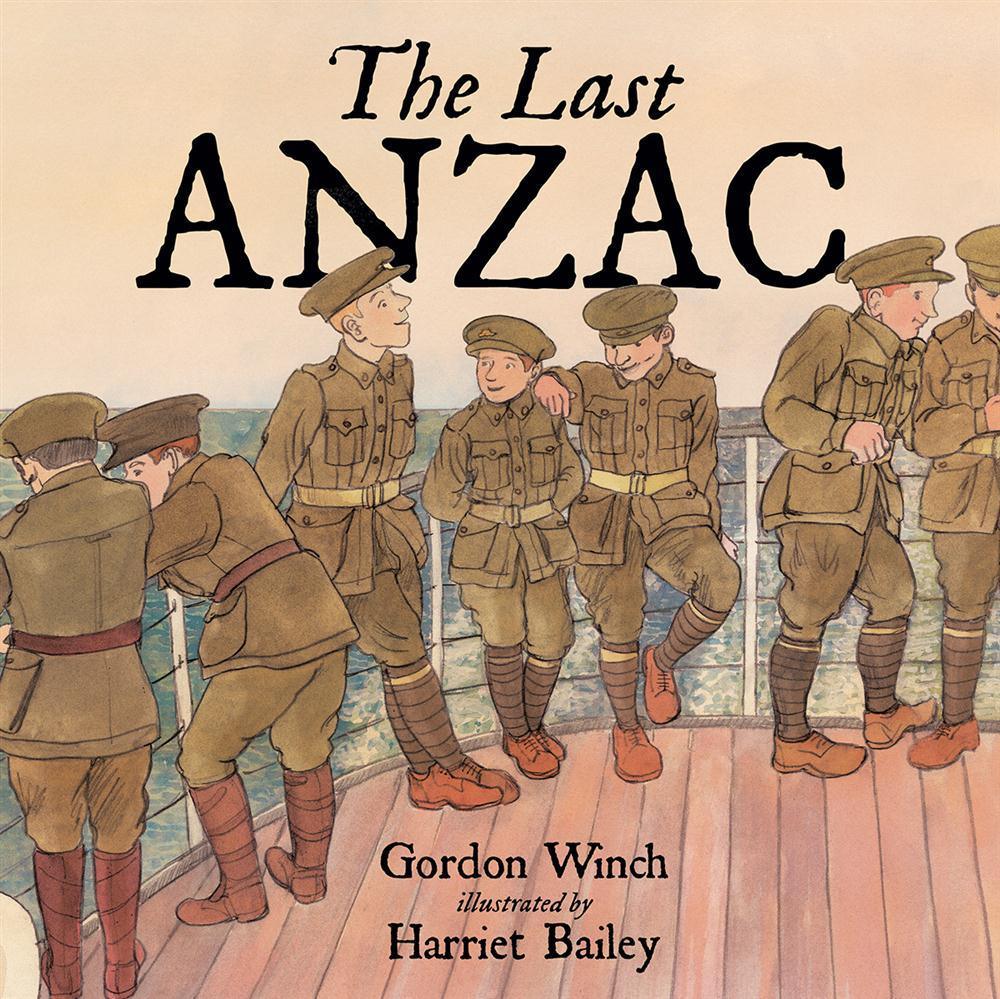
Other books that I've reviewed about boy soldiers include Valentine Joe by Rebecca Stevens, The last Anzac by Gordon Winch, illustrated by Harriet Bailey, One boy’s war by Lynn Huggins-Cooper, illustrated by Ian Benfold Haywood and My mother's eyes: the story of a boy soldier by Mark Wilson.

Things I didn’t know
Every book, no matter how short, can often tell you something you didn’t know about WW1. I learnt from this one that soldiers didn’t have to salute the officers in the front line (but they did if they were sent with a message to HQ.) And I learnt about applying camouflage before a night raid: how they mixed a black powder (burnt cork) with wet mud from the walls of the dugout and smeared the resulting thick paste over their faces.   


Have you read it?
Have you read this book? Let me know what you think!

Wednesday, 29 July 2015

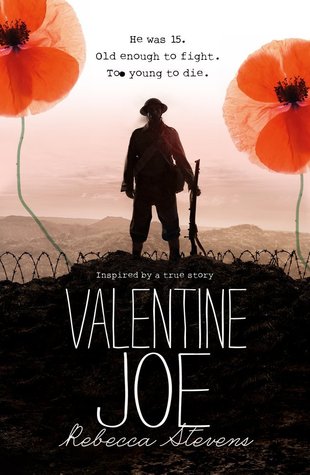
Valentine Joe by Rebecca Stevens

Valentine Joe by Rebecca Stevens (The Chicken House, 2014)

15 chapters; 154 pages

Subjects: World War One, France, Ypres, Belgium, Menin Gate, grandparents, boy soldiers, time travel, junior fiction (Year 5-8)

18663734

Synopsis
Rose’s father died a year ago and she still misses him so much that she secretly sends him texts on her phone. Her grandad takes her along on a trip to visit his uncle’s grave in Ypres, and in the cemetery she comes across the grave of a young soldier who died just before his sixteenth birthday. A stray dog leads her into a time slip adventure where she goes back in time to World War One and meets the soldier, 15-year-old Valentine Joe. As well as being an adventure, this also turns into a way of Rose coming to terms with her father’s death.

The best part of this book for me was the relationship between Rose and her grandad, which is teasing, funny and affectionate, as shown by their nicknames for each other. I found parts of the story slightly disjointed, which reflects the fact that Rose keeps getting thrown back into different times. She is often unsure where or when she is, or what is happening, which made it a bit confusing for the reader too.

Rose is 14 (and not a very sophisticated 14), and for the sake of the plot, she has to go off on her own at night, but I wasn’t sure if her grandad would really have let her wander round the streets of a strange town in the dark, no matter how safe the hotel keeper assured them it was.

This would appeal to readers who like time travel and a touch of romance as well as a war story. I wonder if it would also appeal more to British children who are more likely to go on school trips to visit the graves. 

Reviews:
The first chapter is online on the Guardian children’s books site, which also has a review (“It’s only a slim volume, but in its 150 pages Rebecca Stevens manages to weave a perfect war story: gripping, heartbreaking, realistic, witty and full of hope.”)

The Bookbag also refers to its length and calls it “small in terms of number of pages”, but “decidedly big in terms of themes and emotional weight” with "one of my favourite endings of the year".  

Author’s website
Rebecca Stevens has been an actor, a standup comedian and a script writer for children’s television, writing for shows like Mr Bean and Postman Pat. This is described as “her first solo book project.”
You can see Rebecca Stevens here reading from Valentine Joe.

And here on the BookTrust website ("telling the story of the short life of a real person"), she writes an interesting piece on using someone else’s story, or someone else’s life as the basis for your book:

Did I have the right to use Joe and the events of his tragically short life for the purposes of my book? I don't know... Although I managed to contact one of his relatives who gave me her blessing (and I've subsequently met another), it still felt wrong, disrespectful somehow, to put myself in his shoes, imagine his experiences from his point of view. So I decided to tell his story through the eyes of a character who was entirely invented, someone I felt closer to. Rose is a 14 year old girl from the present day, who goes to Ypres with her granddad.”

She also talks about her own grandfather who signed up when he was 16, but was sent home when a doctor suspected his real age. (He signed up again at 18 but survived the war.)

Other books you might like:
The topic of boy soldiers is a popular one. Charlie and Tommo in Private Peaceful sign up at nearly 16, so does William in My mother’s eyes: the story of a boy soldier, Sydney in One boy’s war and Harry and Jack in The horses didn’t come home. The boys in War game are very young as well.

“Boy soldiers” by Norman Bilbrough in School Journal, Part 4, No 3, 2008 tells the story of two young soldiers, Stan Stanfield and Len Coley, who fought in World War One. 

The red suitcase by Jill Harris and Charlotte sometimes by Penelope Farmer are war-related time travel stories. When the guns fall silent by James Riordan also uses the device of a child visiting the war graves with a grandfather.

Links
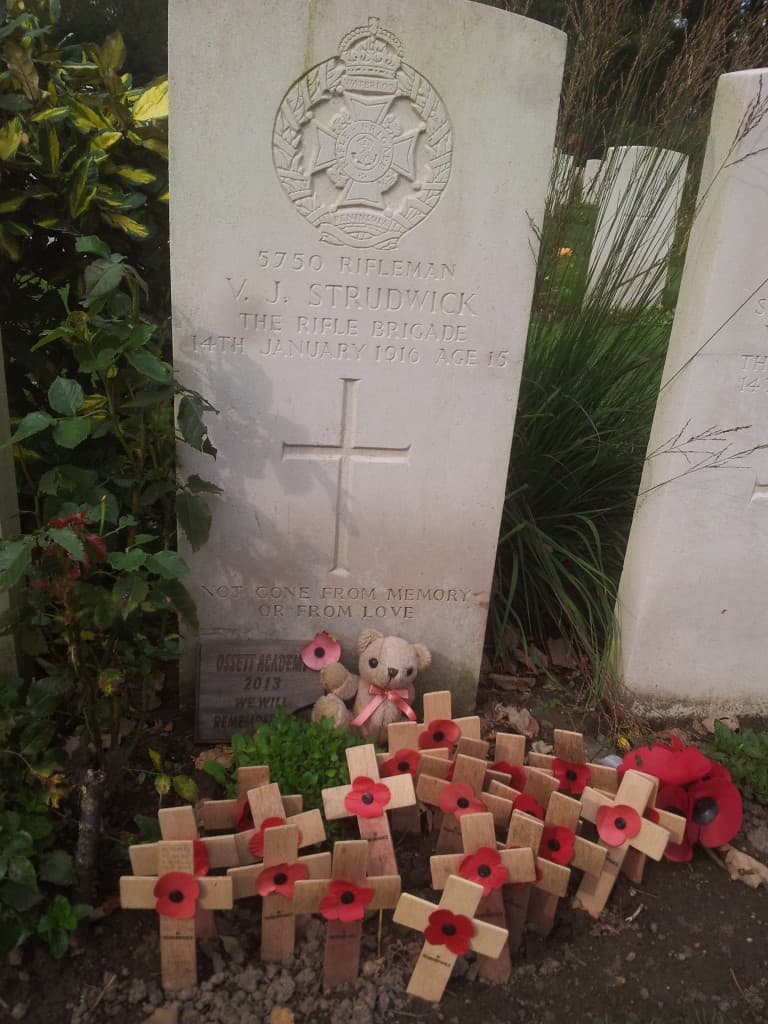
Private Valentine Joe Strudwick was a real soldier. He was born in Dorking, Surrey, and you can read more about him here on the website of the Dorking Museum.

Valentine Joe Strudwick
"Not gone from memory or from love"
Have you read it?
Have you read this book? Let me know what you think!

Sunday, 5 April 2015

The last Anzac: questions and answers

The last Anzac by Gordon Winch, illustrated by Harriet Bailey

I was lucky enough to attend the launch of this lovely book at The Children's Bookshop, Kilbirnie, in March. You can read my review of the book here, and Harriet has very kindly agreed to answer some questions about the book, how she worked on it and her illustrating style.

The book is a lovely production and it' s interesting to see the Anzac connection (Australian author and publisher / NZ illustrator). How were you approached by New Frontier to take the job on?
Thank you! An editor from New Frontier Publishing sent an email asking if I would be interested in illustrating a picture book for them, and that it would be a ANZAC WW1 Centenary title for 2015. I jumped at the chance to illustrate a heavily referenced story and one based on a soldier who served at Gallipoli.

How would you describe your own illustrating style, and why do you think it lent itself to this project in particular?
I have a range of illustration styles and felt the light and descriptive drawing line was needed to depict the various scenes and peoples expressions. When it got to the colouring stage, the publisher originally wanted all the 1915 scenes to be produced in sepia (brown and white or black and white, as was the photography at the time) in order to have a clear contrast between past and present. I wished to retain full colour to make it visually appealing and descriptive. I wanted the oranges to be a lovely juicy orange! We compromised by having the 1915 scenes set on a darker cream background.

At the launch of "The last Anzac", Ruth Paul made some fascinating comments about how well your illustrations worked to balance, and in some cases extend, the text. She used as examples the sequence showing Alec carrying the water and then spilling it when he jumps into the trench, and also the feet in the hospital beds. How do those ideas develop, and how do you decide what aspects of the story you want to illustrate?
This particular story was light on descriptive detail so I filled it in by reading as many accounts of the war at Gallipoli as I could. Books with collections of photographs of WW1 and men’s stories gave me ideas for the other soldiers that are shown. Soldiers injuries were horrific and of those that survived to be treated in the field hospitals, then the hospital ships and after that make shift hospitals in Greece and Egypt. I wanted to show men recuperating and with their wounds being looked after by ANZAC nurses. The missing limbs are sure to be noticed by children looking at the pictures.

Alec Campbell suffered many illness that kept him from sailing off to France to join the frontline but compared to his fellow patients he didn't have war wounds that were apparent until Bells Palsy appeared and 1/2 of his face became immobile.

As far as telling the story in pictures, “what happen’s next” is the major vehicle for turning pages of a picture book. I really wanted to have a sequence of illustrations to show what Alec Campbell did for the majority of the time: carrying water from the beach to inland for the soldiers who were in fighting in the trenches. Illustrating the effort and the danger of such an essential and appreciated task is the most interesting part of the story for children, I think!

I guess you haven't met the author, Gordon Winch, but do you know much about him?
I read about Gordon Winch online and discovered he has had a long career as a teacher of children and training teachers and has written many engaging and humorous books for children of Australia. 

How did you go about doing the research you needed for the illustrations? (at the launch, you told a lovely story about how you pinpointed the cottage that Alec Campbell lived in.)
It pays to use as many contacts that you have available when it comes to research and it was fortunate that I have a retired Australian uncle who is a whizz at tracing things using historical records. Part of the problem of weighing heavily on the internet for information is being certain that it is accurate. I had thought Alec Campbell was in a rest home at the time of James’ visit, but the publishers assured me he was still living with his wife in her mothers cottage, address unknown.

My Uncle was able to consult Electoral Rolls to hone down on a street number using the information I provided, sourced from historian Jonathan King’s book, Gallipoli: Our Last Man Standing. I used Google Street View to take a reference image of the cottage for the illustration. I like to think I have the correct little humble home where Alec lived!

As I have mentioned there was a lot of research needed to for a historical picture book. To avoid confusion due to the backwards and forwards of time and change in narration, I learnt it was important to keep visual elements limited to that which related to Alec and the story. I made a point of contrasting Alec's two ages: his visibly apparent youth when he went to war and his advanced age that he reached after a life where he achieved so much in Australia.

After Harriet had sent me these answers, I showed the book to my sister who came up with another question - which Harriet kindly answered as well!

Did you know any more about the boy's visit to Alec, and how that came about?
This story is based on a true event with one of the publishers' sons visiting Alec Campbell. New Frontier sent me two photos of father and son sitting with Alec and his wife Kate in their living room. I don’t know how the visit came about. I imagine the boy wrote Alec a letter requesting to visit him in Tasmania. I expect that Alec wished to met this young boy who was so keen to met him and learn about his experience at Gallipoli. 


The last Anzac by Gordon Winch; illustrated by Harriet Bailey

The last Anzac by Gordon Winch; illustrated by Harriet Bailey (New Frontier Publishing, 2015, “with historical advice from the Australian War Memorial”)

ISBN 9781925059298

32 pages, hard cover with beautiful colour illustrations

Subjects: World War One, Gallipoli, Australia, boy soldiers, Alec Campbell, veterans, picture books (Year 2-6)

Synopsis
Alec Campbell enlisted in 1915 when he was only sixteen. He served in Gallipoli but got sick and returned home, a veteran, at the age of seventeen. He died in 2002, aged 103. This is his story, told through the eyes of a young boy called James who went to visit him in the year before Alec died. That’s why this Anzac story starts, unusually, on a plane and then at an airport in Tasmania in 2001.

The endpapers contain facsimiles of wartime letters, postcards and envelopes, including a letter written by Alec (at Gallipoli) to his mother on 5 November 1915.

Reviews:
In Aussie reviews, writer Claire Saxby (Meet the Anzacs) points out that “it’s not easy to share the enormity of a war with young readers” and describes this as “an introduction to WW1 for early primary readers, showing them Gallipoli through the eyes of someone who was there”.

Teachers’ notes include the set of questions drawn up by James and his classmates which he took to ask Alec on Sunday 5 August 2001. Question 16 is What was your greatest moment? and the answer (Eating oranges when we got off Gallipoli) appears in one of my favourite illustrations. Also look out for the beautiful illustration of moonlight over the Aegean – and observant children will pick up on some unspoken details in the spread of the hospital scene.

Questions:
I had a number of questions that I wanted to ask the illustrator, Harriet Bailey and she kindly agreed to answer them. You can read her replies here.

About the author:
Gordon Winch was a teacher for over fifty years and has written a number of books for children. 

About the illustrator:
Harriet Bailey is a designer and illustrator based in Wellington, New Zealand. She began her career as a graphic designer. In 2010, she was the inaugural recipient of The Storylines Gavin Bishop Award and since then has illustrated Hester & Lester (Random House, 2011) and Out of Bed, Fred! (Scholastic, 2011). Both books were named in the Storylines Notable Books List 2012 in the picture book category.

You can see other examples of Harriet's art and design work on her website

Other books you might like:
There are several fictional treatments of boy soldiers, such as My mother's eyes: the story of a boy soldier by Mark Wilson, One boy’s war by Lynn Huggins-Cooper; illustrated by Ian Benfold Haywood and The horses didn’t come home by Pamela Rushby. Charlie and Tommo in Private Peaceful sign up at nearly 16, and the boys in War game are very young as well.

Links
You can find out more about Alec Campbell (nicknamed The Kid by his fellow soldiers, because he was so young and small) here, and here on the Australian War Memorial site, which also has an article about the last veterans from a number of different countries.

Have you read it?
Have you read this book? Let me know what you think!
Friday, 9 May 2014

One boy’s war by Lynn Huggins-Cooper; illustrated by Ian Benfold Haywood

One boy’s war by Lynn Huggins-Cooper; illustrated by Ian Benfold Haywood (Frances Lincoln Children’s Books, 2008)

ISBN 978-1-84780-126-5

32 pages with colour illustrations

Subjects: World War One, England, France, family, boy soldiers, picture books (Year 5-8)


Synopsis
The blurb gives an excellent summary:
“It is 1914 and 16-year-old Sydney is bursting to get a crack at the Kaiser. Fired up by the military recruitment campaigns and the brave men going to fight in the Great War, he runs away to enlist, but soon finds himself in a frontline trench where reality - and the rats - begin to bite. Told through Sydney’s optimistic letters home and his journal, this is his honest portrayal of the disillusionment and degradation in the trenches of World War I.”

The Dedication is “for Sydney Dobson” and the Afterword reveals that Sydney was a real young man, born in County Durham in the north of England, who died in the war in Belgium. 

I have to say I preferred this book to My mother’s eyes: the story of a boy soldier which deals with a very similar topic, although based on an Australian, not an English boy. I found the point of view more convincing, in that all the events were clearly seen or through Sydney’s eyes (“I’m joining up. Ma’s smothering me”.) For example, the spread of the women waving encouragement to the men going up the steps to sign up shows the effect that would have had on him. So does the following page, with the sergeant bellowing at the boys in training.

I like the way that not everything is spelt out. Sydney’s mother reads his first letter against the backdrop of a munitions factory where she must be working now.

I also found very moving the way that the mood of the illustrations changes, from the warm, homely scenes of Durham to the grey scenes in the trenches, and the way that Sydney tries to shield his mother from the true knowledge of what he is going through by self-censoring his letters. On one page he says,” I’d give anything to be back at home.” On the next page he writes, "Dear Ma, don’t believe all the scaremongering in the papers. It’s not too bad.”

The descriptions of the weather and of life in the trenches (trench foot, shell shock, lice, rats) are simple but powerful:

“A shell hit nearby today. It was the strangest thing I've ever seen. A wall of mud rose up where the shell hit, and surged towards us. It broke over our heads like a wave, covering us in mud and stones.”

Reviews:
There is a review on Books for Keeps and another one on Kirkus Review

There's even an online review on Youtube whcih shows you the book and pictures. 

Questions:
How old is Sydney at the beginning of the book?
Why does he decide to go off to war? Would this have been an easy or a hard decision? Why was it easy, and what was hard about it?
How old is he at the end of the book?
What happens to his father at the end of the book? What happens to Sydney?

Author’s website
Lynn Huggins-Cooper's blog can be found on An awfully big blog adventure ("the ramblings of a few scattered authors") and she also has a Facebook page which shows you the variety of stuff she writes (over 200 books). 

Info about the illustrator

Other books you might like:
The horses didn’t come home by Pamela Rushby tells the story of two Australian boys who sign up at 16 and go off to serve with the Light Horse.
Charlie and Tommo in Private Peaceful sign up at nearly 16, so does William in My mother’s eyes: the story of a boysoldier, and the boys in War game are very young as well.
“Boy soldiers” by Norman Bilbrough in School Journal, Part 4, No 3, 2008 tells the story of two young soldiers, Stan Stanfield and Len Coley, who fought in World War One. 


Thursday, 10 April 2014

My mother’s eyes: the story of a boy soldier by Mark Wilson

My mother's eyes: the story of a boy soldier by Mark Wilson

ISBN 9780734410894

34 pgs with colour illustrations

Subjects: World War One, France, Bullecourt, Australia, boy soldiers, picture books (Year 5-8)


There is also another edition subtitled:  the story of an Australian boy soldier:

Synopsis
(From the teachers guide):
William is nearly sixteen when he enlists during the First World War, and is accepted (like many other underage boys) into the Australian Imperial Forces (AIF) and sent to the battlefields of France, via Egypt. His letters home from the front reveal how, for the boy soldiers, the ‘great adventure’ of war was both a triumph and a tragedy. William takes part in the Battle of Bullecourt, one of many such disastrous confrontations, and the book starkly suggests that he meets his death there.

This book is beautifully produced in sturdy hardback. There were a few aspects of it that didn't completely work for me. I found the opening very abrupt, and some of the images didn’t quite ring true ("The crunch of early morning frost underfoot was as familiar and comforting to William as his mother’s eyes.") The point of view seems to shift about, with events sometimes being seen through William’s eyes and sometimes from a more removed standpoint ("There was only a distant sense of what danger lay ahead for them all.")

I wasn’t sure if children reading this would understand the meaning and implications of the title from the cover picture, or how the title related to the rest of the book. In fact I wasn’t quite sure myself what William meant in his last letter by "I have learnt to see life through my mother’s eyes."

I did like the picture spread where William slips out the back door with an old suitcase and walks away from home towards the train station. He looks very young and terribly vulnerable, as he does in the picture towards the end, just before sunrise. I also liked the picture where the regiment is traipsing towards the ship which will take them to Egypt; you can see why they viewed this as a “great adventure”.

The text is not detailed; rather, the emphasis is more on the “feel” of what is going on, with evocative illustrations. Some of the story is told through William’s letters which are written in a round, boyish hand, emphasising his youth.

Teachers guide is available here. 

Questions:
How old do you think William is at the beginning of the book?
Why does he decide to go off to war? Would this have been an easy or a hard decision? Why was it easy, and what was hard about it?
How old is he at the end of the book?
What happens to him at the end of the book?

Author’s website
Mark Wilson's website is hereThis is one of three books in his War Trilogy which “explore children’s experiences of and reactions to three different wars involving Australians”: WW1 (My mother's eyes), WW2 (Angel of Kokoda) and the Vietnam War (Vietnam diary.) 

Other books you might like:
The horses didn’t come home by Pamela Rushby tells the story of two Australian boys who sign up at 16 and go off to serve with the Light Horse.

Charlie and Tommo in Private Peaceful sign up at nearly 16, and the boys in War game are very young as well.

Sydney in One boy’s war by Lynn Huggins-Cooper is nearly 16; he signs up in England without telling his mother (his father is already away at war) and is killed in Belgium. 

“Boy soldiers” by Norman Bilbrough in School Journal, Part 4, Number 3, 2008 tells the story of two young soldiers, Stan Stanfield and Len Coley, who fought in World War One. 

Boy soldiers:
At first the war was seen as a “great adventure” (as this book says), and men were keen to get there before it would be all over. Many boys lied about their age or found a recruiting station that was willing to turn a blind eye and let them join up. The Australian boy soldiers who died are listed on the Australian War Memorial’s Roll of Honour, but there would have been many more. 

The youngest Australian soldier to die on active service is thought to have been Private James Charles (Jim) Martin, who enlisted in April 1915, aged 14 years and 3 months, served at Gallipoli and died on a hospital ship in October 1915. The letter to his mother telling of his death is kept at National Archives of Australia


Your son Private J Martin
Reference B2455 Martin J

In New Zealand, schoolboys would undergo basic training as junior cadets

A Certificate of Merit for bayonet instruction, 
presented to a Wellington College cadet, 1915