Showing posts with label Hiroshima. Show all posts

Thursday, 12 October 2017

Hiroshima no pika written and illustrated by Toshi Maruki

Hiroshima no pika written and illustrated by Toshi Maruki (translation of the same Japanese title; New York: Lothrop, Lee & Shepard, 1980)

48 pages with colour illustrations, sometimes full page double spreads

Subjects: World War Two, Hiroshima, atomic bomb, anti-war books, Japan, picture books (Year 6-8)
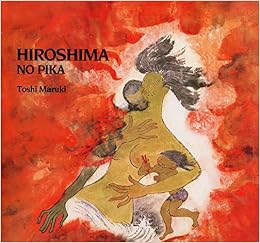
Image result for Hiroshima no pika

Synopsis

This is based on a first-person account that the author heard when he was holding an exhibition of pictures about the atomic bomb in a small town in Hokkaido.

It begins with a cloudless blue morning in Hiroshima, with streetcars picking up people on their way to work and the seven rivers flowing quietly through the city. Seven-year-old Mii and her parents are breakfasting on sweet potatoes “brought in the day before by cousins who lived in the country” when the bomb falls at 8.15am on August 6, 1945. Mii’s mother carries her injured husband on her back across the city, across rivers and all the way to the coast, where they stay for days until he is taken into a makeshift hospital: “no doctors, no medicine, no bandages – only shelter.” 

The illustrations are stylised but portray a powerful sense of the horror of the event, and the consequent suffering, partly through the lurid and unnatural colours of the skies and surroundings.

This is a terrible event, and parts of the text would be upsetting to younger (or even older) children: the mother carrying a dead baby, the floating bodies, the wasteland of the city, Mii’s father’s death, the glass slivers that poke their way out of her scalp in years to come.

Look out for the red chopsticks that Mii clutches for days after the Flash, until her mother manages to prise them from her grip. It’s a clever way to identify her on each page, but also hints at the hidden trauma she has undergone.

The book feeds in some factual details about the atomic bomb and ends with the lantern memorial service held each year on the seven rivers. I couldn’t see a translation of the title anywhere – maybe I missed it – but it means The Flash of Hiroshima.  

Reviews:
An entry in Kirkus reviews is always prestigious. “Japanese artist and antiwar activist Maruki manages to avoid the opposing perils of giving children nightmares and belittling the horror.”

About the author
Toshi Maruki (1912–2000) was born in Hokkaido and studied Western art at the Joshibi Women's School of Art and Design.
“I am now past seventy years old. I have neither children nor grandchildren. But I have written this book for grandchildren everywhere. It took me a very long time to complete it. It is very difficult to tell young people about something bad that happened in the hope that their knowing will help keep it from happening again.”

Maruki Gallery for the Hiroshima Panels, established by husband and wife Iri and Toshi Maruki, "is famous for its message for peace all over the world". The artist couple went into Hiroshima city just three days after the bombing and spent 30 years painting the 15 panels.

Other books you might like:
Sadako by Eleanor Coerr, illustrated by Ed Young, also tells of a young girl in Hiroshima. 

Things I didn’t know
I didn’t know that other Japanese cities like Tokyo, Osaka and Nagoya had already experienced air raids, so the people of Hiroshima were readying for them by storing water and making evacuation plans. There is a sad poignancy in the statement that “Everyone carried small bags of medicine and when they were out of doors, wore air-raid hats or hoods to protect their heads.”

Have you read it?
Have you read this book? Let me know what you think!

Friday, 18 March 2016

Sadako by Eleanor Coerr

This week my new book on Armistice Day is being launched, and it seemed a good time to review this book on Sadako and her work for peace. 

Sadako by Eleanor Coerr, illustrated by Ed Young (Margaret Hamilton Books, 1995)

45 pages with full-page colour illustrations

Subjects: World War Two, Japan, Hiroshima, nuclear war, bombs, family, picture books

A longer version for older children is called Sadako and the thousand paper cranes


Synopsis
Sadako Sasaki was just two years old when the atomic bomb was dropped over her home town, Hiroshima, in 1945. She was an ordinary little girl, surrounded by a loving family, and a keen runner. The story starts with her waking up in August 1954, excited about the Peace Day events at the Peace Park. In the evening, she writes the name of her grandmother who died in the bomb blast and launches it on the river where it floats along amidst rice-paper lanterns lit up by candles.

But when she was 11, Sadako started experiencing dizzy spells and was diagnosed with leukaemia, “the atom bomb disease”. By February 1955, she was in hospital.

One day, Sadako’s best friend Chizuko came to visit her in hospital. Chizuko brought paper and scissors and cut a piece of gold paper into a square. She folded it into a paper crane and told Sadako the old Japanese story about how anyone who folded 1000 cranes would be granted a wish. Sadako knew what her wish would be to get better, so she started folding paper cranes.

Sadako didn’t get her wish and she died a few months later, on 25 October 1955, ten years after the atomic bomb was dropped.  But her name lives on, thanks to her determination, her hope for peace and her wish for a better future, and her paper cranes have now become a symbol of peace. After she died, Japanese children helped to raise money for the Children’s Peace Memorial which now stands in the Hiroshima Peace Memorial Park, with a statue of Sadako on the top, often surrounded and decorated by thousands of paper cranes from all around the world. At the base is written: “This is our cry, this is our prayer. Peace in the world”.

There is a lovely photo of Sadako and one of her paper cranes here

You can read more here about some of the original paper cranes, kept by her brother. 

Reviews:
This review on  The children's war has a picture of Sadako with her relay team and calls it an “a perfect book for introducing this difficult topic to young readers. There are no detailed graphic images described about the war, the bomb or even to after effects, only an acknowledgement of these things. There is some controversy over whether or not Sadako actually did finish folding 1,000 cranes. Regardless of whether she did or didn't, there is much to be learned from Sadako's story.

Sadako, in the middle of the front row, with her relay team

About the author
This is a nice start to Eleanor Cooer's bio on the Penguin website: “Eleanor Coerr was born in Kamsack, Saskatchewan, Canada, and grew up in Saskatoon. Two of her favorite childhood hobbies were reading and making up stories.” It also describes how her fascination with Japan began as a child, her first visit to Japan – and to Hiroshima - as a young reporter, and how she finally managed to get hold of a copy of Sadako’s autobiography, Kokeshi. so she could start writing her own book.

She died in  2010 and you can read her obituary here

About the illustrator
Ed Young was born in China and later moved to Hong Kong, then went to the United States on a student visa to study architecture, but became an artist instead.  He says he draws inspiration from the philosophy of Chinese painting: “There are things that words do that pictures never can, and likewise, there are images that words can never describe.”

Other books you might like:
Hiroshima no pika, written and illustrated by Toshi Maruki, also tells the story of the day the bomb fell. 

How to make paper cranes
You can learn how to make your own paper cranes here
Or here (with an address for where to send them). 
Or here (also with an address). 

Links
You can learn more about Sadako at the Kids Peace Station, Hiroshima.