Showing posts with label Canada. Show all posts

Wednesday, 16 November 2016

Canadian books about war

I’ve had these titles on my list-of-books-to-read for some time, but they are proving hard to get hold of in local libraries – so I’ve decided to put them together in a quick summary.

These books set in WW1 can be found under Teacher resources – Book Lists on the Canadian War Museum site. I haven’t included all the books on these lists, which are very comprehensive. Many are also available in French language editions.

Picture books

A brave soldier by Nicholas Debon (Groundwood, 2002)
Frank enlists in 1914 and travels from Canada to the trenches in Northern France. You can see some colour spreads here. 


Silver threads by Marsha Forchuk Skrypuch, illustrated by Michael Martchenko (Fitzhenry  & Whiteside, 2004). 
Ivan, a recent Ukrainian immigrant, is interned as an enemy alien, while his young wife Anna waits for his return, hoping that the spider in their cottage is a good omen

A poppy is to remember by Heather Patterson, illustrated by Ron Lightburn (Scholastic, 2004)
Tells the story behind the poppy as a symbol of remembrance.

Chapter books and novels

And in the morning by John Wilson (Kids Can Press, 2002)
Told in diary form by 16-year-old, Jim, who goes to war after his father is killed in battle. 

Brothers far from home: the WWI diary of Eliza Bates, Uxbridge, Ontario 1916 by Jean Little (Scholastic, 2003)
Eliza waits at home, hoping that her brothers Hugo and Jack will come back safely.

Charlie Wilcox and Charlie Wilcox’s Great War by Sharon E. McKay (Stoddart Kids, 2000 and Penguin, 2003)
Charlie, aged 14, from Newfoundland, stows away and send up as a stretcher bearer on the Somme

Escape! by John Reid (Fernwood Books, 2004)
Based on the true story of Leon Trotsky’s imprisonment in Nova Scotia during WW1 (I didn’t know that!!! But look, it’s true – in his own words)

Irish chain by Barbara Haworth-Attard  (Harper Collins Canada, 2004)
The story of the 1917 Halifax explosion when a ship carrying munitions collided with another ship – something else I didn’t know much about. More than 1800 people were killed, and thousands more wounded, and the noise of the explosion was heard hundreds of miles away – an astonishing (and terrible) story.

A kind of courage by Colleen Heffernan (Orca, 2005)
Hattie’s brother is away fighting, and her father hires a conscientious objector to help on the farm.

Lesia’s dream by Laura Langston (2005)
Another story about Ukrainain immigrants (some of whom are then classed as enemy aliens) focusing on Lesia and her family.

No safe harbour: the Halifax explosion diary of Charlotte Blackburn, Halifax, Nova Scotia, 1917 by Julie Lawson (Scholastic, 2006)
The diary of 12 year old Charlotte, who ends up in hospital after the Halifax explosion.
Interestingly, there is also a NZ children’s book by David Hill titled No safe harbour, about the sinking of the Wahine.

The star supper: Book Three (our Canadian girl) by Troon Harrison (Penguin, 2006)
How Millie makes a happy Christmas, despite her father being away at war, by befriending the family of interned enemy aliens.

It's interesting to see the different themes and preoccupations that come through, including enemy aliens and the Halifax explosion. 

Other books that I have reviewed, written or set in Canada, include:
Linda Granfield’s Where poppies grow 
Rilla of Ingleside by L.M. (Lucy Maud) Montgomery
Uprooted: a Canadian war story by Lynne Reid Banks

Other Canadian authors are Eleanor Cooer (Sadako) and Iain Lawrence (Lord of the nutcracker men)  

Sunday, 6 November 2016

Rilla of Ingleside by L.M. Montgomery

Rilla of Ingleside by L.M. (Lucy Maud) Montgomery (An Anne of Green Gables novel; first published 1921; this Aladdin edition 2015)

35 chapters; 440 pages

Subjects: World War One, Canada, family, women in war, young adult (Year 7-10)

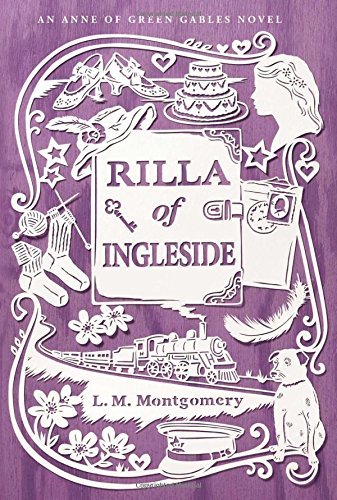
Image result for Rilla of Ingleside by L.M. (Lucy Maud) Montgomery (An Anne of Green Gables, novel; first published 1921; this Aladdin edition 2015)

(The cover of this new edition refers to different elements of the story, like Dog Monday, knitting socks, wedding cakes, the green hat, trains and letters.)

Synopsis
This is the 8th of 9 books (chronologically) in the Anne of Green Gables series, although the 6th to be written. I’d only read the first book in the series before, so I was confused initially as to who were all these people – but I kept reading and hoped it would come clear (it mostly did).

The book focuses on Marilla (“Rilla”) Blythe, Anne and Gilbert’s youngest daughter and the baby of the family. She is desperate to be seen as old enough to go to parties (and not treated as a child), but the years of light-hearted fun she dreams of vanish as World War One gets underway. We see Rilla grow in maturity as she takes on the organisation of the Junior Red Cross and responsibility for a war baby (carried home in a soup tureen), watches her brothers and many other friends go off to war and supports her mother in her grief.

It’s made very clear the pressure that boys were under to enlist – from themselves, their friends and society in general. The agony that every family went through with the news of battles fought, won or lost, is portrayed with complete authenticity, mixed with some humour to make it bearable.  “To me,” Rilla writes in her diary, “the strangest of all the strange things since 1914 is how we have all learned to accept things we never thought we could – to go on with life as a matter of course.”

The Canadian experience of WW1 was in some ways so similar to the NZ experience, but in other ways quite different, so it’s always interesting to read stories told from their perspective – for example, the references to the Gallipoli campaign.

The LM Montgomery Online site says that this is “one of the only contemporary depictions in Canadian fiction of women on the home front during the First World War.” 

Rilla of Ingleside is dedicated to the memory of Frederica Campbell MacFarlane, Maud’s friend and cousin who died in the flu epidemic in 1919. 

About the author
Everything you want to know about Lucy Maud Montgomery, much loved Canadian author (1874-1942) is here.

Some things I didn’t know about her:
  • her mother died of TB when she was 21 months old
  • she grew up with her grandparents
  • she was one of the few women of her time to study at university
  • when her manuscript of Anne of Green Gables was rejected by several publishers, she put it away in a hat box before trying again in 1907 (when it was accepted, published in 1908 and became an immediate bestseller)
  • she was secretly engaged for five years before getting married in 1911
  • she had three sons, but one was still-born
  • she left Prince Edward Island after her marriage, but nearly all (19 out of 20) of her novels are set there. 

I love some of her very delicious and funny lines:
- “I am done with crying which is a waste of time and discourages everybody.” (Susan, the housekeeper)
- (When their own horses aren’t available, and Rilla has to ride a very old one that keeps stopping every few yards) “Rilla felt that this, coupled with the fact that the Germans were only fifty miles from Paris, was hardly to be endured.”
- (Rilla talking about Fred Arnold, who is a very nice young man and “would be quite handsome if it were not for his nose”): “When he talks of commonplace things it does not matter so much, but when he talks of poetry and ideals the contrast between his nose and his conversation is too much for me and I want to shriek with laughter.”

Other books you might like:
Uprooted: a Canadian war story by Lynne Reid Banks tells the story of evacuees in WW2.
Where poppies grow: a World War I companion by Linda Granfield is a non-fiction book about WW1 from the Canadian perspective.

Have you read it?
Have you read this book? Let me know what you think!

Thursday, 11 February 2016

Where poppies grow by Linda Granfield

Where poppies grow: a World War I companion by Linda Granfield (Stoddart, 2001)

48 pages with numerous illustrations

Subjects: World War One, Canada, Flanders, animals, non fiction (Years 5-8)


Synopsis
This is a non-fiction book giving an overview of World War One. There are other similar books, but this one tells the story from a Canadian perspective. Many of the images, letters and photos were new to me because they are sourced from Canadian records and archives. Some of them, such as the postcards, seem to come from the author’s own collection (according to the picture credits).

In many ways, the Canadian experience was similar (with the exception of the Gallipoli campaign) to that of the Anzacs:  training camps at home, sailing across to Europe, more training in England, then across the Channel to Flanders and the trenches.

Some of the images that particularly caught my attention show “Canadian recruits undergoing training at Salisbury” (stabbing with bayonets at hanging bales of straw; hardly the same as the real thing), fresh bread being baked at the field bakery, cinema tickets for a West End Cinema Theatre offering free entry to wounded soldiers and sailors, ships being painted in “dazzle” camouflage and the Poppies poem “In Flanders fields”, written by Canadian medical officer John McCrae.   

Other topics include nurses, propaganda, a child’s war and letters and postcards. The section on animals features the black bear cub Winnie, a mascot later donated to the London Zoo where a young Christopher Milne saw him, went home and christened his own teddy bear “Winnie the Pooh”.
You can read more about Winnie here and here.

Author’s website
Linda Granfield’s website includes a section on books on war and remembrance. She has written about John McCrae whose poem “In Flanders fields” is 100 years old in May 2015, and about The unknown soldier all around the  world. 

"When I write non-fiction books, and you read them, we become time-travellers," she says.  
"History is all around us, inviting us to share our own family and community stories."

Find out more about her here.

Other books you might like:
Archie’s war by Marcia Williams is fiction, but told in a similar scrapbook style.

Things I didn’t know
I didn't know about the church of Notre Dame de Brebières (Our Lady of the Ewes) in the town of Albert, France, although I came across another reference to it just after reading this book. The statue of Mary and Jesus on top of the church was knocked sideways in 1915 by a shell bombardment. A legend developed that when it fell completely, the war would be over. 
In spring 1918, the Germans captured the town and the statue fell (but has since been restored); later that year, the war ended.
The other reference I came across mentioned that passing Australian soldiers would joke that it reminded them of the famous Australian swimmer, Fanny Durack.

Wednesday, 9 December 2015

Uprooted: a Canadian war story by Lynne Reid Banks

Uprooted: a Canadian war story by Lynne Reid Banks (HarperCollins, 2014)

28 chapters; 335 pages with chapter heading illustrations


Subjects: World War Two, Canada, evacuees, junior fiction (Year 5-8)


Synopsis
I went into this book with few expectations, maybe because the subject of evacuees has been written about so much already. But after a few chapters, I realised I haven’t read many books about the experience from a Canadian perspective.  

One reason I liked it is that it is not only a war story but also a coming-of-age story that covers many topics: loneliness, friendship, the degree of freedom that children enjoyed back then, a growing understanding of adult relationships, the difficulty of maintaining a marriage under the stresses of distance and war. It also gives a memorable picture of the Canadian landscape (especially in winter), so different from the English countryside.

It’s summer 1940, and as war rages across Europe, ten-year-old Lindy travels by boat and then train to Saskatoon, Canada, with her Mother and her smart cousin Cameron. Canada is a long way from home but it is also full of exciting new adventures. This story is inspired by the author’s own childhood experience and her time in Canada, which must be why many of the details sound so convincing: icebergs floating in the Atlantic Ocean, the three-day train trip across the plains, playground games, Hallowe’en, skating and tobogganing in winter and holidays at the lake in summer.

Lindy’s reactions are convincing; she keeps being offered Coke to drink, but finds it sweet and sickly; she revels in a hot deep bubble bath after “the three-inches-of-hot-water ones we’d been rationed to at home”; she marvels at the powdery snow, so different from wet English snow, and the deceptive cold that can give you frostbite without your noticing.  She picks up Canadian words (candies for sweets) and relishes all the new foods: peanut butter and jelly sandwiches, waffles with maple syrup, pork spare ribs cooked with brown sugar.  

She and Cameron have to cope with feelings of guilt at being safe and far from danger when London is being bombarded by bombs, as shown on the newsreels at the cinema. Is it okay for them to be happy? How do they come to terms with not being there? 

Author’s website
Lynne Reid Banks’ best-known book for children is probably The Indian in the cupboard. On her website, you can “Read my latest news, my interview with myself, and see an array of photographs and videos, and you can even listen to me read from some of my books.”

I couldn’t resist the interview, which she wrote for the very good reason that “I've been interviewed many times, but the interviewers hardly ever ask me the questions I wish they would! So here is me, interviewing myself.” (And it’s a very funny interview!)

I:
Excuse me.
Me:
What?
I:
I thought you were supposed to be interviewing me.
Me:
Sorry, I got a bit carried away. After all, writing for a living is a great life, if you don't weaken, and can keep the ideas coming.
I:
Aren't you going to ask me which is my favourite book, and to give tips for young writers, and all that?
Me:
No. How could we have a favourite book, we love them all and are proud of them, just like our children.

Other books you might like
There are lots of other books about evacuees, such as Ronnie’s war by Bernard Ashley, Carrie’s war by Nina Bawden and When the sirens wailed by Noel Streatfeild.

NZ connections
I made a nice personal link on pg 175 where Lindy talks about how terrible her handwriting was because she was still “trying to learn Canadian cursive”.

Things I didn’t know
Lots of things! For starters, I didn’t know that evacuees to Canada were called “war guests”. This was apparently because “Canadians are usually very polite and nobody wanted to hurt our feelings by calling us evacuees”.

I didn’t know that government war time restrictions meant that women who went to Canada with their children weren’t allowed to take more than ten pounds per person out of the country. This small amount was soon exhausted, so they were completely reliant on the charity of the people who offered them a home. This often put them in difficult situations, and eventually so many families complained to their Members of Parliament that the restrictions were lifted. 

I vaguely remembered hearing about a ship carrying evacuees that was torpedoed and sunk. In the book this ship isn’t named, but it could have been the City of Benares – or the Volendam.

I liked the details about the First Peoples that Lindy found out from visiting her neighbours, and was sorry when they disappeared quite abruptly from the story.

I liked the description of the river ice breaking up at the end of winter, and how the children laid bets on the day and time it would happen.

Have you read it?
Have you read this book? Let me know what you think!