Showing posts with label Belgium. Show all posts

Saturday, 21 May 2016

The year it all ended by Kirsty Murray

The year it all ended by Kirsty Murray (Allen & Unwin, 2014)

30 chapters; 243 pages

Subjects: World War One, Australia, France, Belgium, Germany, enemy aliens, white feathers, family, influenza, armistice, peace, Peace Day, war graves, Cheer Up Society, young adult fiction (Year 9-12)


Synopsis
This book starts with a poignant vignette of a pre-war scene, when 11-year-old Tiney – short for Martina - is allowed to join her big brother Louis and older cousin Will on their early morning expedition to Glenelg Beach. Six years later, everything has changed. Louis has gone to war and now the bells are ringing on Tiney’s 17th birthday to signal the armistice on 11 November 1918. 

As well as Louis, the family includes Tiney’s three older sisters: Dorothea (or Thea) the artist, Minna and Nette. Their family ancestry is German and Will (or Wilhelm) went to Heidelberg to study and was caught in Germany when the war started. As a result he was conscripted to fight on the German side. Will’s brother Paul, their other cousin, was interned as an enemy alien on Torrens Island.

As the cover suggests, “the year it all ended” was the year that things started to change, and the sub title (“War ends, the Jazz Age dawns. What will destiny bring Tiney Flynn?”) underlines this theme. Although the war is over, its effects continue and there will be many changes in Tiney’s life, both good and bad. Tiney is obsessed with what seems like an impossible dream, to go to Europe, but she manages to achieve it and sails across the world with her friend Ida and Ida’s mother, to visit the battlefields of France and Belgium.

I found this a very interesting viewpoint – not just Tiney’s, but that of a German-Australian family and the attitudes they faced in the war. 

Reviews:
I’ve tried to look for reviews that don’t give away too much of the plot, which is tricky as this reviewer acknowledges (but succeeds in doing - or not doing!) The reviewer loved "the vivid way in which Kirsty Murray has bought a period of history to life."

This review does contain more plot descriptions but I’ve included it as it has an author interview, I liked the answers to questions 4 and 6 in particular.

Here is a review from the Kids’ Bookshop (having given up by now on trying to avoid spoilers).

And there are more excerpts from reviews on Kirsty Murray's website here

About the author:
Kirsty Murray grew up in a family of seven children, in Melbourne and then Canada, has travelled widely, loves reading and says her most important job “and the one that took up most of my time was being a mother”, but has still produced a string of prize winning books. Lots of other info about her on her bio and FAQ pages.

I like her answers to What were your favourite books when you were a kid? and What’s the hardest part of writing for you?

Teachers’ notes are also available on her website here.

Other books you might like:
Remembrance by Theresa Breslin and Flora’s war by Pamela Rushby both tell the story of WW1 from the viewpoint of girls about Tiney's age. 

Things I didn’t know
The Cheer Up Society really did exist. “Its object was to support the soldiers in the First and Second World Wars as well as to bring them into contact with the 'highest type of womanhood'. “

You can see some wonderful photos here and here


Wednesday, 5 August 2015

The Belgian twins by Lucy Fitch Perkins

The Belgian twins by Lucy Fitch Perkins (Houghton Mifflin, 1917)

18 chapters; 192 pages

Subjects: World War One, Belgium, refugees, twins, families, junior fiction (Year 5-8)


Synopsis
This is quite exciting as I’ve been wanting to read some older books, which can be hard to access in print, but I’ve just realised that they are accessible online, for example on Project Gutenburg. This title even seems to be on youtube as an audiobook. 

Jan and Marie are twins (as we know from the title), 8 years old, living on a farm in Belgium. It’s summer, harvest time; everything is peaceful and idyllic. There are rumours of a German army at the borders, but Belgium is neutral and surely she will be protected.

The men of the village are called away to join the army and it is hard for the women and children to know what is happening. (“There were no daily papers in Meer, and now there were no young men to go to the city and bring back the gossip of the day, as there had used to be.”) Then news comes that the Germans have crossed the eastern border and want to cross into France. That night their mother fastens a locket around Marie’s neck, and tells her, “You must wear it always… and remember that your mother's name is Leonie Van Hove, and your father's name is Georges Van Hove. If by any chance—which God forbid—we should become separated from one another, keep the locket on your neck, and our names in your memory until we meet again; for if such a thing should happen, do not doubt that I should find you, though I had to swim the sea to do it!"

When the “great tidal wave” of “a long gray line of soldiers on horseback” approaches the village, their mother hides the twins and the dog in the vegetable cellar. When they venture out again, the house has been ransacked for food and their mother has disappeared. In fact “there was not a human being but themselves in the entire village; all the others had been driven away like sheep, before the invading army.”

The children are brave and appealing and never lose faith that their mother will find them. The dialogue is realistic and often funny - here are a few examples:
  • "I think I could be braver if I had some breakfast," sobbed Janke.
  • "I don't see anything to laugh at," said Jan with dignity; "it might have happened to any man."
  • "She said no matter what happened we should never despair, and here we are despairing as hard as ever we can."


Marie and Jan go in search of their mother and join a flood of refugees on the road to Antwerp and safety in Holland. On the way they are taken in by an old woman, then a family on board a barge who take care of them and protect them from noticing too much of what is happening (burning houses and villages) but they can’t help seeing all the German soldiers.  Just in time they escape the siege and bombing of Antwerp and reach Rotterdam where they are placed in the care of the British Consul and put on a boat going to England, then taken to a large country house set aside for homeless Belgians.

“At night they and the other homeless children slept in little white cots set all in a row in a great picture gallery… Every day more Belgians came, and still more, until not only the big house, but the stable and outbuildings were all running-over full of homeless people.”

The next stage of their journey is by sea to New York to live with a childless Belgian couple who have offered to look after them. “They had chicken for supper, and, after that, ice cream! Jan and Marie had never tasted ice cream before in their whole lives! They thought they should like America very much.”

The last chapter is called THE MOST WONDERFUL PART, so you can guess it has a happy ending. It does seem coincidental, but the Preface says that “this story of two little Belgian refugees is based upon the actual experience of two Belgian children, and the incident of the locket is quite true." I tried to find proof of this, and couldn't - it would be fascinating to know the background to the sorry.  

Reviews:
You can read a short, but very early, review of this book in the New York Times for December 9, 1917. 

Booksylvania posts reviews by 11-year-old Lucy: "This book is inspired by the actual events in Belgium, of two Belgian children. I loved this book because of the truth in it."

About the author
Lucy Fitch Perkins (1865-1937), American author, educator and illustrator, wrote the popular Twins series of books. Born in Maples, Indiana, she studied at the Fine Arts School in Boston, then worked as a book illustrator with the an educational company and taught at art school. In August 1891, she married Dwight Perkins, an architect and teacher. Her first book (The Dutch Twins) was published when she was 48, and she kept writing one or two books a year from then on, wanting to give children "a correct idea of life in other countries" and to encourage "a spirit of friendliness and good will for children of other nationalities."

You can find a list of all her twins books hereWhat is quite astonishing is that this book was published while the war was still going, so that (as the Suggestions to teachers says) “American children who have been giving their pennies to help take care of little Belgian children will find this new "Twins" book one of the most appealing that Mrs. Perkins has ever written.” The French twins (1918) was also written in war time.

Things I didn't know
I didn't know anything about Belgian refugees in England and recently came across this article about the thousands who fled across the Channel when the Germans invaded. Many of them settled in a refugee community in Elisabethville, near Durham. Both of these articles feature some fascinating facts and photographs.

Have you read it?
Have you read this book? Let me know what you think!


Wednesday, 29 July 2015

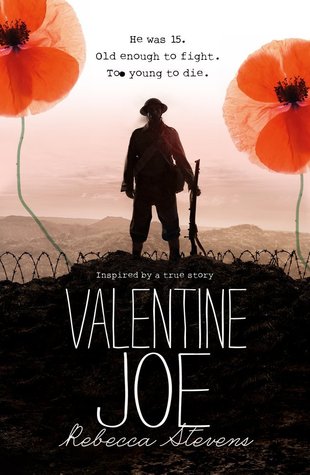
Valentine Joe by Rebecca Stevens

Valentine Joe by Rebecca Stevens (The Chicken House, 2014)

15 chapters; 154 pages

Subjects: World War One, France, Ypres, Belgium, Menin Gate, grandparents, boy soldiers, time travel, junior fiction (Year 5-8)

18663734

Synopsis
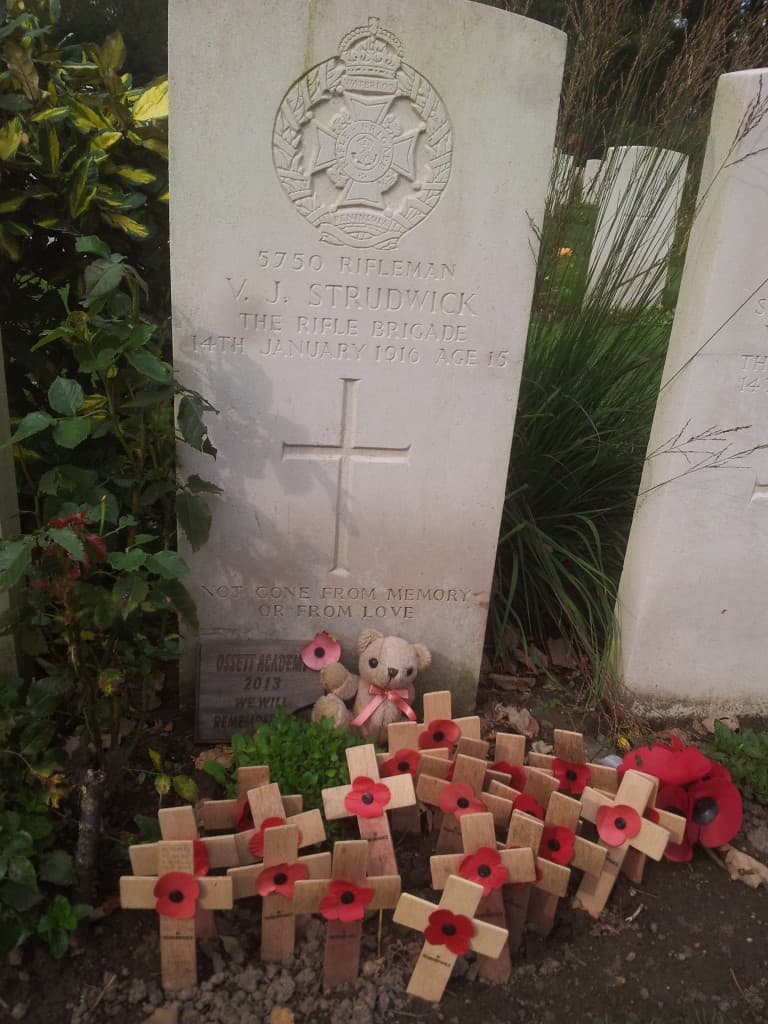
Rose’s father died a year ago and she still misses him so much that she secretly sends him texts on her phone. Her grandad takes her along on a trip to visit his uncle’s grave in Ypres, and in the cemetery she comes across the grave of a young soldier who died just before his sixteenth birthday. A stray dog leads her into a time slip adventure where she goes back in time to World War One and meets the soldier, 15-year-old Valentine Joe. As well as being an adventure, this also turns into a way of Rose coming to terms with her father’s death.

The best part of this book for me was the relationship between Rose and her grandad, which is teasing, funny and affectionate, as shown by their nicknames for each other. I found parts of the story slightly disjointed, which reflects the fact that Rose keeps getting thrown back into different times. She is often unsure where or when she is, or what is happening, which made it a bit confusing for the reader too.

Rose is 14 (and not a very sophisticated 14), and for the sake of the plot, she has to go off on her own at night, but I wasn’t sure if her grandad would really have let her wander round the streets of a strange town in the dark, no matter how safe the hotel keeper assured them it was.

This would appeal to readers who like time travel and a touch of romance as well as a war story. I wonder if it would also appeal more to British children who are more likely to go on school trips to visit the graves. 

Reviews:
The first chapter is online on the Guardian children’s books site, which also has a review (“It’s only a slim volume, but in its 150 pages Rebecca Stevens manages to weave a perfect war story: gripping, heartbreaking, realistic, witty and full of hope.”)

The Bookbag also refers to its length and calls it “small in terms of number of pages”, but “decidedly big in terms of themes and emotional weight” with "one of my favourite endings of the year".  

Author’s website
Rebecca Stevens has been an actor, a standup comedian and a script writer for children’s television, writing for shows like Mr Bean and Postman Pat. This is described as “her first solo book project.”
You can see Rebecca Stevens here reading from Valentine Joe.

And here on the BookTrust website ("telling the story of the short life of a real person"), she writes an interesting piece on using someone else’s story, or someone else’s life as the basis for your book:

Did I have the right to use Joe and the events of his tragically short life for the purposes of my book? I don't know... Although I managed to contact one of his relatives who gave me her blessing (and I've subsequently met another), it still felt wrong, disrespectful somehow, to put myself in his shoes, imagine his experiences from his point of view. So I decided to tell his story through the eyes of a character who was entirely invented, someone I felt closer to. Rose is a 14 year old girl from the present day, who goes to Ypres with her granddad.”

She also talks about her own grandfather who signed up when he was 16, but was sent home when a doctor suspected his real age. (He signed up again at 18 but survived the war.)

Other books you might like:
The topic of boy soldiers is a popular one. Charlie and Tommo in Private Peaceful sign up at nearly 16, so does William in My mother’s eyes: the story of a boy soldier, Sydney in One boy’s war and Harry and Jack in The horses didn’t come home. The boys in War game are very young as well.

“Boy soldiers” by Norman Bilbrough in School Journal, Part 4, No 3, 2008 tells the story of two young soldiers, Stan Stanfield and Len Coley, who fought in World War One. 

The red suitcase by Jill Harris and Charlotte sometimes by Penelope Farmer are war-related time travel stories. When the guns fall silent by James Riordan also uses the device of a child visiting the war graves with a grandfather.

Links
Private Valentine Joe Strudwick was a real soldier. He was born in Dorking, Surrey, and you can read more about him here on the website of the Dorking Museum.

Valentine Joe Strudwick
"Not gone from memory or from love"
Have you read it?
Have you read this book? Let me know what you think!


Saturday, 2 August 2014

When our Jack went to war by Sandy McKay

When our Jack went to war by Sandy McKay (Longacre, 2013)

ISBN 978 1 77553 309 2

192 pages

Subjects: World War One, France, Belgium, England, letters, Messines, Ypres, junior fiction (Year 5-8)


Synopsis
When our Jack went to war is described on the title page as “a fictional story based on a real-life event”. It is dedicated to “Private John McIntosh, 27553, 2nd Battalion Otago Regiment, NZEF” who was the author’s great uncle, killed in action in 1917.

In Sandy McKay’s story, her great uncle John becomes the “Jack” of the title, and the narrator is his younger brother Tom, who is twelve when Jack leaves his carpenter’s apprenticeship and signs up in 1916. Many of Jack’s friends sign up at the same time: Ted, Cyril, Stuart, Billy. The rest of the family consists of their mother and Tom’s younger sister Amy; their father had died a year or two earlier, soon after the war began. 

The story is told in Tom’s voice, interspersed with Jack’s letters and (real) newspaper clippings and other notices. Jack’s first letters are from Trentham Training Camp; then from the troop ship on the way to England, Sling Camp on Salisbury Plain, a trip on leave to London and Scotland and finally the trenches of the Western Front. He is wounded and sent to recover at a hospital in England, but then goes back to the front line again. Meanwhile Tom’s letters tell about his own school and home life.

The newspaper clippings include descriptions of the battles (not always the same as Jack’s descriptions), casualty lists and articles about conscientious objectors. Headlines give glimpses into little known aspects of the war at home; stories like “Disloyal utterance – indiscretion in railway carriage” (a man who made use of “language calculated to interfere with recruiting” by claiming “a man is a *** fool for going to the front”), “Drawing of first ballot” (for conscription)  or “Refusing to parade” (a man who was a Quaker, and “objected to service” as a conscientious objector.)

The dialogue, slang and domestic details of the time ring true (Jack’s letters are kept “in a biscuit tin on the shelf in the kitchen, right next to the hook for his nail bag”.) At the end is a factual section titled What do you know about the First World War?

Reviews:
You can read a review of the book on Bobs books blog. Bob says: "The last 15 pages will wrench your heart out."

Teaching notes are also available here and include a great set of suggestions for creative or research responses.  

Author’s website
Sandy McKay's website is here

You can also read about her on the NZ Book Council site and the Christchurch City Libraries Interviews with NZ children's authors

New Zealand connections:

In the acknowledgements, Sandy McKay makes special mention of the Papers Past website of the National Library. This really is an amazing resource. At present it covers from 1839 to 1945, and includes 90 publications from all over the country, but more newspapers - and newspaper issues - are being added all the time.