Showing posts with label fable. Show all posts

Tuesday, 25 April 2017

The butter battle book by Dr Seuss

The butter battle book by Dr Seuss (Random House, 1984)

48 pages with typical Dr Seuss style illustrations!

Subjects: anti-war books, fable, picture books (Year 3-8)


Synopsis
Written in Dr Seuss’ usual zany rhyming style, this book tells the story of two neighbouring communities – Yooks and Zooks – who are divided by their differing opinions on the best way to butter their bread. Things get more heated, and following an initial exchange with a slingshot, the Boys in the Back Room dream up bigger, crazily-named and ever more powerful weapons.

But it’s also a metaphorical look at The Cold War (after all, it’s surely no coincidence that “Yooks” and “Zooks” sound like “Nukes”, and that they are divided by a Wall.) As I got closer to the end, I wondered how it was going to finish and whether the escalating situation could be resolved – but it ends on top of the wall in a situation of total uncertainty.

You can read the whole text online here
Or you can watch it on YouTube

Reviews:
The Teach Peace Foundation calls it an “anti-war…children’s rhyming story addressing fears from the cold war era during which it was written. Specifically it deals with the nuclear war and the possibility of mutually assured destruction”. The website has some suggested teaching notes. 

Questions:
Does it matter which way up your butter your bread?
What are some equivalent differences between people in today’s world? (Which way do you...?) 
The Teaching Children Philosophy site also poses lots of good questions arising from this story.

About the author
Everyone knows Theodor Seuss Geisel (1904-1991) in other words, Dr Seuss! 
Some things I didn’t know about him –
  • His first book, And to think that I saw it on Mulberry Street, was rejected 27 times before being published by Vanguard Press
  • Seuss was his middle name and his mother’s maiden name
  • And my favourite fact: his mother used to soothe her children to sleep by chanting rhymes, which is where Dr Seuss thought he got his ability to rhyme from.


Find out more about him here
And see more of his art here

Other things I didn’t know
According to the Teach Peace Foundation, this book “was censored and taken out of public libraries for its obvious statements against the arms race between the United States and the Soviet Union.

Other books you might like:
Other anti-war picture books include The story of Ferdinand by Munro Leaf, The general by Janet Charters, illustrated by Michael Foreman, and Bravo! by Philip Waechter and Moni Port.

Have you read it?
Have you read this book? Let me know what you think! 

Friday, 5 August 2016

Bravo! by Philip Waechter and Moni Port

Bravo! by Philip Waechter and Moni Port, translated by Sally-Ann Spencer (Gecko Press, 2011; original title Der Krakeeler)

32 pages with colour illustrations

Subjects:  anger management, anti-war books, peace, animals, fable, picture books (Year 3-6)


Synopsis
I wouldn’t have thought to review this book, if not for finding it on Raymond Huber’s excellent list of Anti-war books for children.

It tells the story of Helena, “a little girl” who “lived in a crooked house, deep in a valley, beside a turquoise stream”. (I love the hint of fairytale in the word “crooked”, and the exactness of “turquoise”.)

Helena’s life is almost perfect, apart from her loud shouting father, and the book follows the decisions she makes, and the outcome of those decisions.  (As Raymond says, “Children have to find peace within themselves before they can change the world".)

Raymond also provides teaching notes – on words, characters, story structure and illustrations - here.


Reviews:
Publishers Weekly calls it a “spare, delicately drawn offering” in which “Helena’s decisive act allows her to find her own voice and to mend her relationship with her father, too.” 

Curled up with a good kid's book says it "delivers a thought provoking message about positive behaviour and making socially acceptable and positive choices". 

Questions:
Raymond Huber poses some excellent questions in his teaching notes:
  • What does Helena think of her father? 
  • Is she scared of him? 
  • Is it his loudness she hates or something else? (Remember she plays the trumpet).

About the author and illustrator
This book was originally published as Der Krakeeler, which means “rowdy type”, “brawler” or “roisterer”. It’s interesting that the translator and publishers (the wonderful Gecko Press) have chosen a different sort of title for the English version, focusing more on Helena and her actions than on her father.
It’s also interesting that the cover gives both names equal weight, with no clues as to which is the author and which the illustrator. A bit of sleuthing reveals that it is written by Moni Port and illustrated by Philip Waechter (so the names on the cover are in the opposite order to how you would usually find them displayed on a NZ picture book). 
According to Gecko Press, Moni Port was born in 1968 in Germany. She has worked as a bookseller, then studied communication design, focussing on illustration and book design. 
Philip Waechter was born in 1968 in Germany. He now lives as a freelance graphic designer and illustrator in Frankfurt am Main. In 1999, Philip and Moni co-founded the community studio LABOR. You can read more about Philip here.

Other books you might like:
Other anti-war books for children include The story of Ferdinand by Munro Leaf and The general by Janet Charters, illustrated by Michael Foreman.

Tuesday, 2 December 2014

The story of Ferdinand by Munro Leaf

The story of Ferdinand by Munro Leaf, illustrated by Robert Lawson (first published by Viking Press in 1936; published Picture Puffins 1977; reprinted numerous times)

About 70 pgs with large print on one side and charming, full page black and white illustrations on the facing page

Subjects: peace, pacifism, Spain, animals, fable, picture books (Year 2-6)


Synopsis
I've included this title because I think that the topic of children’s war books should also include children’s books about peace – and the story of Ferdinand is one of the most famous, as well as the most charming!  

(From the Wellington City Libraries catalogue record)
“A true classic with a timeless message, The Story of Ferdinand has enchanted readers since it was first published in 1936. All the other bulls would run and jump and butt their heads together. But Ferdinand would rather sit and smell the flowers. So what will happen when our pacifist hero is picked for the bullfights in Madrid?”

Reviews:
This School Library Journal review lists it amongst the top 100 picture books and includes a number of the illustrations, as well as a clip from an Oscar-winning Disney cartoon short (1938). 

It is also listed in 100bookseverychildshouldreadbeforegrowingup. (Pause here while you count how many of the 100 you have read.) 

The Story Philosophy site uses it as a starter for discussion on animal rights, violence, conformity and obedience to authority. 


About the author
Munro Leaf (1905-1976) was an American teacher, football coach and author of over 30 books for children. The story of Ferdinand was his most well-known and has been translated into over sixty languages.

This author profile contains a lovely description of how the book came to be written:
“Munro Leaf and his friend, award-winning artist and writer Robert Lawson, had been talking about the kind of book they would want to write if they could get past the publisher’s ideas of what made a good book. It took him less than an hour - “25 minutes on a rainy Saturday” - to scribble down the story on a yellow pad of paper. With Lawson’s illustrations, the beatific bull was on his way to becoming internationally famous for his peaceful message in 1936--a time when the world was coming apart in war.”

About the illustrator
Robert Lawson (1892-1957) studied at the New York School of Fine and Applied Arts, served in WW1 designing camouflage and illustrated for books as well as magazines. He once said: "I have never, as far as I can remember, given one moment's thought as to whether any drawing that I was doing was for adults or children. I have never changed one conception or line or detail to suit the supposed age of the readers." (Hornbook, 1940)

Other books you might like:
My brother’s war by David Hill is a fictional treatment of pacifism, seen through the eyes of two brothers who sign up and refuse to sign up for WW1 at the same time.
Other fables about war and peace include The duck and the gun by Joy Cowley, illustrated by Robyn Belton and The general by Michael Foreman.

What was happening in 1936
  • George VI was crowned king of England after his brother Edward’s abdication.
  • The Spanish Civil War was being fought.
  • It was 18 years since the end of WW1, and the start of WW2 was only three years away.
  • Hitler had become Chancellor of Germany in 1933
Despite these events, and the looming threat of war, Munro Leaf always denied any political intentions; he said, "it’s 'a happy-ending story about being yourself.'”(Source: School Library Journal)

Sunday, 19 October 2014

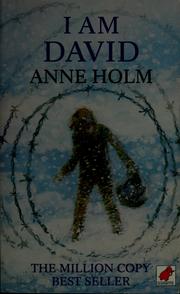
I am David by Anne Holm

I am David by Anne Holm, translated from the Danish by L.W. Kingsland (Puffin, 1969; first published in Denmark, 1963)

8 chapters; 153 pages

Subjects: Denmark, Italy, Eastern Europe, concentration camps, Cold War, dogs, fable, intermediate fiction (Year 6-8)


Synopsis
This entry might be a bit of a cheat, but it is included in all sincerity, even if under slightly false pretences. 

I am David made a strong impression on me when I read it as a child. It’s one of the many classic Puffin books discovered and published by their marvellous editor Kaye Webb.

Recently I re-read it in preparation for a workshop I was holding on Writing about war for children, and discovered that what I thought I knew about it was quite wrong. I thought it was a book about a Jewish boy escaping from a concentration camp in World War Two (a bit like The boy in the striped pyjamas, but with a happier ending.) Turns out that’s not true at all.

The clue is on pg 50 (in my edition). Because David has grown up in the camp, he has no idea about geography or anything else in the outside world, and he’s trying to work out which countries are safe. His definition of a safe country is one with a king or queen, and when he asks someone about England, the answer given is that “at the moment there was a queen because the last king had had no sons, only daughters.” So the book must be set after 1953 (when Queen Elizabeth came to the throne) and it’s an Eastern Europe / Cold War / Communism story, not a World War Two story at all.

Or is it? This article points out that David is 12 in the story, so it's possible that he could have been born during World War Two. 

There are some unlikely coincidences in the plot, especially towards the end, but I think this ambiguity is partly why it has stayed in my memory. It is quite a haunting book.

The book cover above is my own copy, but there are a number of other editions with different covers.


Reviews:
This review on The bookbag calls David "an introspective, deep child" who "observes constantly and learns quickly and ... has his own, strong sense of what is right and what is wrong." 

Another review on Reading matters comments that “the book is not set in a real time or place. Although the circumstances seem real enough, David's background is a synthesis of all the terrible persecution that happened during the Second World War and the subsequent years of cold war communism. This helps to make David a very powerful and pure figure. I don't think he is particularly real. Anne Holm uses him as a blank canvas on which can be drawn the first experiences of life - beauty, knowledge, trust, religion, love, everything.”

It’s a classic, there are masses of reviews and reading guides online. Don’t get bogged down in them. Just read the book for yourself.

About the author
For such a famous book, I couldn’t find much info on the author.

According to this obituary in the Independent, Anne Lise Elfe was born in Aal, Jutland, on 10 September 1922. She married Johan Holm in 1949 and they had one son. She died on 27 December 1998. 

The writer of the obituary describes the book as "a landmark in bringing to children's attention the existence of a world of political evil and the misery this causes. Some doubted the need for revealing such harsh truths at an early stage, but the thousands of children who read the book often sent letters of thanks to the author. Sometimes they wrote directly to the fictional David as well." 

found this very interesting as it echoed the issues we were discussing in the workshop, to do with "how much” to tell children about war.

In the book, David himself says, “I am glad I told Maria that evil exists. I don’t want her to be afraid, but it’s something you have to know about. Can’t you understand that children have a right to know everything that’s true?”

Other books you might like:
The silver sword by Ian Serraillier (1956) is also about children wandering through post-war Europe, trying to reach a safe country (in this case, Switzerland), although these children do have each other and aren't as completely alone as David.  

Number the stars by Lois Lowry is set in Denmark (where David is told to head to) in World War Two and celebrates the bravery and compassion of the Danish people

Things I didn’t know
That this book which I loved as a child isn't about World War Two at all!

Thursday, 3 July 2014

The snow goose by Paul Gallico, illustrated by Peter Scott

The snow goose by Paul Gallico, illustrated by Peter Scott (Michael Joseph, 1946)

10 chapters; 55 pages with colour and black and white illustrations

Subjects: World War Two, France, Dunkirk, birds, fable, boats, young adult fiction (Year 9-13)


Synopsis
I’m not sure if this counts as a children’s book, but it doesn’t really fall into any other category that I can think of, and some older children would definitely enjoy it. Apparently (according to Wikipedia), it was “first published in 1940 as a short story in The Saturday Evening Post, then … expanded … to create a short novella which was first published on April 7, 1941.”

The book covers the decade from 1930 to 1940. It is set on an abandoned lighthouse on the remote Essex marches and tells the story of Philip Rhayader, a hunchbacked reclusive painter and Fritha, a young girl from the nearby fishing village. The two of them are linked in friendship and, later, unspoken love by the snow goose of the title, until Philip sails away to help in the evacuation of British troops from the beaches of Dunkirk in late May 1940. What happens to him can only be guessed by Fritha, but is told in snatches of overheard dialogue by by soldiers and naval officers.

When I went to borrow a copy from the library, I had to ask a librarian to retrieve it from the YA Fiction Nostalgia section out the back. (I didn’t even know there was such a section.) And the loveliest thing happened, which was when I gave her the title, she said. “I’m named after that book.” Her name was Fritha.

Fritha (in the library) told me about a 1970s BBC film of The snow goose, starring Richard Harris (aka Dumbledore in Harry Potter) and Jenny Agutter (from The railway children.) She said it’s hard to track down, but can be viewed on Youtube, and here it is (I'm going to watch it, and it looks wonderful.) 

The original 1940 copy of The Snow Goose, as it appeared in The Saturday Evening Post is now available online.


Reviews:
If you’ve read this book, you will know it is a sad, melancholic, haunting tale. Some contemporary reviewers called the book sentimental, but it achieved near classic status almost at once and Michael Morpurgo cites it as an influence on his book War Horse.

Winter reads in The Guardian calls it a wartime classic, “a novella no thicker than a love letter, in which every sentence seems to shiver with the salt-laden chill of the desolate landscape in which it is set.” The reviewer made me think of my Fritha-in-the-library. She says, “My mother loved the story so much she wanted to call me Fritha, after the untamed Anglo-Saxon heroine. And growing up I would think of that other girl I might have been if only my resolutely unsentimental father had not intervened.”

The Guardian also put it on its list of 1000 Novels You Must Read


(1000 novels is a lot of reading! If you are feeling brave, here is a link to the compete list.)

Another review says it is "a moving story about love and courage, with an ending that is unforgettable."

About the author
Paul Gallico (1897 – 1976) was an American writer whose name is not often heard these days, but he used to be popular. His other well-known stories include The small miracle, about a little boy and his beloved donkey,  Thomasina (filmed by Walt Disney) and The Poseidon adventure, about a cruise ship sinking, which was also made into a movie.

About the illustrator
The Nostalgic library copy was the 1946 edition with illustrations by Peter Scott, which we had at home when I was growing up. Peter Scott (1909-1989) was the son of Antarctic explorer Sir Robert Falcon Scott, who died when he was only two years old. Famously, Scott left instructions for his wife that she should "Make the boy interested in natural history; it is better than games. Make him a strenuous man". 

Peter Scott became a naval officer in WW2, and was also a famous painter, ornithologist and conservationist, who founded the Wildlife and Wetlands Trust at Slimbridge on the Severn River estuary in Gloucester. 

According to Wikipedia (again) he used his first wife Elizabeth Jane Howard as the model for Fritha – another fascinating sidebar, as I’m currently reading her wartime chronicles of the Cazalet family.  EJH was about 15 years younger than him, and had striking good looks; their marriage ended in divorce, and she later married Kingsley Amis; she died in January 2014, aged 90.

You can read more about Peter Scott's life here and here.  

I never knew this and it's fascinating:
According to a story in the Telegraph in 2010, a disused lighthouse at Sutton Bridge on the Norfolk Wash provided the inspiration for the setting of this book. Peter Scott rented it for £5 a year in the 1930s, and was visited every year by a pink-footed goose that he called Annabel. Gallico, who was a friend of his, transformed the timing (to wartime), the setting (to Essex) and the bird (to a snow goose.) The story is told in more detail on the website of Sutton Bridge village.   

Peter Scott in front of the East Lighthouse
Peter Scott in front of the East Bank Lighthouse 
If you visit the area, you can go on the Peter Scott walk, which follows the old sea bank along the Wash from King's Lynn, to the Peter Scott lighthouse at Sutton Bridge. 

Other books you might like
The dolphin crossing by Jill Paton Walsh tells the story of two school boys who take a small boat across the Channel to help in the evacuation of Dunkirk. 

The story of Dunkirk
The evacuation from Dunkirk took place over ten days from late May to early June 1940, and ten days later, German troops entered Paris. It's true that hundreds of small boats sailed across the Channel to help take men off the beaches. You can read more about Dunkirk here and listen to Voices from Dunkirk in the words of eight survivors here

You can also see some images of the evacuation on the Imperial War Museum site. 


Friday, 7 June 2013

The silver donkey by Sonya Hartnett

The silver donkey by Sonya Hartnett (Viking, 2004)

ISBN 0 670 04240 4

18 chapters; 192 pages with about 10 full page black and white illustrations

Subjects: World War One, France, deserters, animals, fable, junior fiction (Year 5-8)


This story is set in northern France, near the coast, sometime during the battles fought along the Western Front during World War One. 

Two sisters, Coco and Marcelle, find a soldier hiding in the woods, desperate to get back to his sick brother in England. The trauma of war has left him temporarily blind. Together with their older brother Pascal and a friend, Fabrice, the girls concoct a plan to help him. The two of them are delightful, especially Coco who is entranced by the soldier’s tiny silver donkey (there is a lovely passage where she imagines riding away on it.) Pascal, on the other hand, would prefer to hear gruesome first-hand accounts of the war, “a tale about machine-guns and bayonets.”

Interspersed with the main narrative are four stand-alone stories, told by the soldier, three of them with a donkey theme: Mary and Joseph travelling to Bethlehem, a legend about why storm clouds are grey and the tale of the “donkey man” at Gallipoli (although again the place is not mentioned.)  

The story is beautifully told in almost poetic language. One plot detail that bothered me was that the soldier would still be treated as a deserter when he reached England, so he was not really escaping to safety.  But this is partly because details are often left vague, and the story has an almost dreamlike quality of “fable”. The book is asking questions about the nature of bravery and courage and the sort of qualities that really matter, like the donkey’s qualities of loyalty, humility, gentleness, trustworthiness and steadfastness.

The silver donkey was made into a musical by the Australian team of Dean Bryant and Matthew Frank, and the production toured Australia and  the USA in 2006. You can see a clip from it here on Youtube. 

Reviews: 

Charm under fireSonya Hartnett's The Silver Donkey shows that life in wartime offers surprising opportunities. Another review is here: The silver donkey by Sonya Hartnett


You can also find teacher's notes for the book here


Questions:
  • What do you think is the answer to Fabrice’s question (in the chapter called Heroes): “Do you really have a brother… Or is he a ghost made of wishes and fear, someone you invented to disguise your shame in fleeing a war which other men… have stayed behind to fight?"
  • Do you think the Lieutenant did the right thing when he lay beside the dying Ernie Whittaker? What else could he have done? How do you think he felt afterwards?
  • What does the silver donkey represent?
  • Why don’t we ever learn the Lieutenant’s real name?
  • Who is a “hero” in this book? What is heroism?

Author’s website:
Sonya Hartnett is an Australian writer. 


Her other war-related children’s books include Children of the King (2012),  a time-overlap adventure about three children sent to the countryside to escape the war in London, and The midnight zoo (2010) (“Under cover of darkness, two brothers cross a war-ravaged countryside carrying a secret bundle. One night they stumble across a deserted town reduced to smouldering ruins. But at the end of a blackened street they find a small green miracle: a zoo filled with animals in need of hope.”)

Other books you might like:
Private Peaceful by Michael Morpurgo also deals with the topic of army deserters and how they were treated.

New Zealand connections:
Desertion was treated as a crime by the army and could be punished by  court-martial and execution.  On pg 47 of Anzac Day: the New Zealand story is a section called “Pardoned at last”. This tells the story of the men who were court-martialled for mutiny or desertion, often because they were suffering from undiagnosed shell shock. Many of these men had fought bravely in other parts of the war but had just reached the limit of what they could endure. Their deaths were seen as terribly shameful for their families and often they were not talked about for years.

In England, there is a memorial  to some of these young men from Britain and the Commonwealth at the National Memorial Arboretum in Staffordshire.

File:Shot at Dawn memorial.JPG
Called the Shot At Dawn Memorial, it contains a statue of a young man ­blindfolded and strapped to a post, surrounded by 306 other posts, each with the name, age and ­regiment of a man who was executed.

In 2000, the Pardon for Soldiers of the Great War Act was passed to pardon the five NZ soldiers who were subsequently shot. You can read more about the Act here and hereThe medals and certificate of pardon for one of the soldiers, Victor Spencer, were later gifted to the Bluff Maritime Museum

Of the five soldiers listed, two were born in Australia and their story is told further here:
ANZAC tragedies revealed after 80 years: the stories of Private John Sweeney and Frank Needs / John King , both Australians who signed up in NZ, and served bravely in Gallipoli but were charged with desertion in France and shot. (It’s interesting to note that Australian never allowed its own soldiers to be shot, perhaps because the AIF was made up of volunteers  - conscription was voted against twice by the Australian public during World War One - and the public outcry would have been huge. But these two men had signed up for the NZ army.)