Showing posts with label France. Show all posts

Monday, 23 April 2018

The red poppy by David Hill, illustrated by Fifi Colston

The red poppy by David Hill, illustrated by Fifi Colston (Scholastic, 2012)

Also published in te reo as Te Popi Whero. 

Subjects: World War One, France, poppy, dogs, animals, picture books (Year 3-6)


The Red Poppy (Book and CD)

Synopsis

Jim McLeod is a young soldier like any other, waiting in the trenches as the time of attack draws nearer. Nipper is a stray dog, found in an abandoned French  village, whom the soldiers have trained to act as a messenger dog, carrying messages in a leather bag around his neck (and he was a good rat-killer as well).

The only patch of colour is a cluster of poppies amidst the grey mud. Jim, an "enemy" German soldier and Nipper are about to see their paths meet - and the poppies have a role to play as well.

There's a CD at the back of the book  (and lyrics on the back page) featuring an original song (Little red poppy) written by Canadian musician Rob Kennedy and performed by Giselle Sanderson. (David Hill says in the acknowledgements that the song "started everything off".) Little red poppy has now been sung at commemoration services around the world and you can listen to it here on You tube.

You can also listen to The red poppy on Radio NZ's Treasure chest.

Reviews:
My bestfriends are books interviews David and Fifi about family history, writing this book and what it meant to them. 
Kids' book review calls it "a breathtaking and deeply moving book. It’s about a man, a war, and the basic concepts of humankind. It’s about a dog, an unlikely friendship and the iconic red poppy used to commemorate our fallen". 
You can find teacher notes from Scholastic here

About the author:
David Hill is one of New Zealand's best (and best loved) writers for children and young adults. You can read more about him on the NZ Book Council site or the Christchurch City libraries site. 
His other books with a war theme include Enemy camp and Flight path.  (Interestingly, he says in this newspaper interview that he started writing war stories because "it became embarrassing for an "old guy" to try and write contemporary teenage slang ".)

About the illustrator:
Fifi Colston has a great website with this page about her children's book illustration (including The red poppy).  

Other books you might like:
Caesar the Anzac dog and The Anzac puppy are both stories about dogs in World War One.

Links
Dogs were used for many different purposes in World War One (there was even a War Dog School Of Instruction). This article has some interesting facts about "four-legged fighters". 
This one has a picture of a dog wearing a gas mask. 
More pictures and info here and here

Have you read it?
Have you read this book? Let me know what you think!

Friday, 14 July 2017

A present from the past by Jennifer Beck; illustrated by Lindy Fisher

A present from the past by Jennifer Beck; illustrated by Lindy Fisher (Scholastic, 2006)

32 pages with colour illustrations

Subjects: World War One, France, Christmas, nurses, women in war, grandparents, family, picture books (Year 1-4)


Synopsis

It’s nearly Christmas time. Emily is waiting with her parents at the airport for her Aunt Mary whom she’s never met before. Aunt Mary has come all the way from England, bringing a special gift: a small oblong parcel, with a note saying “Best wishes from Princess Mary”. Inside, to Emily’s disappointment, is nothing but a small brass box with a damaged lid. But as Aunt Mary tells the story behind the box, Emily comes to realise that it is indeed a precious family heirloom.

These boxes, containing items such as sweets and tobacco, were the idea of Princess Mary, the 17-year-old daughter of King George V and Queen Mary, who wanted to give every serving soldier, sailor and nurse a Christmas present in December 1914 as a personal thank you for their sacrifices and hard work. You can read more about them here and here.

These Christmas boxes make a lovely story on their own, but the box in this book played an even more important role.

Don’t miss the dedication: “In memory of women in wartime”. There is also a fact sheet at the end.

Reviews:
A review on Perfect Picture Book Friday says the book "would be a great resource in History classes enticing conversations about war, troops overseas, and families dealing with loved ones during war time in the past."

There's another review on Momo celebrating time to read (great title for a blog!) 

About the author
You can read an interview with Jennifer Beck on the Christchurch City Libraries website, or learn more about her on the Book Council Writers files

About the illustrator
Lindy Fisher is profiled on the Book Council and Storylines sites. She has also had over 75 stamps published by New Zealand Post! You can see some of her artwork on her website.

Other books you might like:
Jennifer Beck is the author of the much-loved picture book The bantam and the soldier. She and Lindy Fisher have worked together on other books, including Stefania’s dancing slippers and Remember that November (about Parihaka).

NZ connections:
When I was researching for my Anzac Day book, I got to see one of these tins. It belonged to Hami Grace, an old boy of Wellington College, and is now held in the College Archives.


Things I didn’t know
I didn’t know that Princess Mary was born on 25 April (1897) – the day that later became Anzac Day! What a lovely connection!

Have you read it?
Have you read this book? Let me know what you think!

Monday, 22 August 2016

Toitoi: Anzac special issue

Toitoi: Anzac special issue (February 2016)

92 pages with full page colour illustrations

Subjects: World War One, World War Two, Gallipoli, France, trenches, junior fiction, children’s writing (Year 5-8)

toitoi_anzac


Synopsis
Toitoi is a quarterly journal for young New Zealand writers and artists, aged 5-13, which publishes “material with an original and authentic voice that other young people can connect to and be inspired by and that reflects the cultures and experiences of life in New Zealand.” It encourages creativity and can also be used in the classroom with teaching notes for each issue.
You can read more about it here
And they also have a Facebook page.

This Anzac special issue is filled with highly imaginative work that tells the story of war in many different forms: stories, poems, letters, diary entries and even a song, with accompanying full page illustrations. One piece in French (Poilu by Tristan Hosking, aged 9) manages to be an acrostic poem as well.  

They cover topics such as leaving NZ by ship (from the point of view both of those leaving and those left behind), posting a tin of Anzac biscuits, Gallipoli, France, the trenches, seeing friends die in battle, losing a loved one and remembering the war years later in Anzac Day ceremonies and small family interactions. Many of the writers show great sensitivity and they also use some powerful sensory descriptions.

I liked so many of these pieces that it’s hard to single any out, but here are a few lines that particularly moved or impressed me with their thoughtfulness, empathy and imagination:

“Imagine having great valour then slowly having a disheartened mind.”
(from Imagine by Kareena Dunlop, aged 11)

“It looks like we are winning which is quite good so I might be home in time for Christmas”
(from April 1915, a letter, by Alice Kelsall, aged 7)

“In Flanders Fields I see death / In every second and every breath.”
(from In Flanders Fields, a poem by Kyuss Williamson, aged 12)

“How still you die / When you are dead / How still you lie…
I know both sides / Both stories / Both losses / I know both sides.”
(from My people, a poem by Ilana Kizildere, aged 10)

“I am ashamed that I killed people. But then again, I’m proud that I ought for my country. That’s why I just sit here. The Second World War haunts me every day.”
(from Grandpa’s story by Megan Foster and Madison Blackwood, aged 11)

Similarly with the many wonderful illustrations, it’s hard to select just a few, but I was especially impressed by Alisha Sangster’s illustration for Grandpa’s story, showing the old man leaning on a stick with a soldier’s shadow looming behind him. I also liked Aisha Tanaka-Avers’ departing  ship, Apple Minoza’s white cross on a swirly coloured background, Pieta Bayley’s woman packing up the tin of Anzac biscuits, Anna de Boyett’s dramatic portrait of a horse, Stella Hinton’s soldier silhouette (reproduced on the front cover above) and Shahni Tagatoa’s muted graveside scene.

Have you read it?
Have you read this issue of Toitoi? Let me know what you think!
Have you submitted anything to Toitoi? Check out the dates that the next submissions close and have a go. It's such a great magazine and a wonderful opportunity to see your work in print.  

Saturday, 21 May 2016

The year it all ended by Kirsty Murray

The year it all ended by Kirsty Murray (Allen & Unwin, 2014)

30 chapters; 243 pages

Subjects: World War One, Australia, France, Belgium, Germany, enemy aliens, white feathers, family, influenza, armistice, peace, Peace Day, war graves, Cheer Up Society, young adult fiction (Year 9-12)


Synopsis
This book starts with a poignant vignette of a pre-war scene, when 11-year-old Tiney – short for Martina - is allowed to join her big brother Louis and older cousin Will on their early morning expedition to Glenelg Beach. Six years later, everything has changed. Louis has gone to war and now the bells are ringing on Tiney’s 17th birthday to signal the armistice on 11 November 1918. 

As well as Louis, the family includes Tiney’s three older sisters: Dorothea (or Thea) the artist, Minna and Nette. Their family ancestry is German and Will (or Wilhelm) went to Heidelberg to study and was caught in Germany when the war started. As a result he was conscripted to fight on the German side. Will’s brother Paul, their other cousin, was interned as an enemy alien on Torrens Island.

As the cover suggests, “the year it all ended” was the year that things started to change, and the sub title (“War ends, the Jazz Age dawns. What will destiny bring Tiney Flynn?”) underlines this theme. Although the war is over, its effects continue and there will be many changes in Tiney’s life, both good and bad. Tiney is obsessed with what seems like an impossible dream, to go to Europe, but she manages to achieve it and sails across the world with her friend Ida and Ida’s mother, to visit the battlefields of France and Belgium.

I found this a very interesting viewpoint – not just Tiney’s, but that of a German-Australian family and the attitudes they faced in the war. 

Reviews:
I’ve tried to look for reviews that don’t give away too much of the plot, which is tricky as this reviewer acknowledges (but succeeds in doing - or not doing!) The reviewer loved "the vivid way in which Kirsty Murray has bought a period of history to life."

This review does contain more plot descriptions but I’ve included it as it has an author interview, I liked the answers to questions 4 and 6 in particular.

Here is a review from the Kids’ Bookshop (having given up by now on trying to avoid spoilers).

And there are more excerpts from reviews on Kirsty Murray's website here

About the author:
Kirsty Murray grew up in a family of seven children, in Melbourne and then Canada, has travelled widely, loves reading and says her most important job “and the one that took up most of my time was being a mother”, but has still produced a string of prize winning books. Lots of other info about her on her bio and FAQ pages.

I like her answers to What were your favourite books when you were a kid? and What’s the hardest part of writing for you?

Teachers’ notes are also available on her website here.

Other books you might like:
Remembrance by Theresa Breslin and Flora’s war by Pamela Rushby both tell the story of WW1 from the viewpoint of girls about Tiney's age. 

Things I didn’t know
The Cheer Up Society really did exist. “Its object was to support the soldiers in the First and Second World Wars as well as to bring them into contact with the 'highest type of womanhood'. “

You can see some wonderful photos here and here


Saturday, 2 April 2016

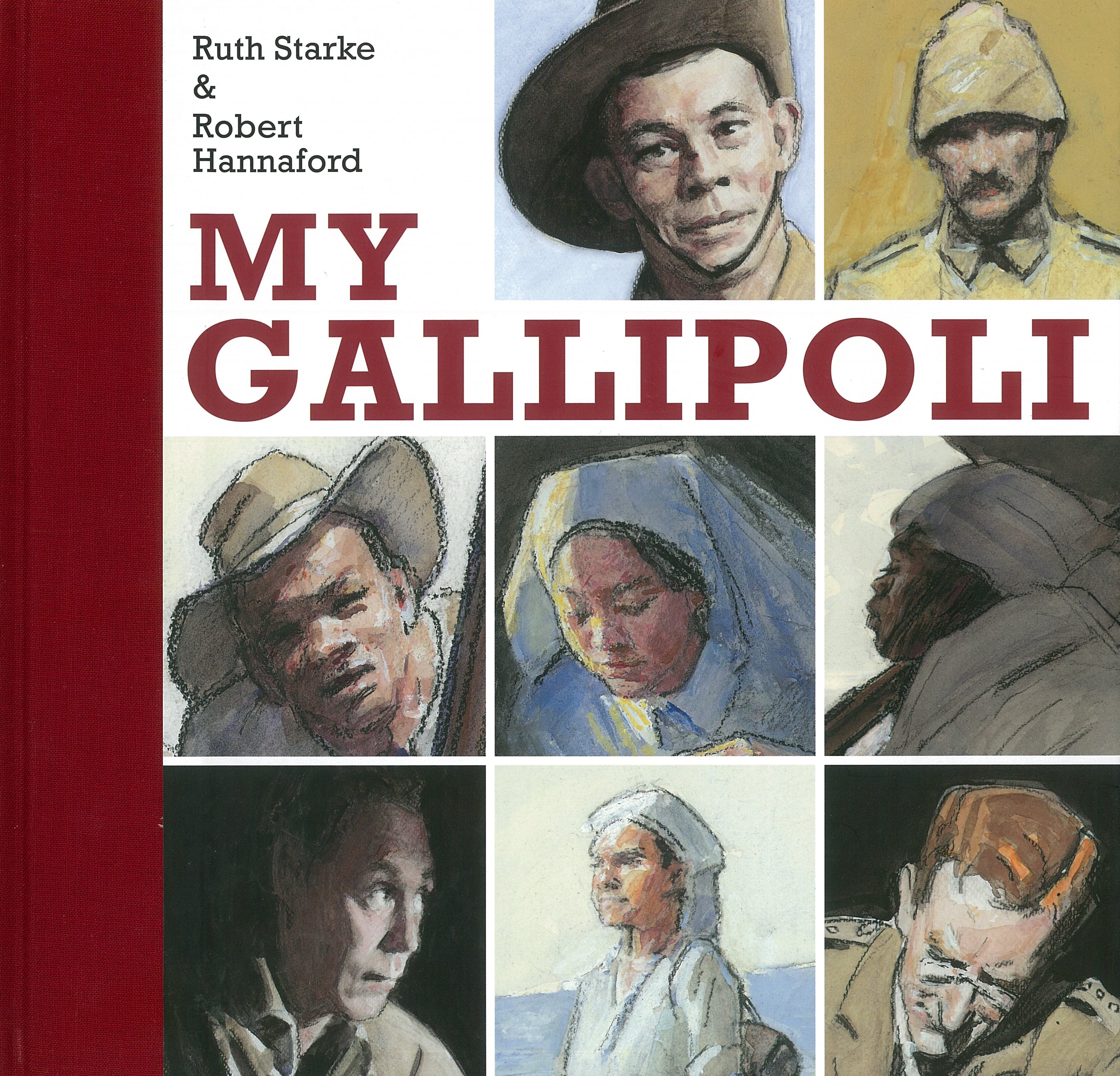
My Gallipoli by Ruth Starke, illustrated by Robert Hannaford

Anzac Day is only a few weeks away and so this book on people who were at at Gallipoli seems like a good one to review at this time. It also marks my 70th book review for this blog. 

My Gallipoli by Ruth Starke, illustrated by Robert Hannaford (Working Title Press, 2015)

32 pages with full page illustrations

Subjects: World War One, France, Australia, Turkey, nurses, chaplains, war correspondents, Charles Bean, war artists, George Lambert, snipers, Billy Sing, Ataturk, Mule Corps, war graves, Cyril Hughes, sophisticated picture books (Year 6-12)

Book Cover:  My Gallipoli

Synopsis
From the shores of Anzac Cove to the heights of Chunuk Bair, from Cape Helles to Gurkha Bluff, the Gallipoli Peninsula was the place where thousands of men from sixteen nations fought, suffered, endured or died during the eight months of occupation in 1915. For each of them, their families and their nurses, Gallipoli meant something different. Their voices emerge from the landscape and across the decades with stories of courage, valour, despair and loss.” (Penguin Books website)

The title suggests that Gallipoli has some personal resonance for all of us, while the cover, with its portraits in individual squares, gives a clue to the way the story will be told inside. I like the way that it focuses on real historical characters, as well as nameless Anzac soldiers and Turkish people, and also includes women, stretcher bearers, the chaplain and indigenous soldiers.

I also like the fact that it doesn’t finish in December 1915, but shows the ongoing effects of the campaign, and what it might be like to revisit Gallipoli today. There are useful extra facts at the back and a map at the front. Each spread could be used as a springboard to find out lots more information.

Teachers’ notes are available here and include comments from both author and illustrator about the thinking, ideas and inspiration behind the book.

Reviews:
There are plenty of good reviews that will give you a idea of the book’s themes and potential readership. The Readings website says that "the rich panoply of voices in Ruth Starke’s text offers upper primary and lower secondary students a broad understanding of the Anzac Campaign and the current views of those engaged in the war as well as those at home." Other reviews appear in The Book Chook and Kids Book Review.

Questions:
Which page was the most surprising for you? Which one presented a viewpoint that you hadn’t thought of before?

Author’s website
Ruth Starke lives in Adelaide, South Australia, and has published more than 20 novels for young people. Before becoming an author, Ruth worked in public relations and travel marketing, and at a great variety of other jobs - of which the most interesting, she says, were selling French perfume in Harrods, cooking on the radio, taking tourists to Kashmir, and interviewing Grand Prix drivers. Ruth has also written “An Anzac tale,” a graphic novel about Gallipoli.

This is my favourite of “20 questions with Ruth” on her website:
What is the naughtiest thing you did?
Accidentally swallowed my best friend's brother's prize goldfish during a “dare”.

Info about the illustrator
This is Robert Hannaford’s gallery

In an interview in The Advertiser, he explains “How to paint a portrait” and says, “This is why I paint. I never get sick of it. Painting for me is a learning experience.”

NZ connections:
I’m pleased to see that  Ruth Starke, included a story told by a New Zealand soldier, “Private Andrew McBain” of the Auckland Mounted Rifles, and his mate Frankie, in the pages on Chunuk Bair.

Tuesday, 1 March 2016

Five children on the Western Front by Kate Saunders

Five children on the Western Front by Kate Saunders (Faber & Faber, 2014)

24 chapters; 318 pages

Subjects: World War One, France, England, children, fantasy, Edith Nesbit, Five children and it, Psammead, junior fiction (Year 5-8)


Synopsis
This book came out to much acclaim as “an epic, heart-wrenching follow-on from E. Nesbit’s Five children and It stories” (from the back cover) and won the Costa Children’s Book of the Year award.

Five Children and It was published in 1902, with two sequels: The phoenix and the carpet (1904) and The story of the amulet (1906). I read them all as a child and loved them, although I haven’t looked at them again for a long time and I’m not sure if they are as widely read today.

In the Prologue (set in 1905, and adapted from a chapter of The story of the amulet), Cyril is 12, Anthea 11, Robert 9, Jane 7 and the (youngest child) Lamb – actually Hilary – is still a baby. By the start of WW1 in 1914, they are old enough, in some cases, to go off and fight, or volunteer as a VAD (Voluntary Aid Detachment) .

Because Cyril and Anthea are almost grown up and often away, Kate Saunders adds another child (Edie, aged 9) and she and the Lamb/Hilary, now 11, become the main characters. The two of them rediscover the Psammead (a grumpy, wish-granting sand fairy - “you pronounce it Sammy-ad”) and he stays with them for almost the duration of the war. The story gets sadder and the mood more sombre as it gets closer to the end.

The idea behind the book – bringing these children from their Edwardian childhood into the horrors of WW1 – is very clever. I did wonder if the theme of the  Psammead’s “repentance” could be confusing for children.

Reviews:
The Guardian calls it a “respectful homage” and says that “transplanting E Nesbit’s much-loved characters into the trenches tugs at the heartstrings in a way statistics can’t”.

“For all Saunders's delight in channelling Nesbit's Edwardian sensibilities, this is not a nostalgic book. It asks questions about lost innocence and the kind of stories we used to tell ourselves. Saunders dedicates her book "To all the boys and girls, 1914-18". Nesbit described her characters as "not bad sorts on the whole; in fact, they were rather like you". The same can be said, Saunders implies, about the doomed generation that met its fate in Flanders fields.”

About the author
In this interview in the Telegraph, Kate Saunders talks about events in her own life that background the story; some of it is very moving, and it made me think about the book in a different way.

There’s another interview with her here on BBC news.

About E Nesbit
The Edith Nesbit Society has its own website where you can read sedate biography of Edith Nesbit (1858-1924). 

But this article in the Guardian paints a rather racier (and sadder) picture of her life.

Other books you might like:
Edith Nesbit also wrote the much-loved classic The railway children, published in 1906 and never out of print since.  

Saturday, 16 January 2016

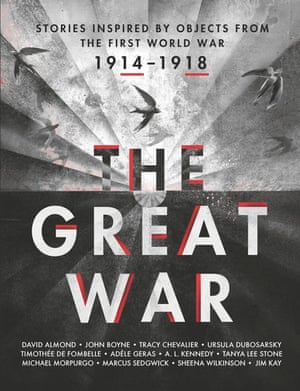
The Great War: stories inspired by objects from the First World War

The Great War: stories inspired by objects from the First World War (Walker Books, 2014)

304 pages, with full page black and white illustrations by Jim Kay; 11 stories by David Almond, John Boyne, Tracy Chevalier, Ursula Dubosarsky, Timothée de Fombelle, Adèle Geras, A.L. Kennedy, Tanya Lee Stone, Michael Morpurgo, Marcus Sedgwick and Sheena Wilkinson.

Subjects: World War One, England, France, short stories (Year 5-8)

Great War: Great War cover

Synopsis
This anthology contains stories by English, American, French, Irish and Australian authors. Each author uses a particular object as the inspiration for a story about the First World War. The objects include items belonging to individual soldiers – a helmet, a writing case, a compass. Some are printed material: sheet music, school magazines, a recruitment poster.  There is a French toy soldier, the nose from a Zeppelin bomb and a Victoria Cross and a Princess Mary gift box. One of my favourite items was a hand-painted war time butter dish.

Some stories are set in the present day (a school history trip to the battlefields), others in the past. A number of them have girls as the main characters. One is a sort of ghost story. One is written as a poem. Many are firmly based in family life. As in all anthologies, some stories work better than others, but all are of a very high standard.

The pages at the end of the book contain biographical information about the contributors and pictures of their chosen objects. From the picture credits, you can work out where most of the objects come from (many are held in the Imperial War Museum), but I would have liked some more information about how the authors chose the object they wrote about. (This article in the Guardian shows some of the objects.)

About the illustrator
Interesting random facts: Jim Kay won the Kate Greenaway Medal in 2012 for his illustrations for A monster calls by Patrick Ness and was chosen by J.K. Rowling to illustrate the full-colour editions of the Harry Potter series. Here they are!

And here he talks about his illustrations for The Great War.

Other books you might like:
War girls is another recent collection of war-related short stories. The curioseum, although not war- related, is another example of using museum objects to spark a story. 

Things I didn’t know
The country you call home by John Boyne describes the fierce debate amongst the Irish about whether they should support England in the First World War, when for years they had been fighting to get England out of Ireland.

The words that struck me most were from A world that has no war in it by David Almond, a story about a long-running neighbourhood feud.  Near the end, the narrator is talking about all the wars that feature on the news every day. “Are we daft?” he asks. “Are we evil? Is it just the way we are? Are we acting out something that started with our ancestors? Is it in our bones and blood? Do we go to war because we’re in love with war? Will we be asking those damn questions till the very end of time?”

The words stayed in my mind because I think a lot about writing books about war for children, and why we do it and what we are trying to say. Surely we want our readers to reflect on the futility of war, but as David Almond says, the wars just keep happening.

Tuesday, 27 October 2015

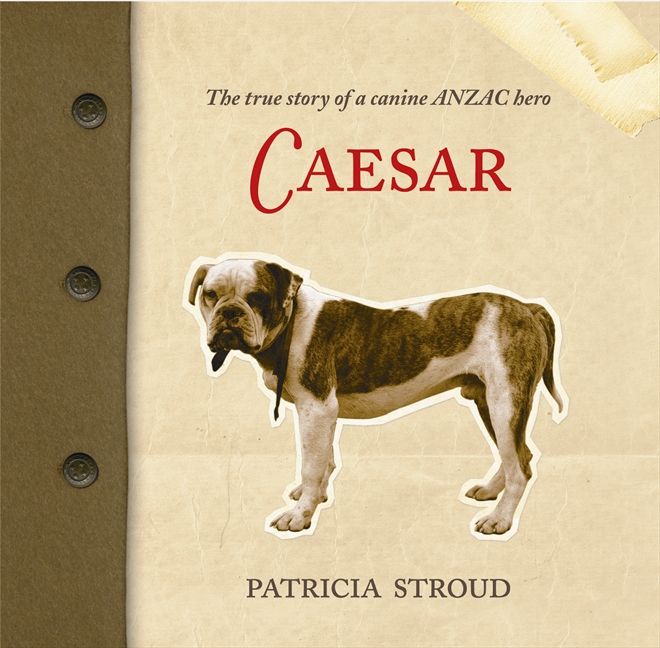
Caesar the Anzac dog by Patricia Stroud, illustrated by Bruce Potter

Caesar the Anzac dog by Patricia Stroud, illustrated by Bruce Potter (Harper Collins, 2003)

40 pages with sepia illustrations

Subjects: World War One, France, dogs, animals, mascots, junior fiction (Year 2-6)


Synopsis:
This book is based on the true story of Caesar, which was told to the author, Patricia Stroud, by her mother, Ida. 

Ida (aged four) was in the crowd when Caesar the bulldog, as official mascot, led the Rifle Brigade down Queen St in Auckland to board the ships that would take them to Egypt and the Western Front. As described in the book, Ida donated her blue ribbon for Caesar to wear. She gave it to her uncle Tom who was Caesar’s handler and he tied it onto Caesar’s collar.

Caesar worked during the Battle of the Somme in 1916 as a Red Cross dog. These dogs helped the stretcher-bearers to rescue wounded soldiers at night from No man’s land, the area in-between the trenches of the two opposing sides. They were trained to look for something that belonged to the man, such as a coat or cap, bring that item back to the stretcher bearers and then lead them to the wounded soldier.

Caesar was shot and killed in action. His handler, Tom, was temporarily blinded by mustard gas and sent to hospital in England. He married one of the nurses and they returned home on a hospital ship.

The family history aspect of the story is underlined by the way it is told to three boys, James, Brendon and Michael, who are visiting their great-grandmother (Ida) in the summer holidays. She tells them about the parade, and how her other uncles also went off to war.

The book was reprinted in 2009, with extra content, as Caesar: The True Story of a Canine ANZAC Hero ("A recount of the life of the bulldog that became the official mascot of the 4th Battalion of the NZ Rifle Brigade").


About the author
According to the Harper Collins website: “Patricia Stroud is a mother and grandmother, who has researched the facts behind a much loved family story to record a little-known aspect of New Zealand’s military history. As a volunteer, she spends many hours interviewing war veterans and recording their stories for the oral history archives of her local museum. Patricia and her mother Ida both live in Auckland.”

There is an interview with Patricia in the New Zealand herald, and here she is visiting the children of Botany Downs school

About the illustrator
Bruce Potter (here is his Storylines profile) has illustrated many other books, including The Donkey Man by Glyn Harper, Grandad's Medals by Tracy Duncan, Soldier in the Yellow socks by Janice Marriott and My Grandfather's War by Glyn Harper. (And who knew he is also "an internationally ranked powerlifter"??)

Other books you might like 
The Anzac puppy by Peter Millett and Trish Bowles is an appealing picture book based on the true story of a World War One mascot. The red poppy by David Hill, illustrated by Fifi Colston, tells the story of Nipper the messenger dog. 

Links
This unusual vintage clip shows a French Bulldog working on the Western Front in France in 1917.

The article about Caesar on the NZ History website includes this photograph of his collar (with an incorrect spelling of his name), now held at the Auckland War Memorial Museum (where you can also buy a soft toy Caesar!).


Jack, the New Zealand Engineers' canine mascot in France, World War I
Jack, the New Zealand Engineers' canine mascot in France, World War I. Ref: 1/2-013104-G. Alexander Turnbull Library. http://natlib.govt.nz/records/23171041

Bull, George Robert, 1910-1966 (Photographer) : Maori Battalion soldier and dog Paddy the mascot, Christmas Day, Maadi camp, Egypt
WW2 Maori Battalion soldier and dog Paddy, the mascot, share some pork from the hangi on Christmas Day at Maadi Camp, Egypt; Ref: DA-04880-F. Alexander Turnbull Library, http://natlib.govt.nz/records/22812710

Have you read it?
Have you read this book? Let me know what you think!