Showing posts with label Vietnam. Show all posts

Sunday, 24 June 2018

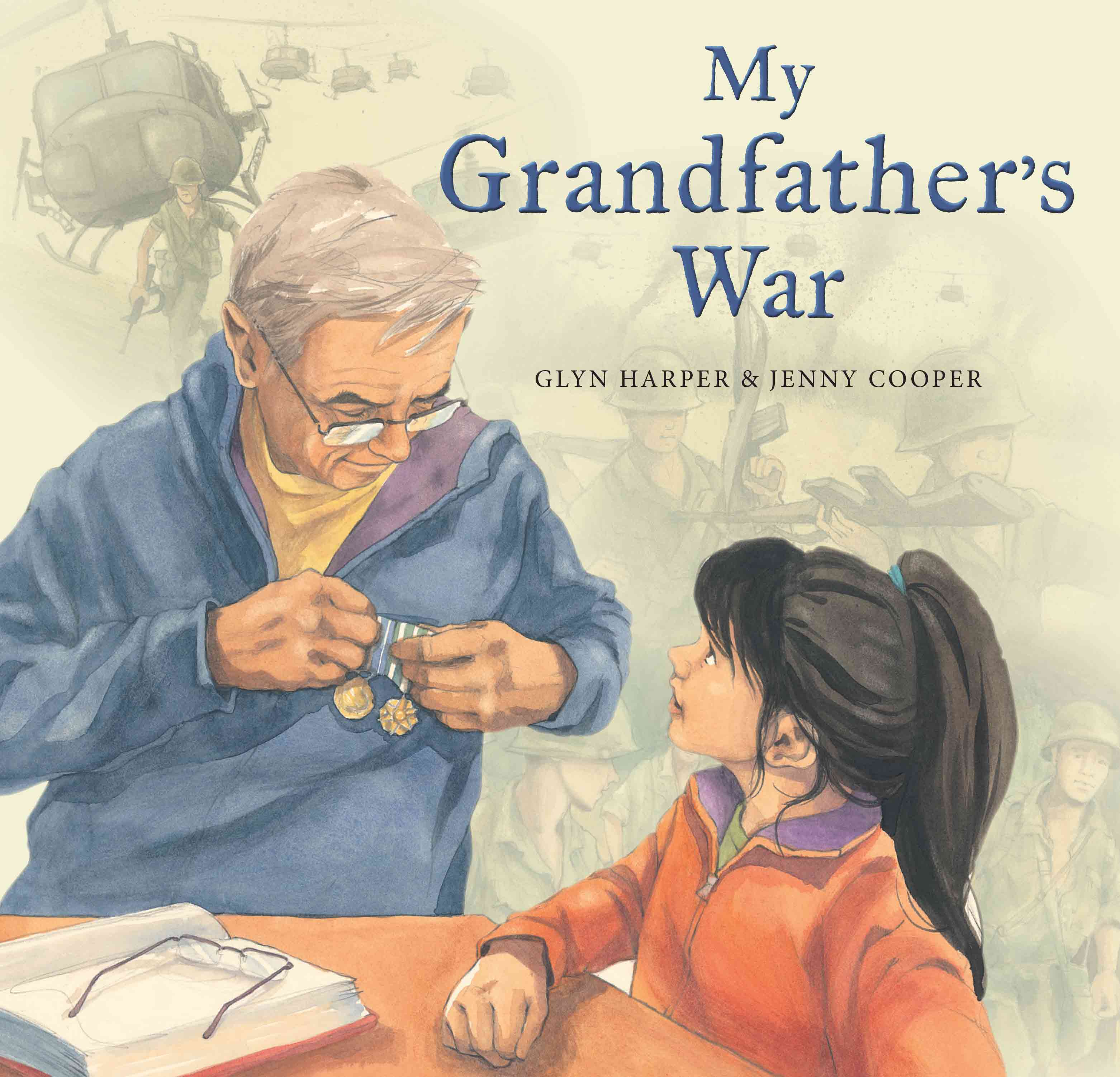
My grandfather’s war by Glyn Harper, illustrated by Jenny Cooper


My grandfather’s war by Glyn Harper, illustrated by Jenny Cooper (EK Books, 2018)

32 pages with full page colour illustrations (hardback edition)

Subjects: Vietnam, grandparents, veterans, picture books (Year 3-4)


Synopsis
My Grandfather’s War tells the story of 8-year-old Sarah and her grandfather Robert, who lives with her family and looks after her before and after school. The pair have a close relationship and Sarah is sensitive to her grandfather’s occasional spells of sadness. The family doesn’t talk about these, except to tell Sarah that he is thinking about a war in a place called Vietnam.

When Sarah summons up her courage to ask her grandfather why he feels sad, he tells her about his time in Vietnam. The flashbacks of his memory present images of a war which was “not like other wars” and he also tells Sarah about the difficulties the troops faced when they returned home, from anti-war protesters and the after-effects of chemicals.

This is a reworked version of an earlier book, now with the added magic of Glyn Harper’s collaboration with Jenny Cooper, whose illustrations show the warm bond between grandfather and grandchild. 

Another thing I really liked about this book is how it models (to both children and adults) how to handle difficult conversations. Sarah is nervous about asking her question but summons up the courage to do so because she loves her grandfather. She tells him that she’s scared and he acknowledges that with a serious, concerned expression (that picture is one of my favourites). Her grandfather doesn’t fob her off and answers carefully but truthfully. The conversation doesn’t make his sadness go away but now Sarah understands it better.

Reviews
Kids book reviews calls it "the perfect mix of narrative and history" and "a gentle educational tool, highly recommended" for classrooms. 
Teacher notes are available here and include some thoughtful comments from Jenny about how she approaches the subject of war as an illustrator.

Author’s website
Glyn Harper is Professor of War Studies at Massey University in Palmerston North, New Zealand. He is Massey's Project Manager of the Centenary History of New Zealand and the First World War. A former teacher, he joined the Australian Army in 1988 and after eight years transferred to the New Zealand Army, where he rose to the rank of lieutenant colonel. Glyn was the army's official historian for the deployment to East Timor and is the author of numerous history books. (From the Penguin website)

Info about the illustrator
Jenny Cooper is a wonderful artist who has illustrated more than 70 children’s books. Read more about her on the Book Council site or Christchurch City libraries or Storylines.

Other books you might like
This is the sixth book that Glyn Harper and Jenny Cooper have worked on together. Their previous titles are Roly the Anzac donkey, Jim’s letters, Le Quesnoy: the story of the town New Zealand saved, Gladys goes to war and Bobby the littlest war hero.
There aren’t many books for young readers about Vietnam. Memorial by Gary Crew and Lest we forget by Feana Tu’akoi both touch on it. Other books are Vietnam diary by Mark Wilson and I was only nineteen by John Schumann.
Books about the grandfather-grandchild relationship include Grandad’s medals by Tracy Duncan.

Have you read it?
Have you read this book? Let me know what you think!

Sunday, 6 August 2017

Three books by Mark Wilson

Angel of Kokoda (Lothian Children’s Books, 2010)
Vietnam diary (Lothian Children’s Books, 2013)
The Afghanistan pup (Lothian Children’s Books, 2014)

All similar format: hardback, 32 pages with full colour illustrations

Subjects: World War Two, Papua New Guinea, Pacific, Vietnam, brothers, Afghanistan, animals, dogs, mascots, picture books (Year 3-6)


Synopsis
A Papua New Guinea boy helps a wounded Australian soldier along the Kokoda Track. A young man goes off to fight in Vietnam, despite the protests of his brother. A dog is rescued from the ruins of a bombed school and becomes a soldier’s pet. 

These three books are part of the Children in War series which explores children’s experiences of, and reactions to, four different wars involving Australians:  World War One, World War Two, the Vietnam War and the war in Afghanistan. The texts are clear and not too detailed (apart from the Vietnam one, which includes handwritten diary entries).

They are well-produced books that cover lesser known aspects of war, although I would have liked some more context for each story (perhaps because they are very Australian - oriented). 

Reviews
Reading time (from the Children's Book Council of Australia)
reviews The Afghanistan pup here and admires the way that Mark Wilson "skilfully weaves narratives that tell stories of tragedy and hope with his extraordinarily evocative illustrations", while "snippets of newspaper clippings, reports, poems and letters enrich the stories and add layers of meaning."

There are teacher notes and activities - 
for The Afghanistan pup here 
for Angel of Kokoda here
for Vietnam diary here.

About the author: 
Mark Wilson's website shows his prolific and impressive output and also talks about his interesting life and varied career!

Other books you might like: Also by the same author is My mother’s eyes: the story of a boy soldier.  Mark Wilson illustrated A day to remember: the story of Anzac Day by Jackie French.

Have you read it? Have you read these books? Let me know what you think!

Saturday, 10 June 2017

Dreaming the enemy by David Metzenthen

Dreaming the enemy by David Metzenthen (Allen & Unwin, 2016)
47 chapters; 292 pages
Subjects: Vietnam, Australia, conscription, veterans, PTSD (post-traumatic stress disorder), young adult fiction (Year 11-13)

Synopsis
Johnny Shoebridge has come home from fighting in the jungles of Vietnam. It’s hard to readjust to ordinary life with his parents and the girl he used to know. He is haunted by memories of all the things he has seen; literally haunted, by a Viet-Cong ghost fighter called Khan who won’t leave him alone.

He is still young and can't understand how he has ended up in this position: “How had he gone from a kid swinging a stick as a Samurai sword, the star of a flickering home movie, to a nineteen-year-old digger on ambush, prepared to shoot someone in the side of the head?” He has lost good mates in battle and is trying to summon up the courage to go and visit their families. (These eventual encounters make for heart-wrenching scenes.) Even though he was a conscript with no choice about going, he’s assailed by anti-Vietnam war protesters, with people coming up to say “I just hope you’re happy… with what you did.”

“There was an awful lot of stuff that he wished he didn’t know.”

The story jumps back and forth in time and place. In the present, Johnny is back home again, heading off on a road trip. In the past, he is getting to know his new mates Baz and Lex; they start training together, go out on patrol, and fight side by side in battle. Another parallel story is that of Khan, Trung and Thang as they hide in the jungle, crawl through tunnels and fight on the other side.

I found the parts where Johnny somehow knows or imagines what Khan is doing a bit confusing, perhaps because of the distance imposed by having Johnny comment on what he sees. What worked best for me were the scenes between Johnny and his mates, and their convincing teenage-boy speech as they get to know and rely on each other. Johnny “knew himself to be one corner of a triangle, the strongest shape of all. He knew Lex and he knew Barry like he knew no one else on the planet.”

Of course you know that’s not going to end well. They’re going to get caught up in some terrible fighting and you suspect that at least one of them won’t make it home again.  

Reviews:
Booksellers NZ calls it “a poignant novel, posing meaningful questions about the effects of war”. It acknowledges “some might suggest the book is difficult to keep up with as it flicks from past to present to imagination “, but suggests that “this is in keeping with Johnny’s head and the confusion that follows him”.
A very good review in The Australian too: this final paragraph is worth quoting in full:
"Senior secondary students, especially boys, (and their teachers) might be grateful if Dreaming the Enemy were set for study. It is a sophisticated work — substantial, powerful, highly readable and with key characters close to their age. It touches on many issues: the aftermath of war, including how returned fighters were and are treated; the effects on mental and physical health and on families and relationships. It looks at conscription, the politics of wars, the destruction caused by the bombing and napalm, the attitudes of Americans, the contribution of Australians, and much else. The story is infused with humanity and embellished by Metzenthen’s flair for language and flashes of dry Aussie humour."
And on Reading time, David Metzenthen has some very wise words about the book:
"I wanted strongly to present something of what young Australians went through in this war, at the orders of their Government, and the great toll it took on them, their families, friends, and futures. In Dreaming The Enemy, I hope to have shown what happens to people, that what we do or is done to us, stays with us for a long time and must be met with compassion and understanding."
About the author
David Metzenthen lives in Melbourne. He is a keen environmentalist and was an advertising copywriter and a builder’s labourer before turning to fiction. He has written another war-related YA novel, Boys of blood and bone, as well as the thought-provoking picture book One minute’s silence.
Other books you might like:
There aren't nearly as many books about Vietnam as about World Wars One and Two. One book that I have reviewed is The battle of Messines Road.
Have you read it?
Have you read this book? Let me know what you think!

Sunday, 2 April 2017

A day to remember: the story of Anzac Day by Jackie French, illustrated by Mark Wilson

A day to remember: the story of Anzac Day by Jackie French, illustrated by Mark Wilson (Angus & Robertson, 2012)

32 pages with Mark Wilson’s colour and black and white illustrations

Subjects: World War One, Gallipoli, World War Two, Korean War, Vietnam War, protest movement, Anzac Day, picture books, non fiction (Year 5-8)


Synopsis
This book tells the story of Anzac Day by tying the date of 25 April to specific events in particular years, starting with the first landings at Gallipoli on 25 April 1915. The first Anzac Day parades and services are held in 1916; in 1918, the war still continues, but it is over by 25 April 1919. In the late 1920s, the tradition of the dawn service begins; in the 1930s, many returned soldiers are suffering through the Depression. Anzac Day continues to be marked through World War Two, the Korean War and the protest years of the Vietnam War.

The book continues up to the present day through Australian involvement (again often controversial) in other wars, such as in Iraq and Afghanistan, and traces the increased interest in visiting Gallipoli for the dawn service at Anzac Cove.

Teacher’s notes include Jackie French talking about her inspiration for the book, and Mark Wilson talking about his technique and how he interpreted his task. The figures on the cover are his son and granddaughter – how lovely is that?

Reviews:
Kids Book Review recommends it highly, saying that "You know a book by Jackie French is going to be researched to the nth degree, and presented with clarity, emotion and fascination - and A Day to Remember is no exception."

The never-ending bookshelf says is it is a picture book that adults would enjoy and learn from as well; "What I found particularly interesting with this book was the way that Jackie French focused on the concept and meaning of Anzac day through various generations and the way that it was developed, shaped and then lessened in meaning before reaching height again today." This reviewer suggests it is not for young children under 8, "as it is very heavy on the history and less narrative based". 


Author’s website
Jackie French is an amazing writer with a brilliant website which features a page on this book. Her other war-related books include The beach they Called Gallipoli, Pennies for Hitler and A rose for the Anzac boys.

Illustrator’s website

NZ connections:
Are we mentioned? Yes, often (thanks, Jackie French!) Sometimes the New Zealanders are left out of (Australian) books on Anzac, so it’s good to see their contribution recognised.

I also appreciated seeing the Aboriginal and Torres Strait Islander soldiers acknowledged, men who “fought long ago in the service of a land where many were not even allowed to vote”.

Have you read it?
Have you read this book? Let me know what you think!

Friday, 22 April 2016

Lest we forget by Feana Tu’akoi

A book for Anzac Day:

Lest we forget by Feana Tu’akoi, illustrated by Elspeth Alix Batt (Scholastic, 2011)

32 pages with pen and wash illustrations

Subjects: World War Two, Vietnam, Anzac Day, dawn parade, family, picture books (Year 2-5)


Synopsis
This story is unusual for a picture book about war, in that it spends a lot of time focusing on women and giving them a voice. Tyson doesn’t want to go along to the Anzac Day dawn parade because he thinks it’s all about glorifying war. But after talking with his mother, Nana and Great-gran, he starts to see another side of the story. On Anzac morning he gets up early after all and goes to the dawn parade with his mother and Koro, who was wounded in Vietnam, and together they recognise the importance of the day and remember those who have died in war.

The te reo Māori version was shortlisted in the SLANZA Te Kura Pounamu awards 2012 and the late Katerina Mataira won the Te Rōpū Whakahau award Te Tohu Pounamu 2012 for her translation.

There’s a family tree at the beginning, which is useful to flip back to until you have the family connections straight in your mind.

Reviews
Here's a review on the National Library Create readers site. 
You can also listen to the story on the RNZ Storytime treasure chest.

About the author
Feana Tu’akoi has written many stories and article for the educational market, as well as the What is a ///? non-fiction series.  She lives in Hamilton with her Tongan husband and their children. amiloton with her Tongan husband and their chidlrne. You can read more about her on the Book Council and Storylines sites.

Here’s an interesting interview with her on Paula Green’s Poetry Box website:
“I wrote Lest We Forget very quickly – in one sitting, in fact – although I did spend a lot of time editing and re-editing, until I was happy with it. I didn’t need to do any research, as it was a mixture of all the thoughts I’d ever had about ANZAC Day parades. The understanding that Tyson comes to during afternoon tea is the understanding I came to, after studying NZ history at university.”

There’s another interview, talking about why she wrote this book, on the My best friends arebooks blog: "We need to remember the past, so we can make better decisions in the future. I think that the next generation is smart enough to do just that. And that’s why I dedicated this book to my kids.”

About the illustrator
Elspeth Alix Batt has also done a lot of illustration work for the educational market, especially the School Journal

Other books you might like:
Grandad’s medals by Tracy Duncan, illustrated by Bruce Potter, My Grandad marches on Anzac Day by Catriona Hoy, Anzac Day parade by Glenda Kane

Have you read it?
Have you read this book? Let me know what you think!

Wednesday, 8 July 2015

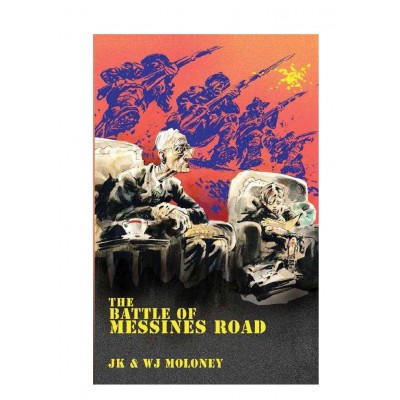
The battle of Messines Road by J K & W J Moloney

The battle of Messines Road by J K & W J Moloney (Willsonscott Publishing, 2015)

43 chapters; 348 pages

Subjects: World War One, France, England, Ireland, Vietnam, diaries, bullying, junior fiction (Year 7-9)
Synopsis
This story is set in Karori, a suburb of Wellington where Messines Road really does exist, as do several other street with names related to World War One. The year is 1968, and 10-year-old Zac is in strife on several fronts; he is often in trouble at school, doesn’t have many friends, things are stressed at home and we learn that his dad is away at the Vietnam War. On top of that, he hates his paper run and longs for an easier, shorter one with fewer hills. However, it’s through his paper run that he meets old Mr Moloney and begins to read to him in the afternoons – initially as a punishment, and at first from the newspaper, but later from Mr Moloney’s old war diaries, dated from 1915 to 1917.

I liked seeing the growing relationship between Zac and Mr Moloney, and the diary entries are well-written and interesting, but their length could provide challenging and I wonder if some younger readers will skip parts of them and just follow Zac's story. I have listed this book under Junior Fiction, but the publisher's blurb says "the two intertwined narratives will hold a wide-range of reader interest and the perspective of 10-year-old Zac will capture the attention of the young adult market while still appealing to more mature readers."

Like many other men of the time, Jack Moloney (see below) was a fluent and observant writer, and other readers might prefer these sections of the book. The parts of the diary that I enjoyed most were not about the fighting, but about aspects of the day to day organisation of war that you don’t often read about. I liked the descriptions of the officers’ training course at Cambridge, his trip on leave to Ireland, playing football, visiting London and (especially) his accidental meeting with Rudyard Kipling at a hotel in Bath.

Having Zac read the diaries out loud presents a few challenges. It makes for long sections which don’t directly affect Zac himself, and I wasn’t convinced that a 10-year-old who has trouble pronouncing “Heliopolis” and “Bedouin” would be able to cope with the vocabulary, foreign names and some of the concepts involved. The switch between Zac’s everyday life and the diaries also requires a degree of repetition to get him over to Mr Moloney’s place, and starting and finishing each day’s reading.  The chapters where Zac and Mr Moloney attend the Anzac Day service at the Cenotaph, with more action and dialogue, are more immediate and gripping. (I also wondered why Zac’s brother and sister are seldom, if ever named. Perhaps it’s to show the fractures in the family – but I would have liked to know!)

Thanks to Willsonscott Publishing for sending me a copy of this book to review. I hadn’t heard of them before, but their website says they "specialise in publishing non-fiction books with a New Zealand, Australian or special international military content and personal perspective" and have “a worldwide reputation for sourcing and producing high quality titles on New Zealand military history, covering noteworthy actions and previously untold stories from many theatres of war.”

You can read a preview of the book (the opening two chapters) here on the publisher’s website.

Reviews:
The National (an Abu Dhabi English-language newspaper) calls it "an interesting hybrid of factual diary and dramatic story". 

There is another review here on Bookfabulous (fabulous title for a blog!) 

Author’s website
This book has an intriguing story behind its authorship. Two authors are listed on the title page: J K Moloney and W J Moloney.

J K (John Keith, also known as Jack) Moloney was the original author of the diaries that Zac reads in the book. He was a 22-year-old law student when he left for WW1 in October 1915. After the war, he settled in Christchurch where he married and had three children, worked as a barrister and became involved in rugby administration, including being President of the Canterbury Rugby Union. His death certificate (from 1971) is reproduced at the back of the book and this is his record on the Auckland Museum Cenotaph website.

W J (William) Moloney is Jack’s grandson. He grew up in Karori, has a Master’s degree in War Studies and worked as a military analyst for many years. He is married with three children and currently lives in Abu Dhabi, UAE.

Jack Moloney’s 120,000-word WW1 diary is held by National Archives, and William has transcribed it over a number of years, as well as researching the stories of some of the men mentioned in it.  This is the diary that Zac reads out loud. William says that his grandfather, who died before he was born, and “Mr Moloney” in the book “have some similarities but they are not the same.”

Other books you might like:
Reading this book made me realise that I don’t know many other books written about Vietnam for younger readers. (There might be plenty of American books that I’m not aware of.)  There is a lot of concentration on WW1 commemorations at the moment, and I’m sure many children wouldn’t know that public opinion was so divided over our involvement in the Vietnam War.

One non-fiction title is Leon Davidson’s Red Haze (Black Dog Books, 2006), about the experience of New Zealanders and Australians in the Vietnam War.

I have reviewed My mother's eyes: the story of a boy soldier by Mark Wilson, one of three books in his war trilogy which also includes Vietnam diary. Gary Crew's Memorial also refers to the Vietnam War. 

Links
You can read more about New Zealand's involvement in the Vietnam War on the NZ History website, which says that “More than 3000 New Zealand military and civilian personnel served in Vietnam between 1963 and 1975... At its peak in 1968, New Zealand’s military force numbered only 548. Thirty-seven men died while on active service and 187 were wounded. Two civilians serving with the surgical and Red Cross teams also lost their lives.”

Have you read it?
Have you read this book? Let me know what you think!

Wednesday, 11 June 2014

Memorial by Gary Crew, illustrated by Shaun Tan

Memorial by Gary Crew, illustrated by Shaun Tan (Thomas C Lothian Pty Ltd., 1999)

ISBN 0 85091 983 5

32 pages with colour illustrations and collage

Subjects: World War One, Ypres, Vietnam, war memorials, unknown soldier, trees, picture books (Year 5-8)


Synopsis
This is a surprising book. Things are hinted at or left unsaid in the text, and the illustrations often seem to go off at a tangent. I don’t think I appreciated it properly until I read Shaun Tan’s comments about how he chose to illustrate it. When you think about it, the title gives it away: Memorial, but not War memorial, even though the tree is a war memorial – but the book is also about the wider subject of memories, how and why and what we remember.

War memorials are a fascinating topic and they make you ponder all sorts of things – how and when they were built, who has gathered there over the years – as well as the stories behind the names of the men and women who went off to war. “Lest we forget” is  a common engraving – “But generations later, what do those who pause in the shadows of the tree’s immense branches remember?”  

Something I discovered when researching for Anzac Day: the New Zealand story was the fact that whereas in New Zealand, World War One war memorials usually list the names of those who died, in Australia they often list the names of all from that community who went to serve. Some people think that the difference is due to the fact that there was no conscription in Australia at that time, so the communities wanted to recognise each person who voluntarily went to serve.

Reviews:
There is a review on the Gathering books blog (if you scroll down), with lovely reproductions of some of the pictures. 

You can also find Teachers notes here. 

Questions:
What do we know about the people in the family? How many generations are there? Who is telling the story?
Which wars did they fight in?
Where do you think the book is set?
Why does the Council want to cut the tree down? Does the tree get cut down? If so when does that happen?
What do people in the book say about memories?
What do you understand or get from the pages that have no words, only pictures?
What does the last page mean?

Author’s website
Gary Crew has a page on the Literature Centre website. 

Info about the illustrator
Shaun Tan has a website that is as amazing as you would expect. (Click on Picture books to get to Memorial.) 

On his website, Shaun Tan says that "Memorial is a story about a tree planted beside a war memorial monument, in a small country town by returned servicemen. Years on, the tree has grown to be huge and unruly, dislodging the statue next to it and creating a traffic hazard in what is now a much larger, busier town. A decision is made by a local council to cut the tree down."

‘Midsummer’ acrylic, gouache and pencil, paper collage.
Further down this page, Shaun Tan has written some thoughtful comments on illustrating the book. Too long to summarise, but I especially liked these remarks: 

"What made the subject of the book engaging for both of us was that it ended up being not about war, memorials or remembrance as ‘grand’ subjects, but about the small, quiet memories that make up ordinary day-to-day lives - really about the nature of memory itself."

"Perhaps the point of this picture book is to open a passage for its readers to think about the way symbols really work in relation to collective memory, as a container that needs to be continually topped up to have any currency."

"I was particularly interested in the idea of silence to add further depth to the book, that there are great reserves of feeling which cannot be expressed in words, and that the stories only ‘skim’ over the top of these lakes." 

Things I didn’t know
The tree that was planted was “a piddly Moreton Bay fig tree.” 

I found out from Gardening Australia  that the Moreton Bay fig (Ficus macrophylla) is native to parts of Australia and Lord Howe Island. According to this article, they also grow in New Zealand. In fact the New Zealand Tree Register has a description of the tree that has been historically considered the largest Moreton Bay fig growing in New Zealand, at Monte Cecilia Park in Hillsborough, Auckland. (Must be worth a look, next time you go to see the Pah Homestead.) 


New Zealand Geographic also has a short article talking about how the Moreton Bay fig ("these banyan-like botanical goliaths" - wonderful description!) arrived in this country.