Showing posts with label Prisoners of war. Show all posts

Tuesday, 29 May 2018

Enemy camp by David Hill

Enemy camp by David Hill (Puffin, 2016)

260 pages (in diary format)


Subjects: World War Two, New Zealand, Japan, Prisoners of war, young adult fiction (Year 7-10)

Image result for enemy camp david hill

Synopsis
“When of hundreds of Japanese captives arrive at Featherston POW camp, the tiny town is divided. Tensions run high and then, on 25 February 1943, disaster strikes. Three boys witness it all.” (Publisher’s blurb)

Ewen lives in the small town of Featherson, where his father works as a guard at the POW camp. His diary covers the months between October 1942 and February 1943 and describes everyday life in wartime, school, the summer holidays, the attitudes of local people to the Japanese and the gradually increasing tension between some of the prisoners and guards. Together with his best friend Barry and Barry’s younger (polio-affected) brother Clarry, Ewen starts taking Japanese lessons from one of the officers, and this provides a great way to show a positive side of Japanese life and culture that many of the townsfolk have no idea of.

David Hill skilfully builds in many other aspects of 1940s life: the ever-present fear of polio, food shortages, barbed wire on the beaches, the blackout, the Home Guard, American GIs handing out sticks of gum, practice air raids, school milk, ink wells, picnics, the movies and dances. He has a wonderful way of capturing a 12-year-old boy’s voice, in Ewen’s remarks on the progress of the war (“So yeah, we’re going to win”) as well as the progress of his friendship with “snobby Susan Proctor” (“And – I’m still trying to believe this – I spent most of the time talking to Susan Proctor”). 

It’s also a refreshing change to read about a boy who reads and likes writing, and wants to be an author when he grows up, and about a warm and close, even if undemonstrative, father-son relationship.  

Reviews:
Bobs book blog says: "Superbly written in short diary entries that primary and intermediate students can easily read, coupled with David Hill’s easy style and you have great historical fiction. The account of the event itself with the boys looking on is sensitively done. A very readable novel." 
Another review by Siobhan Harvey calls it "both an enjoyable read and an imperceptible history lesson" and notes that "importantly, Hill personalises the demonised foe, allowing young readers to see Japanese captives as much victims of war as anyone fighting on the Allied side." 

About the author
David Hill is one of NZ’s best loved authors for young people. Here is an article in which he talks about the book: 
"I'm not preaching any themes. I want them to have a story first. I hope they like the people, especially Ewen the young protagonist. If they see attitudes that they agree with and some they disagree with I'll be very happy with that." 
There's another interview here on Radio NZ. I also enjoyed this interview and David Hill's comments about writing about war ("War is wonderful to write about because it involves conflict - physical, mental and internal") and why he likes writing for and about this age group ("because they're coming across ideas and experiences for the first time. They're surprisingly sophisticated, they have a good vocabulary and understand a lot. They're a lovely mixture between naivety and sophistication.")   

Links
You can read more about the “Featherston incident" here. 
And if you are ever driving on SH 2 between Featherston and Greytown, look out for the roadside memorial to the POW site.

Have you read it?
Have you read this book? Let me know what you think!

Friday, 29 July 2016

Soldier in the yellow socks by Janice Marriott

Soldier in the yellow socks: Charles Upham, our finest fighting soldier by Janice Marriott, illustrated by Bruce Potter (HarperCollins, 2006)

8 chapters; 48 pages with black and white illustrations

Subjects: World War Two, Greece, Crete, North Africa, prisoners of war, non fiction (Year 5-8)


Synopsis
I didn’t know anything about Charles Upham before reading Janice Marriott’s book. In 1939 when war broke out, Upham was a Canterbury high country farmer. By the end of the war he had fought in Greece, Crete and North Africa, been awarded the Victoria Cross (VC) twice - a very rare achievement, been taken prisoner, escaped (sometimes from moving trains) and taken prisoner again several times, and finally ended up imprisoned in the top-security Colditz Castle.

Charles Upham’s reaction to winning the VC was similar to that of Cyril Bassett in World War One. Both insisted that the award was as much for the men as for themselves and were almost embarrassed to be singled out. (I don’t know if that is a peculiarly New Zealand reaction.)  Cyril Bassett famously said, “All my mates ever got were wooden crosses”.

I thought the yellow socks in the title might have more importance, but they were only mentioned once; however, they did seem to symbolise his non-soldierly qualities (we are told several times how bad he was at marching) as opposed to his amazing bravery, courage and calmness under fire.

The book was shortlisted for the NZ Post Children's Book Awards in 2007.

Questions:
Was Charles Upham our "finest fighting soldier"? What makes a fine soldier? What do you think?

About the author
On Janice Marriott's website, she has this lovely description of herself and her current work: 
"After years spent writing fiction, plays, memoir, gardening books and newspaper columns, I became a grandmother, a very involved grandmother. Now life is a discontinuous narrative. Time for writing is unpredictable and starts with clearing clutter off the dining room table. Increasingly I spend my non-family time teaching others what I have learnt about writing and the publishing industry. And in my own writing life I have turned to poetry to express my new self. I think of the poems as small wild animals I have captured for a few moments in my hands and then released."

About the illustrator
You can read more about Bruce Potter and his impressive output of work here on his website. 

Things I didn’t know
After the war, Charles Upham bought a farm in North Canterbury, married and had three children. He lived on the farm until the year he died, in 1994. Crowds of more than 50,000 people lined the streets of Christchurch for his funeral.

His obituary in the Telegraph has a comprehensive overview of his life and the actions which won him his VCs, and includes his statement that "the military honours bestowed on me are the property of the men of my unit". 

There is more info about him on the nzhistory and te ara sites. 

Links
Here is a list of the 22 New Zealand VC winners (Willie Apiata is the only post-WW2 VC winner. I didn't know that Charles Heaphy won one in the New Zealand Wars!)

Monday, 9 May 2016

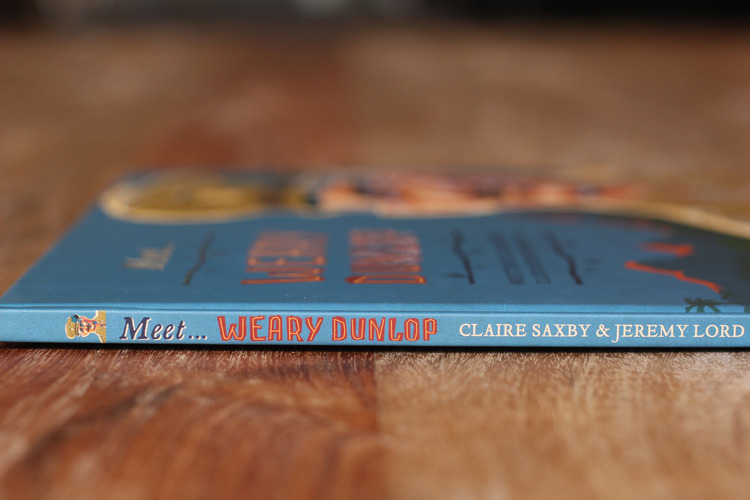
Meet Weary Dunlop by Claire Saxby, illustrated by Jeremy Lord

Meet Weary Dunlop by Claire Saxby, illustrated by Jeremy Lord (Random House Australia, 2015)

32 pages with colour illustrations, map and timeline

Subjects: World War Two, Australia, Singapore, Thailand, Burma, Ernest Dunlop, prisoners of war, junior fiction (Year 5-8)

Synopsis
Thanks to Claire Saxby for kindly sending me a copy of her new book. This is one of a series about “the extraordinary men and women who have shaped Australia’s history”. Others in the Meet… series are Ned Kelly, Mary Mackillop, Captain Cook, Douglas Mawson, Nancy Bird Walton and Banjo Patterson (with more titles promised soon).

“Weary” Dunlop (his nickname is explained inside) was an Australian army surgeon in WW2. His bravery, compassion, knowledge and skill helped to save the lives and bolster the spirits of fellow POWs on the Thai-Burma railway.

About the author
Claire Saxby's website is here. 
I love her description of her early reading habits: “I have always loved reading. I used to go home from boarding school and read for days on end, only emerging to swim and eat. I love words. I love how they sound, the work they do, the images they create.”

About the illustrator
This is Jeremy Lord’s website, with a page about this book (and some illustrations) here. 
He also has an online store (for his prints, often Aussie-themed) where he describes himself as “a French/Aussie, Sydney based illustrator.”

jlcom_illo_weary_pic004.jpg
From Jeremy Lord's website
Other books you might like
Meet the Anzacs, also by Claire Saxby, is another book in the same series.

NZ connections
Each year on 25 April, Anzac Day in Thailand is commemorated with a Dawn Service and Gunfire Breakfast at Hellfire Pass and a Memorial Service and Wreath Laying Ceremony at Kanchanaburi Allied War Cemetery.

People gather for Anzac Day in Hellfire Pass,  Kanchanaburi province, west of Bangkok, Thailand, on the route of the Thai-Burma railway.
People gather for Anzac Day in Hellfire Pass, Kanchanaburi province, Thailand,
on the route of the Thai-Burma railway. Photograph: Sakchai Lalit/AP
Things I didn’t know
What did I know about Sir (Ernest) Edward “Weary” Dunlop before reading this? Nothing! (So this book was a good place to start.) 

The Australian War Memorial bio says that "On 20 January 1943 he left Singapore for Thailand in charge of "Dunlop Force" to work on the Burma-Thailand railway. He remained there until the war ended, labouring tirelessly to save wounded, sick and malnourished men. Many times he put his own life at risk as he stood up to the brutality of his Japanese captors. Though not the only medical officer to act in this selfless way, his name was to become a legend among Australian prisoners of war and an inspiration for their own survival. Throughout his captivity and at great personal risk Dunlop recorded his experiences in his diaries."

After the war, he got married and continued both working as a surgeon and supporting former POWs of the Japanese. Over 10,000 people came to his state funeral in Melbourne in 1993 and portions of his ashes were later interred at Hellfire Pass and floated down the nearby river.

There is lots of info about him online – more here, including a video clip of the floating of his ashes which is a very moving scene.


Friday, 19 September 2014

Summer of my German soldier by Bette Greene

Summer of my German soldier by Bette Greene (Puffin Books, 2006; first published The Dial Press, 1973)

ISBN 0 14 240651 1

21 chapters; 230 pages

Subjects: World War Two, United States, Jews, Germans, Prisoners of war, young adult (Year 8-10)


Synopsis
This book  won ALA Notable Book along with New York Times Book of the Year (1973); it was a National Book Award Finalist and was made into a movie in 1978. I read it for the first time for this blog in this Puffin modern classics edition, which makes it yet another modem children's classic that has somehow passed me by until now.  

(From the Puffin page)”When her small hometown in Arkansas becomes the site of a camp housing German prisoners during World War II, 12-year-old Patty Bergen learns what it means to open her heart. Although she's Jewish, she begins to see a prison escapee, Anton, not as a Nazi--but as a lonely, frightened young man with feelings not unlike her own, who understands and appreciates her in a way her parents never will. And Patty is willing to risk losing family, friends--even her freedom--for what has quickly become the most important part of her life. Thoughtful, moving, and hard-hitting, Summer of My German Soldier has become a modern classic.”

There are different covers on different editions. I can’t say I like this cover, though.

Patty (or Patricia Anne) has a wild imagination, wistful daydreams and a huge vocabulary gleaned from reading the dictionary. “I don’t actually mean to be rude, but I am. My father says I ask a lot of questions and then go around contradicting every answer.”

She sometimes seems much younger than 12 and sometimes much older, but I love the way she talks and thinks. And I’m in awe of how the story is told completely from Patty’s point of view, but the author shows us so clearly the things that she doesn’t notice or can’t understand. 

Patty’s mother is distant, her little sister Sharon is too young to provide any support and her father is a tortured soul, but we lose sympathy for him when he is physically abusive. The beatings that he deals out are hard to read about and it’s sad to see Patty’s desperate attempts to win her parents' love and affection, which is so freely given to Sharon. Her family life is made bearable by occasional visits to her grandparents and by Ruth, their cook, who calls her “Honey Babe” and is “the colour of hot chocolate before the marshmallow bleeds in.”

Her life changes the day that Anon Reiker walks into her father’s shop, and the place where she is sent to live at the end would be awful, if not for the fact that her home life is so sad anyway. In some ways, it’s an escape. And she has Anton’s words to hold onto: “Even if you forget everything else I want you to always remember that you are a person of value, and you have a friend who loved you enough to give you his most valued possession.”

Reviews:
This review calls the book "a poignant coming-of-age story about a young Jewish girl from a small town in Arkansas who helps an escaped German POW, an act which changes her life forever." 

Apparently there is a sequel, Morning is a long time coming, but I don’t know if I want to read that. I think I’d rather imagine Patty’s  future for myself.   

Author’s website
(From the back page) “Bette Greene was born in Memphis, Tennessee on June 28, 1934 and grew up in a small town in Arkansas.” That makes her just a bit younger in World War Two than Patty, age 12, living in Jenkinsville Arkansas. “In many ways, Patty Bergen is based on Ms Greene’s childhood experiences as a Jewish girl in the South.”  

You can read more about Bette Green on her website. 

Other books you might like:
So far from the sea by Eve Bunting describes the camps in picture book format. We follow Laura and her little brother Thomas, who are visiting their grandfather's grave in a remote part of the desert. Gradually we learn that their grandparents and their father, as a small boy, were among the thousands of Americans with a Japanese background who were taken to internment camps in World War Two.

Things I didn’t know
I first read about the Japanese interns in So far from the sea, but I had no idea there were so many Prisoner of War camps in America. Like so many other things, it makes sense when you think about it. The German POW camps were in Germany or in German-occupied countries, but for the Allies to set up their own POW camps in England or Europe would use up food and medical resources that they needed for their own troops.

Across the Atlantic, America had masses of food and acres of empty space - and that’s where the POWs went; nearly 425,000 of them, housed in more than 500 camps.  Nearly 23,000 of them – German and Italian – went to Arkansas, where this book is set.

Not many of them escaped, or even tried to. The camps were set in remote locations – and it wasn’t as if they could ever get back home, across the ocean. They had comfortable surroundings and plenty of food; in fact some Americans felt the military was “coddling” them. The camps were closed down after the war and the prisoners were returned to Europe.

You can read more about them here and here.