
The battle of Messines Road by J K & W J Moloney
(Willsonscott Publishing, 2015)
43
chapters; 348 pages
Subjects:
World War One, France, England, Ireland, Vietnam, diaries, bullying, junior
fiction (Year 7-9)
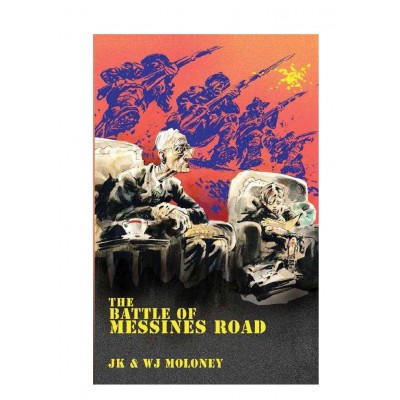
Synopsis
This story is set in
Karori, a suburb of Wellington where Messines Road really does exist, as do
several other street with names related to World War One. The year is 1968, and 10-year-old Zac is in strife on
several fronts; he is often in trouble at school, doesn’t have many friends, things
are stressed at home and we learn that his dad is away at the Vietnam War. On
top of that, he hates his paper run and longs for an easier, shorter one with
fewer hills. However, it’s through his paper run that he meets old Mr
Moloney and begins to read to him in the afternoons – initially as a punishment,
and at first from the newspaper, but later from Mr Moloney’s old war diaries,
dated from 1915 to 1917.
I liked seeing the
growing relationship between Zac and Mr Moloney, and the diary entries are well-written
and interesting, but their length could provide challenging and I wonder if
some younger readers will skip parts of them and just follow Zac's story. I have listed this book under Junior Fiction, but the publisher's blurb says "the two intertwined narratives will hold a wide-range of reader interest and the perspective of 10-year-old Zac will capture the attention of the young adult market while still appealing to more mature readers."
Like many other men of the time, Jack Moloney (see below) was a fluent and observant writer, and other readers might prefer these sections of the book. The parts of the diary that I enjoyed most were not about the fighting, but about aspects of the day to day organisation of war that you don’t often read about. I liked the descriptions of the officers’ training course at Cambridge, his trip on leave to Ireland, playing football, visiting London and (especially) his accidental meeting with Rudyard Kipling at a hotel in Bath.
Having Zac read the diaries out loud presents
a few challenges. It makes for long sections which don’t directly affect Zac himself, and
I wasn’t convinced that a 10-year-old who has trouble pronouncing “Heliopolis”
and “Bedouin” would be able to cope with the vocabulary, foreign names and some
of the concepts involved. The switch between Zac’s everyday life and the
diaries also requires a degree of repetition to get him over to Mr Moloney’s
place, and starting and finishing each day’s reading. The chapters where Zac and Mr Moloney attend
the Anzac Day service at the Cenotaph, with more action and dialogue, are more immediate
and gripping. (I also wondered why Zac’s brother and sister are seldom, if
ever named. Perhaps it’s to show the fractures in the family – but I would have
liked to know!)
Thanks to Willsonscott
Publishing for sending me a copy of this book to review. I hadn’t heard of them
before, but their website says they "specialise in publishing non-fiction books with a New Zealand, Australian or special international military content and personal perspective" and have “a worldwide reputation for sourcing
and producing high quality titles on New Zealand military history, covering
noteworthy actions and previously untold stories from many theatres of war.”
You can read a
preview of the book (the opening two chapters) here on the publisher’s website.
Reviews:
The National (an Abu Dhabi English-language newspaper) calls it "an interesting hybrid of factual diary and dramatic story".
There is another review here on Bookfabulous (fabulous title for a blog!)
Author’s website
This book has an intriguing story behind its authorship. Two authors
are listed on the title page: J K Moloney and W J Moloney.
J K (John
Keith, also known as Jack) Moloney was the original author of the diaries
that Zac reads in the book. He was a 22-year-old law student when he left for
WW1 in October 1915. After the war, he settled in Christchurch
where he married and had three children, worked as a barrister and became
involved in rugby administration, including being President of the Canterbury
Rugby Union. His death certificate (from 1971) is reproduced at the back of the
book and this is his record on the Auckland Museum Cenotaph website.
W J
(William) Moloney is Jack’s grandson. He grew up in Karori, has a Master’s degree in War Studies and worked as a military analyst for
many years. He is married with three children and currently lives in Abu
Dhabi, UAE.
Jack
Moloney’s 120,000-word WW1 diary is held by National Archives, and William has
transcribed it over a number of years, as well as researching the stories
of some of the men mentioned in it.
This is the diary that Zac reads out loud. William says that his
grandfather, who died before he was born, and “Mr Moloney” in the book “have
some similarities but they are not the same.”
Other books you might like:
Reading this book
made me realise that I don’t know many other books written about Vietnam for
younger readers. (There might be plenty of American books that I’m not aware of.) There is a lot of concentration on WW1
commemorations at the moment, and I’m sure many children wouldn’t know that public
opinion was so divided over our involvement in the Vietnam War.
One non-fiction title
is Leon Davidson’s Red Haze (Black Dog Books, 2006), about the experience of New Zealanders and
Australians in the Vietnam War.
I have reviewed My mother's eyes: the story of a boy soldier by Mark Wilson, one of three books in his war trilogy which also includes Vietnam diary. Gary Crew's Memorial also refers to the Vietnam War.
Links
You can read more about New Zealand's involvement in the Vietnam War on the NZ History website, which says that “More
than 3000 New Zealand military and civilian personnel served in Vietnam between
1963 and 1975... At its peak in 1968, New Zealand’s military force numbered
only 548. Thirty-seven men died while on active service and 187 were wounded.
Two civilians serving with the surgical and Red Cross teams also lost their
lives.”
Have you read it?
Have you read it?
Have you
read this book? Let me know what you think!


