Friday, 18 March 2016

Sadako by Eleanor Coerr

This week my new book on Armistice Day is being launched, and it seemed a good time to review this book on Sadako and her work for peace. 

Sadako by Eleanor Coerr, illustrated by Ed Young (Margaret Hamilton Books, 1995)

45 pages with full-page colour illustrations

Subjects: World War Two, Japan, Hiroshima, nuclear war, bombs, family, picture books

A longer version for older children is called Sadako and the thousand paper cranes


Synopsis
Sadako Sasaki was just two years old when the atomic bomb was dropped over her home town, Hiroshima, in 1945. She was an ordinary little girl, surrounded by a loving family, and a keen runner. The story starts with her waking up in August 1954, excited about the Peace Day events at the Peace Park. In the evening, she writes the name of her grandmother who died in the bomb blast and launches it on the river where it floats along amidst rice-paper lanterns lit up by candles.

But when she was 11, Sadako started experiencing dizzy spells and was diagnosed with leukaemia, “the atom bomb disease”. By February 1955, she was in hospital.

One day, Sadako’s best friend Chizuko came to visit her in hospital. Chizuko brought paper and scissors and cut a piece of gold paper into a square. She folded it into a paper crane and told Sadako the old Japanese story about how anyone who folded 1000 cranes would be granted a wish. Sadako knew what her wish would be to get better, so she started folding paper cranes.

Sadako didn’t get her wish and she died a few months later, on 25 October 1955, ten years after the atomic bomb was dropped.  But her name lives on, thanks to her determination, her hope for peace and her wish for a better future, and her paper cranes have now become a symbol of peace. After she died, Japanese children helped to raise money for the Children’s Peace Memorial which now stands in the Hiroshima Peace Memorial Park, with a statue of Sadako on the top, often surrounded and decorated by thousands of paper cranes from all around the world. At the base is written: “This is our cry, this is our prayer. Peace in the world”.

There is a lovely photo of Sadako and one of her paper cranes here

You can read more here about some of the original paper cranes, kept by her brother. 

Reviews:
This review on  The children's war has a picture of Sadako with her relay team and calls it an “a perfect book for introducing this difficult topic to young readers. There are no detailed graphic images described about the war, the bomb or even to after effects, only an acknowledgement of these things. There is some controversy over whether or not Sadako actually did finish folding 1,000 cranes. Regardless of whether she did or didn't, there is much to be learned from Sadako's story.

Sadako, in the middle of the front row, with her relay team

About the author
This is a nice start to Eleanor Cooer's bio on the Penguin website: “Eleanor Coerr was born in Kamsack, Saskatchewan, Canada, and grew up in Saskatoon. Two of her favorite childhood hobbies were reading and making up stories.” It also describes how her fascination with Japan began as a child, her first visit to Japan – and to Hiroshima - as a young reporter, and how she finally managed to get hold of a copy of Sadako’s autobiography, Kokeshi. so she could start writing her own book.

She died in  2010 and you can read her obituary here

About the illustrator
Ed Young was born in China and later moved to Hong Kong, then went to the United States on a student visa to study architecture, but became an artist instead.  He says he draws inspiration from the philosophy of Chinese painting: “There are things that words do that pictures never can, and likewise, there are images that words can never describe.”

Other books you might like:
Hiroshima no pika, written and illustrated by Toshi Maruki, also tells the story of the day the bomb fell. 

How to make paper cranes
You can learn how to make your own paper cranes here
Or here (with an address for where to send them). 
Or here (also with an address). 

Links
You can learn more about Sadako at the Kids Peace Station, Hiroshima.

Tuesday, 1 March 2016

Five children on the Western Front by Kate Saunders

Five children on the Western Front by Kate Saunders (Faber & Faber, 2014)

24 chapters; 318 pages

Subjects: World War One, France, England, children, fantasy, Edith Nesbit, Five children and it, Psammead, junior fiction (Year 5-8)


Synopsis
This book came out to much acclaim as “an epic, heart-wrenching follow-on from E. Nesbit’s Five children and It stories” (from the back cover) and won the Costa Children’s Book of the Year award.

Five Children and It was published in 1902, with two sequels: The phoenix and the carpet (1904) and The story of the amulet (1906). I read them all as a child and loved them, although I haven’t looked at them again for a long time and I’m not sure if they are as widely read today.

In the Prologue (set in 1905, and adapted from a chapter of The story of the amulet), Cyril is 12, Anthea 11, Robert 9, Jane 7 and the (youngest child) Lamb – actually Hilary – is still a baby. By the start of WW1 in 1914, they are old enough, in some cases, to go off and fight, or volunteer as a VAD (Voluntary Aid Detachment) .

Because Cyril and Anthea are almost grown up and often away, Kate Saunders adds another child (Edie, aged 9) and she and the Lamb/Hilary, now 11, become the main characters. The two of them rediscover the Psammead (a grumpy, wish-granting sand fairy - “you pronounce it Sammy-ad”) and he stays with them for almost the duration of the war. The story gets sadder and the mood more sombre as it gets closer to the end.

The idea behind the book – bringing these children from their Edwardian childhood into the horrors of WW1 – is very clever. I did wonder if the theme of the  Psammead’s “repentance” could be confusing for children.

Reviews:
The Guardian calls it a “respectful homage” and says that “transplanting E Nesbit’s much-loved characters into the trenches tugs at the heartstrings in a way statistics can’t”.

“For all Saunders's delight in channelling Nesbit's Edwardian sensibilities, this is not a nostalgic book. It asks questions about lost innocence and the kind of stories we used to tell ourselves. Saunders dedicates her book "To all the boys and girls, 1914-18". Nesbit described her characters as "not bad sorts on the whole; in fact, they were rather like you". The same can be said, Saunders implies, about the doomed generation that met its fate in Flanders fields.”

About the author
In this interview in the Telegraph, Kate Saunders talks about events in her own life that background the story; some of it is very moving, and it made me think about the book in a different way.

There’s another interview with her here on BBC news.

About E Nesbit
The Edith Nesbit Society has its own website where you can read sedate biography of Edith Nesbit (1858-1924). 

But this article in the Guardian paints a rather racier (and sadder) picture of her life.

Other books you might like:
Edith Nesbit also wrote the much-loved classic The railway children, published in 1906 and never out of print since.  

Thursday, 11 February 2016

Where poppies grow by Linda Granfield

Where poppies grow: a World War I companion by Linda Granfield (Stoddart, 2001)

48 pages with numerous illustrations

Subjects: World War One, Canada, Flanders, animals, non fiction (Years 5-8)


Synopsis
This is a non-fiction book giving an overview of World War One. There are other similar books, but this one tells the story from a Canadian perspective. Many of the images, letters and photos were new to me because they are sourced from Canadian records and archives. Some of them, such as the postcards, seem to come from the author’s own collection (according to the picture credits).

In many ways, the Canadian experience was similar (with the exception of the Gallipoli campaign) to that of the Anzacs:  training camps at home, sailing across to Europe, more training in England, then across the Channel to Flanders and the trenches.

Some of the images that particularly caught my attention show “Canadian recruits undergoing training at Salisbury” (stabbing with bayonets at hanging bales of straw; hardly the same as the real thing), fresh bread being baked at the field bakery, cinema tickets for a West End Cinema Theatre offering free entry to wounded soldiers and sailors, ships being painted in “dazzle” camouflage and the Poppies poem “In Flanders fields”, written by Canadian medical officer John McCrae.   

Other topics include nurses, propaganda, a child’s war and letters and postcards. The section on animals features the black bear cub Winnie, a mascot later donated to the London Zoo where a young Christopher Milne saw him, went home and christened his own teddy bear “Winnie the Pooh”.
You can read more about Winnie here and here.

Author’s website
Linda Granfield’s website includes a section on books on war and remembrance. She has written about John McCrae whose poem “In Flanders fields” is 100 years old in May 2015, and about The unknown soldier all around the  world. 

"When I write non-fiction books, and you read them, we become time-travellers," she says.  
"History is all around us, inviting us to share our own family and community stories."

Find out more about her here.

Other books you might like:
Archie’s war by Marcia Williams is fiction, but told in a similar scrapbook style.

Things I didn’t know
I didn't know about the church of Notre Dame de Brebières (Our Lady of the Ewes) in the town of Albert, France, although I came across another reference to it just after reading this book. The statue of Mary and Jesus on top of the church was knocked sideways in 1915 by a shell bombardment. A legend developed that when it fell completely, the war would be over. 
In spring 1918, the Germans captured the town and the statue fell (but has since been restored); later that year, the war ended.
The other reference I came across mentioned that passing Australian soldiers would joke that it reminded them of the famous Australian swimmer, Fanny Durack.

Sunday, 31 January 2016

Ghost soldier by Theresa Breslin

Ghost soldier by Theresa Breslin (Doubleday, 2014)

33 chapters; 291 pages (but fairly large print)

Subjects: World War One, England, Borders, Scotland, trains, animals, dogs, hospitals, junior fiction (Year 5-8)


Synopsis
The author’s website calls this “a mystery plus detective story with poignant scenes as two children, in a desperate search for their ‘missing-in-action’ father, meet the staff and wounded men on the hospital trains that stop near their farm”. The mystery/detective element is related to strange goings-on in an old house in the woods, a suspected German spy and a shadowy ghost figure in an upstairs window.

I liked the relationship between brother and sister Rob and Millie; the focus on how those at home coped – or didn’t cope - while the husbands and fathers were away at war, and the details about how dogs could be taken away by the army (which is why they try to save their puppy, and how they end up hiding it at the old house in the woods). Thousands of dogs were needed in the war so many families must have had to give theirs up, willingly or not. The story of the ambulance trains was interesting, too, although I was never clear about whether they did or didn’t try to take injured soldiers to a hospital near their home.

I found some of the action a bit hard to believe; either too many coincidences, or too unlikely (would they really have let the children on board the train? would they have let the wounded soldier wander round the grounds so freely at night?) but this post by the author about her research suggests that the ambulance trains did stop in the countryside like this.

Reviews:
In this review, Theresa Breslin said she started writing the book because she “was asked to provide a story for a film company and this was a story I felt needed to be told”. So I wonder if that means there is a film underway?

Author’s website
I didn’t know anything about Theresa Breslin before I read her book Remembrance, but according to her website, she was born and brought up in a small town in Scotland, worked as a mobile librarian, has written over 30 books for children and young adults and won the Carnegie Medal for Whispers in the graveyard (1994) about a dyslexic boy. Her website also provides teaching notes for the book. 

Other books you might like:
Remembrance is another book about World War One by Theresa Breslin, but for older readers.
The Anzac puppy by Peter Millett and Trish Bowles is written for younger readers about a dog in war time.

Things I didn’t know
The details about blood transfusion are intriguing. Today we take blood banks for granted but back in WW1 they were still figuring out the science of blood groups and anticoagulants. 
You can read about "A brief history of blood transfusion" at the Institute of Biomedical Science, or find out more at the Science Museum


Saturday, 16 January 2016

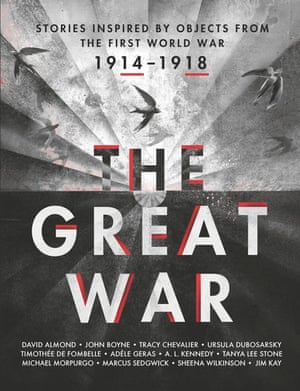
The Great War: stories inspired by objects from the First World War

The Great War: stories inspired by objects from the First World War (Walker Books, 2014)

304 pages, with full page black and white illustrations by Jim Kay; 11 stories by David Almond, John Boyne, Tracy Chevalier, Ursula Dubosarsky, Timothée de Fombelle, Adèle Geras, A.L. Kennedy, Tanya Lee Stone, Michael Morpurgo, Marcus Sedgwick and Sheena Wilkinson.

Subjects: World War One, England, France, short stories (Year 5-8)

Great War: Great War cover

Synopsis
This anthology contains stories by English, American, French, Irish and Australian authors. Each author uses a particular object as the inspiration for a story about the First World War. The objects include items belonging to individual soldiers – a helmet, a writing case, a compass. Some are printed material: sheet music, school magazines, a recruitment poster.  There is a French toy soldier, the nose from a Zeppelin bomb and a Victoria Cross and a Princess Mary gift box. One of my favourite items was a hand-painted war time butter dish.

Some stories are set in the present day (a school history trip to the battlefields), others in the past. A number of them have girls as the main characters. One is a sort of ghost story. One is written as a poem. Many are firmly based in family life. As in all anthologies, some stories work better than others, but all are of a very high standard.

The pages at the end of the book contain biographical information about the contributors and pictures of their chosen objects. From the picture credits, you can work out where most of the objects come from (many are held in the Imperial War Museum), but I would have liked some more information about how the authors chose the object they wrote about. (This article in the Guardian shows some of the objects.)

About the illustrator
Interesting random facts: Jim Kay won the Kate Greenaway Medal in 2012 for his illustrations for A monster calls by Patrick Ness and was chosen by J.K. Rowling to illustrate the full-colour editions of the Harry Potter series. Here they are!

And here he talks about his illustrations for The Great War.

Other books you might like:
War girls is another recent collection of war-related short stories. The curioseum, although not war- related, is another example of using museum objects to spark a story. 

Things I didn’t know
The country you call home by John Boyne describes the fierce debate amongst the Irish about whether they should support England in the First World War, when for years they had been fighting to get England out of Ireland.

The words that struck me most were from A world that has no war in it by David Almond, a story about a long-running neighbourhood feud.  Near the end, the narrator is talking about all the wars that feature on the news every day. “Are we daft?” he asks. “Are we evil? Is it just the way we are? Are we acting out something that started with our ancestors? Is it in our bones and blood? Do we go to war because we’re in love with war? Will we be asking those damn questions till the very end of time?”

The words stayed in my mind because I think a lot about writing books about war for children, and why we do it and what we are trying to say. Surely we want our readers to reflect on the futility of war, but as David Almond says, the wars just keep happening.

Thursday, 7 January 2016

Stefania’s dancing slippers by Jennifer Beck, illustrated by Lindy Fisher

Stefania’s dancing slippers by Jennifer Beck, illustrated by Lindy Fisher (Scholastic, 2007)

32 pages

Subjects: World War Two, Poland, Russia, Siberia, Persia, New Zealand, Pahiatua, refugees, picture book (Year 5-8)


Synopsis
This book won a silver medal for Best Picture Book of all Ages at the Moonbeams Children’s Book Awards in the United States.

Stefania is a young girl who loves to dress up and dance, but her life changes forever when war comes to Poland in December 1939 and her father leaves to join the army. When Stefania and her mother are ousted from their house by Russian soldiers, she slips into her pocket her most treasured possession: her dancing slippers.

Along with many other Polish families, they are put on a crowded train and taken to a camp in Siberia. Later they have a long, difficult journey south to Persia.  Finally, in 1944, Stefania – but not her mother – arrives by ship in Wellington, where, along with other children, she finds a new home in the Polish camp in Pahiatua.

The book includes a map of Stefania’s travels at the front, and a historical note at the back about the Polish children of Pahiatua.

Reviews:
This review calls it a “moving tender historical fiction” which has depth, feeling, sadness and joy. 

Questions:
If you were given only 30 minutes to leave your house, like Stefania, what would be your most treasured possession that you would take with you?

About the author:
You can read an interview with Jennifer Beck on the Christchurch City Libraries website, and another one on the NZ Book Council site. 

About the illustrator
You can read about Lindy Fisher on the Storylines website, and also on the NZ Book Council site. She also has her own website (interesting fact: Lindy has had over 75 stamps published by New Zealand Post!)

Other books you might like:
Jennifer Beck is the author of the much-loved picture book The bantam and the soldier (illustrated by Robyn Belton). She and Lindy Fisher have worked together on other books, including A present from the past (about the Christmas boxes given to the soldiers by Princess Mary in World War One) and Remember that November (about Parihaka).

A Winter’s Day in 1939 (Scholastic, 2013) by Melinda Szymanik tells the story of 13-year-old Adam, who lives with his family on a small farm in rural Poland. In 1939, war breaks out and the Russians invade Poland and confiscate Adam’s family’s house and farm. They are sent to live with another family nearby, but are then moved on and put on a train for a Russian labour camp as refugees, prisoners of Russia. 

NZ connections:
The 70th anniversary of the arrival of the Polish children was marked by a reunion in Wellington in October-November 2014. The reunion's facebook page gives more information. 

NZ on screen also shows a 1966 documentary on The story of Seven Hundred Polish children.

You can find out more about the Polish children who came to Pahiatua on Te ara and also on the Polish Heritage Trust Museum website. 


Polish refugee children arriving at Pahiatua Railway Station
Polish refugee children arriving at Pahiatua Railway Station (Taken by John Pascoe)  Ref: 1/2-003646-F. Alexander Turnbull Library, Wellington.http://natlib.govt.nz/records/32195274


Wednesday, 9 December 2015

Uprooted: a Canadian war story by Lynne Reid Banks

Uprooted: a Canadian war story by Lynne Reid Banks (HarperCollins, 2014)

28 chapters; 335 pages with chapter heading illustrations


Subjects: World War Two, Canada, evacuees, junior fiction (Year 5-8)


Synopsis
I went into this book with few expectations, maybe because the subject of evacuees has been written about so much already. But after a few chapters, I realised I haven’t read many books about the experience from a Canadian perspective.  

One reason I liked it is that it is not only a war story but also a coming-of-age story that covers many topics: loneliness, friendship, the degree of freedom that children enjoyed back then, a growing understanding of adult relationships, the difficulty of maintaining a marriage under the stresses of distance and war. It also gives a memorable picture of the Canadian landscape (especially in winter), so different from the English countryside.

It’s summer 1940, and as war rages across Europe, ten-year-old Lindy travels by boat and then train to Saskatoon, Canada, with her Mother and her smart cousin Cameron. Canada is a long way from home but it is also full of exciting new adventures. This story is inspired by the author’s own childhood experience and her time in Canada, which must be why many of the details sound so convincing: icebergs floating in the Atlantic Ocean, the three-day train trip across the plains, playground games, Hallowe’en, skating and tobogganing in winter and holidays at the lake in summer.

Lindy’s reactions are convincing; she keeps being offered Coke to drink, but finds it sweet and sickly; she revels in a hot deep bubble bath after “the three-inches-of-hot-water ones we’d been rationed to at home”; she marvels at the powdery snow, so different from wet English snow, and the deceptive cold that can give you frostbite without your noticing.  She picks up Canadian words (candies for sweets) and relishes all the new foods: peanut butter and jelly sandwiches, waffles with maple syrup, pork spare ribs cooked with brown sugar.  

She and Cameron have to cope with feelings of guilt at being safe and far from danger when London is being bombarded by bombs, as shown on the newsreels at the cinema. Is it okay for them to be happy? How do they come to terms with not being there? 

Author’s website
Lynne Reid Banks’ best-known book for children is probably The Indian in the cupboard. On her website, you can “Read my latest news, my interview with myself, and see an array of photographs and videos, and you can even listen to me read from some of my books.”

I couldn’t resist the interview, which she wrote for the very good reason thatI've been interviewed many times, but the interviewers hardly ever ask me the questions I wish they would! So here is me, interviewing myself.” (And it’s a very funny interview!)

I:
Excuse me.
Me:
What?
I:
I thought you were supposed to be interviewing me.
Me:
Sorry, I got a bit carried away. After all, writing for a living is a great life, if you don't weaken, and can keep the ideas coming.
I:
Aren't you going to ask me which is my favourite book, and to give tips for young writers, and all that?
Me:
No. How could we have a favourite book, we love them all and are proud of them, just like our children.

Other books you might like
There are lots of other books about evacuees, such as Ronnie’s war by Bernard Ashley, Carrie’s war by Nina Bawden and When the sirens wailed by Noel Streatfeild.

NZ connections
I made a nice personal link on pg 175 where Lindy talks about how terrible her handwriting was because she was still “trying to learn Canadian cursive”.

Things I didn’t know
Lots of things! For starters, I didn’t know that evacuees to Canada were called “war guests”. This was apparently because “Canadians are usually very polite and nobody wanted to hurt our feelings by calling us evacuees”.

I didn’t know that government war time restrictions meant that women who went to Canada with their children weren’t allowed to take more than ten pounds per person out of the country. This small amount was soon exhausted, so they were completely reliant on the charity of the people who offered them a home. This often put them in difficult situations, and eventually so many families complained to their Members of Parliament that the restrictions were lifted. 

I vaguely remembered hearing about a ship carrying evacuees that was torpedoed and sunk. In the book this ship isn’t named, but it could have been the City of Benares – or the Volendam.

I liked the details about the First Peoples that Lindy found out from visiting her neighbours, and was sorry when they disappeared quite abruptly from the story.

I liked the description of the river ice breaking up at the end of winter, and how the children laid bets on the day and time it would happen.

Have you read it?
Have you read this book? Let me know what you think!