Saturday, 16 January 2016

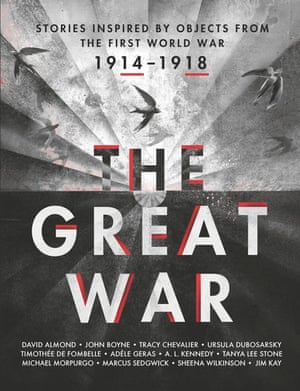
The Great War: stories inspired by objects from the First World War

The Great War: stories inspired by objects from the First World War (Walker Books, 2014)

304 pages, with full page black and white illustrations by Jim Kay; 11 stories by David Almond, John Boyne, Tracy Chevalier, Ursula Dubosarsky, Timothée de Fombelle, Adèle Geras, A.L. Kennedy, Tanya Lee Stone, Michael Morpurgo, Marcus Sedgwick and Sheena Wilkinson.

Subjects: World War One, England, France, short stories (Year 5-8)
Great War: Great War cover

Synopsis
This anthology contains stories by English, American, French, Irish and Australian authors. Each author uses a particular object as the inspiration for a story about the First World War. The objects include items belonging to individual soldiers – a helmet, a writing case, a compass. Some are printed material: sheet music, school magazines, a recruitment poster.  There is a French toy soldier, the nose from a Zeppelin bomb and a Victoria Cross and a Princess Mary gift box. One of my favourite items was a hand-painted war time butter dish.

Some stories are set in the present day (a school history trip to the battlefields), others in the past. A number of them have girls as the main characters. One is a sort of ghost story. One is written as a poem. Many are firmly based in family life. As in all anthologies, some stories work better than others, but all are of a very high standard.

The pages at the end of the book contain biographical information about the contributors and pictures of their chosen objects. From the picture credits, you can work out where most of the objects come from (many are held in the Imperial War Museum), but I would have liked some more information about how the authors chose the object they wrote about. (This article in the Guardian shows some of the objects.)

About the illustrator
Interesting random facts: Jim Kay won the Kate Greenaway Medal in 2012 for his illustrations for A monster calls by Patrick Ness and was chosen by J.K. Rowling to illustrate the full-colour editions of the Harry Potter series. Here they are!

And here he talks about his illustrations for The Great War.

Other books you might like:
War girls is another recent collection of war-related short stories. The curioseum, although not war- related, is another example of using museum objects to spark a story. 

Things I didn’t know
The country you call home by John Boyne describes the fierce debate amongst the Irish about whether they should support England in the First World War, when for years they had been fighting to get England out of Ireland.

The words that struck me most were from A world that has no war in it by David Almond, a story about a long-running neighbourhood feud.  Near the end, the narrator is talking about all the wars that feature on the news every day. “Are we daft?” he asks. “Are we evil? Is it just the way we are? Are we acting out something that started with our ancestors? Is it in our bones and blood? Do we go to war because we’re in love with war? Will we be asking those damn questions till the very end of time?”

The words stayed in my mind because I think a lot about writing books about war for children, and why we do it and what we are trying to say. Surely we want our readers to reflect on the futility of war, but as David Almond says, the wars just keep happening.

Thursday, 7 January 2016

Stefania’s dancing slippers by Jennifer Beck, illustrated by Lindy Fisher

Stefania’s dancing slippers by Jennifer Beck, illustrated by Lindy Fisher (Scholastic, 2007)

32 pages

Subjects: World War Two, Poland, Russia, Siberia, Persia, New Zealand, Pahiatua, refugees, picture book (Year 5-8)


Synopsis
This book won a silver medal for Best Picture Book of all Ages at the Moonbeams Children’s Book Awards in the United States.

Stefania is a young girl who loves to dress up and dance, but her life changes forever when war comes to Poland in December 1939 and her father leaves to join the army. When Stefania and her mother are ousted from their house by Russian soldiers, she slips into her pocket her most treasured possession: her dancing slippers.

Along with many other Polish families, they are put on a crowded train and taken to a camp in Siberia. Later they have a long, difficult journey south to Persia.  Finally, in 1944, Stefania – but not her mother – arrives by ship in Wellington, where, along with other children, she finds a new home in the Polish camp in Pahiatua.

The book includes a map of Stefania’s travels at the front, and a historical note at the back about the Polish children of Pahiatua.

Reviews:
This review calls it a “moving tender historical fiction” which has depth, feeling, sadness and joy. 

Questions:
If you were given only 30 minutes to leave your house, like Stefania, what would be your most treasured possession that you would take with you?

About the author:
You can read an interview with Jennifer Beck on the Christchurch City Libraries website, and another one on the NZ Book Council site. 

About the illustrator
You can read about Lindy Fisher on the Storylines website, and also on the NZ Book Council site. She also has her own website (interesting fact: Lindy has had over 75 stamps published by New Zealand Post!)

Other books you might like:
Jennifer Beck is the author of the much-loved picture book The bantam and the soldier (illustrated by Robyn Belton). She and Lindy Fisher have worked together on other books, including A present from the past (about the Christmas boxes given to the soldiers by Princess Mary in World War One) and Remember that November (about Parihaka).

A Winter’s Day in 1939 (Scholastic, 2013) by Melinda Szymanik tells the story of 13-year-old Adam, who lives with his family on a small farm in rural Poland. In 1939, war breaks out and the Russians invade Poland and confiscate Adam’s family’s house and farm. They are sent to live with another family nearby, but are then moved on and put on a train for a Russian labour camp as refugees, prisoners of Russia. 

NZ connections:
The 70th anniversary of the arrival of the Polish children was marked by a reunion in Wellington in October-November 2014. The reunion's facebook page gives more information. 

NZ on screen also shows a 1966 documentary on The story of Seven Hundred Polish children.

You can find out more about the Polish children who came to Pahiatua on Te ara and also on the Polish Heritage Trust Museum website. 


Polish refugee children arriving at Pahiatua Railway Station
Polish refugee children arriving at Pahiatua Railway Station (Taken by John Pascoe)  Ref: 1/2-003646-F. Alexander Turnbull Library, Wellington.http://natlib.govt.nz/records/32195274


Wednesday, 9 December 2015

Uprooted: a Canadian war story by Lynne Reid Banks

Uprooted: a Canadian war story by Lynne Reid Banks (HarperCollins, 2014)

28 chapters; 335 pages with chapter heading illustrations


Subjects: World War Two, Canada, evacuees, junior fiction (Year 5-8)


Synopsis
I went into this book with few expectations, maybe because the subject of evacuees has been written about so much already. But after a few chapters, I realised I haven’t read many books about the experience from a Canadian perspective.  

One reason I liked it is that it is not only a war story but also a coming-of-age story that covers many topics: loneliness, friendship, the degree of freedom that children enjoyed back then, a growing understanding of adult relationships, the difficulty of maintaining a marriage under the stresses of distance and war. It also gives a memorable picture of the Canadian landscape (especially in winter), so different from the English countryside.

It’s summer 1940, and as war rages across Europe, ten-year-old Lindy travels by boat and then train to Saskatoon, Canada, with her Mother and her smart cousin Cameron. Canada is a long way from home but it is also full of exciting new adventures. This story is inspired by the author’s own childhood experience and her time in Canada, which must be why many of the details sound so convincing: icebergs floating in the Atlantic Ocean, the three-day train trip across the plains, playground games, Hallowe’en, skating and tobogganing in winter and holidays at the lake in summer.

Lindy’s reactions are convincing; she keeps being offered Coke to drink, but finds it sweet and sickly; she revels in a hot deep bubble bath after “the three-inches-of-hot-water ones we’d been rationed to at home”; she marvels at the powdery snow, so different from wet English snow, and the deceptive cold that can give you frostbite without your noticing.  She picks up Canadian words (candies for sweets) and relishes all the new foods: peanut butter and jelly sandwiches, waffles with maple syrup, pork spare ribs cooked with brown sugar.  

She and Cameron have to cope with feelings of guilt at being safe and far from danger when London is being bombarded by bombs, as shown on the newsreels at the cinema. Is it okay for them to be happy? How do they come to terms with not being there? 

Author’s website
Lynne Reid Banks’ best-known book for children is probably The Indian in the cupboard. On her website, you can “Read my latest news, my interview with myself, and see an array of photographs and videos, and you can even listen to me read from some of my books.”

I couldn’t resist the interview, which she wrote for the very good reason thatI've been interviewed many times, but the interviewers hardly ever ask me the questions I wish they would! So here is me, interviewing myself.” (And it’s a very funny interview!)

I:
Excuse me.
Me:
What?
I:
I thought you were supposed to be interviewing me.
Me:
Sorry, I got a bit carried away. After all, writing for a living is a great life, if you don't weaken, and can keep the ideas coming.
I:
Aren't you going to ask me which is my favourite book, and to give tips for young writers, and all that?
Me:
No. How could we have a favourite book, we love them all and are proud of them, just like our children.

Other books you might like
There are lots of other books about evacuees, such as Ronnie’s war by Bernard Ashley, Carrie’s war by Nina Bawden and When the sirens wailed by Noel Streatfeild.

NZ connections
I made a nice personal link on pg 175 where Lindy talks about how terrible her handwriting was because she was still “trying to learn Canadian cursive”.

Things I didn’t know
Lots of things! For starters, I didn’t know that evacuees to Canada were called “war guests”. This was apparently because “Canadians are usually very polite and nobody wanted to hurt our feelings by calling us evacuees”.

I didn’t know that government war time restrictions meant that women who went to Canada with their children weren’t allowed to take more than ten pounds per person out of the country. This small amount was soon exhausted, so they were completely reliant on the charity of the people who offered them a home. This often put them in difficult situations, and eventually so many families complained to their Members of Parliament that the restrictions were lifted. 

I vaguely remembered hearing about a ship carrying evacuees that was torpedoed and sunk. In the book this ship isn’t named, but it could have been the City of Benares – or the Volendam.

I liked the details about the First Peoples that Lindy found out from visiting her neighbours, and was sorry when they disappeared quite abruptly from the story.

I liked the description of the river ice breaking up at the end of winter, and how the children laid bets on the day and time it would happen.

Have you read it?
Have you read this book? Let me know what you think!


Wednesday, 25 November 2015

The machine gunners by Robert Westall

The machine gunners by Robert Westall (Macmillan, 1975)

18 chapters; 189 pages

Subjects: World War Two, England, bombing raids, junior fiction (Year 5-8)


Synopsis
The machine gunners is set in north-eastern England in 1940-41. We often read about the bombing on London - the Blitz and the deadly V2s later in the war – but forget how other parts of England were affected. Tyneside (around Newcastle, or the fictional Garmouth in this story) is surprisingly close to Germany on the map, and it was the focus of many bombing raids at this time, often as devastating as the ones that were targeting London.

Chas is one of the local kids who hang around bomb sites, foraging for items (machine gun bullets, pieces of shrapnel, tail fins, nose cones) to add to their collections of war souvenirs. Their parents, worn out by sleepless nights, food shortages and warden duties, don’t care too much what they are up to, as long as they are safe in the Anderson shelters when the alarm goes.

Then Chas finds a crashed German plane in the woods, with a dead German gunner slumped inside, and the machinegun turret still attached. He calls in a gang of others to help – Cem (short for Cemetery Jones), Clogger, Audrey and Nicky - and they end up with not only the machine gun, but also an elaborate underground bomb shelter in the grounds of a ruined house and Rudi, a captured German airman. Meanwhile, the local Home Guard officer is aware that the machine gun is missing, suspects that local kids are involved and is desperately trying to retrieve it before disaster strikes.

The author comments that the plot was inspired by a newspaper article about a gang of Dutch children who found a wrecked Allied bomber long after the war, in 1969. They managed to “remove its rear gun turret, transport it several miles to their den, clean and repair it and were about to fire it when the Dutch police finally caught up with them”.  He adds that one night in 1941, some people on Tyneside really believed the German invasion had begun.

Some of the dialogue is written in dialect, especially Clogger’s (from Glasgow), which isn’t always easy to follow. But it is could work well as a book for a teacher to read out to a class. The idea of children working together, with little parental supervision, and finding warmth and acceptance in their gang, provides a very different slant on war. 

It has been a popular book over the years, especially in English schools, and there are lots of different covers. 


Reviews
A musical adaptation was first staged in 1998, and later appeared at the Edinburgh Fringe Festival. 

FreelanceProduction: The Machine Gunners
About the author
Robert Westall, according to the blurb on the back flap, “was a schoolboy in Tyneside during the war years” (later he went into the army and then became a teacher) which must be why the passages about the bombing raids and their aftermath – like when Chas and his dad make their way across town to try and find out if his grandparents are still alive - seem so authentic.

Other books you might like
Ronnie’s war by Bernard Ashley (the scene where Ronnie goes to look for his mother is another dramatic description of the aftermath of an air raid).

Things I didn’t know
I didn’t know that school started late if the raids had gone on late the previous night (in the opening chapter, Chas wakes in the air raid shelter after a raid that went on past midnight, so school doesn’t start until 10.30am). I didn’t know how important it was to have your insurance policies with you when you ran for the shelter in your back year, in case your house was destroyed. And I didn’t realise that wardens were unpaid and had to do their warden duties at night on top of a job during the day.

NZ connections
The final chapters – with the arrival of the Polish Free Army 
and non-arrival of the Germans – have semi-comic moments but pose a real question about what you would do and how your family might react to a possible invasion. In WW2, many people in Australia and New Zealand feared that a Japanese invasion was imminent, and I’ve heard stories from people about how their families had planned to retreat to farms in the countryside if that happened. 


Have you read it?
Have you read this book? Let me know what you think!

Monday, 9 November 2015

The singing tree by Kate Seredy

The singing tree written and illustrated by Kate Seredy (George G Harrap & Co, first published 1940)

11 chapters; 216 pages with full page and chapter heading black-and-white illustrations

Subjects: World War One, Hungary, Jews, Christmas, junior fiction (Year 5-8)


Synopsis
I had to request this book from the library's Central Stack section (in other words: “old books not borrowed much any more”). I read it as a child, and the title has stuck in my head, but I didn’t recall exactly what it was about, apart from a vague idea that it was set in Eastern Europe.  

In fact it is set in a small rural village on the Hungarian plains, where 12-year-old Kate lives with her 13-year-old cousin Jancsi on his father’s farm. The opening chapter shows Kate and Jancsi entering the village store, kept by Uncle Moses, so Kate can buy some red satin ribbons for her hat. The children are puzzled and intrigued by Uncle Mo’s method of book-keeping, which relies on his good memory and knowledge of the local people, and involves complicated deals and shrewd bargaining. It’s interesting to think about how this would have read on the book’s first publication in 1940, when the Jews in Europe were already under threat.

The villagers’ way of life is embedded in tradition, hinted at by the costumes in the illustrations. The main street, lined with “freshly whitewashed houses and blooming geraniums in the blue and green windowboxes”, echoes to the cheerful and peaceful sound of “the laughter of playing children, mixed with the cackling of hens, the honk-honk of waddling geese, the yips and barks of dogs”. Wedding celebrations involve the whole village, and run according to a carefully scripted programme, from the calling of the guests at first light to the ceremonies of the Seeking and the Lead Me Home at the end of the night of feasting and dancing; there are herds of horses on the plains and sheep and lambs – “hundreds and thousands of them… like a big white cloud rolling over the meadows.” 

But there are rumours, mutterings and threats like tiny puffs of cloud in a blue sky, and once the storm of WW1 breaks, this calm and peace is threatened forever.

The first real warning sign washes over Kate’s sleepy head as she dozes on the way home from the wedding in the horse-drawn wagon. At a brief stop in front of Uncle Moses’ house, his son Aaron says something that makes her father exclaim in alarm: “Francis Ferdinand had been shot this afternoon – somewhere in Bosnia”.  The adults begin to speak strange and sinister words, “words with a vaguely ugly meaning. ‘Assassination… rights of minorities… ultimatum to Serbia... mobilization.’” Soon not only Hungary but all Europe is at war. (This is at pg 99, so almost halfway through the story.)

Reviews:
This book also led me to an interesting review website: kidlithistory ("Everything I need to know about history, I learned through children's literature".) 

Questions:
Where is Hungary? Look it up on a map (and look for a map of Hungary in 1914 as well).

About the author: 
I couldn't find much biographical info about Kate Seredy, but according to LibraryThing, she was born in Budapest in 1896 and served as a nurse in WW1. She emigrated to the USA in 1922, learned English, ran a children's bookstore and worked as a commercial illustrator and painter. Although she wrote several (award-winning) books, she always thought of herself as an illustrator, not a writer. She died in 1975. 

Other books you might like:
The endless steppe by Esther Hauzig
A winter's day in 1939 by Melinda Szymanik is set in Poland and Russia. 
I am David by Anne Holm also begins in an unnamed concentration camp that seems to be in eastern Europe. 

Things I didn’t know
Anything about life in Hungary before WW1. (We talk about the Austro-Hungarian Empire during WW1, but I’d never thought much about the Hungarian side of it.)

The singing tree is a sequel to Kate Seredy's earlier book, The good master

Have you read it?
Have you read this book? Let me know what you think!

Tuesday, 27 October 2015

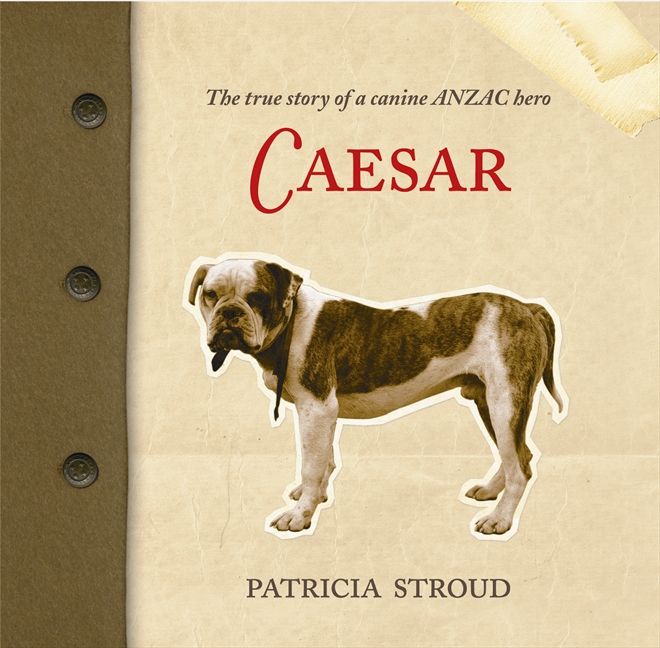
Caesar the Anzac dog by Patricia Stroud, illustrated by Bruce Potter

Caesar the Anzac dog by Patricia Stroud, illustrated by Bruce Potter (Harper Collins, 2003)

40 pages with sepia illustrations

Subjects: World War One, France, dogs, animals, mascots, junior fiction (Year 2-6)


Synopsis:
This book is based on the true story of Caesar, which was told to the author, Patricia Stroud, by her mother, Ida. 

Ida (aged four) was in the crowd when Caesar the bulldog, as official mascot, led the Rifle Brigade down Queen St in Auckland to board the ships that would take them to Egypt and the Western Front. As described in the book, Ida donated her blue ribbon for Caesar to wear. She gave it to her uncle Tom who was Caesar’s handler and he tied it onto Caesar’s collar.

Caesar worked during the Battle of the Somme in 1916 as a Red Cross dog. These dogs helped the stretcher-bearers to rescue wounded soldiers at night from No man’s land, the area in-between the trenches of the two opposing sides. They were trained to look for something that belonged to the man, such as a coat or cap, bring that item back to the stretcher bearers and then lead them to the wounded soldier.

Caesar was shot and killed in action. His handler, Tom, was temporarily blinded by mustard gas and sent to hospital in England. He married one of the nurses and they returned home on a hospital ship.

The family history aspect of the story is underlined by the way it is told to three boys, James, Brendon and Michael, who are visiting their great-grandmother (Ida) in the summer holidays. She tells them about the parade, and how her other uncles also went off to war.

The book was reprinted in 2009, with extra content, as Caesar: The True Story of a Canine ANZAC Hero ("A recount of the life of the bulldog that became the official mascot of the 4th Battalion of the NZ Rifle Brigade").


About the author
According to the Harper Collins website: “Patricia Stroud is a mother and grandmother, who has researched the facts behind a much loved family story to record a little-known aspect of New Zealand’s military history. As a volunteer, she spends many hours interviewing war veterans and recording their stories for the oral history archives of her local museum. Patricia and her mother Ida both live in Auckland.”

There is an interview with Patricia in the New Zealand herald, and here she is visiting the children of Botany Downs school

About the illustrator
Bruce Potter (here is his Storylines profile) has illustrated many other books, including The Donkey Man by Glyn Harper, Grandad's Medals by Tracy Duncan, Soldier in the Yellow socks by Janice Marriott and My Grandfather's War by Glyn Harper. (And who knew he is also "an internationally ranked powerlifter"??)

Other books you might like 
The Anzac puppy by Peter Millett and Trish Bowles is an appealing picture book based on the true story of a World War One mascot. The red poppy by David Hill, illustrated by Fifi Colston, tells the story of Nipper the messenger dog. 

Links
This unusual vintage clip shows a French Bulldog working on the Western Front in France in 1917.

The article about Caesar on the NZ History website includes this photograph of his collar (with an incorrect spelling of his name), now held at the Auckland War Memorial Museum (where you can also buy a soft toy Caesar!).


Jack, the New Zealand Engineers' canine mascot in France, World War I
Jack, the New Zealand Engineers' canine mascot in France, World War I. Ref: 1/2-013104-G. Alexander Turnbull Library. http://natlib.govt.nz/records/23171041

Bull, George Robert, 1910-1966 (Photographer) : Maori Battalion soldier and dog Paddy the mascot, Christmas Day, Maadi camp, Egypt
WW2 Maori Battalion soldier and dog Paddy, the mascot, share some pork from the hangi on Christmas Day at Maadi Camp, Egypt; Ref: DA-04880-F. Alexander Turnbull Library, http://natlib.govt.nz/records/22812710

Have you read it?
Have you read this book? Let me know what you think!

Wednesday, 7 October 2015

My brother’s keeper by Tom and Tony Bradman

My brother’s keeper by Tom and Tony Bradman (A & C Black, 2014)

11 chapters; 111 pages including a few pages of historical notes

Subjects: World War One, France, deserters, boy soldiers, junior fiction (Year 5-8? but shelved in the YA section at library so maybe meant for older but less proficient readers.)


Synopsis
Set in Flanders in 1915, this is the story of young Alfie Barnes. We suspect he is very young right from the opening sentence, when he stands on the fire-step of the trench and “wished he were taller”. He’s been working in Covent Garden markets since he left school at 12, but still looks young for his actual age of 15. When he signs up, claiming to be 19, the sergeant at the recruiting centre grins and says, “I suppose I’ll have to take your word for it.”

In the trenches, his older mates Ernie, Cyril and George look after him. They’ve been in action long enough to learn to keep their heads down, but Alfie is naively excited, hoping to have a go at “the Hun” and yearning for action. When it comes, of course, it’s not what he expects.

There’s not much to tell Ernie, Cyril and George apart, and I wasn’t convinced that a 15-year-old in the army would have spoken up as Alfie did. But there are good, clear descriptions of exactly what life in the trenches was like: how the men boiled their kettles, for example, what they ate and what they wore.

This is not a long story and there are other books that explore these issues more deeply. Perhaps it might serve as a good easy-to-read introduction to the topic. Our local library shelved it in the young adult section, so maybe it is meant for older but less confident readers.  

You can read an extract from Chapter One here.

Author’s website
Tony Bradman writes poetry and fiction for children, including the Dilly the Dinosaur and Swoppers series. He now writes in partnership with his son, Tom Bradman.


Other books you might like:
Other books that I've reviewed about boy soldiers include Valentine Joe by Rebecca Stevens, The last Anzac by Gordon Winch, illustrated by Harriet Bailey, One boy’s war by Lynn Huggins-Cooper, illustrated by Ian Benfold Haywood and My mother's eyes: the story of a boy soldier by Mark Wilson.

Things I didn’t know
Every book, no matter how short, can often tell you something you didn’t know about WW1. I learnt from this one that soldiers didn’t have to salute the officers in the front line (but they did if they were sent with a message to HQ.) And I learnt about applying camouflage before a night raid: how they mixed a black powder (burnt cork) with wet mud from the walls of the dugout and smeared the resulting thick paste over their faces.   


Have you read it?
Have you read this book? Let me know what you think!