Showing posts with label children's writers. Show all posts

Sunday, 5 April 2015

The last Anzac: questions and answers

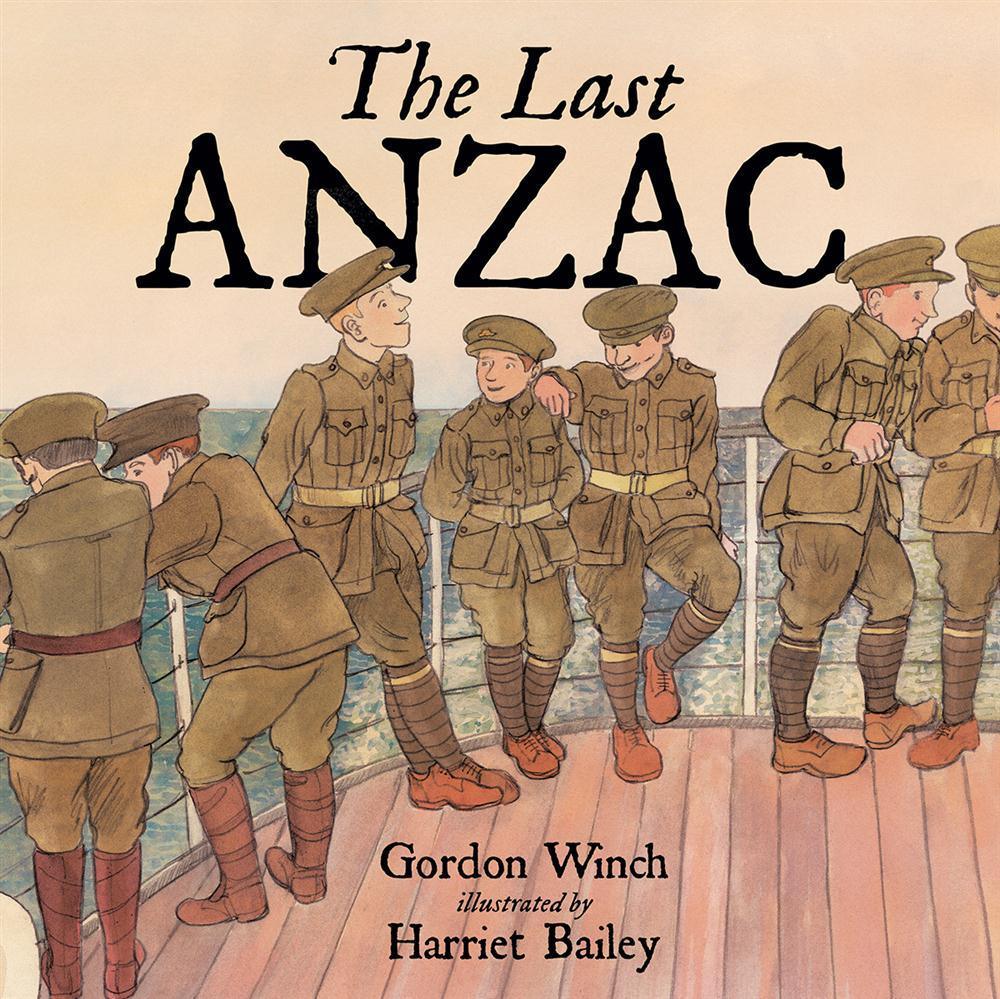
The last Anzac by Gordon Winch, illustrated by Harriet Bailey

I was lucky enough to attend the launch of this lovely book at The Children's Bookshop, Kilbirnie, in March. You can read my review of the book here, and Harriet has very kindly agreed to answer some questions about the book, how she worked on it and her illustrating style.

The book is a lovely production and it' s interesting to see the Anzac connection (Australian author and publisher / NZ illustrator). How were you approached by New Frontier to take the job on?
Thank you! An editor from New Frontier Publishing sent an email asking if I would be interested in illustrating a picture book for them, and that it would be a ANZAC WW1 Centenary title for 2015. I jumped at the chance to illustrate a heavily referenced story and one based on a soldier who served at Gallipoli.

How would you describe your own illustrating style, and why do you think it lent itself to this project in particular?
I have a range of illustration styles and felt the light and descriptive drawing line was needed to depict the various scenes and peoples expressions. When it got to the colouring stage, the publisher originally wanted all the 1915 scenes to be produced in sepia (brown and white or black and white, as was the photography at the time) in order to have a clear contrast between past and present. I wished to retain full colour to make it visually appealing and descriptive. I wanted the oranges to be a lovely juicy orange! We compromised by having the 1915 scenes set on a darker cream background.
At the launch of "The last Anzac", Ruth Paul made some fascinating comments about how well your illustrations worked to balance, and in some cases extend, the text. She used as examples the sequence showing Alec carrying the water and then spilling it when he jumps into the trench, and also the feet in the hospital beds. How do those ideas develop, and how do you decide what aspects of the story you want to illustrate?
This particular story was light on descriptive detail so I filled it in by reading as many accounts of the war at Gallipoli as I could. Books with collections of photographs of WW1 and men’s stories gave me ideas for the other soldiers that are shown. Soldiers injuries were horrific and of those that survived to be treated in the field hospitals, then the hospital ships and after that make shift hospitals in Greece and Egypt. I wanted to show men recuperating and with their wounds being looked after by ANZAC nurses. The missing limbs are sure to be noticed by children looking at the pictures.

Alec Campbell suffered many illness that kept him from sailing off to France to join the frontline but compared to his fellow patients he didn't have war wounds that were apparent until Bells Palsy appeared and 1/2 of his face became immobile.

As far as telling the story in pictures, “what happen’s next” is the major vehicle for turning pages of a picture book. I really wanted to have a sequence of illustrations to show what Alec Campbell did for the majority of the time: carrying water from the beach to inland for the soldiers who were in fighting in the trenches. Illustrating the effort and the danger of such an essential and appreciated task is the most interesting part of the story for children, I think!

I guess you haven't met the author, Gordon Winch, but do you know much about him?
I read about Gordon Winch online and discovered he has had a long career as a teacher of children and training teachers and has written many engaging and humorous books for children of Australia. 

How did you go about doing the research you needed for the illustrations? (at the launch, you told a lovely story about how you pinpointed the cottage that Alec Campbell lived in.)
It pays to use as many contacts that you have available when it comes to research and it was fortunate that I have a retired Australian uncle who is a whizz at tracing things using historical records. Part of the problem of weighing heavily on the internet for information is being certain that it is accurate. I had thought Alec Campbell was in a rest home at the time of James’ visit, but the publishers assured me he was still living with his wife in her mothers cottage, address unknown.

My Uncle was able to consult Electoral Rolls to hone down on a street number using the information I provided, sourced from historian Jonathan King’s book, Gallipoli: Our Last Man Standing. I used Google Street View to take a reference image of the cottage for the illustration. I like to think I have the correct little humble home where Alec lived!

As I have mentioned there was a lot of research needed to for a historical picture book. To avoid confusion due to the backwards and forwards of time and change in narration, I learnt it was important to keep visual elements limited to that which related to Alec and the story. I made a point of contrasting Alec's two ages: his visibly apparent youth when he went to war and his advanced age that he reached after a life where he achieved so much in Australia.

After Harriet had sent me these answers, I showed the book to my sister who came up with another question - which Harriet kindly answered as well!

Did you know any more about the boy's visit to Alec, and how that came about?
This story is based on a true event with one of the publishers' sons visiting Alec Campbell. New Frontier sent me two photos of father and son sitting with Alec and his wife Kate in their living room. I don’t know how the visit came about. I imagine the boy wrote Alec a letter requesting to visit him in Tasmania. I expect that Alec wished to met this young boy who was so keen to met him and learn about his experience at Gallipoli. 


Tuesday, 24 March 2015

Meet the Anzacs: questions and answers

Meet the Anzacs by Claire Saxby, illustrated by Max Berry

I found this a remarkable and unusual book in several ways: the clear, succinct text, the beautiful illustrations and the fact that it ends with the first landings on April 25 at Anzac Cove, which often serve as the starting point for other books about the Gallipoli campaign.

Claire very kindly agreed to answer some questions about the book for me, and I'm posting them here, along with a review of the book, as we get closer to Anzac Day 2015. 

In fact, Claire was extra kind to answer these questions as I realise now that some of them seem to go on forever, but there were lots of fascinating aspects to this book!


  • The blurb describes this series as "From Ned Kelly to Saint Mary MacKillop; Captain Cook to Douglas Mawson, the Meet ... series of picture books tells the exciting stories of the men and women who have shaped Australia's history."  So for Meet the Anzacs, what kind of brief were you given? How did you decide how you would approach the subject?

The brief for Meet the Anzacs started with an email asking if I'd be interested in writing about this topic. I wasn't sure whether I could write about war as I'd always threatened to hide my three sons in the hills should there be a call to war. That night I tossed and turned and somewhere in the night I realised I knew little about how it all began, from a recruiting, training, transport perspective. The next day I pitched the idea of exploring this time that lead up to the landing at Gallipoli. Then I held my breath. Fortunately Random House liked my idea and the research began.

  • The foreword says: "This is the story of how the ANZAC legend began." I liked the way that you included NZ ("In New Zealand men were doing the same", "the Australians and New Zealanders were beginning to work as a unit") which doesn't always happen. Was that your idea, or part of the brief?
My original submission included references to the cricket games between the Australians and New Zealanders while they were training in Egypt. During the editing process, we developed and extended those references. It seems so obvious really, but I guess most countries focus on their particular experience, even when it is part of a broader event.

  • We've talked about the similarities between our covers (for Meet the Anzacs and Best mates).  These were purely coincidental as the books both came out at the same time, but perhaps express some concept that we were both trying to get across. How much did you have to do with the illustrations (by Max Berry) for the book? He uses some remarkable perspectives, eg the seagulls looking down on the ships. Have you got any favourite illustrations?
It was curious that our books look so similar and were published at the same time. Yes, I agree that it reflects the similar experiences of our soldiers, particularly at Gallipoli, and the power and support of friendship.
I had very little to do with the illustrations, apart from loving the examples of Max's work that I was shown before he began. I love his different perspectives. I have at home the image of the open country where the first training camps were set. Although Max is based in Sydney, to me they symbolise the camp in outer Melbourne where I live. The area that was home to the camp is now completely suburban, and I like the idea that Max has shown how it was.
I do love the bird's eye view of the ships heading towards what we now call Anzac Cove, but my favourite I think, is the final image where a long shot shows ships on the horizon, landing boats on shore, and then after you see all that, you notice there are Turkish soldiers watching from the hills. It still gives me a chill.

  • You made a lot of use of dialogue and that's maybe unusual in a picture book. Did you have particular voices in your head? Did you feel as tho' they were the same people talking, or lots of different people?
Meet the Anzacs is non-fiction but I wanted to include the voice of the people, if that makes sense. Opinions were varied and came from the perspective of potential then enlisted soldiers, mothers and fathers, children as well as from other members of the public. In a picture book, those words had to be brief but hopefully evocative, and direct speech allowed me to include several viewpoints.

  • You've written such a lot! Have you written anything else that has the topic of war, or perhaps peace?
I write quite broadly - perhaps symptomatic of a scattered mind? But I'm interested in so many things and there are so many wonderful stories to be shared. From the scatty lovability of a family pet, to life on a farm, to walking on the beach, I love the ordinary and the stories behind stories. Many of my books are about resilience, reflecting the importance of a sense of self. 
Two new books due out this year are historical, one set in WWII, the other earlier. Meet Weary Dunlop looks at the man behind the legend, and My Name is Lizzie Flynn tells a story of the Rajah Quilt made by convict women on a ship travelling to Australia in 1841. I do like the idea of a book about peace, and now you have me thinking ...

  • The teachers' resource for this book says that you have"… nearly forty books in print with more in production. Her poetry appears in magazines, anthologies, on train walls and in museum resources."Can you tell us where the walls and the museums are?
Unfortunately, our train walls no longer sport poetry. It was an art initiative a few years ago, here in Melbourne, where poetry and images were mounted large on suburban train walls after being exhibited in a gallery. It was such a thrill to catch a train and see poetry there. I loved that I received notice of sightings from all lines on our extensive train network! Melbourne Museum had a Pompeii exhibition and as part of that education resources were developed. My poetry was part of the education pack accessible to students attending the exhibition.

  • Is there anything else you'd like to say about writing the book or its reception?
Meet the Anzacs, in fact the whole Meet ... series is designed to be accessible for readers 7+ and I'm delighted that it is being used widely across primary year levels. When I visit schools, I take hard tack biscuits and Anzac biscuits as well a a wide range of Anzac paraphenalia. 100 years is a long time ago, but it's important to for young people to realise that these were real people trying to live the best lives they could, real parents and siblings and friends, people just like them. 
Random House have also made a book trailer which can be viewed here.


  • Thanks again, Claire. It's great to get some of the background to this lovely story, and I'm looking forward to reading your new book, Meet Weary Dunlop. 


Wednesday, 11 March 2015

An unexpected hero: questions and answers

An unexpected hero by L. P. Hansen : questions and answers

After reading this book, I contacted Linda Hansen to ask if she would mind answering some questions about the process of writing it. I liked the way she showed us Matt grappling with his problems and working out how to solve them for himself, and the way in which she has interwoven the two stories (Archie's and Matt's) and shown the themes connecting them, as well as building up a real sense of tension as the climax of the book approaches.


So thanks to Linda for agreeing, and here are her replies!

  • In the teaching notes, you say that you wrote this book because "New Zealanders hear so little about pacifism, yet Archie Baxter and other New Zealand conscientious objectors are celebrated worldwide".  How did the idea for the book sprout?
I work as a Storyteller and a couple of years ago, was developing a story to tell at the Storyteller’s CafĂ© in Wellington around ANZAC Day.  I decided to test my theory that not many adults knew about James K Baxter’s father, Archie.  So I told his story in the form of a mystery, not identifying the Hero, much as Matt does in my book.

Only one person in the audience was able to name him.

After that I felt that it was time New Zealand children had an example of a genuine Kiwi alternative to the seeming ‘inevitability’ of war, especially at this time when war publicity is at its height. 

  • Did you know much about Archie Baxter beforehand? How did you go about finding out what else you needed to know?
    I hadn't known about Archie Baxter until my middle years, and certainly never heard of him during my formal education.  I read his book ‘We Shall Not Cease’ around twelve years ago and was very moved… found it particularly poignant to be teaching at the N.Z. International Campus at Trentham around that time, right next to where he was tortured and imprisoned. 

    I’ve been a writer and researcher all my working life, so found my material ‘by all possible means’, as researchers do.

  • You're a storyteller as well as a writer. How do the two roles interact with each other?
      Writing is a gift to my storytelling and it works the other way around as well.  I write all of my stories myself, even if they are adapted from another source.  I also write them down, as this gets them into my long-term memory.  Then I speak them aloud and find where sentences are clumsy, spaces are needed, sounds collide and so on.  It’s a lovely process. 

  • Can you tell us about the process of publishing the book? CreateBooks has several other books that deal with the topic of bullying, is that coincidental?
      I did submit the manuscript to several New Zealand publishers according to their requirements – a sample chapter, a Synopsis and so on.  It was No thanks or nothing from them, even after promises to get back to me with two months. Only Scholastic Australia, no longer in New Zealand, replied with a very encouraging response.

      Ann Neville of CreateBooks Publishing validated my original feeling, as she had only just learned about Archie Baxter herself when my offer and Synopsis arrived. She immediately asked for the full M/S and within a day or two, accepted it virtually without alteration.  I didn’t then know about the company’s other books, so the Bullying theme was coincidental.

  • Do you want to tell us anything about the process of writing this book - or about the next novel you're working on?
      I tend to write to a topic first and build up the characters and settings later.  Although I already feel I know the characters and their situations well before I begin, it takes time to make them real to readers.

    Being a life-long writer, I am very ‘picky’ about writing clearly.  Lots of adjectives and adverbs might go in but they don’t last long.

   My next novel is currently out for review with some teenage critics.  Perhaps it will be controversial, perhaps not. 
The main character is a hobby photographer in her sixteenth year.

It’s her journey through some current real-life issues that inspire her into courageous actions, resulting in the police visiting her college. She’s a bold, spirited young hero, we need more of them!