Saturday, 26 September 2015

The Flambards trilogy by K.M. Peyton

The Flambards trilogy by K.M. Peyton (Flambards, The edge of the cloud, Flambards in summer) (Penguin, 1980)

Flambards was first published in 1967 and the sequels in 1969; the trilogy runs to just over 500 pages

Subjects: World War One, England, flying, pilots, class system, hunting, horses, women in war, young adult fiction (Year 9-12)


Synopsis
Winner of the 1970 Guardian award, and later made into a film, the Flambards trilogy captures a fascinating slice of history, not just the history of WW1 which is largely peripheral to the main action – mostly shown by men signing up and leaving, returning or failing to return from the front - but also the history of social attitudes, especially concerning women and the class system. Reading it makes you realise how often books about WW1 start in the middle of the war, or at the very beginning, but seldom before it. 

The three parts of the first book, Flambards, are set in 1908, 1910 and 1912. With the benefit of hindsight we know that war is looming, and some of the characters suspect that something bad is coming, but the story stays focused on Christina Parsons, 12 years old when the book opens, an orphan but an heiress, due to come into a fortune at 21. 

Having spent her childhood moving from household to household, Christina is summoned by her Uncle Russell to join him and his two sons, Mark and William, at Flambards, a crumbling estate famous for having the best stables in the county, where the year revolves around the hunting season (the opening sentence is: “The fox was running easily”) and far more care and attention is lavished on the horses than on the house. Uncle Russell, crippled after a hunting accident, angry, frustrated and bullying, rules the house from the study and despises his younger son, Will, who hates hunting so much that he goes to terrible lengths to ensure he will never have to hunt again.

Christina, self-possessed and used to looking after herself from an early age, copes with her new strange surroundings but she is convinced that “they’re all mad”. Everything changes for her when her uncle insists she learns to ride (under the careful tutelage of Dick, the stable boy) and she discovers how much she loves it; like her mother before her, she is “a hunting Russell”. With Mark, she goes out riding and hunting all through the hunting season and returns to talk over each day’s events with Russell over dinner, while Will sits by, mute.

In the two-year jumps between each part of this book, Christina, Mark, Will and Dick all get older and there are more changes. Will, a gifted mathematician, is besotted with the new flying machines. Dick is given his notice, a dreadful thing to happen in the days before social security when poverty and the workhouse posed real threats and families could easily fall through the cracks and disappear. Christina, growing up in a house without women apart from the cook and maid, and ignorant of matters that today’s children would understand at a much younger age, is often at a loss in situations where nobody will explain the truth or meaning to her. She doesn’t understand Will’s views on the inequality between their lives and those of the servants, and thinks it impossible for a servant girl to become pregnant before marriage, but she is brave and resilient, determined, sensible and loyal, with a warm and loving heart.  

The second book, The edge of the cloud, leaves Flambards behind and explores the world of the young flying enthusiasts. Flambards in summer takes us back again, with a grown-up (21-year-old) Christina, to a world that has changed in so many ways because of the war.

I enjoyed the first two books more than the third, because – without revealing too much of later plot (or romantic) developments – the third one has more of an elegiac and introspective tone, overshadowed by death, loss and grief, without any of the excitement of flying, and also the character of the child Tizzy didn’t really work for me. But the three together give a powerful impression of how people’s lives changed so utterly in that decade from 1908 to 1918.

Here is Christina, watching a sunset in the peace of the countryside: 
“It made her more bitter, this peace, that while she was standing looking at everything that was the essence of the sentimental picture of home, which all the newspapers made out that the  ‘boys over there’ were fighting for, the fact that the boys over there were now dead and would never come home again made completely negative the sweetness of every flower and the balm of every sunset.”

Reviews
These books with their long descriptive passages show the differences in writing for young people that have evolved over the last 40 years. On the other hand, I can remember skipping those long passages as a child reader. Did every child do that?
  
About the author
The bio at the front of the book says that K.M. Peyton was born in 1929, studied painting at Manchester Art School, lives in a village in Essex and enjoys sailing, riding and long distance walks.

Other books you might like
There are a number of book about horses in war, especially the Australian and NZ horses that travelled to Egypt, as well as Michael Morpurgo’s famous War horseElizabeth Wein's Rose under fire tells the story of a WW2 female pilot, but I haven't found many books that tell the stories of the early pilots (Biggles learns to fly is one.) The Flambards trilogy captures these heady days when flying was still new and largely untested, when aircraft were fragile and their design still a matter of experimentation, as were techniques like looping the loop, but accidents were common and often fatal. Some adventurous people paid to go up for a ride, others turned up in droves to watch competitions, but many ridiculed the new machines and doubted that they would ever replaces the horse and carriage.


Have you read it?
Have you read these books? Let me know what you think!

Friday, 4 September 2015

Charlotte sometimes by Penelope Farmer

Charlotte sometimes by Penelope Farmer (Red Fox, 1999; first published Chatto and Windus, 1969)

3 parts; 198 pages with a few full-page black and white illustrations

Subjects: World War One, England, Armistice, VE Day, school, sisters, friends, time travel, junior fiction (Year 5-8)


Synopsis
This was one of my favourite books as a child, although I realise now that I read it as a time travel fantasy, with very little understanding of the historical background.

The New York Review has a succinct summary of the plot:
It’s natural to feel a little out of place when you’re the new girl, but when Charlotte Makepeace wakes up after her first night at boarding school, she’s baffled: everyone thinks she’s a girl called Clare Mobley, and even more shockingly, it seems she has traveled forty years back in time to 1918. In the months to follow, Charlotte wakes alternately in her own time and in Clare’s. And instead of having only one new set of rules to learn, she also has to contend with the unprecedented strangeness of being an entirely new person in an era she knows nothing about. Her teachers think she’s slow, the other girls find her odd, and, as she spends more and more time in 1918, Charlotte starts to wonder if she remembers how to be Charlotte at all. If she doesn’t figure out some way to get back to the world she knows before the end of the term, she might never have another chance.

On her blog, Penelope Farmer writes an interesting summary herself, describing the book as being “set in the kind of English boarding school my twin sister and I attended/were incarcerated in – take your pick – for part of the fifties.” No wonder the school scenes ring so true. The girls have very English names: Susannah, Vanessa, Janet, Elizabeth, Sarah, and there is a mystery about Sarah’s unexpected kindness to Charlotte, explained at the end.

(This is the school which Penelope and her sister went to, and which she used as the setting for the book, including the cedar tree and the glassed-over verandah that Charlotte climbs out onto.)

She adds that “the whole book turned – though I didn’t see that when I wrote it – on identity; how do people identify you as you?” and says this is “a particularly relevant question for twins in general, and still more so for two not identical but similar looking twins like my sister and me, quite different in character and ability – even opposites in many respects, she right-handed, me left - but always taken together not singly. This was another connection I did not make at the time I was writing.” (More on her twin sister below.)

The first clues about the war setting come with breakfast (“porridge… as solid as bread, much solider in lumps, and slippery too”) when Bunty tells Charlotte-as-Clare, “Miss Bite says it’s doing your bit, to eat things you don’t like… I don’t see how it hurts Germans myself, eating nasty porridge.” 

In September 1918, the war is drawing to a close. We as readers know it is nearly over, but the girls at school don’t, and it still affects their everyday lives. There are air raid alarms in the middle of the night, and an army training camp nearby with soldiers dressed in khaki, who “strolled casually about or marched stiffly up and down.”  Injured soldiers arrive home on the hospital trains. A girl with a German surname is ostracised by the others, and the teachers, girls and nearby villagers have fiancés, fathers or sons away fighting in France; some of them won’t ever come back.  

Part Three only takes up about 25 pages but it brings the story to a perfect, poignant ending. 

You can find lots of lots of different covers, some of which are better than others.  

About the author
A number of excellent fiction writers are called Penelope. This writer is not Penelope Mortimer or Penelope Fitzgerald or (another of my favourites) Penelope Lively.

Penelope Farmer was born in 1939. At first glance, there isn’t a lot of information about her online, but the New York Review says that she published her first book of short stories for children, The China People, in 1960 and writes novels for adults and children, including several books about Charlotte and her sister Emma.  (We also had Emma in winter when I was a child, which I enjoyed - but not as much as Charlotte sometimes.)

There is some biographical material about her here (including more fascinating twin info about the circumstances of her birth).

However, an absorbing article in the Guardian reveals a lot about her family life. Written in 2007, it describes the events of 16 years before when her twin sister lay dying in hospital in Oxford, and the connection that developed between her and the daughters of the woman who was dying in the next bed. It is a sad, moving and yet lovely story, all hinging on a chance meeting in the street.

Later, living in Lanzarote in the Canary Islands, she wrote about starting a blog called grannyp (“Old writers may not die, but they do have to move on. Thank God for the internet”) but it doesn’t seem to go beyond 2010.

Info about the illustrator
The cover illustration on my copy is by Emma Chichester-Clark who is best known for her Blue kangaroo books (and incidentally she also went to boarding school)

Other books you might like
Valentine Joe is a time travel book about World War One.
The red suitcase by Jill Harris is another, but about World War Two.

Things I didn’t know
I didn’t know anything at all about Penelope Farmer. It has been a delight to find out all this info about her, and this remains one of my favourite books.

And how many children’s books have inspired songs? This one inspired a song by The Cure, called Charlotte Sometimes and full of quotations.  This Smashwords blog article points to two other blog postings that talk about the copyright implications, the impact it had on her sales, how Penelope Farmer actually got to meet the Cure at one of their concerts, how she signed a copy of the Puffin edition for Robert Smith (who told her that his older brother read him the story at bedtime when he was about 12, and “it never got out of my head”) and how she enjoyed her own “brief moment of pop glory” when they played the song as an encore at the end of the concert.
You can read them here and here (scroll down to the entry for June 12).


Have you read it?
Have you read this book? If so, I hope you loved it as much as I do. Let me know what you think!

Monday, 17 August 2015

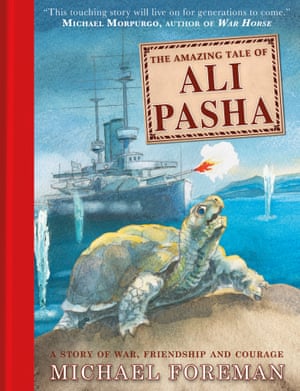
The amazing tale of Ali Pasha by Michael Foreman

The amazing tale of Ali Pasha by Michael Foreman (Templar, 2013)

9 chapters; 128 pages with numerous beautiful colour illustrations

Subjects: World War One, Gallipoli, Egypt, Navy, animals, tortoises, junior fiction (Year 5-8)

Ali Pasha 1

Synopsis
I tracked down this title after reading an article in the Guardian that asked well-known authors, “What are the best first world war books for children?” This book was Michael Morpurgo’s pick.  

On the cover, it is subtitled “a story of fear, friendship and courage”. The story, based on fact, is that of Henry Friston, a 21-year-old seaman on the HMS Implacable. In April 1915, the Implacable sails to Gallipoli and Henry and his gunner mates are sent on shore at X Beach (one of the five landing beaches at Cape Helles) to act as stretcher bearers. Sheltering after a shell blast, he finds a tortoise and determines to take it - against orders - back onto the ship with him. Soon afterwards the Implacable leaves for Egypt and Ali Pasha becomes a companion and good luck totem for the four friends who keep his existence on board a secret.

The author describes these events through the eyes of a young reporter, Trevor Roberts, who in turn hears them from Henry himself as an “old man” (actually not that old – only 59! – but presumably seemed so to the reporter!)

The endpapers contain family photographs of Henry as a young boy at school, a 13-year-old in his first job at the “Big House”, a sailor in his Navy uniform, and after the war as a bus driver, tram conductor, father and (really) old man. There is an afterword by the author explaining how and when he met Henry, his son Don and Ali Pasha himself.  

The final pages show some media coverage of Ali Pasha (who made The Times and even got to appear on the BBC’s Blue Peter show) and tell of how he outlived Henry by  ten years and died, aged at least 90 but quite possibly over 100, in 1987. By then, he had lived with the Friston family for 72 years.

You can see some of the beautiful illustrations from the book in Ali Pasha in pictures.  

Reviews:
Books for Keeps says that “most stories for this age group about the Great War concentrate on the trenches and the Army fighting in France, and it is refreshing to hear of the Navy’s part in the campaigns and especially of the part it played at Gallipoli.

Info on the author: 
Michael Foreman is primarily an illustrator, but his book War boy : a wartime childhood tells of growing up (he was born in 1938) in an English fishing village during World War Two. It is followed by After the war was over.

There is a lovely article about him here in the Guardiancelebrating the 50th anniversary of his first book.

Other books you might like:
Anything else written or illustrated by Michael Foreman about war (or peace), including War game, War boy : a wartime childhood and The General and also The little ships by Louise Borden. 

NZ connections:
A number of tortoises made it back to New Zealand after World War One - not all of them alive. One of the exhibits at the National Army Museum in Waiouru is a tortoise shell from Gallipoli

This tortoise didn’t enjoy the same long life as Ali Pasha, but there was another Gallipoli tortoise that did – in fact, Torty is still alive and living in Hawkes Bay. (Tortoises have been known to live to over 200 years old.) 

PRONE TO WATER: Ninety-one years after coming to New Zealand in a Gallipoli veteran's backpack, Torty is as limber as ever.
KATHY WEBB/ The Dominion Post

The tale of the Anzac tortoise by Shona Riddell, illustrated by official Defence Force artist Matt Gauldie, was partly inspired by the story of another tortoise which was given to a nurse by a wounded soldier and lived out its life on the Kapti Coast.
Official NZ Defence Force artist Matt Gauldie and Shona Riddell have created a children's book about a time-travelling war tortoise.
Matt Gauldie
Have you read it?
Have you read this book? Let me know what you think!
Wednesday, 5 August 2015

The Belgian twins by Lucy Fitch Perkins

The Belgian twins by Lucy Fitch Perkins (Houghton Mifflin, 1917)

18 chapters; 192 pages

Subjects: World War One, Belgium, refugees, twins, families, junior fiction (Year 5-8)


Synopsis
This is quite exciting as I’ve been wanting to read some older books, which can be hard to access in print, but I’ve just realised that they are accessible online, for example on Project Gutenburg. This title even seems to be on youtube as an audiobook. 

Jan and Marie are twins (as we know from the title), 8 years old, living on a farm in Belgium. It’s summer, harvest time; everything is peaceful and idyllic. There are rumours of a German army at the borders, but Belgium is neutral and surely she will be protected.

The men of the village are called away to join the army and it is hard for the women and children to know what is happening. (“There were no daily papers in Meer, and now there were no young men to go to the city and bring back the gossip of the day, as there had used to be.”) Then news comes that the Germans have crossed the eastern border and want to cross into France. That night their mother fastens a locket around Marie’s neck, and tells her, “You must wear it always… and remember that your mother's name is Leonie Van Hove, and your father's name is Georges Van Hove. If by any chance—which God forbid—we should become separated from one another, keep the locket on your neck, and our names in your memory until we meet again; for if such a thing should happen, do not doubt that I should find you, though I had to swim the sea to do it!"

When the “great tidal wave” of “a long gray line of soldiers on horseback” approaches the village, their mother hides the twins and the dog in the vegetable cellar. When they venture out again, the house has been ransacked for food and their mother has disappeared. In fact “there was not a human being but themselves in the entire village; all the others had been driven away like sheep, before the invading army.”

The children are brave and appealing and never lose faith that their mother will find them. The dialogue is realistic and often funny - here are a few examples:
  • "I think I could be braver if I had some breakfast," sobbed Janke.
  • "I don't see anything to laugh at," said Jan with dignity; "it might have happened to any man."
  • "She said no matter what happened we should never despair, and here we are despairing as hard as ever we can."


Marie and Jan go in search of their mother and join a flood of refugees on the road to Antwerp and safety in Holland. On the way they are taken in by an old woman, then a family on board a barge who take care of them and protect them from noticing too much of what is happening (burning houses and villages) but they can’t help seeing all the German soldiers.  Just in time they escape the siege and bombing of Antwerp and reach Rotterdam where they are placed in the care of the British Consul and put on a boat going to England, then taken to a large country house set aside for homeless Belgians.

“At night they and the other homeless children slept in little white cots set all in a row in a great picture gallery… Every day more Belgians came, and still more, until not only the big house, but the stable and outbuildings were all running-over full of homeless people.”

The next stage of their journey is by sea to New York to live with a childless Belgian couple who have offered to look after them. “They had chicken for supper, and, after that, ice cream! Jan and Marie had never tasted ice cream before in their whole lives! They thought they should like America very much.”

The last chapter is called THE MOST WONDERFUL PART, so you can guess it has a happy ending. It does seem coincidental, but the Preface says that “this story of two little Belgian refugees is based upon the actual experience of two Belgian children, and the incident of the locket is quite true." I tried to find proof of this, and couldn't - it would be fascinating to know the background to the sorry.  

Reviews:
You can read a short, but very early, review of this book in the New York Times for December 9, 1917. 

Booksylvania posts reviews by 11-year-old Lucy: "This book is inspired by the actual events in Belgium, of two Belgian children. I loved this book because of the truth in it."

About the author
Lucy Fitch Perkins (1865-1937), American author, educator and illustrator, wrote the popular Twins series of books. Born in Maples, Indiana, she studied at the Fine Arts School in Boston, then worked as a book illustrator with the an educational company and taught at art school. In August 1891, she married Dwight Perkins, an architect and teacher. Her first book (The Dutch Twins) was published when she was 48, and she kept writing one or two books a year from then on, wanting to give children "a correct idea of life in other countries" and to encourage "a spirit of friendliness and good will for children of other nationalities."

You can find a list of all her twins books hereWhat is quite astonishing is that this book was published while the war was still going, so that (as the Suggestions to teachers says) “American children who have been giving their pennies to help take care of little Belgian children will find this new "Twins" book one of the most appealing that Mrs. Perkins has ever written.” The French twins (1918) was also written in war time.

Things I didn't know
I didn't know anything about Belgian refugees in England and recently came across this article about the thousands who fled across the Channel when the Germans invaded. Many of them settled in a refugee community in Elisabethville, near Durham. Both of these articles feature some fascinating facts and photographs.

Have you read it?
Have you read this book? Let me know what you think!


Wednesday, 29 July 2015

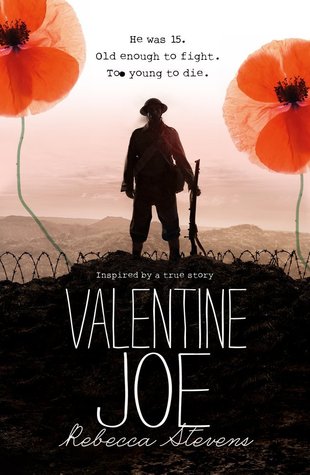
Valentine Joe by Rebecca Stevens

Valentine Joe by Rebecca Stevens (The Chicken House, 2014)

15 chapters; 154 pages

Subjects: World War One, France, Ypres, Belgium, Menin Gate, grandparents, boy soldiers, time travel, junior fiction (Year 5-8)

18663734

Synopsis
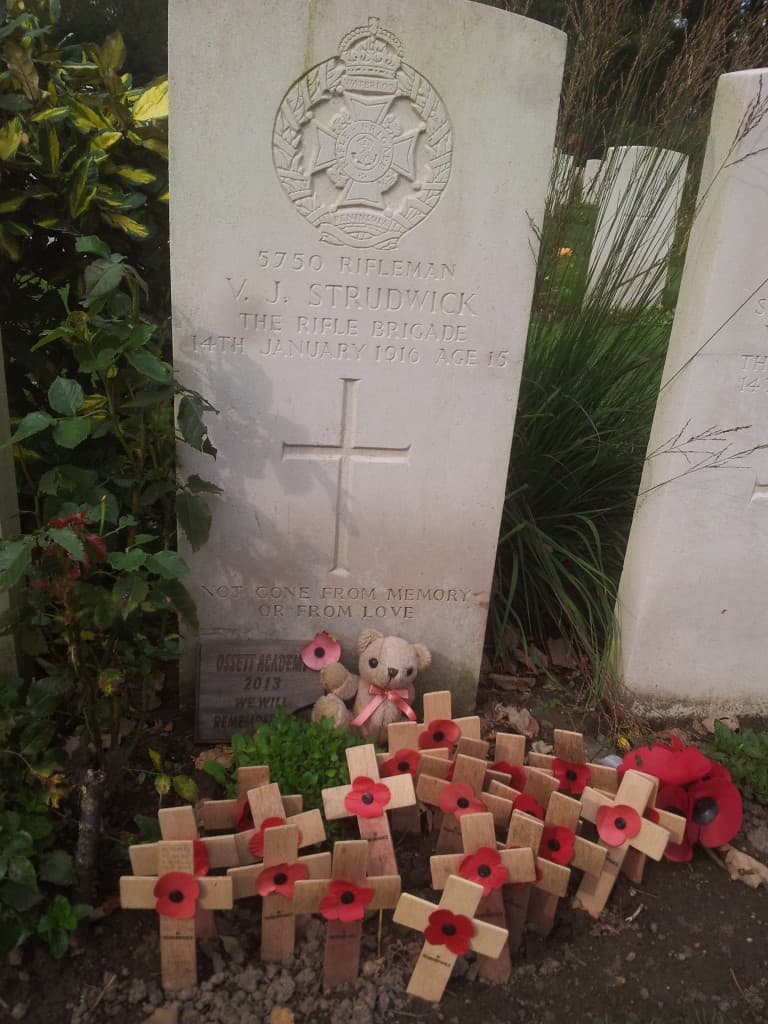
Rose’s father died a year ago and she still misses him so much that she secretly sends him texts on her phone. Her grandad takes her along on a trip to visit his uncle’s grave in Ypres, and in the cemetery she comes across the grave of a young soldier who died just before his sixteenth birthday. A stray dog leads her into a time slip adventure where she goes back in time to World War One and meets the soldier, 15-year-old Valentine Joe. As well as being an adventure, this also turns into a way of Rose coming to terms with her father’s death.

The best part of this book for me was the relationship between Rose and her grandad, which is teasing, funny and affectionate, as shown by their nicknames for each other. I found parts of the story slightly disjointed, which reflects the fact that Rose keeps getting thrown back into different times. She is often unsure where or when she is, or what is happening, which made it a bit confusing for the reader too.

Rose is 14 (and not a very sophisticated 14), and for the sake of the plot, she has to go off on her own at night, but I wasn’t sure if her grandad would really have let her wander round the streets of a strange town in the dark, no matter how safe the hotel keeper assured them it was.

This would appeal to readers who like time travel and a touch of romance as well as a war story. I wonder if it would also appeal more to British children who are more likely to go on school trips to visit the graves. 

Reviews:
The first chapter is online on the Guardian children’s books site, which also has a review (“It’s only a slim volume, but in its 150 pages Rebecca Stevens manages to weave a perfect war story: gripping, heartbreaking, realistic, witty and full of hope.”)

The Bookbag also refers to its length and calls it “small in terms of number of pages”, but “decidedly big in terms of themes and emotional weight” with "one of my favourite endings of the year".  

Author’s website
Rebecca Stevens has been an actor, a standup comedian and a script writer for children’s television, writing for shows like Mr Bean and Postman Pat. This is described as “her first solo book project.”
You can see Rebecca Stevens here reading from Valentine Joe.

And here on the BookTrust website ("telling the story of the short life of a real person"), she writes an interesting piece on using someone else’s story, or someone else’s life as the basis for your book:

Did I have the right to use Joe and the events of his tragically short life for the purposes of my book? I don't know... Although I managed to contact one of his relatives who gave me her blessing (and I've subsequently met another), it still felt wrong, disrespectful somehow, to put myself in his shoes, imagine his experiences from his point of view. So I decided to tell his story through the eyes of a character who was entirely invented, someone I felt closer to. Rose is a 14 year old girl from the present day, who goes to Ypres with her granddad.”

She also talks about her own grandfather who signed up when he was 16, but was sent home when a doctor suspected his real age. (He signed up again at 18 but survived the war.)

Other books you might like:
The topic of boy soldiers is a popular one. Charlie and Tommo in Private Peaceful sign up at nearly 16, so does William in My mother’s eyes: the story of a boy soldier, Sydney in One boy’s war and Harry and Jack in The horses didn’t come home. The boys in War game are very young as well.

“Boy soldiers” by Norman Bilbrough in School Journal, Part 4, No 3, 2008 tells the story of two young soldiers, Stan Stanfield and Len Coley, who fought in World War One. 

The red suitcase by Jill Harris and Charlotte sometimes by Penelope Farmer are war-related time travel stories. When the guns fall silent by James Riordan also uses the device of a child visiting the war graves with a grandfather.

Links
Private Valentine Joe Strudwick was a real soldier. He was born in Dorking, Surrey, and you can read more about him here on the website of the Dorking Museum.

Valentine Joe Strudwick
"Not gone from memory or from love"
Have you read it?
Have you read this book? Let me know what you think!


Saturday, 18 July 2015

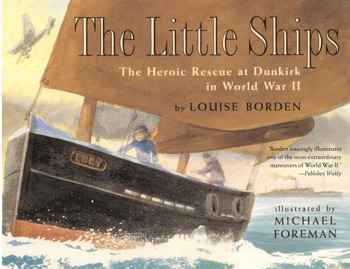
The little ships by Louise Borden

The little ships by Louise Borden, illustrated by Michael Foreman (Pavilion, 1997)

32 pages

Subjects: World War Two, England, France, Dunkirk, boats, girls, picture books (Year 3-6)

Some covers have the subtitle: The heroic rescue at Dunkirk in World War II

The Little Ships
Synopsis
In May 1940, the unnamed narrator lives with her father, a fisherman, in the town of Deal on the Kent Coast.  She is a girl, but “fisherman on the beach said I was my father’s daughter.” Her brother John is away fighting in France.  When word comes that half a million British and French soldiers are trapped on the beaches of Dunkirk, she disguises herself as a boy in some of her brother’s old clothes and joins her father (in his fishing boat the Lucy) and an armada of "little ships" that sets sail across the English Channel to rescue them.
I didn’t know that people from English villages and towns actually signed up to go and help, as shown in one of the illustrations. And I didn’t know that soldiers brought back their pet dogs (and some strays) with them – over 200 dogs were aboard ships landing in Dover!
There is a map in the front, and a historical note and excerpt from Winston Churchill’s famous speech (“we shall fight on the beaches…”) at the end. Some of the pages have a lot of writing on them, and I would think that the text is longer than that of an average picture book. There are a lot of illustrations of boats and ships, which I guess is understandable!
Reviews:
Kirkus reviews (always a prestigious place to get a review) calls this "A moving, fictionalized account of the ``miracle of Dunkirk,'' in which an armada of 861 ships ferried to safety across the English Channel over 300,000 Allied soldiers who had been trapped in northern France by the Germans."

The Children's War blog says it is "an excellent book for introducing the topic of Dunkirk to younger kids but is also a good teaching tool for older kids who may already know something about World War II."

Author’s website
Louise Borden is an American writer from Cincinnati.  I’d never heard of her before reading this book, but now I’m hoping to read more of her work. Her website has a very readable section about Becoming a writer (under the About button). I like how she talks about riding home on her bicycle as a child:Pedaling slowly up my street may be where I learned perseverance, something all writers need when they are working alone at their desks.”

And I love what she says about writers needing to have thinking time. It’s a long quotation but it makes so much sense to me: 
“Often I am in my car, driving to new places to meet new people, and to talk about writing. I have a lot of thinking time on those miles. And I have a lot of thinking time when I am working in my garden at home. Thinking time: It's so very essential for a writer. I think about new ideas for books, and new ways to write them. I think about what is important to me, and the new things that I want to learn. I think about the books I read as a child—and the books I am reading today. 
I think about my family who are my great encouragers. And my wonderful editors who understand, in just the right way, my creative vision for a picture book. These thoughts always inspire me to return to my desk and begin working on a rough draft for a new manuscript.”

Info about the illustrator
You can read more about Michael Foreman on my review of his book War game.

Other books you might like:
The snow goose and The dolphin crossing, both already reviewed on this blog, are other books about Dunkirk. The evacuation of Dunkirk has a resonance for England that is perhaps a bit like Gallipoli for us in New Zealand: a defeat, but a heroic failure.

Things I didn’t know
Louise Borden’s website has pictures of her research trip for writing this book. She took part in one of the Crossings of the Association of Dunkirk’s Little Ships (as referred to in the Foreword), which is “the surviving remnants of the intrepid band of assorted boats and yachts that contributed so much to the miracle of Dunkirk.” 
I didn't know there was an Association of Dunkirk's Little Ships! There  is some fascinating info about it on their website, including an answer to the question “how do I identify if my boat took part in the Dunkirk evacuations?” 

The Association returned to Dunkirk in May 2015 to commemorate the 75th anniversary of Operation Dynamo, with 50 Little Ships escorted by the RNLI and the Royal Navy. There are some great photos and descriptions in this newspaper report from the Telegraph.  

Links
There's a You tube clip here, which describes itself as WW II : RARE COLOR FILM : DUNKIRK : PART 3 OF 3 1939 1940.

Have you read it?
Have you read this book? Let me know what you think!

Wednesday, 8 July 2015

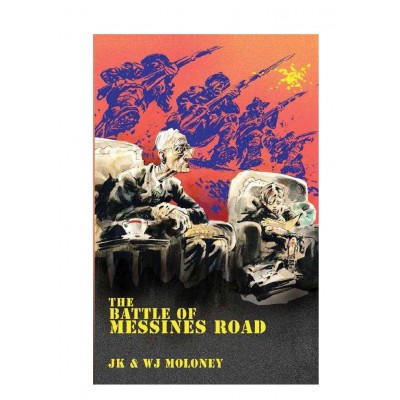
The battle of Messines Road by J K & W J Moloney

The battle of Messines Road by J K & W J Moloney (Willsonscott Publishing, 2015)

43 chapters; 348 pages

Subjects: World War One, France, England, Ireland, Vietnam, diaries, bullying, junior fiction (Year 7-9)
Synopsis
This story is set in Karori, a suburb of Wellington where Messines Road really does exist, as do several other street with names related to World War One. The year is 1968, and 10-year-old Zac is in strife on several fronts; he is often in trouble at school, doesn’t have many friends, things are stressed at home and we learn that his dad is away at the Vietnam War. On top of that, he hates his paper run and longs for an easier, shorter one with fewer hills. However, it’s through his paper run that he meets old Mr Moloney and begins to read to him in the afternoons – initially as a punishment, and at first from the newspaper, but later from Mr Moloney’s old war diaries, dated from 1915 to 1917.

I liked seeing the growing relationship between Zac and Mr Moloney, and the diary entries are well-written and interesting, but their length could provide challenging and I wonder if some younger readers will skip parts of them and just follow Zac's story. I have listed this book under Junior Fiction, but the publisher's blurb says "the two intertwined narratives will hold a wide-range of reader interest and the perspective of 10-year-old Zac will capture the attention of the young adult market while still appealing to more mature readers."

Like many other men of the time, Jack Moloney (see below) was a fluent and observant writer, and other readers might prefer these sections of the book. The parts of the diary that I enjoyed most were not about the fighting, but about aspects of the day to day organisation of war that you don’t often read about. I liked the descriptions of the officers’ training course at Cambridge, his trip on leave to Ireland, playing football, visiting London and (especially) his accidental meeting with Rudyard Kipling at a hotel in Bath.

Having Zac read the diaries out loud presents a few challenges. It makes for long sections which don’t directly affect Zac himself, and I wasn’t convinced that a 10-year-old who has trouble pronouncing “Heliopolis” and “Bedouin” would be able to cope with the vocabulary, foreign names and some of the concepts involved. The switch between Zac’s everyday life and the diaries also requires a degree of repetition to get him over to Mr Moloney’s place, and starting and finishing each day’s reading.  The chapters where Zac and Mr Moloney attend the Anzac Day service at the Cenotaph, with more action and dialogue, are more immediate and gripping. (I also wondered why Zac’s brother and sister are seldom, if ever named. Perhaps it’s to show the fractures in the family – but I would have liked to know!)

Thanks to Willsonscott Publishing for sending me a copy of this book to review. I hadn’t heard of them before, but their website says they "specialise in publishing non-fiction books with a New Zealand, Australian or special international military content and personal perspective" and have “a worldwide reputation for sourcing and producing high quality titles on New Zealand military history, covering noteworthy actions and previously untold stories from many theatres of war.”

You can read a preview of the book (the opening two chapters) here on the publisher’s website.

Reviews:
The National (an Abu Dhabi English-language newspaper) calls it "an interesting hybrid of factual diary and dramatic story". 

There is another review here on Bookfabulous (fabulous title for a blog!) 

Author’s website
This book has an intriguing story behind its authorship. Two authors are listed on the title page: J K Moloney and W J Moloney.

J K (John Keith, also known as Jack) Moloney was the original author of the diaries that Zac reads in the book. He was a 22-year-old law student when he left for WW1 in October 1915. After the war, he settled in Christchurch where he married and had three children, worked as a barrister and became involved in rugby administration, including being President of the Canterbury Rugby Union. His death certificate (from 1971) is reproduced at the back of the book and this is his record on the Auckland Museum Cenotaph website.

W J (William) Moloney is Jack’s grandson. He grew up in Karori, has a Master’s degree in War Studies and worked as a military analyst for many years. He is married with three children and currently lives in Abu Dhabi, UAE.

Jack Moloney’s 120,000-word WW1 diary is held by National Archives, and William has transcribed it over a number of years, as well as researching the stories of some of the men mentioned in it.  This is the diary that Zac reads out loud. William says that his grandfather, who died before he was born, and “Mr Moloney” in the book “have some similarities but they are not the same.”

Other books you might like:
Reading this book made me realise that I don’t know many other books written about Vietnam for younger readers. (There might be plenty of American books that I’m not aware of.)  There is a lot of concentration on WW1 commemorations at the moment, and I’m sure many children wouldn’t know that public opinion was so divided over our involvement in the Vietnam War.

One non-fiction title is Leon Davidson’s Red Haze (Black Dog Books, 2006), about the experience of New Zealanders and Australians in the Vietnam War.

I have reviewed My mother's eyes: the story of a boy soldier by Mark Wilson, one of three books in his war trilogy which also includes Vietnam diary. Gary Crew's Memorial also refers to the Vietnam War

Links
You can read more about New Zealand's involvement in the Vietnam War on the NZ History website, which says that “More than 3000 New Zealand military and civilian personnel served in Vietnam between 1963 and 1975... At its peak in 1968, New Zealand’s military force numbered only 548. Thirty-seven men died while on active service and 187 were wounded. Two civilians serving with the surgical and Red Cross teams also lost their lives.”

Have you read it?
Have you read this book? Let me know what you think!