Sunday, 17 July 2016

Brave Bess and the Anzac horses by Susan Brocker

Brave Bess and the Anzac horses: a true story of courage and loyalty by Susan Brocker (HarperCollins, 2010)

12 chapters; 160 pages with black and white photographs

Subjects: World War One, Middle East, Egypt, Palestine, Mounted Rifles, horses, animals, junior fiction (Year 5-8)


Synopsis
Bess was a real horse, one of the thousands sent overseas in World War One, of which only four (including Bess) returned to New Zealand. Susan has told the story of the horses and the men who rode them and cared for them, using the facts of the campaigns backed up by descriptions of the land and scenery, seen through the eyes of both Bess and her master.  

As well as Bess, we meet two other horses – Jack and Flame, the mascot, a dog called Hawker, and a lot of smelly camels.

Susan’s research is impeccable and she includes a map, timeline, historical notes, bibliography and glossary, as well as short summary notes at the start of each chapter.

Reviews:
Bobs books blog calls it “A well written, well researched novel about a little known battle field of World War One in which NZ soldiers and their horses took a vital part.” 

About the author
Susan is a wonderful writer with a real love for horses, as shown in her other books such as 1914: riding into war, The drover’s quest and Dreams of warriors. You can read more about her and her work on her website.   

Other books you might like:
Other books I have reviewed about horses in WW1 include The horses didn't come home by Pamela Rushby and Light Horse boy by Dianne Wolfer.

Links 
Find out more about:

Friday, 17 June 2016

Pandemic: Spanish flu 1918 by Sally Stone

Pandemic: Spanish flu 1918 by Sally Stone (Scholastic, 2012; part of My New Zealand story series)

159 pages, written in the form of diary entries

Subjects: World War One, influenza, armistice, New Zealand, junior fiction (Year 5-8)


Synopsis
This book follows the fictional diary format of the My New Zealand story series. Eleven-year-old Freda Rose starts her diary after a falling-out with her best friend Pearl. She lives with her parents and grandmother on a farm and her older brother Bobby is serving overseas as a stretcher-bearer in World War One.

The story is primarily about the influenza epidemic, but I’ve included it here as the epidemic was so closely linked with the war and the armistice celebrations, and because Freda’s diary also describes the homecoming of her brother Bobby, and how they all (Bobby included) struggle to cope with how changed he is.

There is a short historical note at the back, a description of what to do in a pandemic and some historical photos.

Reviews:
Bob Docherty in his invaluable Bobs book blog says that the author "gives an excellent portrait of life in these times that will astound today’s kids". 

Teacher notes are provided here

About the author
The Scholastic blurb says that Sally Stone lives in Queenstown with her husband and three children. This is her first book with Scholastic; she has previously written school journals for Learning Media.

Other books you might like:
Black November by Geoffrey Rice (Canterbury University Press, 2005) provides the most comprehensive coverage of the influenza epidemic in New Zealand.

My book Armistice Day also includes a section on the influenza epidemic. 

Things I didn’t know
I did know this, but I always forget the difference between an epidemic and a pandemic. 
So here's a definition from Info please: An epidemic occurs when a disease affects a greater number people than is usual for the locality or one that spreads to areas not usually associated with the disease. A pandemic is an epidemic of world-wide proportions.
Links
Excellent info and photos of the 1918 influenza pandemic here on the NZ history site. 
And also on the Christchurch city libraries site and Te ara.

There's an amazing story on Puke ariki about a four year old boy from Inglewood who survived by chance when it was discovered in the morgue that he was still breathing.

Friday, 3 June 2016

Stay where you are and then leave by John Boyne

Stay where you are and then leave by John Boyne (Doubleday, 2013)

14 chapters; 247 pages

Subjects: World War One, England, London, hospitals, shell shock, conscientious objectors, junior fiction (Year 5-8)


Synopsis
Alfie Summerfield is five years old, living on an ordinary London street called Damley Road, when the war starts. His father, Georgie, signs up almost straightaway. Four years later, Alfie is nine, the war is still going on and there is no word from his father. His letters have stopped arriving and all Alfie knows is what his mother Margie tells him: that his father is on a secret mission for the Government, and that’s why he can’t write any more.

The community of Damley Road is a close-knit one, and we find out what happens to a number of its other occupants during these four years. One of the most powerful moments is when two men in military uniform knock at the door to (slight spoiler alert here) deliver the news of a soldier’s death. Margie’s emotions skip from shock to horror to outrage as she realises they have the wrong house, and every other woman along the street stands in fear on her doorstep, waiting to see where they go next.  

Money is tight and Alfie decides to help out by skipping school (except on the days when they have history or reading) and working as a shoeshine boy at King’s Cross Station. This is where he finds out where his father actually is, and where he starts to dream up a plan to get him home again.

The Guardian review points out some of the coincidence in the plot, and there are some events that stretch credulity. I found it hard to believe that Alfie could get around the hospital without being detected, or that he could escape so easily when finally spotted. But it is still a story that pulls you along, and John Boyne does an amazing job of telling it from the point of view of a young child – for example, the way that Alfie views anyone aged 21 or over to be unimaginably old. There are some lovely insights into the nature of loyalty and friendship, especially that shown by Georgie’s oldest friend, Joe Patience, who is ostracised by everyone else in the street for being a conscientious objector. And I loved any scene with Mr Asquith in it!

Reviews
The Guardian book review (mentioned above) says "There may be a fairytale feel to this wartime tale of a boy's quest to find his father, yet it's a solid, engaging read." 
The Pretty Books blog also comments on the fact that "it is fascinating to see the world through the eyes of a child." 
Finally, the reviewer in The Book zone for Boys loved the book and says it is "much more than just a story about a victim of shell shock" and which "really brought alive the everyday travails of the people left at home".

About the author
You can read about John Boyne on his website, which has a special page for this book (although this older link is also quite amusing). 

About the illustrator
The chapter titles were hand lettered by Oliver Jeffers

Other books you might like
I can’t think of many similar books to this one. The way John Boyne gets into the head of a five-year-old, then a nine-year-old is hard to replicate. If you haven’t read The boy in the striped pyjamas, you should definitely read that.

NZ connections
Only to say that I heard John Boyne speak a year or so ago and was fascinated by his account of how he wrote The boy in the striped pyjamas in about three days, virtually non-stop. You can read about it here in this transcript of a talk with Dublin Public Libraries

Things I didn’t know
I didn’t know much about shoe shine boys, but now I've found out that the Shoeblack Brigade set boys up as shoeblacks in London in 1850. More than a dozen brigades were formed, each with their own uniform, and the boys often lived in hostels. The Shoeblack Brigades had mostly disappeared by the start of World War One. “Shoe shining continued as a London street trade for many years” but had virtually vanished by the 1960s.
You can see more of Frederick Wilfred's evocative photos of London here

Have you read it?
Have you read this book? Let me know what you think!

Saturday, 21 May 2016

The year it all ended by Kirsty Murray

The year it all ended by Kirsty Murray (Allen & Unwin, 2014)

30 chapters; 243 pages

Subjects: World War One, Australia, France, Belgium, Germany, enemy aliens, white feathers, family, influenza, armistice, peace, Peace Day, war graves, Cheer Up Society, young adult fiction (Year 9-12)


Synopsis
This book starts with a poignant vignette of a pre-war scene, when 11-year-old Tiney – short for Martina - is allowed to join her big brother Louis and older cousin Will on their early morning expedition to Glenelg Beach. Six years later, everything has changed. Louis has gone to war and now the bells are ringing on Tiney’s 17th birthday to signal the armistice on 11 November 1918. 

As well as Louis, the family includes Tiney’s three older sisters: Dorothea (or Thea) the artist, Minna and Nette. Their family ancestry is German and Will (or Wilhelm) went to Heidelberg to study and was caught in Germany when the war started. As a result he was conscripted to fight on the German side. Will’s brother Paul, their other cousin, was interned as an enemy alien on Torrens Island.

As the cover suggests, “the year it all ended” was the year that things started to change, and the sub title (“War ends, the Jazz Age dawns. What will destiny bring Tiney Flynn?”) underlines this theme. Although the war is over, its effects continue and there will be many changes in Tiney’s life, both good and bad. Tiney is obsessed with what seems like an impossible dream, to go to Europe, but she manages to achieve it and sails across the world with her friend Ida and Ida’s mother, to visit the battlefields of France and Belgium.

I found this a very interesting viewpoint – not just Tiney’s, but that of a German-Australian family and the attitudes they faced in the war. 

Reviews:
I’ve tried to look for reviews that don’t give away too much of the plot, which is tricky as this reviewer acknowledges (but succeeds in doing - or not doing!) The reviewer loved "the vivid way in which Kirsty Murray has bought a period of history to life."

This review does contain more plot descriptions but I’ve included it as it has an author interview, I liked the answers to questions 4 and 6 in particular.

Here is a review from the Kids’ Bookshop (having given up by now on trying to avoid spoilers).

And there are more excerpts from reviews on Kirsty Murray's website here

About the author:
Kirsty Murray grew up in a family of seven children, in Melbourne and then Canada, has travelled widely, loves reading and says her most important job “and the one that took up most of my time was being a mother”, but has still produced a string of prize winning books. Lots of other info about her on her bio and FAQ pages.

I like her answers to What were your favourite books when you were a kid? and What’s the hardest part of writing for you?

Teachers’ notes are also available on her website here.

Other books you might like:
Remembrance by Theresa Breslin and Flora’s war by Pamela Rushby both tell the story of WW1 from the viewpoint of girls about Tiney's age. 

Things I didn’t know
The Cheer Up Society really did exist. “Its object was to support the soldiers in the First and Second World Wars as well as to bring them into contact with the 'highest type of womanhood'. “

You can see some wonderful photos here and here


Monday, 9 May 2016

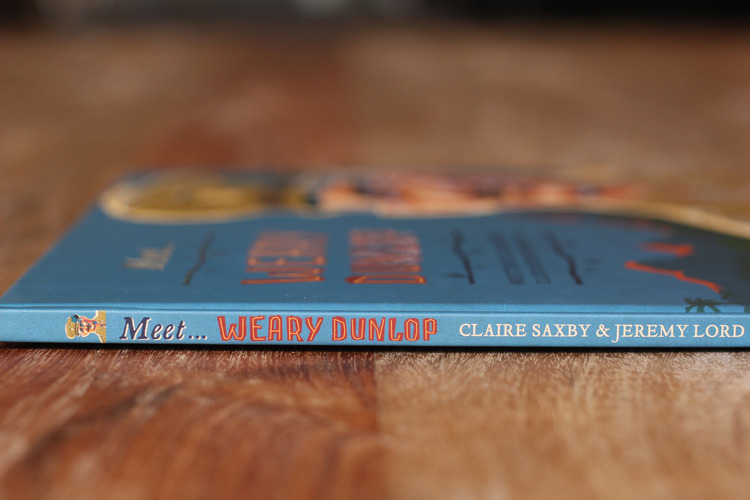
Meet Weary Dunlop by Claire Saxby, illustrated by Jeremy Lord

Meet Weary Dunlop by Claire Saxby, illustrated by Jeremy Lord (Random House Australia, 2015)

32 pages with colour illustrations, map and timeline

Subjects: World War Two, Australia, Singapore, Thailand, Burma, Ernest Dunlop, prisoners of war, junior fiction (Year 5-8)

Synopsis
Thanks to Claire Saxby for kindly sending me a copy of her new book. This is one of a series about “the extraordinary men and women who have shaped Australia’s history”. Others in the Meet… series are Ned Kelly, Mary Mackillop, Captain Cook, Douglas Mawson, Nancy Bird Walton and Banjo Patterson (with more titles promised soon).

“Weary” Dunlop (his nickname is explained inside) was an Australian army surgeon in WW2. His bravery, compassion, knowledge and skill helped to save the lives and bolster the spirits of fellow POWs on the Thai-Burma railway.

About the author
Claire Saxby's website is here
I love her description of her early reading habits“I have always loved reading. I used to go home from boarding school and read for days on end, only emerging to swim and eat. I love words. I love how they sound, the work they do, the images they create.”

About the illustrator
This is Jeremy Lord’s website, with a page about this book (and some illustrations) here
He also has an online store (for his prints, often Aussie-themed) where he describes himself as “a French/Aussie, Sydney based illustrator.”

jlcom_illo_weary_pic004.jpg
From Jeremy Lord's website
Other books you might like
Meet the Anzacs, also by Claire Saxby, is another book in the same series.

NZ connections
Each year on 25 April, Anzac Day in Thailand is commemorated with a Dawn Service and Gunfire Breakfast at Hellfire Pass and a Memorial Service and Wreath Laying Ceremony at Kanchanaburi Allied War Cemetery.

People gather for Anzac Day in Hellfire Pass,  Kanchanaburi province, west of Bangkok, Thailand, on the route of the Thai-Burma railway.
People gather for Anzac Day in Hellfire Pass, Kanchanaburi province, Thailand,
on the route of the Thai-Burma railway. Photograph: Sakchai Lalit/AP
Things I didn’t know
What did I know about Sir (Ernest) Edward “Weary” Dunlop before reading this? Nothing! (So this book was a good place to start.) 

The Australian War Memorial bio says that "On 20 January 1943 he left Singapore for Thailand in charge of "Dunlop Force" to work on the Burma-Thailand railway. He remained there until the war ended, labouring tirelessly to save wounded, sick and malnourished men. Many times he put his own life at risk as he stood up to the brutality of his Japanese captors. Though not the only medical officer to act in this selfless way, his name was to become a legend among Australian prisoners of war and an inspiration for their own survival. Throughout his captivity and at great personal risk Dunlop recorded his experiences in his diaries."

After the war, he got married and continued both working as a surgeon and supporting former POWs of the Japanese. Over 10,000 people came to his state funeral in Melbourne in 1993 and portions of his ashes were later interred at Hellfire Pass and floated down the nearby river.

There is lots of info about him online – more here, including a video clip of the floating of his ashes which is a very moving scene.


Friday, 22 April 2016

Lest we forget by Feana Tu’akoi

A book for Anzac Day:

Lest we forget by Feana Tu’akoi, illustrated by Elspeth Alix Batt (Scholastic, 2011)

32 pages with pen and wash illustrations

Subjects: World War Two, Vietnam, Anzac Day, dawn parade, family, picture books (Year 2-5)


Synopsis
This story is unusual for a picture book about war, in that it spends a lot of time focusing on women and giving them a voice. Tyson doesn’t want to go along to the Anzac Day dawn parade because he thinks it’s all about glorifying war. But after talking with his mother, Nana and Great-gran, he starts to see another side of the story. On Anzac morning he gets up early after all and goes to the dawn parade with his mother and Koro, who was wounded in Vietnam, and together they recognise the importance of the day and remember those who have died in war.

The te reo Māori version was shortlisted in the SLANZA Te Kura Pounamu awards 2012 and the late Katerina Mataira won the Te Rōpū Whakahau award Te Tohu Pounamu 2012 for her translation.

There’s a family tree at the beginning, which is useful to flip back to until you have the family connections straight in your mind.

Reviews
Here's a review on the National Library Create readers site. 
You can also listen to the story on the RNZ Storytime treasure chest.

About the author
Feana Tu’akoi has written many stories and article for the educational market, as well as the What is a ///? non-fiction series.  She lives in Hamilton with her Tongan husband and their children. amiloton with her Tongan husband and their chidlrne. You can read more about her on the Book Council and Storylines sites.

Here’s an interesting interview with her on Paula Green’s Poetry Box website:
“I wrote Lest We Forget very quickly – in one sitting, in fact – although I did spend a lot of time editing and re-editing, until I was happy with it. I didn’t need to do any research, as it was a mixture of all the thoughts I’d ever had about ANZAC Day parades. The understanding that Tyson comes to during afternoon tea is the understanding I came to, after studying NZ history at university.”

There’s another interview, talking about why she wrote this book, on the My best friends arebooks blog: "We need to remember the past, so we can make better decisions in the future. I think that the next generation is smart enough to do just that. And that’s why I dedicated this book to my kids.”

About the illustrator
Elspeth Alix Batt has also done a lot of illustration work for the educational market, especially the School Journal

Other books you might like:
Grandad’s medals by Tracy Duncan, illustrated by Bruce Potter, My Grandad marches on Anzac Day by Catriona Hoy, Anzac Day parade by Glenda Kane

Have you read it?
Have you read this book? Let me know what you think!

Saturday, 2 April 2016

My Gallipoli by Ruth Starke, illustrated by Robert Hannaford

Anzac Day is only a few weeks away and so this book on people who were at at Gallipoli seems like a good one to review at this time. It also marks my 70th book review for this blog. 

My Gallipoli by Ruth Starke, illustrated by Robert Hannaford (Working Title Press, 2015)

32 pages with full page illustrations

Subjects: World War One, France, Australia, Turkey, nurses, chaplains, war correspondents, Charles Bean, war artists, George Lambert, snipers, Billy Sing, Ataturk, Mule Corps, war graves, Cyril Hughes, sophisticated picture books (Year 6-12)

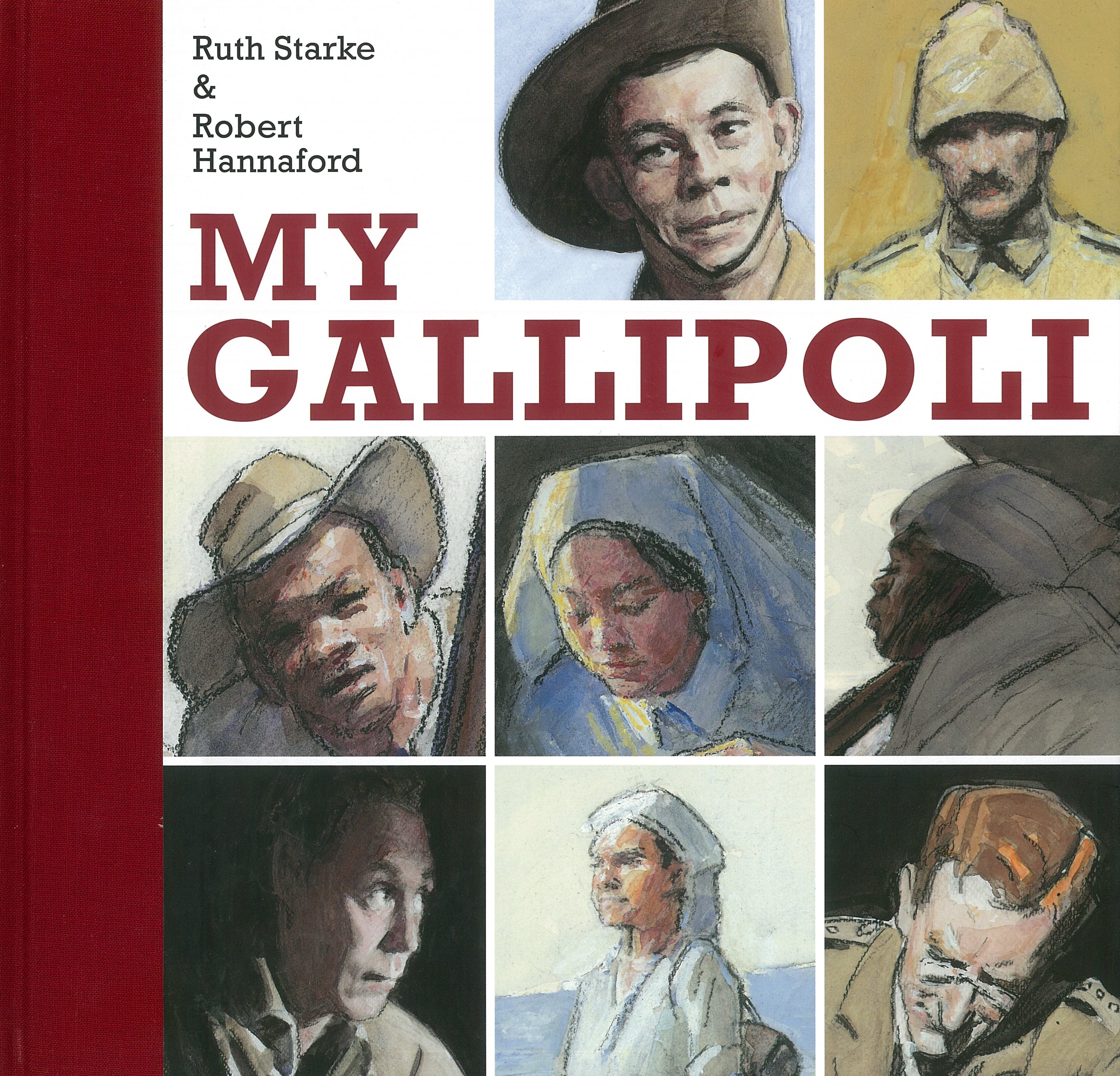
Book Cover:  My Gallipoli

Synopsis
From the shores of Anzac Cove to the heights of Chunuk Bair, from Cape Helles to Gurkha Bluff, the Gallipoli Peninsula was the place where thousands of men from sixteen nations fought, suffered, endured or died during the eight months of occupation in 1915. For each of them, their families and their nurses, Gallipoli meant something different. Their voices emerge from the landscape and across the decades with stories of courage, valour, despair and loss.” (Penguin Books website)

The title suggests that Gallipoli has some personal resonance for all of us, while the cover, with its portraits in individual squares, gives a clue to the way the story will be told inside. I like the way that it focuses on real historical characters, as well as nameless Anzac soldiers and Turkish people, and also includes women, stretcher bearers, the chaplain and indigenous soldiers.

I also like the fact that it doesn’t finish in December 1915, but shows the ongoing effects of the campaign, and what it might be like to revisit Gallipoli today. There are useful extra facts at the back and a map at the front. Each spread could be used as a springboard to find out lots more information.

Teachers’ notes are available here and include comments from both author and illustrator about the thinking, ideas and inspiration behind the book.

Reviews:
There are plenty of good reviews that will give you a idea of the book’s themes and potential readership. The Readings website says that "the rich panoply of voices in Ruth Starke’s text offers upper primary and lower secondary students a broad understanding of the Anzac Campaign and the current views of those engaged in the war as well as those at home." Other reviews appear in The Book Chook and Kids Book Review.

Questions:
Which page was the most surprising for you? Which one presented a viewpoint that you hadn’t thought of before?

Author’s website
Ruth Starke lives in Adelaide, South Australia, and has published more than 20 novels for young people. Before becoming an author, Ruth worked in public relations and travel marketing, and at a great variety of other jobs - of which the most interesting, she says, were selling French perfume in Harrods, cooking on the radio, taking tourists to Kashmir, and interviewing Grand Prix drivers. Ruth has also written “An Anzac tale,” a graphic novel about Gallipoli.

This is my favourite of “20 questions with Ruth” on her website:
What is the naughtiest thing you did?
Accidentally swallowed my best friend's brother's prize goldfish during a “dare”.

Info about the illustrator
This is Robert Hannaford’s gallery

In an interview in The Advertiser, he explains “How to paint a portrait” and says, “This is why I paint. I never get sick of it. Painting for me is a learning experience.”

NZ connections:
I’m pleased to see that  Ruth Starke, included a story told by a New Zealand soldier, “Private Andrew McBain” of the Auckland Mounted Rifles, and his mate Frankie, in the pages on Chunuk Bair.