Monday, 9 May 2016

Meet Weary Dunlop by Claire Saxby, illustrated by Jeremy Lord

Meet Weary Dunlop by Claire Saxby, illustrated by Jeremy Lord (Random House Australia, 2015)

32 pages with colour illustrations, map and timeline

Subjects: World War Two, Australia, Singapore, Thailand, Burma, Ernest Dunlop, prisoners of war, junior fiction (Year 5-8)

Synopsis
Thanks to Claire Saxby for kindly sending me a copy of her new book. This is one of a series about “the extraordinary men and women who have shaped Australia’s history”. Others in the Meet… series are Ned Kelly, Mary Mackillop, Captain Cook, Douglas Mawson, Nancy Bird Walton and Banjo Patterson (with more titles promised soon).

“Weary” Dunlop (his nickname is explained inside) was an Australian army surgeon in WW2. His bravery, compassion, knowledge and skill helped to save the lives and bolster the spirits of fellow POWs on the Thai-Burma railway.

About the author
Claire Saxby's website is here
I love her description of her early reading habits“I have always loved reading. I used to go home from boarding school and read for days on end, only emerging to swim and eat. I love words. I love how they sound, the work they do, the images they create.”

About the illustrator
This is Jeremy Lord’s website, with a page about this book (and some illustrations) here
He also has an online store (for his prints, often Aussie-themed) where he describes himself as “a French/Aussie, Sydney based illustrator.”
jlcom_illo_weary_pic004.jpg
From Jeremy Lord's website
Other books you might like
Meet the Anzacs, also by Claire Saxby, is another book in the same series.

NZ connections
Each year on 25 April, Anzac Day in Thailand is commemorated with a Dawn Service and Gunfire Breakfast at Hellfire Pass and a Memorial Service and Wreath Laying Ceremony at Kanchanaburi Allied War Cemetery.
People gather for Anzac Day in Hellfire Pass,  Kanchanaburi province, west of Bangkok, Thailand, on the route of the Thai-Burma railway.
People gather for Anzac Day in Hellfire Pass, Kanchanaburi province, Thailand,
on the route of the Thai-Burma railway. Photograph: Sakchai Lalit/AP
Things I didn’t know
What did I know about Sir (Ernest) Edward “Weary” Dunlop before reading this? Nothing! (So this book was a good place to start.) 

The Australian War Memorial bio says that "On 20 January 1943 he left Singapore for Thailand in charge of "Dunlop Force" to work on the Burma-Thailand railway. He remained there until the war ended, labouring tirelessly to save wounded, sick and malnourished men. Many times he put his own life at risk as he stood up to the brutality of his Japanese captors. Though not the only medical officer to act in this selfless way, his name was to become a legend among Australian prisoners of war and an inspiration for their own survival. Throughout his captivity and at great personal risk Dunlop recorded his experiences in his diaries."

After the war, he got married and continued both working as a surgeon and supporting former POWs of the Japanese. Over 10,000 people came to his state funeral in Melbourne in 1993 and portions of his ashes were later interred at Hellfire Pass and floated down the nearby river.

There is lots of info about him online – more here, including a video clip of the floating of his ashes which is a very moving scene.


Friday, 22 April 2016

Lest we forget by Feana Tu’akoi

A book for Anzac Day:

Lest we forget by Feana Tu’akoi, illustrated by Elspeth Alix Batt (Scholastic, 2011)

32 pages with pen and wash illustrations

Subjects: World War Two, Vietnam, Anzac Day, dawn parade, family, picture books (Year 2-5)


Synopsis
This story is unusual for a picture book about war, in that it spends a lot of time focusing on women and giving them a voice. Tyson doesn’t want to go along to the Anzac Day dawn parade because he thinks it’s all about glorifying war. But after talking with his mother, Nana and Great-gran, he starts to see another side of the story. On Anzac morning he gets up early after all and goes to the dawn parade with his mother and Koro, who was wounded in Vietnam, and together they recognise the importance of the day and remember those who have died in war.

The te reo Māori version was shortlisted in the SLANZA Te Kura Pounamu awards 2012 and the late Katerina Mataira won the Te Rōpū Whakahau award Te Tohu Pounamu 2012 for her translation.

There’s a family tree at the beginning, which is useful to flip back to until you have the family connections straight in your mind.

Reviews
Here's a review on the National Library Create readers site. 
You can also listen to the story on the RNZ Storytime treasure chest.

About the author
Feana Tu’akoi has written many stories and article for the educational market, as well as the What is a ///? non-fiction series.  She lives in Hamilton with her Tongan husband and their children. amiloton with her Tongan husband and their chidlrne. You can read more about her on the Book Council and Storylines sites.

Here’s an interesting interview with her on Paula Green’s Poetry Box website:
“I wrote Lest We Forget very quickly – in one sitting, in fact – although I did spend a lot of time editing and re-editing, until I was happy with it. I didn’t need to do any research, as it was a mixture of all the thoughts I’d ever had about ANZAC Day parades. The understanding that Tyson comes to during afternoon tea is the understanding I came to, after studying NZ history at university.”

There’s another interview, talking about why she wrote this book, on the My best friends arebooks blog: "We need to remember the past, so we can make better decisions in the future. I think that the next generation is smart enough to do just that. And that’s why I dedicated this book to my kids.”

About the illustrator
Elspeth Alix Batt has also done a lot of illustration work for the educational market, especially the School Journal

Other books you might like:
Grandad’s medals by Tracy Duncan, illustrated by Bruce Potter, My Grandad marches on Anzac Day by Catriona Hoy, Anzac Day parade by Glenda Kane

Have you read it?
Have you read this book? Let me know what you think!

Saturday, 2 April 2016

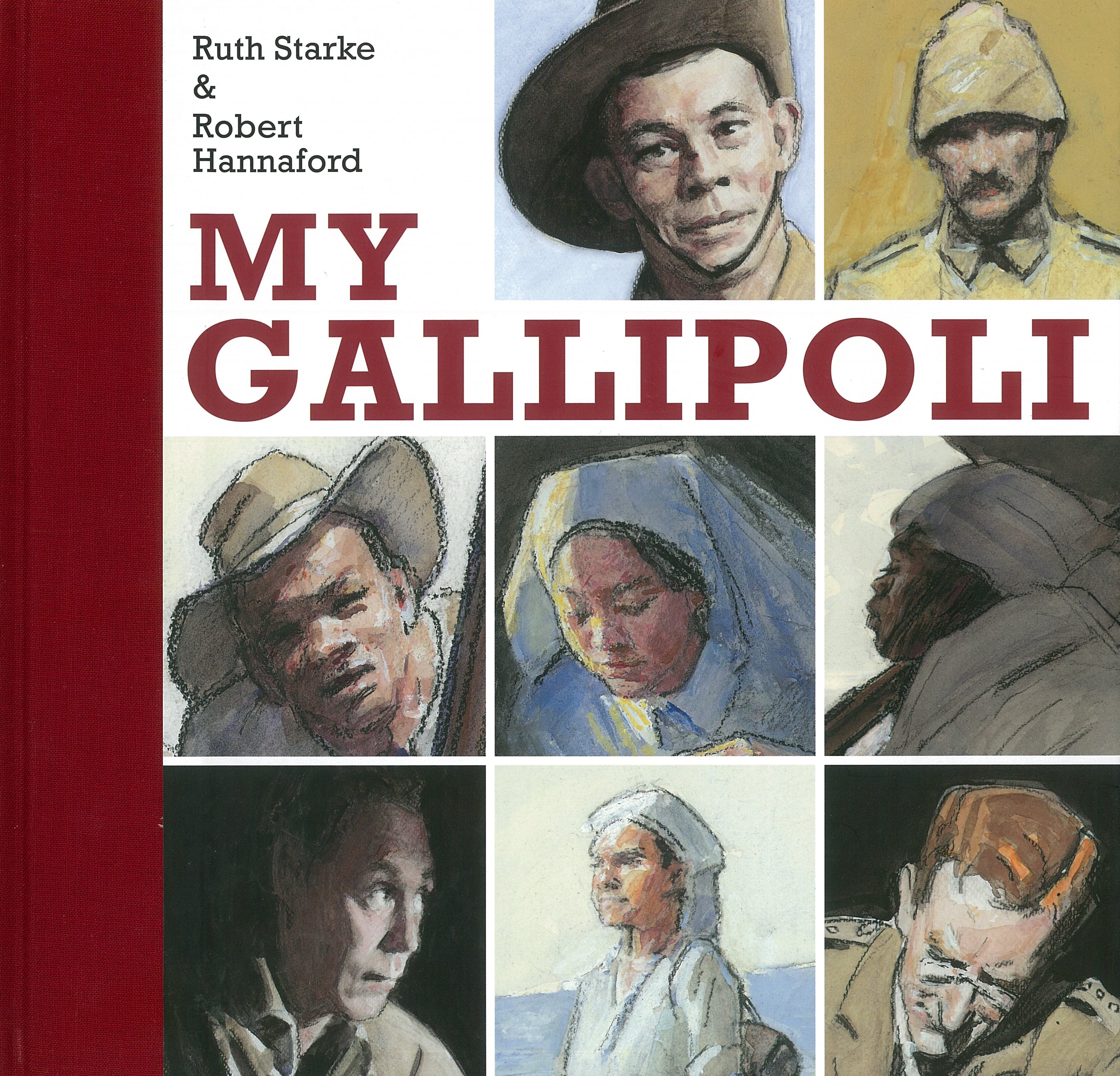
My Gallipoli by Ruth Starke, illustrated by Robert Hannaford

Anzac Day is only a few weeks away and so this book on people who were at at Gallipoli seems like a good one to review at this time. It also marks my 70th book review for this blog. 

My Gallipoli by Ruth Starke, illustrated by Robert Hannaford (Working Title Press, 2015)

32 pages with full page illustrations

Subjects: World War One, France, Australia, Turkey, nurses, chaplains, war correspondents, Charles Bean, war artists, George Lambert, snipers, Billy Sing, Ataturk, Mule Corps, war graves, Cyril Hughes, sophisticated picture books (Year 6-12)

Book Cover:  My Gallipoli

Synopsis
From the shores of Anzac Cove to the heights of Chunuk Bair, from Cape Helles to Gurkha Bluff, the Gallipoli Peninsula was the place where thousands of men from sixteen nations fought, suffered, endured or died during the eight months of occupation in 1915. For each of them, their families and their nurses, Gallipoli meant something different. Their voices emerge from the landscape and across the decades with stories of courage, valour, despair and loss.” (Penguin Books website)

The title suggests that Gallipoli has some personal resonance for all of us, while the cover, with its portraits in individual squares, gives a clue to the way the story will be told inside. I like the way that it focuses on real historical characters, as well as nameless Anzac soldiers and Turkish people, and also includes women, stretcher bearers, the chaplain and indigenous soldiers.

I also like the fact that it doesn’t finish in December 1915, but shows the ongoing effects of the campaign, and what it might be like to revisit Gallipoli today. There are useful extra facts at the back and a map at the front. Each spread could be used as a springboard to find out lots more information.

Teachers’ notes are available here and include comments from both author and illustrator about the thinking, ideas and inspiration behind the book.

Reviews:
There are plenty of good reviews that will give you a idea of the book’s themes and potential readership. The Readings website says that "the rich panoply of voices in Ruth Starke’s text offers upper primary and lower secondary students a broad understanding of the Anzac Campaign and the current views of those engaged in the war as well as those at home." Other reviews appear in The Book Chook and Kids Book Review.

Questions:
Which page was the most surprising for you? Which one presented a viewpoint that you hadn’t thought of before?

Author’s website
Ruth Starke lives in Adelaide, South Australia, and has published more than 20 novels for young people. Before becoming an author, Ruth worked in public relations and travel marketing, and at a great variety of other jobs - of which the most interesting, she says, were selling French perfume in Harrods, cooking on the radio, taking tourists to Kashmir, and interviewing Grand Prix drivers. Ruth has also written “An Anzac tale,” a graphic novel about Gallipoli.

This is my favourite of “20 questions with Ruth” on her website:
What is the naughtiest thing you did?
Accidentally swallowed my best friend's brother's prize goldfish during a “dare”.

Info about the illustrator
This is Robert Hannaford’s gallery

In an interview in The Advertiser, he explains “How to paint a portrait” and says, “This is why I paint. I never get sick of it. Painting for me is a learning experience.”

NZ connections:
I’m pleased to see that  Ruth Starke, included a story told by a New Zealand soldier, “Private Andrew McBain” of the Auckland Mounted Rifles, and his mate Frankie, in the pages on Chunuk Bair.

Friday, 18 March 2016

Sadako by Eleanor Coerr

This week my new book on Armistice Day is being launched, and it seemed a good time to review this book on Sadako and her work for peace. 

Sadako by Eleanor Coerr, illustrated by Ed Young (Margaret Hamilton Books, 1995)

45 pages with full-page colour illustrations

Subjects: World War Two, Japan, Hiroshima, nuclear war, bombs, family, picture books

A longer version for older children is called Sadako and the thousand paper cranes


Synopsis
Sadako Sasaki was just two years old when the atomic bomb was dropped over her home town, Hiroshima, in 1945. She was an ordinary little girl, surrounded by a loving family, and a keen runner. The story starts with her waking up in August 1954, excited about the Peace Day events at the Peace Park. In the evening, she writes the name of her grandmother who died in the bomb blast and launches it on the river where it floats along amidst rice-paper lanterns lit up by candles.

But when she was 11, Sadako started experiencing dizzy spells and was diagnosed with leukaemia, “the atom bomb disease”. By February 1955, she was in hospital.

One day, Sadako’s best friend Chizuko came to visit her in hospital. Chizuko brought paper and scissors and cut a piece of gold paper into a square. She folded it into a paper crane and told Sadako the old Japanese story about how anyone who folded 1000 cranes would be granted a wish. Sadako knew what her wish would be to get better, so she started folding paper cranes.

Sadako didn’t get her wish and she died a few months later, on 25 October 1955, ten years after the atomic bomb was dropped.  But her name lives on, thanks to her determination, her hope for peace and her wish for a better future, and her paper cranes have now become a symbol of peace. After she died, Japanese children helped to raise money for the Children’s Peace Memorial which now stands in the Hiroshima Peace Memorial Park, with a statue of Sadako on the top, often surrounded and decorated by thousands of paper cranes from all around the world. At the base is written: “This is our cry, this is our prayer. Peace in the world”.

There is a lovely photo of Sadako and one of her paper cranes here

You can read more here about some of the original paper cranes, kept by her brother. 

Reviews:
This review on  The children's war has a picture of Sadako with her relay team and calls it an “a perfect book for introducing this difficult topic to young readers. There are no detailed graphic images described about the war, the bomb or even to after effects, only an acknowledgement of these things. There is some controversy over whether or not Sadako actually did finish folding 1,000 cranes. Regardless of whether she did or didn't, there is much to be learned from Sadako's story.

Sadako, in the middle of the front row, with her relay team

About the author
This is a nice start to Eleanor Cooer's bio on the Penguin website: “Eleanor Coerr was born in Kamsack, Saskatchewan, Canada, and grew up in Saskatoon. Two of her favorite childhood hobbies were reading and making up stories.” It also describes how her fascination with Japan began as a child, her first visit to Japan – and to Hiroshima - as a young reporter, and how she finally managed to get hold of a copy of Sadako’s autobiography, Kokeshi. so she could start writing her own book.

She died in  2010 and you can read her obituary here

About the illustrator
Ed Young was born in China and later moved to Hong Kong, then went to the United States on a student visa to study architecture, but became an artist instead.  He says he draws inspiration from the philosophy of Chinese painting: “There are things that words do that pictures never can, and likewise, there are images that words can never describe.”

Other books you might like:
Hiroshima no pika, written and illustrated by Toshi Maruki, also tells the story of the day the bomb fell. 

How to make paper cranes
You can learn how to make your own paper cranes here
Or here (with an address for where to send them). 
Or here (also with an address). 

Links
You can learn more about Sadako at the Kids Peace Station, Hiroshima.

Tuesday, 1 March 2016

Five children on the Western Front by Kate Saunders

Five children on the Western Front by Kate Saunders (Faber & Faber, 2014)

24 chapters; 318 pages

Subjects: World War One, France, England, children, fantasy, Edith Nesbit, Five children and it, Psammead, junior fiction (Year 5-8)


Synopsis
This book came out to much acclaim as “an epic, heart-wrenching follow-on from E. Nesbit’s Five children and It stories” (from the back cover) and won the Costa Children’s Book of the Year award.

Five Children and It was published in 1902, with two sequels: The phoenix and the carpet (1904) and The story of the amulet (1906). I read them all as a child and loved them, although I haven’t looked at them again for a long time and I’m not sure if they are as widely read today.

In the Prologue (set in 1905, and adapted from a chapter of The story of the amulet), Cyril is 12, Anthea 11, Robert 9, Jane 7 and the (youngest child) Lamb – actually Hilary – is still a baby. By the start of WW1 in 1914, they are old enough, in some cases, to go off and fight, or volunteer as a VAD (Voluntary Aid Detachment) .

Because Cyril and Anthea are almost grown up and often away, Kate Saunders adds another child (Edie, aged 9) and she and the Lamb/Hilary, now 11, become the main characters. The two of them rediscover the Psammead (a grumpy, wish-granting sand fairy - “you pronounce it Sammy-ad”) and he stays with them for almost the duration of the war. The story gets sadder and the mood more sombre as it gets closer to the end.

The idea behind the book – bringing these children from their Edwardian childhood into the horrors of WW1 – is very clever. I did wonder if the theme of the  Psammead’s “repentance” could be confusing for children.

Reviews:
The Guardian calls it a “respectful homage” and says that “transplanting E Nesbit’s much-loved characters into the trenches tugs at the heartstrings in a way statistics can’t”.

“For all Saunders's delight in channelling Nesbit's Edwardian sensibilities, this is not a nostalgic book. It asks questions about lost innocence and the kind of stories we used to tell ourselves. Saunders dedicates her book "To all the boys and girls, 1914-18". Nesbit described her characters as "not bad sorts on the whole; in fact, they were rather like you". The same can be said, Saunders implies, about the doomed generation that met its fate in Flanders fields.”

About the author
In this interview in the Telegraph, Kate Saunders talks about events in her own life that background the story; some of it is very moving, and it made me think about the book in a different way.

There’s another interview with her here on BBC news.

About E Nesbit
The Edith Nesbit Society has its own website where you can read sedate biography of Edith Nesbit (1858-1924). 

But this article in the Guardian paints a rather racier (and sadder) picture of her life.

Other books you might like:
Edith Nesbit also wrote the much-loved classic The railway children, published in 1906 and never out of print since.  

Thursday, 11 February 2016

Where poppies grow by Linda Granfield

Where poppies grow: a World War I companion by Linda Granfield (Stoddart, 2001)

48 pages with numerous illustrations

Subjects: World War One, Canada, Flanders, animals, non fiction (Years 5-8)


Synopsis
This is a non-fiction book giving an overview of World War One. There are other similar books, but this one tells the story from a Canadian perspective. Many of the images, letters and photos were new to me because they are sourced from Canadian records and archives. Some of them, such as the postcards, seem to come from the author’s own collection (according to the picture credits).

In many ways, the Canadian experience was similar (with the exception of the Gallipoli campaign) to that of the Anzacs:  training camps at home, sailing across to Europe, more training in England, then across the Channel to Flanders and the trenches.

Some of the images that particularly caught my attention show “Canadian recruits undergoing training at Salisbury” (stabbing with bayonets at hanging bales of straw; hardly the same as the real thing), fresh bread being baked at the field bakery, cinema tickets for a West End Cinema Theatre offering free entry to wounded soldiers and sailors, ships being painted in “dazzle” camouflage and the Poppies poem “In Flanders fields”, written by Canadian medical officer John McCrae.   

Other topics include nurses, propaganda, a child’s war and letters and postcards. The section on animals features the black bear cub Winnie, a mascot later donated to the London Zoo where a young Christopher Milne saw him, went home and christened his own teddy bear “Winnie the Pooh”.
You can read more about Winnie here and here.

Author’s website
Linda Granfield’s website includes a section on books on war and remembrance. She has written about John McCrae whose poem “In Flanders fields” is 100 years old in May 2015, and about The unknown soldier all around the  world. 

"When I write non-fiction books, and you read them, we become time-travellers," she says.  
"History is all around us, inviting us to share our own family and community stories."

Find out more about her here.

Other books you might like:
Archie’s war by Marcia Williams is fiction, but told in a similar scrapbook style.

Things I didn’t know
I didn't know about the church of Notre Dame de Brebières (Our Lady of the Ewes) in the town of Albert, France, although I came across another reference to it just after reading this book. The statue of Mary and Jesus on top of the church was knocked sideways in 1915 by a shell bombardment. A legend developed that when it fell completely, the war would be over. 
In spring 1918, the Germans captured the town and the statue fell (but has since been restored); later that year, the war ended.
The other reference I came across mentioned that passing Australian soldiers would joke that it reminded them of the famous Australian swimmer, Fanny Durack.

Sunday, 31 January 2016

Ghost soldier by Theresa Breslin

Ghost soldier by Theresa Breslin (Doubleday, 2014)

33 chapters; 291 pages (but fairly large print)

Subjects: World War One, England, Borders, Scotland, trains, animals, dogs, hospitals, junior fiction (Year 5-8)


Synopsis
The author’s website calls this “a mystery plus detective story with poignant scenes as two children, in a desperate search for their ‘missing-in-action’ father, meet the staff and wounded men on the hospital trains that stop near their farm”. The mystery/detective element is related to strange goings-on in an old house in the woods, a suspected German spy and a shadowy ghost figure in an upstairs window.

I liked the relationship between brother and sister Rob and Millie; the focus on how those at home coped – or didn’t cope - while the husbands and fathers were away at war, and the details about how dogs could be taken away by the army (which is why they try to save their puppy, and how they end up hiding it at the old house in the woods). Thousands of dogs were needed in the war so many families must have had to give theirs up, willingly or not. The story of the ambulance trains was interesting, too, although I was never clear about whether they did or didn’t try to take injured soldiers to a hospital near their home.

I found some of the action a bit hard to believe; either too many coincidences, or too unlikely (would they really have let the children on board the train? would they have let the wounded soldier wander round the grounds so freely at night?) but this post by the author about her research suggests that the ambulance trains did stop in the countryside like this.

Reviews:
In this review, Theresa Breslin said she started writing the book because she “was asked to provide a story for a film company and this was a story I felt needed to be told”. So I wonder if that means there is a film underway?

Author’s website
I didn’t know anything about Theresa Breslin before I read her book Remembrance, but according to her website, she was born and brought up in a small town in Scotland, worked as a mobile librarian, has written over 30 books for children and young adults and won the Carnegie Medal for Whispers in the graveyard (1994) about a dyslexic boy. Her website also provides teaching notes for the book. 

Other books you might like:
Remembrance is another book about World War One by Theresa Breslin, but for older readers.
The Anzac puppy by Peter Millett and Trish Bowles is written for younger readers about a dog in war time.

Things I didn’t know
The details about blood transfusion are intriguing. Today we take blood banks for granted but back in WW1 they were still figuring out the science of blood groups and anticoagulants. 
You can read about "A brief history of blood transfusion" at the Institute of Biomedical Science, or find out more at the Science Museum