Sunday, 10 August 2014

So far from the sea by Eve Bunting

So far from the sea by Eve Bunting, illustrated by Chris K. Soentpiet (Sandpiper, 1998)

ISBN 978-0-395-72095-0

32 pages with black and white and colour illustrations

Subjects: World War Two, Japan, USA, family, internees, junior fiction (Year 5-8)

Synopsis
Laura Iwasaki and her little brother Thomas are in the car, driving to visit her grandfather’s grave. Their family is moving from California to Boston, so this may be their last visit for some time. They are all huddled up in warm clothes, it is February, and bitterly cold. From their sad and solemn faces, we realise this is a difficult trip for them to make.

The cemetery is in the middle of a deserted, sandy site that was once bustling with people. Gradually we find out that Laura’s grandparents and her father, as a small boy, were among the thousands of Americans with a Japanese background who were taken to internment camps in World War Two. Her grandfather, a tuna fisherman, hated being so far from the sea and in the end he died in the camp, at Manzanar.

The writing is simple but evocative and some of the descriptions are very effective: “The road is straight and endless. Crows strut in the stubbly fields.”

The illustrations vary page by page, from black and white –for the scenes in the camp during the 1940s – to colour, for the family’s farewell visit more than thirty years later, in the 1970s. The picture of the offerings left at the monument – “origami birds, their wings trapped under little rocks” and “crumbs of a rice cake” – is especially moving. So too is the picture of Laura’s father as a boy, dressed in his American Cub Scout uniform, saluting the soldiers who have come to take him and his parents away.

Reviews:
This review in Publishers weekly describes how "the artist's watercolors recreate two vastly different settings, evoking the tense 1940s scenarios in black and white and the serene yet wistful 1970s setting in bright color" and calls it "an exceptionally effective collaboration."  

Author’s website
Eve Bunting was born in Ireland but emigrated to the USA with her husband and three small children and has since written more than 200 books for children. Her first book, written after she took a creative writing course, was a retelling of an Irish folk tale. Her books often deal with the experiences of immigrants or with difficult issues such as race riots or homelessness.

In this biography of Eve Bunting, she says “One of my greatest joys is writing picture books. I have discovered the pleasures of telling a story of happiness or sorrow in a few simple words. I like to write picture books that make young people ponder, that encourage them to ask questions. 'Why did that happen, Mom? Could it happen again? Can't we help? What can we do?' One child wrote to tell me that one of my books had won the Heal the World award at her school. It is among the most cherished honors I have ever received and the plaque hangs proudly above my desk."


There is a video interview with her here.

And this is her talking about how her father used to read to her as a child:
"You know, it rains a lot in Ireland, and lots of times we'd sit in the house by the big turf fire. And he would take me on his lap and read to me. He would stop now and then when it would maybe be a little difficult. And he would say, "Now, my darlin', do ya understand that? What's the poet trying to say?" And we would talk about it."

About the illustrator
Chris K.Soentpiet was born in south Korea. When he was eight, he and his sister were adopted by the Soentpiet family and they moved to Hawaii. His website includes teacher’s lesson plans for this book. 

Other books you might like:
I only just realised from reading this interview that Eve Bunting wrote another book that my children enjoyed: Spying on Miss Müller. “The main character, Jessie, is a thinly disguised Eve attending boarding school in Ireland during World War II.”

Summer of my German soldier by Bette Greene is a book for older readers about the German Prisoner of War camps set up in America in World War Two. 

Things I didn’t know
I had never heard of Manzanar (Spanish for “apple orchard”) which is now a national historic site in California. It was one of ten war relocation centres, built to house 120,000 men, women and children of Japanese ancestry who were living in the USA when Japan bombed Pearl Harbor on 7 December 1941, thus bringing the USA into World War Two.  

These Japanese Americans were given only days to sort out their houses, farms, businesses and possessions before they were moved to the camps. Two thirds of the internees at Manzanar were under 18 years of age and 541 babies were born there. Manzanar was in the desert so it was very hot in summer, freezing cold in winter, with fierce winds that blew dust everywhere.

New Zealand links
Parallels in this country (where internees were held in the war) would be Matiu/Somes Island in Wellington harbour and Motuihe island in the Hauraki Gulf.

Camp on Somes Island [ca 1910s]. Reference number: 1/2-038622-F. Permission of the Alexander Turnbull Library, Wellington, New Zealand, must be obtained before any re-use of this image.
Camp on Matiu/Somes Island 
during WWI


Saturday, 2 August 2014

When our Jack went to war by Sandy McKay

When our Jack went to war by Sandy McKay (Longacre, 2013)

ISBN 978 1 77553 309 2

192 pages

Subjects: World War One, France, Belgium, England, letters, Messines, Ypres, junior fiction (Year 5-8)


Synopsis
When our Jack went to war is described on the title page as “a fictional story based on a real-life event”. It is dedicated to “Private John McIntosh, 27553, 2nd Battalion Otago Regiment, NZEF” who was the author’s great uncle, killed in action in 1917.

In Sandy McKay’s story, her great uncle John becomes the “Jack” of the title, and the narrator is his younger brother Tom, who is twelve when Jack leaves his carpenter’s apprenticeship and signs up in 1916. Many of Jack’s friends sign up at the same time: Ted, Cyril, Stuart, Billy. The rest of the family consists of their mother and Tom’s younger sister Amy; their father had died a year or two earlier, soon after the war began. 

The story is told in Tom’s voice, interspersed with Jack’s letters and (real) newspaper clippings and other notices. Jack’s first letters are from Trentham Training Camp; then from the troop ship on the way to England, Sling Camp on Salisbury Plain, a trip on leave to London and Scotland and finally the trenches of the Western Front. He is wounded and sent to recover at a hospital in England, but then goes back to the front line again. Meanwhile Tom’s letters tell about his own school and home life.

The newspaper clippings include descriptions of the battles (not always the same as Jack’s descriptions), casualty lists and articles about conscientious objectors. Headlines give glimpses into little known aspects of the war at home; stories like “Disloyal utterance – indiscretion in railway carriage” (a man who made use of “language calculated to interfere with recruiting” by claiming “a man is a *** fool for going to the front”), “Drawing of first ballot” (for conscription)  or “Refusing to parade” (a man who was a Quaker, and “objected to service” as a conscientious objector.)

The dialogue, slang and domestic details of the time ring true (Jack’s letters are kept “in a biscuit tin on the shelf in the kitchen, right next to the hook for his nail bag”.) At the end is a factual section titled What do you know about the First World War?

Reviews:
You can read a review of the book on Bobs books blog. Bob says: "The last 15 pages will wrench your heart out."

Teaching notes are also available here and include a great set of suggestions for creative or research responses.  

Author’s website
Sandy McKay's website is here. 

You can also read about her on the NZ Book Council site and the Christchurch City Libraries Interviews with NZ children's authors. 

New Zealand connections:

In the acknowledgements, Sandy McKay makes special mention of the Papers Past website of the National Library. This really is an amazing resource. At present it covers from 1839 to 1945, and includes 90 publications from all over the country, but more newspapers - and newspaper issues - are being added all the time. 

Tuesday, 8 July 2014

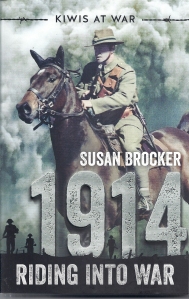
1914: Riding into war by Susan Brocker

1914: Riding into war by Susan Brocker (Scholastic, 2014)

ISBN 978-1-77543-206-7

216 pages with some notes and photos at the end

Subjects: World War One, Egypt, Gallipoli, Mounted Rifles, horses, young adult fiction (Year 8-11)

riding into war

Synopsis
The first thing you notice about this book is the striking cover, with the large embossed “1914”, the barbed wire pattern and the dramatic picture, which immediately tells you that horses are going to play a big part in this story. 

Seventeen-year-old Billy Bowman is old enough to be working on a farm, but young enough to be nicknamed “Billy the Kid” by the older farmworkers, who scoff at the idea of him signing up with the rest of them when war is declared in August 1914. But Billy’s mate Jack reckons “the enlistment age is just for city slickers who can’t ride or shoot”, and they are country boys who can do both. Sure enough, Billy is accepted by the recruitment officer – as long as his parents agree – and soon he and Jack are off with their horses to join the Mounted Rifles at the Awapuni Training Camp near Palmerston North.

The story of how the New Zealand troops got to war is sometimes overshadowed by the events that followed, but is fascinating in itself: the farewell dances, the weeks of training and drills, more farewells at the wharves, the long sea voyages (with the added difficultly here of keeping the horses in good shape), the exotic stopovers, the passage through the Suez Canal and the final arrival in Egypt. This section takes up about a third of the book and the details about caring for the horses on board are especially convincing.

Once in Egypt, there are more weeks of training in the desert before they are sent to Gallipoli - without their horses - after the first landings in April, but in time for the battle of Chunuk Bair in August 1915. The author manages to fit a lot of details about the Gallipoli campaign: the May armistice to bury the bodies, the torpedoing of the British battleship Triumph, the jam pot grenades, the periscope rifles, the awful food. These books are aimed at readers from 12+ but the language is mild with no expletives worse than “Jeez”. 

The focus is kept tightly on Billy, his mate Jack and their nemesis Chopper (“a tall, heavy-set man in his late twenties”, who calls him “Billy Boy” and “a little squirt”.) Other soldiers are there in the background but are seldom named. Billy exchanges letters with Alice, the daughter of the farm owner, although as the months go by, he finds there is more and more that he can’t tell her.

There is a map at the front – very important for tracing the troops' journey to Egypt and beyond (school visits have showed me that children might know about the Anzac landings at Gallipoli, but often don’t know where Gallipoli is – their guesses range from Germany to Russia.) The book also includes a timeline, glossary and bibliography at the back. (I looked for, but couldn’t find any details of the cover art on the front and back covers.)

Kiwis at War
This is the first title in Scholastic’s new Kiwis at War series, which will eventually consist of five books based on events for each year of World War One. (The events in this book carry over into 1915, which is understandable, given that the troops didn’t leave New Zealand until October 1914.) The other books in the series – each to be released in their centenary year - will be written by Diana Menefy (1915), David Hair (1916), Brian Falkner (1917) and Des Hunt (1918).

One of the interesting features about this series is that, while individually written (and perfectly readable as standalone texts), the five titles will be linked by characters who appear in more than one book. I love the idea of this collaboration amongst the authors, each working on their own story but also finding ways to create connections between them.

Susan’s book is to be launched on August 4th (exactly 100 years after the declaration of war), and the launch for each of the other books will also be tied in to a significant date. I’m looking forward to reading them, and to seeing if my guess about the “link” character in this book is correct.


Author’s website
On Susan Brocker's website, she says: “My favourite books are stories I’ve written about my favourite things, such as horses, dogs and animals of all sorts. I also love bringing history alive and making it exciting – and sometimes the two come together in novels like The Drover’s Quest and Brave Bess.”

This book is another example of the two things coming together. I can’t think of a better person to have chosen to write this story. Susan’s knowledge of history, her love of horses and her understanding of their needs and and personalities all come through clearly on every page.

Susan also has a Facebook author page, and you can read more about her on the Bookrapt site and the Storylines site. There is also an interview with her on the wonderful Christchurch City Libraries section on Interviews with NZ authors. 


Other books you might like:
If you like this book, you are sure to enjoy reading others that Susan has written. Brave Bess and the ANZAC horses (Harper Collins, 2010) is subtitled “a true story of courage and loyalty” – the qualities shown by the thousands of horses that were sent overseas with the New Zealand troops to face heat, stress, thirst, hunger, exhaustion, disease and injury in the deserts of the Middle East. Dreams of Warriors (Harper Collins, 2010), set in Featherston in World War Two, features fourteen-year-old Bella, who is trying to help save their family farm while her father is away at war, and also coping with a crazy bad-tempered horse called Gipsy. 

The horses didn’t come home by Pamela Rushby tells the story of Harry and his friend Jack, both aged 16, who set off for war with the Australian Light Horse and end up taking part in the last great cavalry charge in history, at Beersheba in the Sinai Desert in 1917.

Light Horse Boy by Dianne Wolfer follows Jim, a young Australian who works as a farrier (someone who trims and shoes horses’ hooves) and his best mate Charlie, who also sail for Egypt, camp in the desert and visit the pyramids; they are sent to Gallipoli (without their horses) and later, back in Egypt, Jim takes part in the battles of the Desert Campaign.

James Bayne's World War One diary
While looking for photos of the Mounted Rifles, I came across this diary which is held by the Alexander Turnbull Library and part of the WW1 digitisation project. 

Bayne, James, d 1915 : World War One diary
Bayne, James, d 1915 : World War One diary. Ref: MS-Papers-1418. Alexander Turnbull Library, Wellington, New Zealand. http://natlib.govt.nz/records/23160459
Like many other WW1 soldiers, James Bayne kept a diary; his runs from 10 Aug 1914 to 8 May 1915, and describes many of the same events that Billy and Jack experience, although he served with the Wellington Infantry Battalion, not the Mounted Rifles. James enlisted at Dannevirke, was sent to Awapuni Camp for military training and embarked for Egypt in October 1914. He describes life on board ship and the stopover at Colombo (in modern day Sri Lanka), the arrival in Alexandria, more training at Zeitoun Camp and the "Battle of the Wozzer" in April 1915. After taking part in the first landings at Anzac Cove, he was sent to fight at Cape Helles in the south of the peninsula in May 1915, and that is where he died.

If you scroll down to and click on "See original record", then scroll down to and click on "View archived copy online", you can read every page of his diary, which is a strange and sombre experience - a bit like being in Gallipoli itself, where you often feel like you are trying to match up the past with the present. 


Thursday, 3 July 2014

The snow goose by Paul Gallico, illustrated by Peter Scott

The snow goose by Paul Gallico, illustrated by Peter Scott (Michael Joseph, 1946)

10 chapters; 55 pages with colour and black and white illustrations

Subjects: World War Two, France, Dunkirk, birds, fable, boats, young adult fiction (Year 9-13)


Synopsis
I’m not sure if this counts as a children’s book, but it doesn’t really fall into any other category that I can think of, and some older children would definitely enjoy it. Apparently (according to Wikipedia), it was “first published in 1940 as a short story in The Saturday Evening Post, then … expanded … to create a short novella which was first published on April 7, 1941.”

The book covers the decade from 1930 to 1940. It is set on an abandoned lighthouse on the remote Essex marches and tells the story of Philip Rhayader, a hunchbacked reclusive painter and Fritha, a young girl from the nearby fishing village. The two of them are linked in friendship and, later, unspoken love by the snow goose of the title, until Philip sails away to help in the evacuation of British troops from the beaches of Dunkirk in late May 1940. What happens to him can only be guessed by Fritha, but is told in snatches of overheard dialogue by by soldiers and naval officers.

When I went to borrow a copy from the library, I had to ask a librarian to retrieve it from the YA Fiction Nostalgia section out the back. (I didn’t even know there was such a section.) And the loveliest thing happened, which was when I gave her the title, she said. “I’m named after that book.” Her name was Fritha.

Fritha (in the library) told me about a 1970s BBC film of The snow goose, starring Richard Harris (aka Dumbledore in Harry Potter) and Jenny Agutter (from The railway children.) She said it’s hard to track down, but can be viewed on Youtube, and here it is (I'm going to watch it, and it looks wonderful.) 

The original 1940 copy of The Snow Goose, as it appeared in The Saturday Evening Post is now available online.


Reviews:
If you’ve read this book, you will know it is a sad, melancholic, haunting tale. Some contemporary reviewers called the book sentimental, but it achieved near classic status almost at once and Michael Morpurgo cites it as an influence on his book War Horse.

Winter reads in The Guardian calls it a wartime classic, “a novella no thicker than a love letter, in which every sentence seems to shiver with the salt-laden chill of the desolate landscape in which it is set.” The reviewer made me think of my Fritha-in-the-library. She says, “My mother loved the story so much she wanted to call me Fritha, after the untamed Anglo-Saxon heroine. And growing up I would think of that other girl I might have been if only my resolutely unsentimental father had not intervened.”

The Guardian also put it on its list of 1000 Novels You Must Read. 


(1000 novels is a lot of reading! If you are feeling brave, here is a link to the compete list.)

Another review says it is "a moving story about love and courage, with an ending that is unforgettable."

About the author
Paul Gallico (1897 – 1976) was an American writer whose name is not often heard these days, but he used to be popular. His other well-known stories include The small miracle, about a little boy and his beloved donkey,  Thomasina (filmed by Walt Disney) and The Poseidon adventure, about a cruise ship sinking, which was also made into a movie.

About the illustrator
The Nostalgic library copy was the 1946 edition with illustrations by Peter Scott, which we had at home when I was growing up. Peter Scott (1909-1989) was the son of Antarctic explorer Sir Robert Falcon Scott, who died when he was only two years old. Famously, Scott left instructions for his wife that she should "Make the boy interested in natural history; it is better than games. Make him a strenuous man". 

Peter Scott became a naval officer in WW2, and was also a famous painter, ornithologist and conservationist, who founded the Wildlife and Wetlands Trust at Slimbridge on the Severn River estuary in Gloucester. 

According to Wikipedia (again) he used his first wife Elizabeth Jane Howard as the model for Fritha – another fascinating sidebar, as I’m currently reading her wartime chronicles of the Cazalet family.  EJH was about 15 years younger than him, and had striking good looks; their marriage ended in divorce, and she later married Kingsley Amis; she died in January 2014, aged 90.

You can read more about Peter Scott's life here and here.  

I never knew this and it's fascinating:
According to a story in the Telegraph in 2010, a disused lighthouse at Sutton Bridge on the Norfolk Wash provided the inspiration for the setting of this book. Peter Scott rented it for £5 a year in the 1930s, and was visited every year by a pink-footed goose that he called Annabel. Gallico, who was a friend of his, transformed the timing (to wartime), the setting (to Essex) and the bird (to a snow goose.) The story is told in more detail on the website of Sutton Bridge village.   

Peter Scott in front of the East Lighthouse
Peter Scott in front of the East Bank Lighthouse 
If you visit the area, you can go on the Peter Scott walk, which follows the old sea bank along the Wash from King's Lynn, to the Peter Scott lighthouse at Sutton Bridge. 

Other books you might like
The dolphin crossing by Jill Paton Walsh tells the story of two school boys who take a small boat across the Channel to help in the evacuation of Dunkirk. 

The story of Dunkirk
The evacuation from Dunkirk took place over ten days from late May to early June 1940, and ten days later, German troops entered Paris. It's true that hundreds of small boats sailed across the Channel to help take men off the beaches. You can read more about Dunkirk here and listen to Voices from Dunkirk in the words of eight survivors here. 

You can also see some images of the evacuation on the Imperial War Museum site. 


Thursday, 19 June 2014

Rose under fire by Elizabeth Wein

Rose under fire by Elizabeth Wein (Hyperion, 2013)

ISBN 978-142318309-9

360 pages


Subjects: World War Two, France, Resistance, pilots, women in war, concentration camps, Ravensbrück, Nuremburg, young adult fiction (Years 10-13)


Synopsis
It’s August, 1944. Rose Moyer Justice, aged 18, from a Pennsylvania Dutch family in the United States, has come to England to work for the British Air Transport Auxiliary. Rose’s family is obviously wealthy and she learnt to fly at the age of 12, so she is quite confident delivering planes to bases all over the country. 

Rose is keen to fly to France as well, and gets permission to do so a few days after Paris has been freed in September 1944 but her return flight goes wrong when she is captured in the air by German planes and made to land at an airfield in Germany. From there, she is taken to Ravensbrück concentration camp where she is registered as a French political prisoner, despite having an American passport.

Rose makes friends at the camp, including Irina, a Russian pilot, and a young Polish girl called Roza, one of the group known as Rabbits who have been used for medical experiments by the Nazis. Everyone is treated badly in the camp, but the women are determined that the story of the brutality meted out to the Rabbits should reach the outside world. Rose, an aspiring poet, comforts them with poems by her favourite writer, Edna St Vincent Millay, and also makes up a poem to remember their names. She doesn’t let on that she has already heard reports about their treatment on the wireless and dismissed them as propaganda.

There is little let-up from the grim scenes at the camp, which take up 200 of the 360 pages. The events and living conditions are not dwelt on gratuitously, but they are still stomach-churning if you stop to think of the implications or to imagine the reality. Readers who only know of the camps from Anne Frank’s diary – which stops, of course, before she arrives there – will find this a very different, and possibly difficult reading experience.

The story of how Rose readjusts to outside life takes up the last section of the book (which is where the Nuremburg Trials come into it.) In some ways, this widens the scope of the book as it relates to how anyone who has been through trauma comes to terms with it.

Rose Under Fire UK

Reviews:
This review on Gossamer obsessions calls it "definitely a darker, bleaker novel than Verity." The review does raise the point - which I was aware of as I read - that the diary nature of the book works “for and against” it. Rose can’t keep a diary in Ravensbrück (or it would have stretched credibility if she had been able to write one in sufficient detail and smuggle it out  as well) so that portion of the story is written while she is staying in a hotel in Paris after her release. But that means we realise she has escaped to safety, which takes away some of the tension of the events described. The only (slight) tension left is that we know something about her boyfriend, Nick, that she doesn’t yet know. Rose has lost touch with her concentration camp friends, but we expect she will find them again.

The Los Angeles times called the book "a soaring tale of triumph." 

Author’s website
Elizabeth Wein has written books set in Arthurian Britain and sixth century Ethiopia. Code name Verity is about a female pilot who is captured in France; her story is mentioned in Rose under fire, because the character of Maddie connects the two pilots.

There is an interview with Elizabeth Wein here on the girls like giants blog. 
And it’s also interesting to note that she is a pilot herself.

From another interview in the Vancouver Sun:
Q Why did you write this book?
A I think that the dark underbelly of women’s wartime roles is fascinating. My previous novel, Code Name Verity, takes an inside look at the dangerous and dirty work that women did as spies and saboteurs for resistance movements in Nazi occupied Europe. Rose Under Fire more or less continues the story of these women — about a third of those sent into occupied France ended their lives as prisoners in concentration camps. I was particularly fascinated with Ravensbrück because it was a camp specifically for women. It was operated differently from other camps; its history is not well known and is worth knowing.

Other books you might like:
There must be very few books written about women in concentration camps, compared to the large number of books about men in that situation. The books that spring to mind are escape stories, like The great escape, so they are more “heroic” in nature, and perhaps it was simply impossible for women to even try to escape – how would they have survived outside?

NZ connections:
You can read my review of Code name Verity for more details about the Air Transport Auxiliary, including a brief profile of Jane Winstone, one of the few NZers in the ATA.

Things I didn’t know
It’s a side issue, but I didn’t know that the emigrants who settled in Pennsylvania Dutch Country in the USA (incl the Amish) weren’t named because they were Dutch, but because of the dialect of the language they spoke. They came from a number of German-speaking areas in Europe, such as Alsace in France, Switzerland and Germany. This adds an extra layer of irony of the story, in that Rose is being held captive in the land where her family came from.

If you want to, you can read more about the Nuremburg Trial or the Polish Rabbits, but some of this material is confronting.  

Ravensbrück is now a museum. More than 132,000 women and children from twenty-three countries passed through this concentration camp…At least 92,000 of them perished. They were gassed, shot, beaten and starved to death; or they died from sadistic medical experiments or exposure or dis­ease or exhaustion, or just be­cause they gave up trying to survive. 

A low stone wall newly built by the lakeside bears a chiseled inscription in German by the East German writer Anna Seghers. It reads: “The women of Ravensbrück are the mothers and sisters of us all. You would not have been able to learn and play in liberty—indeed you might even not have been born—if women like these had not placed their delicate, weak bodies as a steel shield before you and your future.”

A work team in Ravensbrück
[​IMG]


One of those who died Ravensbrück was Violette Szabo, the legendary SOE special agent. There is a poignant story about her training when she was trying to commit a poem to memory (this was a device to help code messages, using words from the poem. ) It was best not to choose well known poems in case the enemy could recognise them, and it was important to get the words and the spelling of the chosen poem exactly right.  Violette kept making mistakes until the SOE codemaster, Leo Marks, gave her a new poem to learn. It was simple but memorable and it worked for Violette. Leo Marks had written the poem himself after the woman he loved had been killed in a plane crash. 

The life that I have
Is all that I have
And the life that I have
Is yours

The love that I have
Of the life that I have
Is yours and yours and yours

A sleep I shall have
A rest I shall have
Yet death will be but a pause

For the peace of my years
In the long green grass
Will be yours and yours
And yours