Showing posts with label Gallipoli. Show all posts

Sunday, 2 April 2017

A day to remember: the story of Anzac Day by Jackie French, illustrated by Mark Wilson

A day to remember: the story of Anzac Day by Jackie French, illustrated by Mark Wilson (Angus & Robertson, 2012)

32 pages with Mark Wilson’s colour and black and white illustrations

Subjects: World War One, Gallipoli, World War Two, Korean War, Vietnam War, protest movement, Anzac Day, picture books, non fiction (Year 5-8)


Synopsis
This book tells the story of Anzac Day by tying the date of 25 April to specific events in particular years, starting with the first landings at Gallipoli on 25 April 1915. The first Anzac Day parades and services are held in 1916; in 1918, the war still continues, but it is over by 25 April 1919. In the late 1920s, the tradition of the dawn service begins; in the 1930s, many returned soldiers are suffering through the Depression. Anzac Day continues to be marked through World War Two, the Korean War and the protest years of the Vietnam War.

The book continues up to the present day through Australian involvement (again often controversial) in other wars, such as in Iraq and Afghanistan, and traces the increased interest in visiting Gallipoli for the dawn service at Anzac Cove.

Teacher’s notes include Jackie French talking about her inspiration for the book, and Mark Wilson talking about his technique and how he interpreted his task. The figures on the cover are his son and granddaughter – how lovely is that?

Reviews:
Kids Book Review recommends it highly, saying that "You know a book by Jackie French is going to be researched to the nth degree, and presented with clarity, emotion and fascination - and A Day to Remember is no exception."

The never-ending bookshelf says is it is a picture book that adults would enjoy and learn from as well; "What I found particularly interesting with this book was the way that Jackie French focused on the concept and meaning of Anzac day through various generations and the way that it was developed, shaped and then lessened in meaning before reaching height again today." This reviewer suggests it is not for young children under 8, "as it is very heavy on the history and less narrative based". 


Author’s website
Jackie French is an amazing writer with a brilliant website which features a page on this book. Her other war-related books include The beach they Called Gallipoli, Pennies for Hitler and A rose for the Anzac boys.

Illustrator’s website

NZ connections:
Are we mentioned? Yes, often (thanks, Jackie French!) Sometimes the New Zealanders are left out of (Australian) books on Anzac, so it’s good to see their contribution recognised.

I also appreciated seeing the Aboriginal and Torres Strait Islander soldiers acknowledged, men who “fought long ago in the service of a land where many were not even allowed to vote”.

Have you read it?
Have you read this book? Let me know what you think!

Monday, 22 August 2016

Toitoi: Anzac special issue

Toitoi: Anzac special issue (February 2016)

92 pages with full page colour illustrations

Subjects: World War One, World War Two, Gallipoli, France, trenches, junior fiction, children’s writing (Year 5-8)

toitoi_anzac


Synopsis
Toitoi is a quarterly journal for young New Zealand writers and artists, aged 5-13, which publishes “material with an original and authentic voice that other young people can connect to and be inspired by and that reflects the cultures and experiences of life in New Zealand.” It encourages creativity and can also be used in the classroom with teaching notes for each issue.
You can read more about it here
And they also have a Facebook page.

This Anzac special issue is filled with highly imaginative work that tells the story of war in many different forms: stories, poems, letters, diary entries and even a song, with accompanying full page illustrations. One piece in French (Poilu by Tristan Hosking, aged 9) manages to be an acrostic poem as well.  

They cover topics such as leaving NZ by ship (from the point of view both of those leaving and those left behind), posting a tin of Anzac biscuits, Gallipoli, France, the trenches, seeing friends die in battle, losing a loved one and remembering the war years later in Anzac Day ceremonies and small family interactions. Many of the writers show great sensitivity and they also use some powerful sensory descriptions.

I liked so many of these pieces that it’s hard to single any out, but here are a few lines that particularly moved or impressed me with their thoughtfulness, empathy and imagination:

“Imagine having great valour then slowly having a disheartened mind.”
(from Imagine by Kareena Dunlop, aged 11)

“It looks like we are winning which is quite good so I might be home in time for Christmas”
(from April 1915, a letter, by Alice Kelsall, aged 7)

“In Flanders Fields I see death / In every second and every breath.”
(from In Flanders Fields, a poem by Kyuss Williamson, aged 12)

“How still you die / When you are dead / How still you lie…
I know both sides / Both stories / Both losses / I know both sides.”
(from My people, a poem by Ilana Kizildere, aged 10)

“I am ashamed that I killed people. But then again, I’m proud that I ought for my country. That’s why I just sit here. The Second World War haunts me every day.”
(from Grandpa’s story by Megan Foster and Madison Blackwood, aged 11)

Similarly with the many wonderful illustrations, it’s hard to select just a few, but I was especially impressed by Alisha Sangster’s illustration for Grandpa’s story, showing the old man leaning on a stick with a soldier’s shadow looming behind him. I also liked Aisha Tanaka-Avers’ departing  ship, Apple Minoza’s white cross on a swirly coloured background, Pieta Bayley’s woman packing up the tin of Anzac biscuits, Anna de Boyett’s dramatic portrait of a horse, Stella Hinton’s soldier silhouette (reproduced on the front cover above) and Shahni Tagatoa’s muted graveside scene.

Have you read it?
Have you read this issue of Toitoi? Let me know what you think!
Have you submitted anything to Toitoi? Check out the dates that the next submissions close and have a go. It's such a great magazine and a wonderful opportunity to see your work in print.  

Monday, 17 August 2015

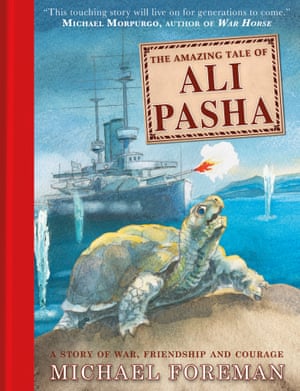
The amazing tale of Ali Pasha by Michael Foreman

The amazing tale of Ali Pasha by Michael Foreman (Templar, 2013)

9 chapters; 128 pages with numerous beautiful colour illustrations

Subjects: World War One, Gallipoli, Egypt, Navy, animals, tortoises, junior fiction (Year 5-8)

Ali Pasha 1

Synopsis
I tracked down this title after reading an article in the Guardian that asked well-known authors, “What are the best first world war books for children?” This book was Michael Morpurgo’s pick.  

On the cover, it is subtitled “a story of fear, friendship and courage”. The story, based on fact, is that of Henry Friston, a 21-year-old seaman on the HMS Implacable. In April 1915, the Implacable sails to Gallipoli and Henry and his gunner mates are sent on shore at X Beach (one of the five landing beaches at Cape Helles) to act as stretcher bearers. Sheltering after a shell blast, he finds a tortoise and determines to take it - against orders - back onto the ship with him. Soon afterwards the Implacable leaves for Egypt and Ali Pasha becomes a companion and good luck totem for the four friends who keep his existence on board a secret.

The author describes these events through the eyes of a young reporter, Trevor Roberts, who in turn hears them from Henry himself as an “old man” (actually not that old – only 59! – but presumably seemed so to the reporter!)

The endpapers contain family photographs of Henry as a young boy at school, a 13-year-old in his first job at the “Big House”, a sailor in his Navy uniform, and after the war as a bus driver, tram conductor, father and (really) old man. There is an afterword by the author explaining how and when he met Henry, his son Don and Ali Pasha himself.  

The final pages show some media coverage of Ali Pasha (who made The Times and even got to appear on the BBC’s Blue Peter show) and tell of how he outlived Henry by  ten years and died, aged at least 90 but quite possibly over 100, in 1987. By then, he had lived with the Friston family for 72 years.

You can see some of the beautiful illustrations from the book in Ali Pasha in pictures.  

Reviews:
Books for Keeps says that “most stories for this age group about the Great War concentrate on the trenches and the Army fighting in France, and it is refreshing to hear of the Navy’s part in the campaigns and especially of the part it played at Gallipoli.

Info on the author: 
Michael Foreman is primarily an illustrator, but his book War boy : a wartime childhood tells of growing up (he was born in 1938) in an English fishing village during World War Two. It is followed by After the war was over.

There is a lovely article about him here in the Guardiancelebrating the 50th anniversary of his first book.

Other books you might like:
Anything else written or illustrated by Michael Foreman about war (or peace), including War game, War boy : a wartime childhood and The General and also The little ships by Louise Borden. 

NZ connections:
A number of tortoises made it back to New Zealand after World War One - not all of them alive. One of the exhibits at the National Army Museum in Waiouru is a tortoise shell from Gallipoli

This tortoise didn’t enjoy the same long life as Ali Pasha, but there was another Gallipoli tortoise that did – in fact, Torty is still alive and living in Hawkes Bay. (Tortoises have been known to live to over 200 years old.) 

PRONE TO WATER: Ninety-one years after coming to New Zealand in a Gallipoli veteran's backpack, Torty is as limber as ever.
KATHY WEBB/ The Dominion Post

The tale of the Anzac tortoise by Shona Riddell, illustrated by official Defence Force artist Matt Gauldie, was partly inspired by the story of another tortoise which was given to a nurse by a wounded soldier and lived out its life on the Kapti Coast.
Official NZ Defence Force artist Matt Gauldie and Shona Riddell have created a children's book about a time-travelling war tortoise.
Matt Gauldie
Have you read it?
Have you read this book? Let me know what you think!

Sunday, 12 April 2015

Roly the Anzac donkey by Glyn Harper, illustrated by Jenny Cooper

Roly the Anzac donkey by Glyn Harper, illustrated by Jenny Cooper (Puffin, 2015)

ISBN 978-0-14-350663-8

32 pages with Jenny Cooper’s beautiful colour illustrations

Subjects: World War One, Gallipoli, animals, donkeys, Richard Henderson, picture books (Year 2-6)


Synopsis
This is a retelling of Glyn Harper’s 2008 book, The Donkey Man (illustrated by Bruce Potter), which describes the war experience through the eyes of Roly the donkey. This version is bigger than the original and has new artwork by children's illustrator Jenny Cooper. It includes two maps (of the Aegean region and the Gallipoli peninsula) and notes on the Gallipoli campaign and the donkey man himself. A lot of people would assume this to be Simpson, but Glyn Harper tells the story of a New Zealander, Richard Alexander Henderson.

It’s interesting to see how the text has been pared back in the updated version. The main story is still there, but a lot of the background detail has been taken out. I think The donkey man still has value as a text with more detailed information, for older children, but this version makes for a stronger picture book.


About the author
Glyn Harper is professor of war studies at Massey University and the uni website has an interview with him here. There a lovely article about the book launch here.

About the illustrator
You can read about Jenny Cooper and her work on the NZ Book Council and Christchurch City Council websites.  

I liked this comment: "Funnily enough, I don’t particularly like seeing my books after they are printed, because there are so many things I would improve or change. But I keep thinking that the NEXT book will be better."

Other books you might like:
Glyn Harper has also written Le Quesnoy and Jim’s letters, both illustrated by Jenny Cooper. 

Links
You can read more about Private Richard Henderson, New Zealand's own "donkey man" at Gallipoli, here on the RSA site. 

Find out about the true story behind the famous painting of Simpson and the donkey. Moore-Jones painted six versions of this painting and the last one in private hands sold recently for $220,000.

Have you read it?
Have you read this book? Let me know what you think!
Sunday, 5 April 2015

The last Anzac: questions and answers

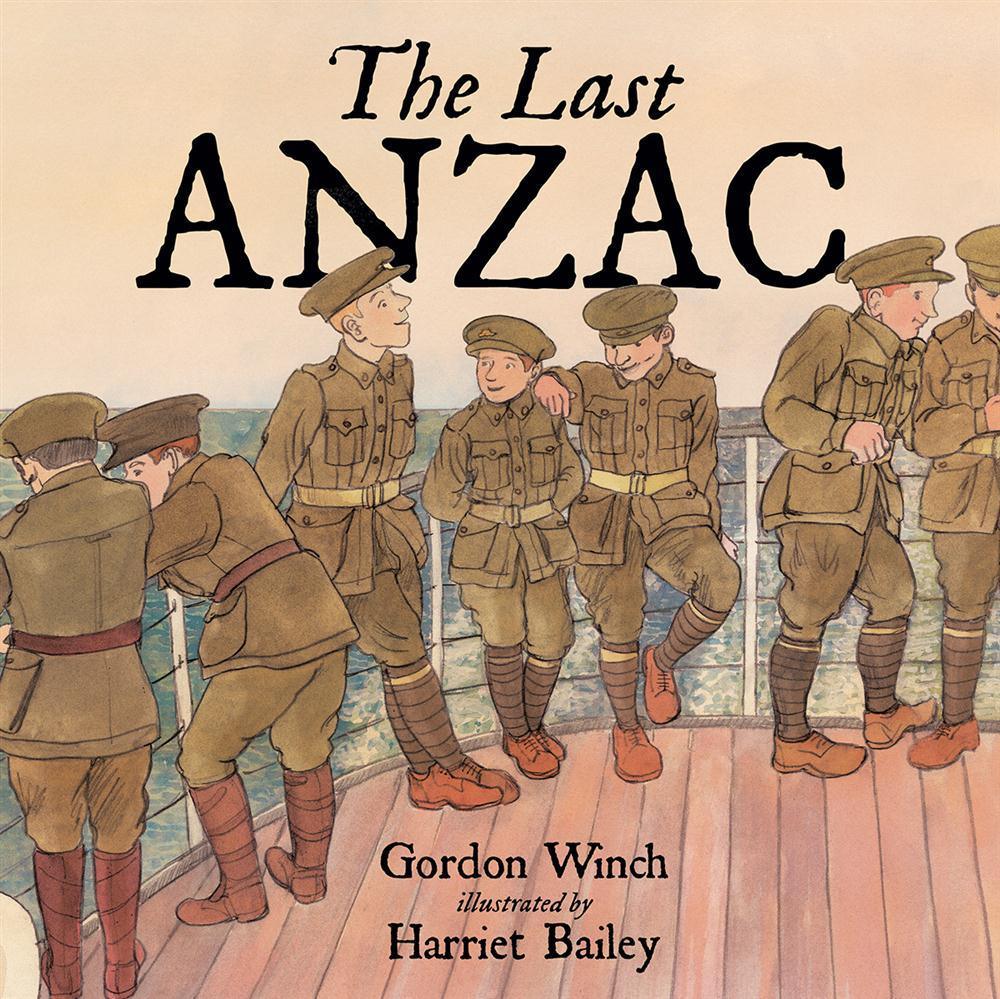
The last Anzac by Gordon Winch, illustrated by Harriet Bailey

I was lucky enough to attend the launch of this lovely book at The Children's Bookshop, Kilbirnie, in March. You can read my review of the book here, and Harriet has very kindly agreed to answer some questions about the book, how she worked on it and her illustrating style.

The book is a lovely production and it' s interesting to see the Anzac connection (Australian author and publisher / NZ illustrator). How were you approached by New Frontier to take the job on?
Thank you! An editor from New Frontier Publishing sent an email asking if I would be interested in illustrating a picture book for them, and that it would be a ANZAC WW1 Centenary title for 2015. I jumped at the chance to illustrate a heavily referenced story and one based on a soldier who served at Gallipoli.

How would you describe your own illustrating style, and why do you think it lent itself to this project in particular?
I have a range of illustration styles and felt the light and descriptive drawing line was needed to depict the various scenes and peoples expressions. When it got to the colouring stage, the publisher originally wanted all the 1915 scenes to be produced in sepia (brown and white or black and white, as was the photography at the time) in order to have a clear contrast between past and present. I wished to retain full colour to make it visually appealing and descriptive. I wanted the oranges to be a lovely juicy orange! We compromised by having the 1915 scenes set on a darker cream background.

At the launch of "The last Anzac", Ruth Paul made some fascinating comments about how well your illustrations worked to balance, and in some cases extend, the text. She used as examples the sequence showing Alec carrying the water and then spilling it when he jumps into the trench, and also the feet in the hospital beds. How do those ideas develop, and how do you decide what aspects of the story you want to illustrate?
This particular story was light on descriptive detail so I filled it in by reading as many accounts of the war at Gallipoli as I could. Books with collections of photographs of WW1 and men’s stories gave me ideas for the other soldiers that are shown. Soldiers injuries were horrific and of those that survived to be treated in the field hospitals, then the hospital ships and after that make shift hospitals in Greece and Egypt. I wanted to show men recuperating and with their wounds being looked after by ANZAC nurses. The missing limbs are sure to be noticed by children looking at the pictures.

Alec Campbell suffered many illness that kept him from sailing off to France to join the frontline but compared to his fellow patients he didn't have war wounds that were apparent until Bells Palsy appeared and 1/2 of his face became immobile.

As far as telling the story in pictures, “what happen’s next” is the major vehicle for turning pages of a picture book. I really wanted to have a sequence of illustrations to show what Alec Campbell did for the majority of the time: carrying water from the beach to inland for the soldiers who were in fighting in the trenches. Illustrating the effort and the danger of such an essential and appreciated task is the most interesting part of the story for children, I think!

I guess you haven't met the author, Gordon Winch, but do you know much about him?
I read about Gordon Winch online and discovered he has had a long career as a teacher of children and training teachers and has written many engaging and humorous books for children of Australia. 

How did you go about doing the research you needed for the illustrations? (at the launch, you told a lovely story about how you pinpointed the cottage that Alec Campbell lived in.)
It pays to use as many contacts that you have available when it comes to research and it was fortunate that I have a retired Australian uncle who is a whizz at tracing things using historical records. Part of the problem of weighing heavily on the internet for information is being certain that it is accurate. I had thought Alec Campbell was in a rest home at the time of James’ visit, but the publishers assured me he was still living with his wife in her mothers cottage, address unknown.

My Uncle was able to consult Electoral Rolls to hone down on a street number using the information I provided, sourced from historian Jonathan King’s book, Gallipoli: Our Last Man Standing. I used Google Street View to take a reference image of the cottage for the illustration. I like to think I have the correct little humble home where Alec lived!

As I have mentioned there was a lot of research needed to for a historical picture book. To avoid confusion due to the backwards and forwards of time and change in narration, I learnt it was important to keep visual elements limited to that which related to Alec and the story. I made a point of contrasting Alec's two ages: his visibly apparent youth when he went to war and his advanced age that he reached after a life where he achieved so much in Australia.

After Harriet had sent me these answers, I showed the book to my sister who came up with another question - which Harriet kindly answered as well!

Did you know any more about the boy's visit to Alec, and how that came about?
This story is based on a true event with one of the publishers' sons visiting Alec Campbell. New Frontier sent me two photos of father and son sitting with Alec and his wife Kate in their living room. I don’t know how the visit came about. I imagine the boy wrote Alec a letter requesting to visit him in Tasmania. I expect that Alec wished to met this young boy who was so keen to met him and learn about his experience at Gallipoli. 


The last Anzac by Gordon Winch; illustrated by Harriet Bailey

The last Anzac by Gordon Winch; illustrated by Harriet Bailey (New Frontier Publishing, 2015, “with historical advice from the Australian War Memorial”)

ISBN 9781925059298

32 pages, hard cover with beautiful colour illustrations

Subjects: World War One, Gallipoli, Australia, boy soldiers, Alec Campbell, veterans, picture books (Year 2-6)

Synopsis
Alec Campbell enlisted in 1915 when he was only sixteen. He served in Gallipoli but got sick and returned home, a veteran, at the age of seventeen. He died in 2002, aged 103. This is his story, told through the eyes of a young boy called James who went to visit him in the year before Alec died. That’s why this Anzac story starts, unusually, on a plane and then at an airport in Tasmania in 2001.

The endpapers contain facsimiles of wartime letters, postcards and envelopes, including a letter written by Alec (at Gallipoli) to his mother on 5 November 1915.

Reviews:
In Aussie reviews, writer Claire Saxby (Meet the Anzacs) points out that “it’s not easy to share the enormity of a war with young readers” and describes this as “an introduction to WW1 for early primary readers, showing them Gallipoli through the eyes of someone who was there”.

Teachers’ notes include the set of questions drawn up by James and his classmates which he took to ask Alec on Sunday 5 August 2001. Question 16 is What was your greatest moment? and the answer (Eating oranges when we got off Gallipoli) appears in one of my favourite illustrations. Also look out for the beautiful illustration of moonlight over the Aegean – and observant children will pick up on some unspoken details in the spread of the hospital scene.

Questions:
I had a number of questions that I wanted to ask the illustrator, Harriet Bailey and she kindly agreed to answer them. You can read her replies here.

About the author:
Gordon Winch was a teacher for over fifty years and has written a number of books for children. 

About the illustrator:
Harriet Bailey is a designer and illustrator based in Wellington, New Zealand. She began her career as a graphic designer. In 2010, she was the inaugural recipient of The Storylines Gavin Bishop Award and since then has illustrated Hester & Lester (Random House, 2011) and Out of Bed, Fred! (Scholastic, 2011). Both books were named in the Storylines Notable Books List 2012 in the picture book category.

You can see other examples of Harriet's art and design work on her website

Other books you might like:
There are several fictional treatments of boy soldiers, such as My mother's eyes: the story of a boy soldier by Mark Wilson, One boy’s war by Lynn Huggins-Cooper; illustrated by Ian Benfold Haywood and The horses didn’t come home by Pamela Rushby. Charlie and Tommo in Private Peaceful sign up at nearly 16, and the boys in War game are very young as well.

Links
You can find out more about Alec Campbell (nicknamed The Kid by his fellow soldiers, because he was so young and small) here, and here on the Australian War Memorial site, which also has an article about the last veterans from a number of different countries.

Have you read it?
Have you read this book? Let me know what you think!

Tuesday, 8 July 2014

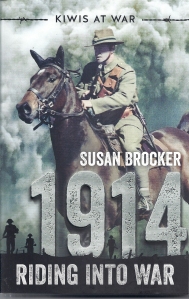
1914: Riding into war by Susan Brocker

1914: Riding into war by Susan Brocker (Scholastic, 2014)

ISBN 978-1-77543-206-7

216 pages with some notes and photos at the end

Subjects: World War One, Egypt, Gallipoli, Mounted Rifles, horses, young adult fiction (Year 8-11)

riding into war

Synopsis
The first thing you notice about this book is the striking cover, with the large embossed “1914”, the barbed wire pattern and the dramatic picture, which immediately tells you that horses are going to play a big part in this story. 

Seventeen-year-old Billy Bowman is old enough to be working on a farm, but young enough to be nicknamed “Billy the Kid” by the older farmworkers, who scoff at the idea of him signing up with the rest of them when war is declared in August 1914. But Billy’s mate Jack reckons “the enlistment age is just for city slickers who can’t ride or shoot”, and they are country boys who can do both. Sure enough, Billy is accepted by the recruitment officer – as long as his parents agree – and soon he and Jack are off with their horses to join the Mounted Rifles at the Awapuni Training Camp near Palmerston North.

The story of how the New Zealand troops got to war is sometimes overshadowed by the events that followed, but is fascinating in itself: the farewell dances, the weeks of training and drills, more farewells at the wharves, the long sea voyages (with the added difficultly here of keeping the horses in good shape), the exotic stopovers, the passage through the Suez Canal and the final arrival in Egypt. This section takes up about a third of the book and the details about caring for the horses on board are especially convincing.

Once in Egypt, there are more weeks of training in the desert before they are sent to Gallipoli - without their horses - after the first landings in April, but in time for the battle of Chunuk Bair in August 1915. The author manages to fit a lot of details about the Gallipoli campaign: the May armistice to bury the bodies, the torpedoing of the British battleship Triumph, the jam pot grenades, the periscope rifles, the awful food. These books are aimed at readers from 12+ but the language is mild with no expletives worse than “Jeez”. 

The focus is kept tightly on Billy, his mate Jack and their nemesis Chopper (“a tall, heavy-set man in his late twenties”, who calls him “Billy Boy” and “a little squirt”.) Other soldiers are there in the background but are seldom named. Billy exchanges letters with Alice, the daughter of the farm owner, although as the months go by, he finds there is more and more that he can’t tell her.

There is a map at the front – very important for tracing the troops' journey to Egypt and beyond (school visits have showed me that children might know about the Anzac landings at Gallipoli, but often don’t know where Gallipoli is – their guesses range from Germany to Russia.) The book also includes a timeline, glossary and bibliography at the back. (I looked for, but couldn’t find any details of the cover art on the front and back covers.)

Kiwis at War
This is the first title in Scholastic’s new Kiwis at War series, which will eventually consist of five books based on events for each year of World War One. (The events in this book carry over into 1915, which is understandable, given that the troops didn’t leave New Zealand until October 1914.) The other books in the series – each to be released in their centenary year - will be written by Diana Menefy (1915), David Hair (1916), Brian Falkner (1917) and Des Hunt (1918).

One of the interesting features about this series is that, while individually written (and perfectly readable as standalone texts), the five titles will be linked by characters who appear in more than one book. I love the idea of this collaboration amongst the authors, each working on their own story but also finding ways to create connections between them.

Susan’s book is to be launched on August 4th (exactly 100 years after the declaration of war), and the launch for each of the other books will also be tied in to a significant date. I’m looking forward to reading them, and to seeing if my guess about the “link” character in this book is correct.


Author’s website
On Susan Brocker's website, she says: “My favourite books are stories I’ve written about my favourite things, such as horses, dogs and animals of all sorts. I also love bringing history alive and making it exciting – and sometimes the two come together in novels like The Drover’s Quest and Brave Bess.”

This book is another example of the two things coming together. I can’t think of a better person to have chosen to write this story. Susan’s knowledge of history, her love of horses and her understanding of their needs and and personalities all come through clearly on every page.

Susan also has a Facebook author page, and you can read more about her on the Bookrapt site and the Storylines site. There is also an interview with her on the wonderful Christchurch City Libraries section on Interviews with NZ authors


Other books you might like:
If you like this book, you are sure to enjoy reading others that Susan has written. Brave Bess and the ANZAC horses (Harper Collins, 2010) is subtitled “a true story of courage and loyalty” – the qualities shown by the thousands of horses that were sent overseas with the New Zealand troops to face heat, stress, thirst, hunger, exhaustion, disease and injury in the deserts of the Middle East. Dreams of Warriors (Harper Collins, 2010), set in Featherston in World War Two, features fourteen-year-old Bella, who is trying to help save their family farm while her father is away at war, and also coping with a crazy bad-tempered horse called Gipsy. 

The horses didn’t come home by Pamela Rushby tells the story of Harry and his friend Jack, both aged 16, who set off for war with the Australian Light Horse and end up taking part in the last great cavalry charge in history, at Beersheba in the Sinai Desert in 1917.

Light Horse Boy by Dianne Wolfer follows Jim, a young Australian who works as a farrier (someone who trims and shoes horses’ hooves) and his best mate Charlie, who also sail for Egypt, camp in the desert and visit the pyramids; they are sent to Gallipoli (without their horses) and later, back in Egypt, Jim takes part in the battles of the Desert Campaign.

James Bayne's World War One diary
While looking for photos of the Mounted Rifles, I came across this diary which is held by the Alexander Turnbull Library and part of the WW1 digitisation project. 

Bayne, James, d 1915 : World War One diary
Bayne, James, d 1915 : World War One diary. Ref: MS-Papers-1418. Alexander Turnbull Library, Wellington, New Zealand. http://natlib.govt.nz/records/23160459
Like many other WW1 soldiers, James Bayne kept a diary; his runs from 10 Aug 1914 to 8 May 1915, and describes many of the same events that Billy and Jack experience, although he served with the Wellington Infantry Battalion, not the Mounted Rifles. James enlisted at Dannevirke, was sent to Awapuni Camp for military training and embarked for Egypt in October 1914. He describes life on board ship and the stopover at Colombo (in modern day Sri Lanka), the arrival in Alexandria, more training at Zeitoun Camp and the "Battle of the Wozzer" in April 1915. After taking part in the first landings at Anzac Cove, he was sent to fight at Cape Helles in the south of the peninsula in May 1915, and that is where he died.

If you scroll down to and click on "See original record", then scroll down to and click on "View archived copy online", you can read every page of his diary, which is a strange and sombre experience - a bit like being in Gallipoli itself, where you often feel like you are trying to match up the past with the present


Thursday, 23 January 2014

Lone Pine by Susie Brown and Margaret Warner

Lone Pine by Susie Brown and Margaret Warner; illustrated by Sebastian Ciaffaglione (Little Hare, 2012)
CBCA Notable Book 2012

32 pages with full page colour illustrations

Subjects: World War One, Gallipoli, Australia, Lone Pine, trees, brothers, picturebooks (Year 2-6)


Synopsis:
The story starts in December 2008 with the image of a lone pine tree being lashed by a storm in the grounds of the Australian War Memorial. The rest of the book tells how and why it got there.

The battle of Lone Pine took place in August 1915. For the Australians at Gallipoli, it was as crucial and defining an event as the battle of Chunuk Bair for the New Zealanders. Pine trees grew on the Turkish hillsides, but many were cut down to provide cover for the Turkish trenches, leaving only one standing on the particular hill where this battle took place.

The battle is lightly touched on, but afterwards a soldier wanders the empty battle field searching for his brother. He slips a pine cone into his pocket because its scent reminds him of home. Later he posts it to his mother, who keeps it in a drawer. Three of her sons have gone off to war and only two will return. She plants the seeds and raises three saplings (only two of which survive.) In January 1930, one sapling is planted in a park in Inverell, the town where her sons grew up. In October 1934, the second sapling is planted in the grounds of the Australian War Memorial in Canberra. This is the tree that we see at the beginning, still standing tall and strong. 


Lone Pine tree at the Australian War Memorial, December 2010
Lone Pine tree at the Australian War Memorial, December 2010.
PAIU2010/119.07
Colours and light make up a big part of this story, from the steely blue and stormy grey of the sky in the opening scene, through the dusty yellow of the battlefield and the Australian outback, the green colours of planting and regrowth and the sunset shades at the end. The book shows the impact of war on those who were left behind to wait and often to grieve, and the importance of remembering. 

Two pages of notes at the back cover the battle of Lone Pine, and the Canberra and the Inverell pine trees, and give brief biographical details about the mother and three sons of the Smith family, on whom the story is based. 

Reviews:
You can read reviews of the book on the Aussie Reviews site and on My little bookcase

Teachers notes are also available here. 

Questions and Activities:
How do the colours on each page make you feel? Why do you think the artist chose those colours?

Draw a time line that includes each date given in this book (remember the notes at the back.)

Author’s websites:
Susie Brown is a teacher librarian who has written for the educational market. Margaret Warner is also a teacher; the two of them taught together for a number of years and developed the story together.

About the illustrator:
Sebastian Ciaffaglione is a freelance artist based in Melbourne. He has illustrated Carol Wilkinson’s Dragon Keeper series. His blog shows some of the spreads for the book:


New Zealand connections:
On pg 39 of Anzac Day: the New Zealand story is a section called “Lone Pine”. This describes other Anzac pines planted in various places around New Zealand, for example, in Taradale, Wanganui, Stratford and Featherston.

Most of these are derived from pine trees that grew on other parts of the Gallipoli peninsula. Some botanists have worked out that there is only one pine tree in New Zealand that can be linked back to the original Lone Pine, and that tree is on the Paeroa golf course.  

Links:
An article titled “Lone Pine: seeds grown into a living memorial points out that at least one other digger brought home a pine cone from Lone Pine. Sergeant Keith McDowell carried a cone in his rucksack for the rest of the war and gave it to an aunt when he returned home. She planted some of the seeds and several grew and were planted in Melbourne and elsewhere.

You can read more about “The battle of Lone Pine” here

Lone Pine cemetery, Gallipoli.