Showing posts with label New Zealand. Show all posts

Friday, 17 June 2016

Pandemic: Spanish flu 1918 by Sally Stone

Pandemic: Spanish flu 1918 by Sally Stone (Scholastic, 2012; part of My New Zealand story series)

159 pages, written in the form of diary entries

Subjects: World War One, influenza, armistice, New Zealand, junior fiction (Year 5-8)


Synopsis
This book follows the fictional diary format of the My New Zealand story series. Eleven-year-old Freda Rose starts her diary after a falling-out with her best friend Pearl. She lives with her parents and grandmother on a farm and her older brother Bobby is serving overseas as a stretcher-bearer in World War One.

The story is primarily about the influenza epidemic, but I’ve included it here as the epidemic was so closely linked with the war and the armistice celebrations, and because Freda’s diary also describes the homecoming of her brother Bobby, and how they all (Bobby included) struggle to cope with how changed he is.

There is a short historical note at the back, a description of what to do in a pandemic and some historical photos.

Reviews:
Bob Docherty in his invaluable Bobs book blog says that the author "gives an excellent portrait of life in these times that will astound today’s kids". 

Teacher notes are provided here

About the author
The Scholastic blurb says that Sally Stone lives in Queenstown with her husband and three children. This is her first book with Scholastic; she has previously written school journals for Learning Media.

Other books you might like:
Black November by Geoffrey Rice (Canterbury University Press, 2005) provides the most comprehensive coverage of the influenza epidemic in New Zealand.

My book Armistice Day also includes a section on the influenza epidemic. 

Things I didn’t know
I did know this, but I always forget the difference between an epidemic and a pandemic. 
So here's a definition from Info please: An epidemic occurs when a disease affects a greater number people than is usual for the locality or one that spreads to areas not usually associated with the disease. A pandemic is an epidemic of world-wide proportions.
Links
Excellent info and photos of the 1918 influenza pandemic here on the NZ history site. 
And also on the Christchurch city libraries site and Te ara.

There's an amazing story on Puke ariki about a four year old boy from Inglewood who survived by chance when it was discovered in the morgue that he was still breathing.

Thursday, 7 January 2016

Stefania’s dancing slippers by Jennifer Beck, illustrated by Lindy Fisher

Stefania’s dancing slippers by Jennifer Beck, illustrated by Lindy Fisher (Scholastic, 2007)

32 pages

Subjects: World War Two, Poland, Russia, Siberia, Persia, New Zealand, Pahiatua, refugees, picture book (Year 5-8)


Synopsis
This book won a silver medal for Best Picture Book of all Ages at the Moonbeams Children’s Book Awards in the United States.

Stefania is a young girl who loves to dress up and dance, but her life changes forever when war comes to Poland in December 1939 and her father leaves to join the army. When Stefania and her mother are ousted from their house by Russian soldiers, she slips into her pocket her most treasured possession: her dancing slippers.

Along with many other Polish families, they are put on a crowded train and taken to a camp in Siberia. Later they have a long, difficult journey south to Persia.  Finally, in 1944, Stefania – but not her mother – arrives by ship in Wellington, where, along with other children, she finds a new home in the Polish camp in Pahiatua.

The book includes a map of Stefania’s travels at the front, and a historical note at the back about the Polish children of Pahiatua.

Reviews:
This review calls it a “moving tender historical fiction” which has depth, feeling, sadness and joy. 

Questions:
If you were given only 30 minutes to leave your house, like Stefania, what would be your most treasured possession that you would take with you?

About the author:
You can read an interview with Jennifer Beck on the Christchurch City Libraries website, and another one on the NZ Book Council site. 

About the illustrator
You can read about Lindy Fisher on the Storylines website, and also on the NZ Book Council site. She also has her own website (interesting fact: Lindy has had over 75 stamps published by New Zealand Post!)

Other books you might like:
Jennifer Beck is the author of the much-loved picture book The bantam and the soldier (illustrated by Robyn Belton). She and Lindy Fisher have worked together on other books, including A present from the past (about the Christmas boxes given to the soldiers by Princess Mary in World War One) and Remember that November (about Parihaka).

A Winter’s Day in 1939 (Scholastic, 2013) by Melinda Szymanik tells the story of 13-year-old Adam, who lives with his family on a small farm in rural Poland. In 1939, war breaks out and the Russians invade Poland and confiscate Adam’s family’s house and farm. They are sent to live with another family nearby, but are then moved on and put on a train for a Russian labour camp as refugees, prisoners of Russia. 

NZ connections:
The 70th anniversary of the arrival of the Polish children was marked by a reunion in Wellington in October-November 2014. The reunion's facebook page gives more information. 

NZ on screen also shows a 1966 documentary on The story of Seven Hundred Polish children.

You can find out more about the Polish children who came to Pahiatua on Te ara and also on the Polish Heritage Trust Museum website. 


Polish refugee children arriving at Pahiatua Railway Station
Polish refugee children arriving at Pahiatua Railway Station (Taken by John Pascoe)  Ref: 1/2-003646-F. Alexander Turnbull Library, Wellington.http://natlib.govt.nz/records/32195274


Sunday, 5 April 2015

The last Anzac: questions and answers

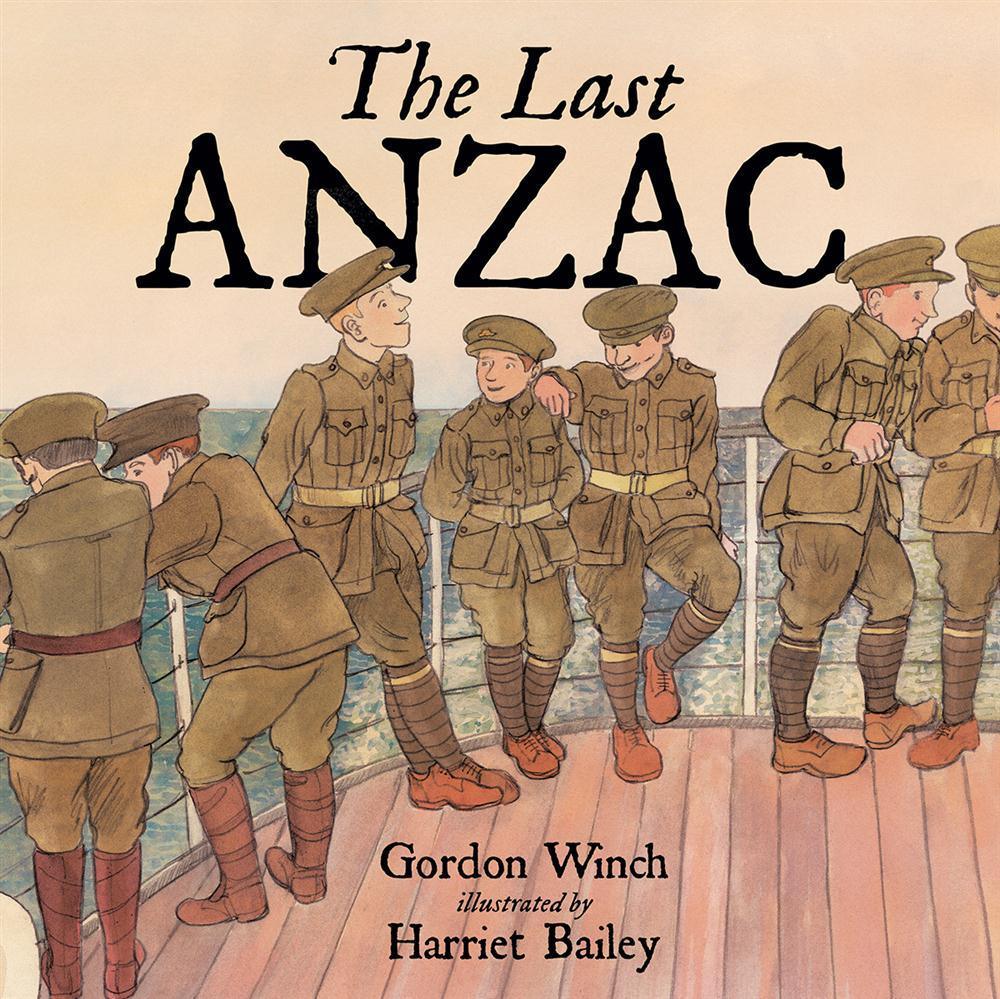
The last Anzac by Gordon Winch, illustrated by Harriet Bailey

I was lucky enough to attend the launch of this lovely book at The Children's Bookshop, Kilbirnie, in March. You can read my review of the book here, and Harriet has very kindly agreed to answer some questions about the book, how she worked on it and her illustrating style.

The book is a lovely production and it' s interesting to see the Anzac connection (Australian author and publisher / NZ illustrator). How were you approached by New Frontier to take the job on?
Thank you! An editor from New Frontier Publishing sent an email asking if I would be interested in illustrating a picture book for them, and that it would be a ANZAC WW1 Centenary title for 2015. I jumped at the chance to illustrate a heavily referenced story and one based on a soldier who served at Gallipoli.

How would you describe your own illustrating style, and why do you think it lent itself to this project in particular?
I have a range of illustration styles and felt the light and descriptive drawing line was needed to depict the various scenes and peoples expressions. When it got to the colouring stage, the publisher originally wanted all the 1915 scenes to be produced in sepia (brown and white or black and white, as was the photography at the time) in order to have a clear contrast between past and present. I wished to retain full colour to make it visually appealing and descriptive. I wanted the oranges to be a lovely juicy orange! We compromised by having the 1915 scenes set on a darker cream background.

At the launch of "The last Anzac", Ruth Paul made some fascinating comments about how well your illustrations worked to balance, and in some cases extend, the text. She used as examples the sequence showing Alec carrying the water and then spilling it when he jumps into the trench, and also the feet in the hospital beds. How do those ideas develop, and how do you decide what aspects of the story you want to illustrate?
This particular story was light on descriptive detail so I filled it in by reading as many accounts of the war at Gallipoli as I could. Books with collections of photographs of WW1 and men’s stories gave me ideas for the other soldiers that are shown. Soldiers injuries were horrific and of those that survived to be treated in the field hospitals, then the hospital ships and after that make shift hospitals in Greece and Egypt. I wanted to show men recuperating and with their wounds being looked after by ANZAC nurses. The missing limbs are sure to be noticed by children looking at the pictures.

Alec Campbell suffered many illness that kept him from sailing off to France to join the frontline but compared to his fellow patients he didn't have war wounds that were apparent until Bells Palsy appeared and 1/2 of his face became immobile.

As far as telling the story in pictures, “what happen’s next” is the major vehicle for turning pages of a picture book. I really wanted to have a sequence of illustrations to show what Alec Campbell did for the majority of the time: carrying water from the beach to inland for the soldiers who were in fighting in the trenches. Illustrating the effort and the danger of such an essential and appreciated task is the most interesting part of the story for children, I think!

I guess you haven't met the author, Gordon Winch, but do you know much about him?
I read about Gordon Winch online and discovered he has had a long career as a teacher of children and training teachers and has written many engaging and humorous books for children of Australia. 

How did you go about doing the research you needed for the illustrations? (at the launch, you told a lovely story about how you pinpointed the cottage that Alec Campbell lived in.)
It pays to use as many contacts that you have available when it comes to research and it was fortunate that I have a retired Australian uncle who is a whizz at tracing things using historical records. Part of the problem of weighing heavily on the internet for information is being certain that it is accurate. I had thought Alec Campbell was in a rest home at the time of James’ visit, but the publishers assured me he was still living with his wife in her mothers cottage, address unknown.

My Uncle was able to consult Electoral Rolls to hone down on a street number using the information I provided, sourced from historian Jonathan King’s book, Gallipoli: Our Last Man Standing. I used Google Street View to take a reference image of the cottage for the illustration. I like to think I have the correct little humble home where Alec lived!

As I have mentioned there was a lot of research needed to for a historical picture book. To avoid confusion due to the backwards and forwards of time and change in narration, I learnt it was important to keep visual elements limited to that which related to Alec and the story. I made a point of contrasting Alec's two ages: his visibly apparent youth when he went to war and his advanced age that he reached after a life where he achieved so much in Australia.

After Harriet had sent me these answers, I showed the book to my sister who came up with another question - which Harriet kindly answered as well!

Did you know any more about the boy's visit to Alec, and how that came about?
This story is based on a true event with one of the publishers' sons visiting Alec Campbell. New Frontier sent me two photos of father and son sitting with Alec and his wife Kate in their living room. I don’t know how the visit came about. I imagine the boy wrote Alec a letter requesting to visit him in Tasmania. I expect that Alec wished to met this young boy who was so keen to met him and learn about his experience at Gallipoli. 


Wednesday, 11 March 2015

An unexpected hero: questions and answers

An unexpected hero by L. P. Hansen : questions and answers

After reading this book, I contacted Linda Hansen to ask if she would mind answering some questions about the process of writing it. I liked the way she showed us Matt grappling with his problems and working out how to solve them for himself, and the way in which she has interwoven the two stories (Archie's and Matt's) and shown the themes connecting them, as well as building up a real sense of tension as the climax of the book approaches.


So thanks to Linda for agreeing, and here are her replies!

  • In the teaching notes, you say that you wrote this book because "New Zealanders hear so little about pacifism, yet Archie Baxter and other New Zealand conscientious objectors are celebrated worldwide".  How did the idea for the book sprout?
I work as a Storyteller and a couple of years ago, was developing a story to tell at the Storyteller’s Café in Wellington around ANZAC Day.  I decided to test my theory that not many adults knew about James K Baxter’s father, Archie.  So I told his story in the form of a mystery, not identifying the Hero, much as Matt does in my book.

Only one person in the audience was able to name him.

After that I felt that it was time New Zealand children had an example of a genuine Kiwi alternative to the seeming ‘inevitability’ of war, especially at this time when war publicity is at its height. 

  • Did you know much about Archie Baxter beforehand? How did you go about finding out what else you needed to know?
    I hadn't known about Archie Baxter until my middle years, and certainly never heard of him during my formal education.  I read his book ‘We Shall Not Cease’ around twelve years ago and was very moved… found it particularly poignant to be teaching at the N.Z. International Campus at Trentham around that time, right next to where he was tortured and imprisoned. 

    I’ve been a writer and researcher all my working life, so found my material ‘by all possible means’, as researchers do.

  • You're a storyteller as well as a writer. How do the two roles interact with each other?
      Writing is a gift to my storytelling and it works the other way around as well.  I write all of my stories myself, even if they are adapted from another source.  I also write them down, as this gets them into my long-term memory.  Then I speak them aloud and find where sentences are clumsy, spaces are needed, sounds collide and so on.  It’s a lovely process. 

  • Can you tell us about the process of publishing the book? CreateBooks has several other books that deal with the topic of bullying, is that coincidental?
      I did submit the manuscript to several New Zealand publishers according to their requirements – a sample chapter, a Synopsis and so on.  It was No thanks or nothing from them, even after promises to get back to me with two months. Only Scholastic Australia, no longer in New Zealand, replied with a very encouraging response.

      Ann Neville of CreateBooks Publishing validated my original feeling, as she had only just learned about Archie Baxter herself when my offer and Synopsis arrived. She immediately asked for the full M/S and within a day or two, accepted it virtually without alteration.  I didn’t then know about the company’s other books, so the Bullying theme was coincidental.

  • Do you want to tell us anything about the process of writing this book - or about the next novel you're working on?
      I tend to write to a topic first and build up the characters and settings later.  Although I already feel I know the characters and their situations well before I begin, it takes time to make them real to readers.

    Being a life-long writer, I am very ‘picky’ about writing clearly.  Lots of adjectives and adverbs might go in but they don’t last long.

   My next novel is currently out for review with some teenage critics.  Perhaps it will be controversial, perhaps not. 
The main character is a hobby photographer in her sixteenth year.

It’s her journey through some current real-life issues that inspire her into courageous actions, resulting in the police visiting her college. She’s a bold, spirited young hero, we need more of them!


An unexpected hero by L.P. Hansen

An unexpected hero by L.P. Hansen (CreateBooks, 2014)

ISBN 978-0-9941102-7-5

12 chapters; 145 pages

Subjects: World War One, New Zealand, conscientious objectors, pacifism, Archibald Baxter, schools, bullying, farms, junior fiction (Year 5-8)


Synopsis
Matt Turner, 12 years old, faces a move from the big city to the country for family reasons. Instead of living with his parents, he has to stay on the farm with his grandparents and attend the same small country school where his father once went.

First chapters can be tricky when then there is a lot of information to get across, but Linda Hansen’s opening chapter does a fine job of introducing Matt, his grandparents and the farm, explaining why he is there, showing us how difficult it can be for kids on that first day at a new school and hinting at some of the major themes to follow (local war history and Matt’s struggles with public speaking).  

At Matt’s new school, the annual Year 8 farewell speeches are a big community event, and he has arrived in time to be a part of it. Matt’s family has never made a big deal about war, so he doesn’t know who to choose for his “war hero”. Even worse, he hates speaking in public (a fact that his grandparents don’t know about him) and is terrified that he will stutter, blush and totally mess up.

The book follows Matt’s journey both in thinking about the nature of heroism and in taking steps towards a victory of his own. I liked the way that the author shows us Matt struggling with both of these issues, and getting help from other people, but ultimately finding a way towards his own resolution of them.

Reviews:
Bobs book blog (always an excellent resource) gives the book a very good review and calls it “an excellent short novel …for primary and intermediate children and a timely reminder that it takes courage to refuse to fight

Free Teachers’ Resource kits are available from the publisher here.

Questions:
Who would you choose as your war time hero?
(I’m currently taking my first ever MOOC (Massive Open Online) course on “Changing faces of heroism”,  and this is one of the first questions we were asked.)

About the author
Linda Hansen is both a storyteller and a writer. In 2012, she won the Jack Lasenby Children’s Writing Award for ‘Socks in the Library,’ a story about homelessness.

Linda developed her writing skills by working in places like Radio New Zealand and then in Parliament where, as the deputy director of one of the Research Units, she researched and wrote for politicians. During her time at Volunteer Service Abroad, she learned about countries where the volunteers worked and wrote handbooks about them.

Other books you might like:
Other books that deal with the topic of pacifism are Evan’s Gallipoli by Kerry Greenwood, Remembrance by Theresa Breslin and My brother’s war by David Hill. 

Things I didn’t know
I did know something about Archibald Baxter and I‘ve read his classic memoir We will not cease, but I didn't know anything about the developments in the country that Matt uses for the basis of his speech. I don’t want to spoil the plot but it is worth searching online for the idea of “changing rifles into notebooks”.

Links
You can find more info about Archibald Baxter on Te ara, NZ history or the site Lest we forget – "remembering peacemakers on Anzac Day".

Have you read it?
Have you read this book? Let me know what you think!

Friday, 9 January 2015

The red suitcase by Jill Harris

The red suitcase by Jill Harris (Makaro Press, 2014)

ISBN 978-0-9941069-0-2

30 chapters; 240 pages

Subjects: World War Two, England, air force, Bomber Command, Goldfish Club, New Zealand, Germany, Dresden, Cologne, young adult fiction (Years 8-11)


Synopsis
At first I didn't think this was going to be a book about war (and in the interview below, Jill Harris says that “even though her uncle's story was inspirational, she didn't want to write a ‘war book’”.) Set in the present day, it deals with contemporary issues like bullying and making friends, but also experiments with ideas of time, touches on terrorism and reaches back into the events of World War Two.

Ruth and her family have been living in Indonesia until a terrorist bomb forces them to leave. For various reasons the family is temporarily split up, with 14-year-old Ruth and her dad staying with her grandma at Takapuna Beach in Auckland. Ruth finds it difficult readjusting to New Zealand life and a new school, and what’s more, she finds herself experiencing strange episodes that seem to relate to an airman and his WW2 air crew. (These sections are written in italics.) The "red suitcase" of the title contains family papers that may provide a clue.

I found the dialogue between members of the crew in the plane both convincing and moving. When you remember how young many of them were and what responsibility they bore for each other, it's no wonder these air crews became melded into such tight units.

The foreword is a 1915 poem by Rudyard Kipling, titled "My boy Jack". Kipling lost his only son in WW1 and spent years searching for his body or grave, but never found him.

‘Have you news of my boy Jack?’
Not this tide.
‘When d’you think that he’ll come back?”
 Not with this wind blowing, and this tide. 

Reviews:
The red suitcase features on Bob’s books blogwhich always has reliably good reviews.

You can also listen to John McIntyre from The Children's Bookshop reviewing the book here.

Questions:
You could ask yourself some of the questions that trouble Ruth and Thomas, or that Ruth tries to find answers for:
  • Was the bombing of German cities during the war “mass murder”, “aimed at civilians, not strategic war targets”, or was it justified because “the Germans started it”?
  • “Everyone knew about people doing terrible things, but how did you stop them? And what about the good people who did terrible things, like dropping bombs on all those cities?”
  • Where is Cologne, and what happened there in the war?
  • Where is Coventry, and what happened there in the war?

About the author
You can read about Jill Harris on the NZ Book Council site, where she mentions that she grew up in Takapuna and remembers how she "made huts using towels hooked onto the barbed wire that stretched along the beaches to keep the Japanese from landing during the Second World War." 

There’s a lovely newspaper interview (and photo) here about the inspiration for this book: how a  few years ago, Jill Harris' cousin gave her a stack of old letters written by her uncle Colwyn Jones, a navigator in the RAF's Bomber Command – “the group with the dangerous job of flying deep into German territory during World War II to attack enemy targets.”

I especially like these words of hers: 
"A former librarian and school-teacher, Harris took up fiction seriously around 2002. "I got sick to death of being the last car in the carpark at work. And I thought 'If you don't stop working, you will never get your writing done'. So I just stopped."
Writing for young people demands brevity, she says. "You can't go on and on about characters, and you can't get too heavy on what the book's saying ... It's all little dabs of colour.'"
Another interview (with equally lovely photo) here mentions that fact that Jill had been fighting serious illness, and sadly she died, aged 76, on Christmas Day 2014

Thanks to Barbara Murison for this photo of Jill at the launch of The red suitcase
Other books you might like:
In the newspaper interview above, Jill Harris mentions that her son was using her uncle’s letters for a a non-fiction book, Under a bomber’s moon. You can read about it here, along with extracts from the book and lots of added material including photos and maps.

Jill Harris' other books (not about war) are all well worth reading: At the lake, Missing Toby and Silwhich won an Honour award in the 2006 NZ Post Book Awards. We are so lucky that she made that decision to stop being "the last car in the carpark" and concentrate on her writing. 

Valentine Joe by Rebecca Stevens is a time travel book about World War One. Charlotte sometimes by Penelope Farmer is another title that explores ideas of moving back through time (and into war-time) and finding your own identity

Things I didn’t know
I first heard of The Goldfish Club ("gold for the value of life and fish for the sea") at the funeral of a friend’s father, but this story prompted me to find out more. Founded in 1942, it was an exclusive club for airmen who had survived a wartime aircraft ditching. There are some fascinating details here and here. The club was set up informally, but “news ...spread rapidly, even to POW camps, where eligible aircrew soon claimed membership. Their cards and badges were sent to their next of kin. …By the end of the war the club had over 9000 members.”

I checked on the Auckland War Memorial Museum library catalogue and they hold a ring binder containing details of 95 NZ airmen who survived after being shot down or forced to ditch their aircraft into water (sea, river, lake or canal) during WW2. And the Air Force Museum of NZ has a framed certificate for Warrant Officer Jim Colway, awarded to him after a 1942 crash over the Marlborough Sounds; he was the only one of the seven crew to survive.  


Links
In 2012, the Bomber Command Memorial was unveiled in Green Park, London, in a ceremony attended by thousands of veterans (including some from New Zealand) and relatives of the 55,000 airmen who died serving in Bomber Command in the war.

I find these statues very poignant - the seven Bomber Command crew, just back from a mission, searching the sky, waiting for their comrades to return - but there is an interestingly ambivalent review of the overall memorial here
The statues of seven airmen stand at the heart of the Bomber Command Memorial 
(photo taken by Mark Rea for the RAF Benevolent Fund) 

Thursday, 4 July 2013

Harry and the Anzac poppy by John Lockyer

Harry and the Anzac poppy by John Lockyer, illustrated by Raewyn Whaley (Reed, 1997)

New Zealand author and illustrator. 

Picturebook; 24 pgs, with text facing full page illustrations

Subjects: World War One, France, Anzac Day, poppy, letters, New Zealand, grandparents, junior fiction (Year 3-6)

9781869489595.jpg

Synopsis:
Harry and his Great-Grandma Kate go through her special box of letters, sent to her as a child by her father (Harry’s great-great-grandad) when he was away at World War One in 1917 and 1918.

Reviews:
TKI notes are available here

Questions:
How many generations away is a great-great-grandfather? How many great-great-grandfathers are on your family tree? Do you know any of their names?

Harry is named after his great-great-grandfather. Are you or anyone else in your family named after another family member? Do you know why?

In his letters, Harry’s great-great-grandfather compares himself to different animals: a pack horse, a rat, a rabbit in a hole, a crayfish. What does he mean in each case?

What do the letters tell you about conditions at the Front: the weather, the food, the sleeping arrangements and other living conditions?

What was happening in World War One in 1917 and 1918?

Where does the poppy first appear in the story? What significance does it have for us now?

Info on the author:
New Zealand Book Council biography
Christchurch City Libraries interview

John Lockyer’s other titles include Lottie Gallipoli Nurse (1998) and The Anzacs at Gallipoli (1999). Willie Apiata VC (2009, Puffin), written with Paul Little, was a finalist in the Non-Fiction category of the 2010 NZ Post Children’s Book Awards.

Info on the illustrator:
You can read a short bio of Raewyn Whaley here
  
Other books you might like:
War game by Michael Foreman also talks about Christmas in the trenches.

New Zealand connection:
Letters were very important to the soldiers at the front, and to their families back home.  On pg 14 of Anzac Day: the New Zealand story is a section called “How do we know about the war?” This explains how the soldiers’ diaries and letters home tell us a lot of what we know about  the war. “Word from the front” on pg 15 explains how the Turkish soldiers, many of whom could not read or write, got their news from home. 

Delivery of mail to New Zealand soldiers, Etaples
Delivery of mail to New Zealand soldiers, Etaples. World War 1914-1918 albums. Ref: PA1-f-102-0416. Alexander Turnbull Library, Wellington, New Zealand. http://natlib.govt.nz/records/23164376


Sorting letters for troops at the NZ Army Post Office in Cairo, Egypt
Sorting letters for troops at the NZ Army Post Office in Cairo, Egypt, about 1941. NZ Dpt of Internal Affairs. War History Branch : Ref: DA-01414-F. Alexander Turnbull Library, Wellington, New Zealand.http://natlib.govt.nz/records/22903066


Sometimes the mail arrived back home with black marks where the censors (usually officers)  had crossed out anything that they thought might be secret information. The soldiers would often censor what they wrote themselves, not wanting their families to know the worst of what they were going through. 

Lieutenant A R Martin censoring mail outside his bivy near Sora, Italy, World War II - Photograph taken by George Kaye

Lieutenant A R Martin censoring mail outside his bivy near Sora, Italy, World War II , June 1944- Photograph taken by George Kaye. NZ Dpt of Internal Affairs. War History Branch : Ref: DA-06115-F. Alexander Turnbull Library, Wellington, New Zealand. http://natlib.govt.nz/records/22770800

You can read an interesting account here about New Zealand prisoner of war mail in World War Two.