Showing posts with label animals. Show all posts

Monday, 23 April 2018

The red poppy by David Hill, illustrated by Fifi Colston

The red poppy by David Hill, illustrated by Fifi Colston (Scholastic, 2012)

Also published in te reo as Te Popi Whero. 

Subjects: World War One, France, poppy, dogs, animals, picture books (Year 3-6)


The Red Poppy (Book and CD)

Synopsis

Jim McLeod is a young soldier like any other, waiting in the trenches as the time of attack draws nearer. Nipper is a stray dog, found in an abandoned French  village, whom the soldiers have trained to act as a messenger dog, carrying messages in a leather bag around his neck (and he was a good rat-killer as well).

The only patch of colour is a cluster of poppies amidst the grey mud. Jim, an "enemy" German soldier and Nipper are about to see their paths meet - and the poppies have a role to play as well.

There's a CD at the back of the book  (and lyrics on the back page) featuring an original song (Little red poppy) written by Canadian musician Rob Kennedy and performed by Giselle Sanderson. (David Hill says in the acknowledgements that the song "started everything off".) Little red poppy has now been sung at commemoration services around the world and you can listen to it here on You tube.

You can also listen to The red poppy on Radio NZ's Treasure chest.

Reviews:
My bestfriends are books interviews David and Fifi about family history, writing this book and what it meant to them. 
Kids' book review calls it "a breathtaking and deeply moving book. It’s about a man, a war, and the basic concepts of humankind. It’s about a dog, an unlikely friendship and the iconic red poppy used to commemorate our fallen". 
You can find teacher notes from Scholastic here

About the author:
David Hill is one of New Zealand's best (and best loved) writers for children and young adults. You can read more about him on the NZ Book Council site or the Christchurch City libraries site. 
His other books with a war theme include Enemy camp and Flight path.  (Interestingly, he says in this newspaper interview that he started writing war stories because "it became embarrassing for an "old guy" to try and write contemporary teenage slang ".)

About the illustrator:
Fifi Colston has a great website with this page about her children's book illustration (including The red poppy).  

Other books you might like:
Caesar the Anzac dog and The Anzac puppy are both stories about dogs in World War One.

Links
Dogs were used for many different purposes in World War One (there was even a War Dog School Of Instruction). This article has some interesting facts about "four-legged fighters". 
This one has a picture of a dog wearing a gas mask. 
More pictures and info here and here

Have you read it?
Have you read this book? Let me know what you think!

Wednesday, 13 December 2017

The duck in the gun by Joy Cowley, illustrated by Robyn Belton

The duck in the gun by Joy Cowley, illustrated by Robyn Belton (Walker Books, 2009; first published 1969)

32 pages with delightful colour illustrations

Subjects: peace, ducks, animals, picture books (Year 2-6)

Image result for The duck in the gun by Joy Cowley

Synopsis
For the last post of the year, it seems appropriate to feature a book about peace -
“The General and his men are about to fire on a town they are at war with. But the Gunner has bad news for the General – they can’t load the gun as there is a duck nesting inside it! Determined to not let a single duck stop an army, the General visits the Prime Minister of the town he is preparing to fight to resolve the situation. Can one duck put an end to the war?” (Outline from Walker Books)

This book won the NZLA Russell Clark Award and was also one of ten children’s books selected for the Hiroshima Peace Memorial Museum. You can see the 1984 Shortland Educational Publications edition online at the International Children’s Digital Library.

Activities
Lots of good classroom ideas here.

Questions
There are some very good questions in Walker Books’ list of classroom ideas (shown above), including these ones:
“What does ‘peace’ mean to you? 
Do you have a favourite place that makes you feel at peace, or a person that makes you feel peaceful? 
Draw a place, person (this can be imaginary or real) that makes you feel this way.”

About the author
One of New Zealand's best-loved writers, Joy Cowley needs little introduction. 

About the illustrator
RobynBelton is also well known for her many prize-winning children’s books. 

I love the illustrations in this book. One of my favourites is the picture of the General  relaxing over his newspaper while his men are painting houses in the town (that's the town they are supposed to be at war with!)

Other books you might like:
Other anti-war books for children include The story of Ferdinand by Munro Leaf, The general by Janet Charters, illustrated by Michael Foreman, Bravo! by Philip Waechter and Moni Port and Thebutter battle book by Dr Seuss.

Things I didn’t know
In the brief bios at the back, Robyn Belton says she added a dog that wasn’t in Joy’s text, to act as a “mirror” - “amplifying the gestures and expressions of the girl”. 
Joy says that the book grew out of her “feelings of distress” about the Vietnam War in the late 1960s, combined with a heart-warming news story about a duck that made its nest on a building site in Chicago and halted construction for three weeks.   

Have you read it?
Have you read this book? Let me know what you think!

Sunday, 6 August 2017

Three books by Mark Wilson

Angel of Kokoda (Lothian Children’s Books, 2010)
Vietnam diary (Lothian Children’s Books, 2013)
The Afghanistan pup (Lothian Children’s Books, 2014)

All similar format: hardback, 32 pages with full colour illustrations

Subjects: World War Two, Papua New Guinea, Pacific, Vietnam, brothers, Afghanistan, animals, dogs, mascots, picture books (Year 3-6)


Synopsis
A Papua New Guinea boy helps a wounded Australian soldier along the Kokoda Track. A young man goes off to fight in Vietnam, despite the protests of his brother. A dog is rescued from the ruins of a bombed school and becomes a soldier’s pet. 

These three books are part of the Children in War series which explores children’s experiences of, and reactions to, four different wars involving Australians:  World War One, World War Two, the Vietnam War and the war in Afghanistan. The texts are clear and not too detailed (apart from the Vietnam one, which includes handwritten diary entries).

They are well-produced books that cover lesser known aspects of war, although I would have liked some more context for each story (perhaps because they are very Australian - oriented). 

Reviews
Reading time (from the Children's Book Council of Australia)
reviews The Afghanistan pup here and admires the way that Mark Wilson "skilfully weaves narratives that tell stories of tragedy and hope with his extraordinarily evocative illustrations", while "snippets of newspaper clippings, reports, poems and letters enrich the stories and add layers of meaning."

There are teacher notes and activities - 
for The Afghanistan pup here 
for Angel of Kokoda here
for Vietnam diary here.

About the author: 
Mark Wilson's website shows his prolific and impressive output and also talks about his interesting life and varied career!

Other books you might like: Also by the same author is My mother’s eyes: the story of a boy soldier.  Mark Wilson illustrated A day to remember: the story of Anzac Day by Jackie French.

Have you read it? Have you read these books? Let me know what you think!

Friday, 5 August 2016

Bravo! by Philip Waechter and Moni Port

Bravo! by Philip Waechter and Moni Port, translated by Sally-Ann Spencer (Gecko Press, 2011; original title Der Krakeeler)

32 pages with colour illustrations

Subjects:  anger management, anti-war books, peace, animals, fable, picture books (Year 3-6)


Synopsis
I wouldn’t have thought to review this book, if not for finding it on Raymond Huber’s excellent list of Anti-war books for children.

It tells the story of Helena, “a little girl” who “lived in a crooked house, deep in a valley, beside a turquoise stream”. (I love the hint of fairytale in the word “crooked”, and the exactness of “turquoise”.)

Helena’s life is almost perfect, apart from her loud shouting father, and the book follows the decisions she makes, and the outcome of those decisions.  (As Raymond says, “Children have to find peace within themselves before they can change the world".)

Raymond also provides teaching notes – on words, characters, story structure and illustrations - here.


Reviews:
Publishers Weekly calls it a “spare, delicately drawn offering” in which “Helena’s decisive act allows her to find her own voice and to mend her relationship with her father, too.” 

Curled up with a good kid's book says it "delivers a thought provoking message about positive behaviour and making socially acceptable and positive choices". 

Questions:
Raymond Huber poses some excellent questions in his teaching notes:
  • What does Helena think of her father? 
  • Is she scared of him? 
  • Is it his loudness she hates or something else? (Remember she plays the trumpet).

About the author and illustrator
This book was originally published as Der Krakeeler, which means “rowdy type”, “brawler” or “roisterer”. It’s interesting that the translator and publishers (the wonderful Gecko Press) have chosen a different sort of title for the English version, focusing more on Helena and her actions than on her father.
It’s also interesting that the cover gives both names equal weight, with no clues as to which is the author and which the illustrator. A bit of sleuthing reveals that it is written by Moni Port and illustrated by Philip Waechter (so the names on the cover are in the opposite order to how you would usually find them displayed on a NZ picture book). 
According to Gecko Press, Moni Port was born in 1968 in Germany. She has worked as a bookseller, then studied communication design, focussing on illustration and book design. 
Philip Waechter was born in 1968 in Germany. He now lives as a freelance graphic designer and illustrator in Frankfurt am Main. In 1999, Philip and Moni co-founded the community studio LABOR. You can read more about Philip here.

Other books you might like:
Other anti-war books for children include The story of Ferdinand by Munro Leaf and The general by Janet Charters, illustrated by Michael Foreman.

Sunday, 17 July 2016

Brave Bess and the Anzac horses by Susan Brocker

Brave Bess and the Anzac horses: a true story of courage and loyalty by Susan Brocker (HarperCollins, 2010)

12 chapters; 160 pages with black and white photographs

Subjects: World War One, Middle East, Egypt, Palestine, Mounted Rifles, horses, animals, junior fiction (Year 5-8)


Synopsis
Bess was a real horse, one of the thousands sent overseas in World War One, of which only four (including Bess) returned to New Zealand. Susan has told the story of the horses and the men who rode them and cared for them, using the facts of the campaigns backed up by descriptions of the land and scenery, seen through the eyes of both Bess and her master.  

As well as Bess, we meet two other horses – Jack and Flame, the mascot, a dog called Hawker, and a lot of smelly camels.

Susan’s research is impeccable and she includes a map, timeline, historical notes, bibliography and glossary, as well as short summary notes at the start of each chapter.

Reviews:
Bobs books blog calls it “A well written, well researched novel about a little known battle field of World War One in which NZ soldiers and their horses took a vital part.” 

About the author
Susan is a wonderful writer with a real love for horses, as shown in her other books such as 1914: riding into war, The drover’s quest and Dreams of warriors. You can read more about her and her work on her website.   

Other books you might like:
Other books I have reviewed about horses in WW1 include The horses didn't come home by Pamela Rushby and Light Horse boy by Dianne Wolfer.

Links 
Find out more about:

Thursday, 11 February 2016

Where poppies grow by Linda Granfield

Where poppies grow: a World War I companion by Linda Granfield (Stoddart, 2001)

48 pages with numerous illustrations

Subjects: World War One, Canada, Flanders, animals, non fiction (Years 5-8)


Synopsis
This is a non-fiction book giving an overview of World War One. There are other similar books, but this one tells the story from a Canadian perspective. Many of the images, letters and photos were new to me because they are sourced from Canadian records and archives. Some of them, such as the postcards, seem to come from the author’s own collection (according to the picture credits).

In many ways, the Canadian experience was similar (with the exception of the Gallipoli campaign) to that of the Anzacs:  training camps at home, sailing across to Europe, more training in England, then across the Channel to Flanders and the trenches.

Some of the images that particularly caught my attention show “Canadian recruits undergoing training at Salisbury” (stabbing with bayonets at hanging bales of straw; hardly the same as the real thing), fresh bread being baked at the field bakery, cinema tickets for a West End Cinema Theatre offering free entry to wounded soldiers and sailors, ships being painted in “dazzle” camouflage and the Poppies poem “In Flanders fields”, written by Canadian medical officer John McCrae.   

Other topics include nurses, propaganda, a child’s war and letters and postcards. The section on animals features the black bear cub Winnie, a mascot later donated to the London Zoo where a young Christopher Milne saw him, went home and christened his own teddy bear “Winnie the Pooh”.
You can read more about Winnie here and here.

Author’s website
Linda Granfield’s website includes a section on books on war and remembrance. She has written about John McCrae whose poem “In Flanders fields” is 100 years old in May 2015, and about The unknown soldier all around the  world. 

"When I write non-fiction books, and you read them, we become time-travellers," she says.  
"History is all around us, inviting us to share our own family and community stories."

Find out more about her here.

Other books you might like:
Archie’s war by Marcia Williams is fiction, but told in a similar scrapbook style.

Things I didn’t know
I didn't know about the church of Notre Dame de Brebières (Our Lady of the Ewes) in the town of Albert, France, although I came across another reference to it just after reading this book. The statue of Mary and Jesus on top of the church was knocked sideways in 1915 by a shell bombardment. A legend developed that when it fell completely, the war would be over. 
In spring 1918, the Germans captured the town and the statue fell (but has since been restored); later that year, the war ended.
The other reference I came across mentioned that passing Australian soldiers would joke that it reminded them of the famous Australian swimmer, Fanny Durack.

Sunday, 31 January 2016

Ghost soldier by Theresa Breslin

Ghost soldier by Theresa Breslin (Doubleday, 2014)

33 chapters; 291 pages (but fairly large print)

Subjects: World War One, England, Borders, Scotland, trains, animals, dogs, hospitals, junior fiction (Year 5-8)


Synopsis
The author’s website calls this “a mystery plus detective story with poignant scenes as two children, in a desperate search for their ‘missing-in-action’ father, meet the staff and wounded men on the hospital trains that stop near their farm”. The mystery/detective element is related to strange goings-on in an old house in the woods, a suspected German spy and a shadowy ghost figure in an upstairs window.

I liked the relationship between brother and sister Rob and Millie; the focus on how those at home coped – or didn’t cope - while the husbands and fathers were away at war, and the details about how dogs could be taken away by the army (which is why they try to save their puppy, and how they end up hiding it at the old house in the woods). Thousands of dogs were needed in the war so many families must have had to give theirs up, willingly or not. The story of the ambulance trains was interesting, too, although I was never clear about whether they did or didn’t try to take injured soldiers to a hospital near their home.

I found some of the action a bit hard to believe; either too many coincidences, or too unlikely (would they really have let the children on board the train? would they have let the wounded soldier wander round the grounds so freely at night?) but this post by the author about her research suggests that the ambulance trains did stop in the countryside like this.

Reviews:
In this review, Theresa Breslin said she started writing the book because she “was asked to provide a story for a film company and this was a story I felt needed to be told”. So I wonder if that means there is a film underway?

Author’s website
I didn’t know anything about Theresa Breslin before I read her book Remembrance, but according to her website, she was born and brought up in a small town in Scotland, worked as a mobile librarian, has written over 30 books for children and young adults and won the Carnegie Medal for Whispers in the graveyard (1994) about a dyslexic boy. Her website also provides teaching notes for the book. 

Other books you might like:
Remembrance is another book about World War One by Theresa Breslin, but for older readers.
The Anzac puppy by Peter Millett and Trish Bowles is written for younger readers about a dog in war time.

Things I didn’t know
The details about blood transfusion are intriguing. Today we take blood banks for granted but back in WW1 they were still figuring out the science of blood groups and anticoagulants. 
You can read about "A brief history of blood transfusion" at the Institute of Biomedical Science, or find out more at the Science Museum


Tuesday, 27 October 2015

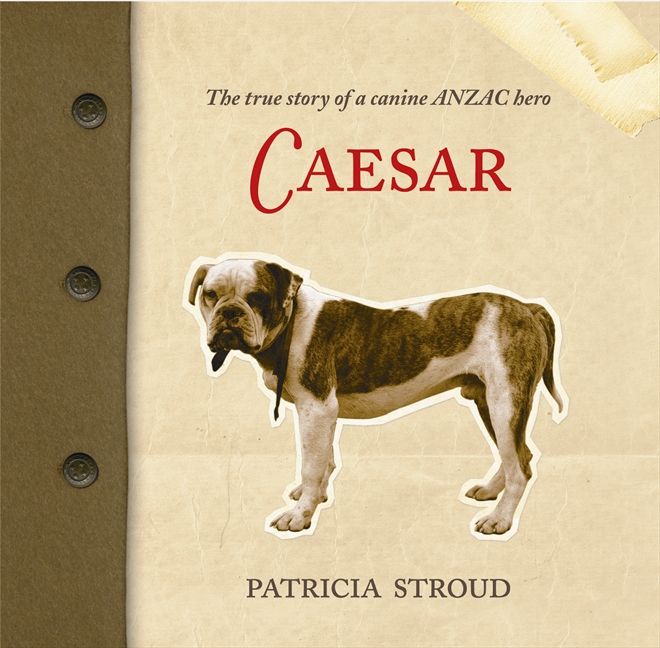
Caesar the Anzac dog by Patricia Stroud, illustrated by Bruce Potter

Caesar the Anzac dog by Patricia Stroud, illustrated by Bruce Potter (Harper Collins, 2003)

40 pages with sepia illustrations

Subjects: World War One, France, dogs, animals, mascots, junior fiction (Year 2-6)


Synopsis:
This book is based on the true story of Caesar, which was told to the author, Patricia Stroud, by her mother, Ida. 

Ida (aged four) was in the crowd when Caesar the bulldog, as official mascot, led the Rifle Brigade down Queen St in Auckland to board the ships that would take them to Egypt and the Western Front. As described in the book, Ida donated her blue ribbon for Caesar to wear. She gave it to her uncle Tom who was Caesar’s handler and he tied it onto Caesar’s collar.

Caesar worked during the Battle of the Somme in 1916 as a Red Cross dog. These dogs helped the stretcher-bearers to rescue wounded soldiers at night from No man’s land, the area in-between the trenches of the two opposing sides. They were trained to look for something that belonged to the man, such as a coat or cap, bring that item back to the stretcher bearers and then lead them to the wounded soldier.

Caesar was shot and killed in action. His handler, Tom, was temporarily blinded by mustard gas and sent to hospital in England. He married one of the nurses and they returned home on a hospital ship.

The family history aspect of the story is underlined by the way it is told to three boys, James, Brendon and Michael, who are visiting their great-grandmother (Ida) in the summer holidays. She tells them about the parade, and how her other uncles also went off to war.

The book was reprinted in 2009, with extra content, as Caesar: The True Story of a Canine ANZAC Hero ("A recount of the life of the bulldog that became the official mascot of the 4th Battalion of the NZ Rifle Brigade").


About the author
According to the Harper Collins website: “Patricia Stroud is a mother and grandmother, who has researched the facts behind a much loved family story to record a little-known aspect of New Zealand’s military history. As a volunteer, she spends many hours interviewing war veterans and recording their stories for the oral history archives of her local museum. Patricia and her mother Ida both live in Auckland.”

There is an interview with Patricia in the New Zealand herald, and here she is visiting the children of Botany Downs school

About the illustrator
Bruce Potter (here is his Storylines profile) has illustrated many other books, including The Donkey Man by Glyn Harper, Grandad's Medals by Tracy Duncan, Soldier in the Yellow socks by Janice Marriott and My Grandfather's War by Glyn Harper. (And who knew he is also "an internationally ranked powerlifter"??)

Other books you might like 
The Anzac puppy by Peter Millett and Trish Bowles is an appealing picture book based on the true story of a World War One mascot. The red poppy by David Hill, illustrated by Fifi Colston, tells the story of Nipper the messenger dog. 

Links
This unusual vintage clip shows a French Bulldog working on the Western Front in France in 1917.

The article about Caesar on the NZ History website includes this photograph of his collar (with an incorrect spelling of his name), now held at the Auckland War Memorial Museum (where you can also buy a soft toy Caesar!).


Jack, the New Zealand Engineers' canine mascot in France, World War I
Jack, the New Zealand Engineers' canine mascot in France, World War I. Ref: 1/2-013104-G. Alexander Turnbull Library. http://natlib.govt.nz/records/23171041

Bull, George Robert, 1910-1966 (Photographer) : Maori Battalion soldier and dog Paddy the mascot, Christmas Day, Maadi camp, Egypt
WW2 Maori Battalion soldier and dog Paddy, the mascot, share some pork from the hangi on Christmas Day at Maadi Camp, Egypt; Ref: DA-04880-F. Alexander Turnbull Library, http://natlib.govt.nz/records/22812710

Have you read it?
Have you read this book? Let me know what you think!

Monday, 17 August 2015

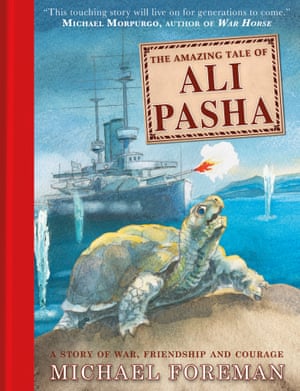
The amazing tale of Ali Pasha by Michael Foreman

The amazing tale of Ali Pasha by Michael Foreman (Templar, 2013)

9 chapters; 128 pages with numerous beautiful colour illustrations

Subjects: World War One, Gallipoli, Egypt, Navy, animals, tortoises, junior fiction (Year 5-8)

Ali Pasha 1

Synopsis
I tracked down this title after reading an article in the Guardian that asked well-known authors, “What are the best first world war books for children?” This book was Michael Morpurgo’s pick.  

On the cover, it is subtitled “a story of fear, friendship and courage”. The story, based on fact, is that of Henry Friston, a 21-year-old seaman on the HMS Implacable. In April 1915, the Implacable sails to Gallipoli and Henry and his gunner mates are sent on shore at X Beach (one of the five landing beaches at Cape Helles) to act as stretcher bearers. Sheltering after a shell blast, he finds a tortoise and determines to take it - against orders - back onto the ship with him. Soon afterwards the Implacable leaves for Egypt and Ali Pasha becomes a companion and good luck totem for the four friends who keep his existence on board a secret.

The author describes these events through the eyes of a young reporter, Trevor Roberts, who in turn hears them from Henry himself as an “old man” (actually not that old – only 59! – but presumably seemed so to the reporter!)

The endpapers contain family photographs of Henry as a young boy at school, a 13-year-old in his first job at the “Big House”, a sailor in his Navy uniform, and after the war as a bus driver, tram conductor, father and (really) old man. There is an afterword by the author explaining how and when he met Henry, his son Don and Ali Pasha himself.  

The final pages show some media coverage of Ali Pasha (who made The Times and even got to appear on the BBC’s Blue Peter show) and tell of how he outlived Henry by  ten years and died, aged at least 90 but quite possibly over 100, in 1987. By then, he had lived with the Friston family for 72 years.

You can see some of the beautiful illustrations from the book in Ali Pasha in pictures.  

Reviews:
Books for Keeps says that “most stories for this age group about the Great War concentrate on the trenches and the Army fighting in France, and it is refreshing to hear of the Navy’s part in the campaigns and especially of the part it played at Gallipoli.

Info on the author: 
Michael Foreman is primarily an illustrator, but his book War boy : a wartime childhood tells of growing up (he was born in 1938) in an English fishing village during World War Two. It is followed by After the war was over.

There is a lovely article about him here in the Guardiancelebrating the 50th anniversary of his first book.

Other books you might like:
Anything else written or illustrated by Michael Foreman about war (or peace), including War game, War boy : a wartime childhood and The General and also The little ships by Louise Borden. 

NZ connections:
A number of tortoises made it back to New Zealand after World War One - not all of them alive. One of the exhibits at the National Army Museum in Waiouru is a tortoise shell from Gallipoli

This tortoise didn’t enjoy the same long life as Ali Pasha, but there was another Gallipoli tortoise that did – in fact, Torty is still alive and living in Hawkes Bay. (Tortoises have been known to live to over 200 years old.) 

PRONE TO WATER: Ninety-one years after coming to New Zealand in a Gallipoli veteran's backpack, Torty is as limber as ever.
KATHY WEBB/ The Dominion Post

The tale of the Anzac tortoise by Shona Riddell, illustrated by official Defence Force artist Matt Gauldie, was partly inspired by the story of another tortoise which was given to a nurse by a wounded soldier and lived out its life on the Kapti Coast.
Official NZ Defence Force artist Matt Gauldie and Shona Riddell have created a children's book about a time-travelling war tortoise.
Matt Gauldie
Have you read it?
Have you read this book? Let me know what you think!