Showing posts with label USA. Show all posts

Friday, 19 September 2014

Summer of my German soldier by Bette Greene

Summer of my German soldier by Bette Greene (Puffin Books, 2006; first published The Dial Press, 1973)

ISBN 0 14 240651 1

21 chapters; 230 pages

Subjects: World War Two, United States, Jews, Germans, Prisoners of war, young adult (Year 8-10)


Synopsis
This book  won ALA Notable Book along with New York Times Book of the Year (1973); it was a National Book Award Finalist and was made into a movie in 1978. I read it for the first time for this blog in this Puffin modern classics edition, which makes it yet another modem children's classic that has somehow passed me by until now.  

(From the Puffin page)”When her small hometown in Arkansas becomes the site of a camp housing German prisoners during World War II, 12-year-old Patty Bergen learns what it means to open her heart. Although she's Jewish, she begins to see a prison escapee, Anton, not as a Nazi--but as a lonely, frightened young man with feelings not unlike her own, who understands and appreciates her in a way her parents never will. And Patty is willing to risk losing family, friends--even her freedom--for what has quickly become the most important part of her life. Thoughtful, moving, and hard-hitting, Summer of My German Soldier has become a modern classic.”

There are different covers on different editions. I can’t say I like this cover, though.

Patty (or Patricia Anne) has a wild imagination, wistful daydreams and a huge vocabulary gleaned from reading the dictionary. “I don’t actually mean to be rude, but I am. My father says I ask a lot of questions and then go around contradicting every answer.”

She sometimes seems much younger than 12 and sometimes much older, but I love the way she talks and thinks. And I’m in awe of how the story is told completely from Patty’s point of view, but the author shows us so clearly the things that she doesn’t notice or can’t understand. 

Patty’s mother is distant, her little sister Sharon is too young to provide any support and her father is a tortured soul, but we lose sympathy for him when he is physically abusive. The beatings that he deals out are hard to read about and it’s sad to see Patty’s desperate attempts to win her parents' love and affection, which is so freely given to Sharon. Her family life is made bearable by occasional visits to her grandparents and by Ruth, their cook, who calls her “Honey Babe” and is “the colour of hot chocolate before the marshmallow bleeds in.”

Her life changes the day that Anon Reiker walks into her father’s shop, and the place where she is sent to live at the end would be awful, if not for the fact that her home life is so sad anyway. In some ways, it’s an escape. And she has Anton’s words to hold onto: “Even if you forget everything else I want you to always remember that you are a person of value, and you have a friend who loved you enough to give you his most valued possession.”

Reviews:
This review calls the book "a poignant coming-of-age story about a young Jewish girl from a small town in Arkansas who helps an escaped German POW, an act which changes her life forever." 

Apparently there is a sequel, Morning is a long time comingbut I don’t know if I want to read that. I think I’d rather imagine Patty’s  future for myself.   

Author’s website
(From the back page) “Bette Greene was born in Memphis, Tennessee on June 28, 1934 and grew up in a small town in Arkansas.” That makes her just a bit younger in World War Two than Patty, age 12, living in Jenkinsville Arkansas. “In many ways, Patty Bergen is based on Ms Greene’s childhood experiences as a Jewish girl in the South.”  

You can read more about Bette Green on her website

Other books you might like:
So far from the sea by Eve Bunting describes the camps in picture book format. We follow Laura and her little brother Thomas, who are visiting their grandfather's grave in a remote part of the desert. Gradually we learn that their grandparents and their father, as a small boy, were among the thousands of Americans with a Japanese background who were taken to internment camps in World War Two.

Things I didn’t know
I first read about the Japanese interns in So far from the sea, but I had no idea there were so many Prisoner of War camps in America. Like so many other things, it makes sense when you think about it. The German POW camps were in Germany or in German-occupied countries, but for the Allies to set up their own POW camps in England or Europe would use up food and medical resources that they needed for their own troops.

Across the Atlantic, America had masses of food and acres of empty space - and that’s where the POWs went; nearly 425,000 of them, housed in more than 500 camps.  Nearly 23,000 of them – German and Italian – went to Arkansas, where this book is set.

Not many of them escaped, or even tried to. The camps were set in remote locations – and it wasn’t as if they could ever get back home, across the ocean. They had comfortable surroundings and plenty of food; in fact some Americans felt the military was “coddling” them. The camps were closed down after the war and the prisoners were returned to Europe.

You can read more about them here and here


Wednesday, 20 August 2014

Emil and Karl by Yankev Glatshteyn

Emil and Karl by Yankev Glatshteyn; translated by Jeffrey Shandler (first published as Emil und Karl in 1940; this edition Roaring Brook Press, 2006)

ISBN 1-59643-119-9

25 chapters; 186 pages with an Afterword

Subjects: World War Two, Austria, Vienna, USA, children, friends, Jews,  junior fiction (Year 5-8)


Synopsis
This is another book I had never heard of before and one that is unique in many ways. For a start, it is one of the first books to be written for children about what we now call the Holocaust, before people even knew what that really meant.

The story is set in Vienna, Austria, sometime before the start of World War Two. Germany annexed Austria in March 1938 and many Austrian Jews tried to escape but often it was impossible for them to get out, or there was nowhere for them to go. “Incidents described in Emil and Karl, such as Jewish shops being looted, Jews being forced to scrub Vienna’s streets with their bare hands and to act like animals in a public park, actually happened and were reported in American newspapers" (from the Afterword).

Karl has been told to keep away from Emil because he is Jewish, but the two boys are left on their own, with only each other to rely on, when their parents are taken away by the authorities. (Karl is not Jewish, but his parents are Socialists, another category that the Nazis targeted.)  The story of what happens to them over the next few days is told in a quiet, matter of fact way but is absolutely riveting. Together, they meet good people who will help them, and some who suffer for helping them; they encounter cruelty and courage, desperation and generosity, horror and love.

“What makes them do it?” Karl asks after they have been forced to endure the brutality of the pavement-scrubbling scene.  But the book also reminds us that there were many ordinary people who did find the courage to stand up against the regime and fight for freedom, even when they knew that it would probably cost them their lives.

The story is told in very simple language but I think it could actually be quite frightening for younger children, because it is about what happens to two ordinary boys, just like them.

Reviews:
Text Publishing calls this book "A taut, gripping page-turner" and says that it "holds a unique place in publishing history as one of the first works published in any language about what was happening under the Nazi regime."

A Teacher’s resource kit is available here. 

This review in the New York times makes some interesting points about writing for children about war, specifically about the Holocaust: "Indeed, the story of the Holocaust has overwhelmed countless novels intended for adults. The challenge in a book for children is far greater — the risk of frightening them competes with the possibility that an overload of horror will leave them numb. It is perhaps surprising, then, that a writer working with no hindsight at all hit the mark so precisely."

About the author:
Yankev Glatshteyn (1896-1971) was born in Lublin, Poland. He grew up speaking Yiddish, which was the first language for millions of Jews in both America and Europe. When he was 18, he emigrated to the USA and studied law but became a writer instead of a lawyer. He was part of a group of writers who wanted to write poetry and fiction in Yiddish (which was what Emil and Karl was originally written in).

In 1934, Glatshteyn went back to Poland to visit his mother who was unwell. This was when he saw for himself what conditions were like for Jewish people living in Poland and other parts of Europe at that time. In the years leading up to World War Two, Jewish people were being discriminated against and attacked, both economically and even physically. 

Back in America, Glatshteyn wrote two adult novels about this situation as well as Emil and Karl, which was published in New York in February 1940. This was after Nazi Germany had invaded Poland in September 1939 but before America joined the war. In other words, the book was written at the start of the war when nobody yet knew what its ending would be. It was first read by American Jewish children who attended Yiddish schools (as well as their public schools) in the afternoons and weekends. 

Other books you might like:
The silver sword is another famous example of a book about children  being left to cope on their own in war-torn situations. 

The hare with amber eyes: a hidden inheritance by Edmund de Waal is not a children's book, but a fascinating memoir that paints a picture of Vienna at this time. You can read reviews of it in the Guardian and the Telegraph

Things I didn't know: Vienna
You can read more about the history of Vienna here and here

We find it hard to comprehend this at a distance but who knows how we would have reacted at the time, if we had been the cowed, frightened or equally uncomprehending onlookers? 

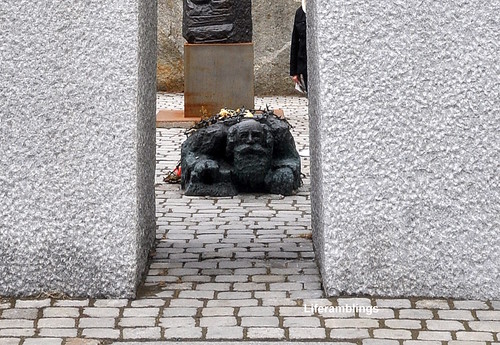
DSC_0203
A travel blogger posted this sad depiction which features a bronze sculpture of an elderly Jewish man, on his hands and knees, scrubbing anti-Nazi slogans from the street surface with a toothbrush

Sunday, 10 August 2014

So far from the sea by Eve Bunting

So far from the sea by Eve Bunting, illustrated by Chris K. Soentpiet (Sandpiper, 1998)

ISBN 978-0-395-72095-0

32 pages with black and white and colour illustrations

Subjects: World War Two, Japan, USA, family, internees, junior fiction (Year 5-8)

Synopsis
Laura Iwasaki and her little brother Thomas are in the car, driving to visit her grandfather’s grave. Their family is moving from California to Boston, so this may be their last visit for some time. They are all huddled up in warm clothes, it is February, and bitterly cold. From their sad and solemn faces, we realise this is a difficult trip for them to make.

The cemetery is in the middle of a deserted, sandy site that was once bustling with people. Gradually we find out that Laura’s grandparents and her father, as a small boy, were among the thousands of Americans with a Japanese background who were taken to internment camps in World War Two. Her grandfather, a tuna fisherman, hated being so far from the sea and in the end he died in the camp, at Manzanar.

The writing is simple but evocative and some of the descriptions are very effective: “The road is straight and endless. Crows strut in the stubbly fields.”

The illustrations vary page by page, from black and white –for the scenes in the camp during the 1940s – to colour, for the family’s farewell visit more than thirty years later, in the 1970s. The picture of the offerings left at the monument – “origami birds, their wings trapped under little rocks” and “crumbs of a rice cake” – is especially moving. So too is the picture of Laura’s father as a boy, dressed in his American Cub Scout uniform, saluting the soldiers who have come to take him and his parents away.

Reviews:
This review in Publishers weekly describes how "the artist's watercolors recreate two vastly different settings, evoking the tense 1940s scenarios in black and white and the serene yet wistful 1970s setting in bright color" and calls it "an exceptionally effective collaboration. 

Author’s website
Eve Bunting was born in Ireland but emigrated to the USA with her husband and three small children and has since written more than 200 books for children. Her first book, written after she took a creative writing course, was a retelling of an Irish folk tale. Her books often deal with the experiences of immigrants or with difficult issues such as race riots or homelessness.

In this biography of Eve Bunting, she says “One of my greatest joys is writing picture books. I have discovered the pleasures of telling a story of happiness or sorrow in a few simple words. I like to write picture books that make young people ponder, that encourage them to ask questions. 'Why did that happen, Mom? Could it happen again? Can't we help? What can we do?' One child wrote to tell me that one of my books had won the Heal the World award at her school. It is among the most cherished honors I have ever received and the plaque hangs proudly above my desk."


There is a video interview with her here.

And this is her talking about how her father used to read to her as a child:
"You know, it rains a lot in Ireland, and lots of times we'd sit in the house by the big turf fire. And he would take me on his lap and read to me. He would stop now and then when it would maybe be a little difficult. And he would say, "Now, my darlin', do ya understand that? What's the poet trying to say?" And we would talk about it."

About the illustrator
Chris K.Soentpiet was born in south Korea. When he was eight, he and his sister were adopted by the Soentpiet family and they moved to Hawaii. His website includes teacher’s lesson plans for this book. 

Other books you might like:
I only just realised from reading this interview that Eve Bunting wrote another book that my children enjoyed: Spying on Miss Müller. “The main character, Jessie, is a thinly disguised Eve attending boarding school in Ireland during World War II.”

Summer of my German soldier by Bette Greene is a book for older readers about the German Prisoner of War camps set up in America in World War Two. 

Things I didn’t know
I had never heard of Manzanar (Spanish for “apple orchard”) which is now a national historic site in California. It was one of ten war relocation centres, built to house 120,000 men, women and children of Japanese ancestry who were living in the USA when Japan bombed Pearl Harbor on 7 December 1941, thus bringing the USA into World War Two.  

These Japanese Americans were given only days to sort out their houses, farms, businesses and possessions before they were moved to the camps. Two thirds of the internees at Manzanar were under 18 years of age and 541 babies were born there. Manzanar was in the desert so it was very hot in summer, freezing cold in winter, with fierce winds that blew dust everywhere.

New Zealand links
Parallels in this country (where internees were held in the war) would be Matiu/Somes Island in Wellington harbour and Motuihe island in the Hauraki Gulf.

Camp on Somes Island [ca 1910s]. Reference number: 1/2-038622-F. Permission of the Alexander Turnbull Library, Wellington, New Zealand, must be obtained before any re-use of this image.
Camp on Matiu/Somes Island 
during WWI