I've been keeping this blog all through the World War One centenary commemorations. I had no idea there were so many children's books about war and there are many more I could review, both contemporary and from the past. These books are wise, thoughtful, exciting, moving, often very sad; their heroes and heroines are brave, scared, courageous, resourceful and inspiring.
I have loved reading them. But Armistice Day 2018 seems like a good time to draw this project to a close. It is wonderful to read about the many joyful projects being planned to mark the centenary of the end of World War One.
And this is my own project, due out in March 2019.
Sunday, 11 November 2018
Sunday, 24 June 2018
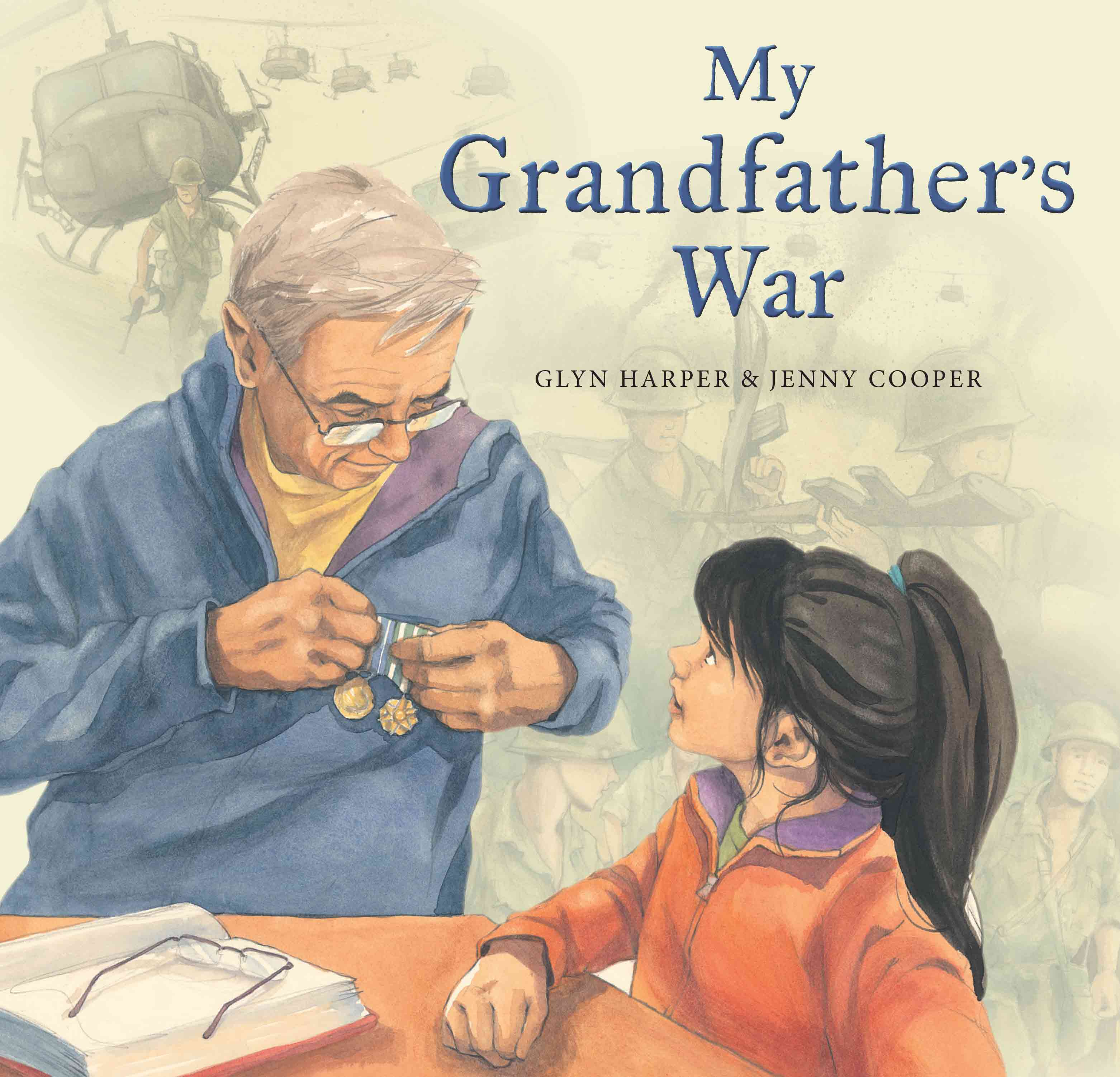
My grandfather’s war by Glyn Harper, illustrated by Jenny Cooper
My grandfather’s war by Glyn Harper, illustrated by Jenny Cooper (EK Books, 2018)
32 pages
with full page colour illustrations (hardback edition)
Subjects:
Vietnam, grandparents, veterans, picture books (Year 3-4)

Synopsis
My
Grandfather’s War tells the story of 8-year-old Sarah and her grandfather
Robert, who lives with her family and looks after her before and after school.
The pair have a close relationship and Sarah is sensitive to her grandfather’s
occasional spells of sadness. The family doesn’t talk about these, except to
tell Sarah that he is thinking about a war in a place called Vietnam.
When Sarah
summons up her courage to ask her grandfather why he feels sad, he tells her
about his time in Vietnam. The flashbacks of his memory present images of a war
which was “not like other wars” and he also tells Sarah about the difficulties
the troops faced when they returned home, from anti-war protesters and the
after-effects of chemicals.
This is a reworked version of an
earlier book, now with the added magic of Glyn Harper’s collaboration with
Jenny Cooper, whose illustrations show the warm bond between grandfather and
grandchild.
Another thing I really liked about
this book is how it models (to both children and adults) how to handle difficult
conversations. Sarah is nervous about asking her question but summons up the
courage to do so because she loves her grandfather. She tells him that she’s
scared and he acknowledges that with a serious, concerned expression (that
picture is one of my favourites). Her grandfather doesn’t fob her off and
answers carefully but truthfully. The conversation doesn’t make his sadness go
away but now Sarah understands it better.
Reviews
Kids book reviews calls it "the perfect mix of narrative and history" and "a gentle educational tool, highly recommended" for classrooms.
Teacher
notes are available here and include some thoughtful comments from Jenny about how she approaches the
subject of war as an illustrator.
Author’s website
Glyn Harper is Professor of War Studies at Massey University in
Palmerston North, New Zealand. He is Massey's Project Manager of the Centenary
History of New Zealand and the First World War. A former teacher, he joined the
Australian Army in 1988 and after eight years transferred to the New Zealand
Army, where he rose to the rank of lieutenant colonel. Glyn was the army's
official historian for the deployment to East Timor and is the author of
numerous history books. (From the Penguin website)
Info about the illustrator
Jenny
Cooper is a wonderful artist who has illustrated more than 70 children’s books.
Read more about her on the Book Council site or Christchurch City libraries or Storylines.
Other books you might like
This is the
sixth book that Glyn Harper and Jenny Cooper have worked on together. Their
previous titles are Roly the Anzac donkey,
Jim’s letters, Le Quesnoy: the story of the town New Zealand saved, Gladys goes to war and Bobby the littlest war hero.
There aren’t many books for young readers about
Vietnam. Memorial by Gary Crew and Lest we forget by Feana Tu’akoi both
touch on it. Other books are Vietnam diary by Mark Wilson and I
was only nineteen by John Schumann.
Books about
the grandfather-grandchild relationship include Grandad’s medals by Tracy Duncan.
Have you read it?
Have you
read this book? Let me know what you think!
Monday, 4 June 2018
Top 100 Children’s Book Blogs and Websites for Parents, Teachers and Kids
Very pleased to announce that my Children's war books blog is now included in this list of Top 100 Children’s Book Blogs and Websites for Parents, Teachers and Kids. Lots of other great blogs on there as well.
Tuesday, 29 May 2018
Enemy camp by David Hill
Enemy camp by David
Hill (Puffin, 2016)
260 pages (in diary format)
Subjects: World War Two, New Zealand, Japan, Prisoners of war, young adult fiction (Year 7-10)
260 pages (in diary format)
Subjects: World War Two, New Zealand, Japan, Prisoners of war, young adult fiction (Year 7-10)

Synopsis
“When of hundreds of
Japanese captives arrive at Featherston POW camp, the tiny town is divided.
Tensions run high and then, on 25 February 1943, disaster strikes. Three boys
witness it all.” (Publisher’s blurb)
Ewen lives in the
small town of Featherson, where his father works as a guard at the POW camp.
His diary covers the months between October 1942 and February 1943 and
describes everyday life in wartime, school, the summer holidays, the attitudes
of local people to the Japanese and the gradually increasing tension between
some of the prisoners and guards. Together with his best friend Barry and
Barry’s younger (polio-affected) brother Clarry, Ewen starts taking Japanese
lessons from one of the officers, and this provides a great way to show a
positive side of Japanese life and culture that many of the townsfolk have no
idea of.
David Hill skilfully
builds in many other aspects of 1940s life: the ever-present fear of polio, food
shortages, barbed wire on the beaches, the blackout, the Home Guard, American
GIs handing out sticks of gum, practice air raids, school milk, ink wells,
picnics, the movies and dances. He has a wonderful way of capturing a
12-year-old boy’s voice, in Ewen’s remarks on the progress of the war (“So
yeah, we’re going to win”) as well as the progress of his friendship with
“snobby Susan Proctor” (“And – I’m still trying to believe this – I spent most
of the time talking to Susan Proctor”).
It’s also a
refreshing change to read about a boy who reads and likes writing, and wants to
be an author when he grows up, and about a warm and close, even if
undemonstrative, father-son relationship.
Reviews:
Bobs book blog says: "Superbly
written in short diary entries that primary and intermediate students can
easily read, coupled with David Hill’s easy style and you have great historical
fiction. The account of the event itself with the boys looking on is
sensitively done. A very readable novel."
Another review by Siobhan Harvey calls it "both an enjoyable read and an imperceptible history lesson" and notes that "importantly, Hill personalises the demonised foe, allowing young readers to see Japanese captives as much victims of war as anyone fighting on the Allied side."
About the author
Another review by Siobhan Harvey calls it "both an enjoyable read and an imperceptible history lesson" and notes that "importantly, Hill personalises the demonised foe, allowing young readers to see Japanese captives as much victims of war as anyone fighting on the Allied side."
About the author
David Hill is one of NZ’s best loved authors for young people. Here is an article in which he talks about the book:
"I'm not preaching any themes. I want them to have a story first. I hope they like the people, especially Ewen the young protagonist. If they see attitudes that they agree with and some they disagree with I'll be very happy with that."
There's another interview here on Radio NZ. I also enjoyed this interview and David Hill's comments about writing about war ("War is wonderful to write about because it involves conflict - physical, mental and internal") and why he likes writing for and about this age group ("because they're coming across ideas and experiences for the first time. They're surprisingly sophisticated, they have a good vocabulary and understand a lot. They're a lovely mixture between naivety and sophistication.")
"I'm not preaching any themes. I want them to have a story first. I hope they like the people, especially Ewen the young protagonist. If they see attitudes that they agree with and some they disagree with I'll be very happy with that."
There's another interview here on Radio NZ. I also enjoyed this interview and David Hill's comments about writing about war ("War is wonderful to write about because it involves conflict - physical, mental and internal") and why he likes writing for and about this age group ("because they're coming across ideas and experiences for the first time. They're surprisingly sophisticated, they have a good vocabulary and understand a lot. They're a lovely mixture between naivety and sophistication.")
Links
You can
read more about the “Featherston incident" here.
And if you
are ever driving on SH 2 between Featherston and Greytown, look out for the
roadside memorial to the POW site.
Have you read it?
Have you
read this book? Let me know what you think!
Monday, 23 April 2018
The red poppy by David Hill, illustrated by Fifi Colston
The red poppy by David
Hill, illustrated by Fifi Colston (Scholastic, 2012)
Also
published in te reo as Te Popi Whero.
Subjects:
World War One, France, poppy, dogs, animals, picture books (Year 3-6)

Synopsis
Jim McLeod is a young soldier
like any other, waiting in the trenches as the time of attack draws nearer.
Nipper is a stray dog, found in an abandoned French village, whom the soldiers have trained to
act as a messenger dog, carrying messages in a leather bag around his neck (and
he was a good rat-killer as well).
The only patch of colour is a
cluster of poppies amidst the grey mud. Jim, an "enemy" German soldier
and Nipper are about to see their paths meet - and the poppies have a role to
play as well.
There's a CD at the back of the
book (and
lyrics on the back page) featuring
an original song (Little red poppy) written
by Canadian musician Rob Kennedy and performed by Giselle Sanderson. (David Hill says in
the acknowledgements that the song "started everything off".) Little red poppy has now been sung at
commemoration services around the world and you can listen to it here on You tube.
You can also listen to The red poppy on Radio NZ's Treasure chest.
Reviews:
My bestfriends are books interviews David
and Fifi about family history, writing this book and what it meant to them.
Kids' book review calls it "a breathtaking and
deeply moving book. It’s about a man, a war, and the basic concepts of
humankind. It’s about a dog, an unlikely friendship and the iconic red poppy
used to commemorate our fallen".
You can
find teacher notes from Scholastic here.
About the author:
David Hill
is one of New Zealand's best (and best loved) writers for children and young
adults. You can read more about him on
the NZ Book Council site or the Christchurch City libraries site.
His
other books with a war theme include Enemy
camp and Flight path. (Interestingly, he says in this newspaper interview that he started writing war
stories because "it became embarrassing
for an "old guy" to try and write contemporary teenage
slang ".)
About the illustrator:
Fifi
Colston has a great website with this page about her children's book
illustration (including The red poppy).
Other books you might like:
Caesar the Anzac dog and The Anzac puppy are both stories about dogs in World War One.
Links
Dogs were
used for many different purposes in World War One (there was even a War Dog School Of Instruction). This article has some interesting facts
about "four-legged fighters".
This one
has a picture of a dog wearing a gas mask.
Have you read it?
Have you read this book? Let me know what you
think!
Wednesday, 13 December 2017
The duck in the gun by Joy Cowley, illustrated by Robyn Belton
The duck in the gun by Joy Cowley, illustrated by Robyn Belton (Walker Books, 2009; first
published 1969)
32 pages
with delightful colour illustrations
Subjects: peace,
ducks, animals, picture books (Year 2-6)

Synopsis
For the last post of the year, it seems appropriate to feature a book about peace -
“The General and his men are
about to fire on a town they are at war with. But the Gunner has bad news for
the General – they can’t load the gun as there is a duck nesting inside it!
Determined to not let a single duck stop an army, the General visits the Prime
Minister of the town he is preparing to fight to resolve the situation. Can one
duck put an end to the war?” (Outline from Walker Books)
This book won the
NZLA Russell Clark Award and was also one of ten children’s books selected for
the Hiroshima Peace Memorial Museum. You can see the 1984
Shortland Educational Publications edition online at the International Children’s Digital Library.
Activities
Lots of
good classroom ideas here.
Questions
There are some very
good questions in Walker Books’ list of classroom ideas (shown above), including
these ones:
“What does ‘peace’ mean to you?
Do you have a favourite
place that makes you feel at peace, or a person that makes you feel peaceful?
Draw a place, person (this can be imaginary or real) that makes you feel this
way.”
About the author
One of New Zealand's best-loved writers, Joy Cowley needs little introduction.
About the illustrator
RobynBelton is also well known for her many prize-winning children’s books.
I love
the illustrations in this book. One of my favourites is the picture of the
General relaxing over his newspaper
while his men are painting houses in the town (that's the town they are supposed to be at
war with!)
Other books you might like:
Other anti-war books for children include The story of Ferdinand by Munro Leaf, The general by Janet Charters, illustrated by Michael Foreman, Bravo! by
Philip Waechter and Moni Port and Thebutter battle book by Dr Seuss.
Things I didn’t know
In the
brief bios at the back, Robyn Belton says she added a dog that wasn’t in Joy’s
text, to act as a “mirror” - “amplifying the gestures and expressions of the
girl”.
Joy says that the book grew out of her “feelings of distress” about the
Vietnam War in the late 1960s, combined with a heart-warming news story about a
duck that made its nest on a building site in Chicago and halted construction
for three weeks.
Have you read it?
Have you
read this book? Let me know what you think!
Monday, 30 October 2017
The war that saved my life by Kimberly Brubaker Bradley
The war that saved my life by Kimberly Brubaker Bradley (Dial Books, 2015)
46 chapters; 316 pages
Subjects: World War Two, London, evacuees, family, junior fiction (Year 5-8)
46 chapters; 316 pages
Subjects: World War Two, London, evacuees, family, junior fiction (Year 5-8)

Synopsis
I’ve always
been fascinated by stories about World War Two evacuees, as it’s not part of the New
Zealand war story at all. This author takes a different approach. The
main character Ada is already damaged by a childhood of emotional and physical
abuse by her mother, who seems to hate Ada for her disability (a clubfoot,
which could have been easily fixed) and never lets her go outside. (The
local children, who only ever see her waving from their window, think she is
simple, not disabled.)
Ada is about ten years old, although she doesn’t know for sure. Despite being kept indoors for her whole life, she is smart and determined, and she gets her chance when her little brother Jamie comes home from school and announces that they are being sent to the country because of the war. Ada manages to escape to the train with him and as nobody else wants the two of them, they are reluctantly taken into the home of a childless woman, Susan Smith.
WW2 forms a backdrop to the story, with the neighbouring airfield and the danger of spies, and it provides several important plot points, especially at the end. The book traces the developing relationship between Ada and Susan, but also Ada’s growing sense of her own self-worth, which has been almost destroyed by her mother’s treatment of her.
Because she has lived such a restricted life up until now, Ada has never been to school, and can’t read or write. The fact that she doesn’t know what everyday things like shops or banks are, or the meaning of many common words, is potentially tricky for a writer but Kimberly Bradley handles the challenge very skilfully.
Ada is about ten years old, although she doesn’t know for sure. Despite being kept indoors for her whole life, she is smart and determined, and she gets her chance when her little brother Jamie comes home from school and announces that they are being sent to the country because of the war. Ada manages to escape to the train with him and as nobody else wants the two of them, they are reluctantly taken into the home of a childless woman, Susan Smith.
WW2 forms a backdrop to the story, with the neighbouring airfield and the danger of spies, and it provides several important plot points, especially at the end. The book traces the developing relationship between Ada and Susan, but also Ada’s growing sense of her own self-worth, which has been almost destroyed by her mother’s treatment of her.
Because she has lived such a restricted life up until now, Ada has never been to school, and can’t read or write. The fact that she doesn’t know what everyday things like shops or banks are, or the meaning of many common words, is potentially tricky for a writer but Kimberly Bradley handles the challenge very skilfully.
This is a memorable story
and I especially liked Susan as a character. Her life story is only hinted at, never fully described, but enough is hinted at to make it understandable, at
least for older readers.
I didn’t find Ada’s
mother quite as convincing. She was so utterly malevolent that she seemed less
believable, although the scene when Jamie finally realised the truth about her
(which he had always been shielded from before) is very sad.
Reviews:
Reviews:
There are
many glowing reviews of this book, such as this one on NZBookgirl.
Kidsreads calls it “an unforgettable gripping story, one that is not only earmarked to be an award-winning novel, but also has the potential of becoming an all-time classic.”
The School Library Journal describes it as “Anne of Green Gables without quite
so much whimsy” in which “hope,
in whatever form it ultimately takes, is the name of the game.” “Enormously
satisfying and fun to read, Bradley takes a work of historical fiction and
gives the whole premise of WWII evacuees a kick in the pants.”
And this from Kirkus Reviews: “Set against a backdrop of war and
sacrifice, Ada’s personal fight for freedom and ultimate triumph are cause for
celebration.”
You can find Kimberly Brubaker Bradley's website here.
In this review on book reporter, she describes how she was born in Fort Wayne, Indiana, studied
chemistry at college and married her high school sweetheart, and now lives on a 52-acre farm, with ponies, dogs, cats, sheep, goats,
and lots and lots of trees in the foothills of the Appalachian mountains.
Other books you might like:
Other books about evacuees include: Lord of the nutcracker men by Iain Lawrence, When the siren wailed by Noel Streatfeild, Ronnie’s war by Bernard Ashley, The dolphin crossing by Jill Paton
Walsh, Carrie’s war by Nina Bawden
and Uprooted: a Canadian war story by
Lynne Reid Banks.
Have you read it?
Have you
read this book? Let me know what you think!
Thursday, 12 October 2017
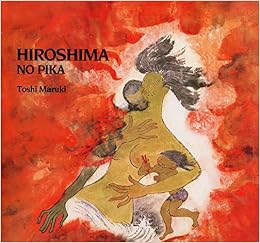
Hiroshima no pika written and illustrated by Toshi Maruki
Hiroshima no pika written and illustrated by Toshi Maruki (translation
of the same Japanese title; New York: Lothrop, Lee & Shepard, 1980)
48 pages
with colour illustrations, sometimes full page double spreads
Subjects:
World War Two, Hiroshima, atomic bomb, anti-war books, Japan, picture books (Year 6-8)

Synopsis
This is based on a first-person
account that the author heard when he was holding an exhibition of pictures
about the atomic bomb in a small town in Hokkaido.
It begins with a
cloudless blue morning in Hiroshima, with streetcars picking up people on their
way to work and the seven rivers flowing quietly through the city. Seven-year-old
Mii and her parents are breakfasting on sweet potatoes “brought in the day
before by cousins who lived in the country” when the bomb falls at 8.15am on
August 6, 1945. Mii’s mother carries her injured husband on her back across the
city, across rivers and all the way to the coast, where they stay for days
until he is taken into a makeshift hospital: “no doctors, no medicine, no
bandages – only shelter.”
The illustrations are
stylised but portray a powerful sense of the horror of the event, and the
consequent suffering, partly through the lurid and unnatural colours of the
skies and surroundings.
This is a terrible
event, and parts of the text would be upsetting to younger (or even older)
children: the mother carrying a dead baby, the floating bodies, the wasteland
of the city, Mii’s father’s death, the glass slivers that poke their way out of
her scalp in years to come.
Look out for the red
chopsticks that Mii clutches for days after the Flash, until her mother manages
to prise them from her grip. It’s a clever way to identify her on each page,
but also hints at the hidden trauma she has undergone.
The book feeds in
some factual details about the atomic bomb and ends with the lantern memorial
service held each year on the seven rivers. I couldn’t see a translation of the
title anywhere – maybe I missed it – but it means The Flash of Hiroshima.
Reviews:
An entry in Kirkus reviews is always
prestigious. “Japanese
artist and antiwar activist Maruki manages to avoid the opposing perils of
giving children nightmares and belittling the horror.”
About the author
Toshi Maruki (1912–2000) was born in
Hokkaido and studied Western art at the Joshibi Women's School of Art and
Design.
“I am now past seventy years old. I have neither children nor grandchildren. But I have written this book for grandchildren everywhere. It took me a very long time to complete it. It is very difficult to tell young people about something bad that happened in the hope that their knowing will help keep it from happening again.”
Maruki Gallery for the Hiroshima Panels, established by husband and wife Iri and
Toshi Maruki, "is famous for its message for peace all over
the world". The artist couple went into Hiroshima city just three days after the bombing and spent 30 years painting the 15 panels.
Other books you might like:
Sadako by Eleanor Coerr, illustrated by Ed
Young, also tells of a young girl in Hiroshima.
Things I didn’t know
I didn’t
know that other Japanese cities like Tokyo, Osaka and Nagoya had already
experienced air raids, so the people of Hiroshima were readying for them by
storing water and making evacuation plans. There is a sad poignancy in the
statement that “Everyone carried small bags of medicine and when they were out
of doors, wore air-raid hats or hoods to protect their heads.”
Have you read it?
Have you
read this book? Let me know what you think!
Thursday, 24 August 2017
A winter’s day in 1939 by Melinda Szymanik
A winter’s day in 1939 by Melinda
Szymanik (Scholastic, 2013)
24 chapters; 285 pages
Subjects: World War Two; Poland; family; evacuees, refugees; junior fiction (Year 7-10)

Synopsis
I
should have reviewed this book before, because it is so good and has
collected lots of awards and shortlistings: Storylines Notable Book 2014, Finalist 2014 NZ Post Book
Awards, Finalist 2014 LIANZA Esther Glen Junior Fiction Award, Winner
Librarian's Choice Award 2014 LIANZA Children's Book Awards
Melinda explains in the foreword that A winter’s day in
1939 is based on the story of her father, Leszek Szymanik, who was 12 when
the Soviet Red Army invaded his homeland of Poland in 1939. His family was
transported from Poland to a Russian labour camp in 1940.
The family in the book are Adam, his parents, older brother
Tomasz and younger sisters Zofia and Maria. They live on a small farm, growing
crops (tobacco, potatoes) and raising cows, pigs and chickens. Tragedy strikes
the family at the very start of the story, followed by uncertainty and worry as
Germany invades Poland – and then the Russian tanks arrive. Their farm is
requisitioned (taken over by the Russians) and they are given a week to leave
and find a new home - one room in a house in a village 15km away.
Things get worse, not better, and more long hard
journeys, and much sadness, lie ahead of them.
Melinda includes a historical note, a map of the family’s
journey, glossary, bibliography and a postscript about what happened next. Her
foreword ends: “The past is filled with stories like these, of people who
suffered terrible conditions and overwhelming sadness but remained hopeful and
survived, despite everything. It is up to us to honour their memories and
remember this stories to make the world a better place.”
I’m lucky to have a signed copy, and Melinda has written this
in the front of my book: “We have to know the past to make a better future.”
Reviews
Booksellers NZ comments that “Melinda is a very skilled observer of family relationships,
and this is what really brings the book to a higher level”.
Hooked on NZ books has links to a whole collection of reviews.
Teacher notes from Scholastic here.
About the author
Melinda has a great blog where she talks about all sort of writing
issues and the writing life. In this blog post, she talks about how she came to write the book.
You can read more about Melinda here.
Other books you might like:
Stefania's dancing slippers by Jennifer Beck tells another story of a Polish refugee family in picture book format.
New Zealand connection
Of course there is a very real NZ connection in this case, because
Melinda’s father ended up here, and so did over 700 Polish children
who came out by ship and went to the Polish children’s camp at Pahiatua. It’s
hard for us as an island nation to imagine what it must be like to live in
a country that is surrounded by other nations and has been the site of conflict
for centuries.
Links
In November 2014, there was a series of events to mark the 70th anniversary of the arrival of the Polish children at Pahiatua. You can read more about the "Polish Week" anniversary here.
Have you read it?
Have you read this book? Let me know what you think.
Sunday, 6 August 2017
Three books by Mark Wilson
Angel of
Kokoda (Lothian Children’s Books, 2010)
Vietnam
diary (Lothian Children’s Books, 2013)
The
Afghanistan pup (Lothian Children’s Books, 2014)
All similar
format: hardback, 32 pages with full colour illustrations
Subjects:
World War Two, Papua New Guinea, Pacific, Vietnam, brothers, Afghanistan,
animals, dogs, mascots, picture books (Year 3-6)
Synopsis
A Papua New Guinea boy helps a wounded Australian soldier along the Kokoda Track. A young man goes off to fight in Vietnam, despite the protests of his brother. A dog is rescued from the ruins of a bombed school and becomes a soldier’s pet.
These three books are
part of the Children in War series which explores children’s experiences of,
and reactions to, four different wars involving Australians: World War One, World War Two, the Vietnam War and the war in
Afghanistan. The texts are clear and not
too detailed (apart from the Vietnam one, which includes handwritten diary
entries).
They are
well-produced books that cover lesser known aspects of war, although I would
have liked some more context for each story (perhaps because they are very
Australian - oriented).
Reviews
Reading time (from the Children's Book Council of Australia)
reviews The Afghanistan pup here and admires the way that Mark Wilson "skilfully weaves narratives that tell stories of tragedy and hope with his extraordinarily evocative illustrations", while "snippets of newspaper clippings, reports, poems and letters enrich the stories and add layers of meaning."
There are teacher notes and activities -
for The Afghanistan pup here
for Angel of Kokoda here
for Vietnam diary here.
About the author:
Mark Wilson's website shows his prolific and impressive output and also talks about his interesting life and varied career!
Other books you might like: Also by the same author is My mother’s eyes: the story of a boy soldier. Mark Wilson illustrated A day to remember: the story of Anzac Day by
Jackie French.
Have
you read it? Have
you read these books? Let me know what you think!
Friday, 14 July 2017
A present from the past by Jennifer Beck; illustrated by Lindy Fisher
A present from the past by Jennifer Beck; illustrated by Lindy Fisher (Scholastic, 2006)
32 pages
with colour illustrations
Subjects:
World War One, France, Christmas, nurses, women in war, grandparents, family, picture
books (Year 1-4)
It’s nearly Christmas
time. Emily is waiting with her parents at the airport for her Aunt Mary whom
she’s never met before. Aunt Mary has come all the way from England, bringing a special gift: a small oblong parcel, with a note saying “Best wishes from
Princess Mary”. Inside, to Emily’s disappointment, is nothing but a small brass
box with a damaged lid. But as Aunt Mary tells the story behind the box,
Emily comes to realise that it is indeed a precious family heirloom.
These boxes,
containing items such as sweets and tobacco, were the idea of Princess Mary, the 17-year-old
daughter of King George V and Queen Mary, who wanted to give every serving
soldier, sailor and nurse a Christmas present in December 1914 as a personal
thank you for their sacrifices and hard work. You can read more about them
here and here.
These Christmas boxes
make a lovely story on their own, but the box in this book played an even more
important role.
Don’t miss the
dedication: “In memory of women in wartime”. There is also a fact sheet at the
end.
Reviews:
A review on Perfect Picture Book Friday says the book "would be a great resource in History classes enticing conversations about war, troops overseas, and families dealing with loved ones during war time in the past."
There's another review on Momo celebrating time to read (great title for a blog!)
About the author
You can
read an interview with Jennifer Beck on the Christchurch City Libraries website, or learn more about her on the Book Council Writers files.
About the illustrator
Lindy Fisher is profiled on the Book Council and Storylines sites. She has
also had over 75
stamps published by New Zealand Post! You can see some of her artwork on her website.
Other books you might like:
Jennifer
Beck is the author of the much-loved picture book The bantam and the soldier. She and Lindy Fisher have worked
together on other books, including Stefania’s dancing slippers and Remember that November (about Parihaka).
NZ connections:
When I
was researching for my Anzac Day book, I got to see one of these tins. It belonged to Hami Grace, an old boy of Wellington College, and is now held in the College Archives.
Things I didn’t know
I didn’t know that Princess Mary was born on 25 April
(1897) – the day that later became Anzac Day! What a lovely connection!
Have you read it?
Have you
read this book? Let me know what you think!
Subscribe to:
Posts (Atom)